Choose a direction by the experience, usable days and amount of moving. Compare the seven mainland travel regions and the separate Hong Kong/Macau crossing choices, then build a stay around the places you select.
Start with one main reason to come
For a first trip with nine or ten calendar days, a history-and-city interest, and Beijing arrival / Shanghai departure, choose Beijing + Shanghai. Four nights in each gives three complete sightseeing days in each city and one full moving day. A tenth day can go to the city that matters more.
Choose the lower Yangtze instead when gardens, neighbourhoods and lakes matter more than imperial monuments: Shanghai 3, Suzhou 2 and Hangzhou 2 nights. With only seven days, choose one base or accept the shorter two-city visits below. If mountains are the main purpose, protect a mountain stay and reduce the city list.
Before selecting a direction, fix the days available inside China, any booked entry/exit cities, the one experience you most want and the amount of moving your party can manage. Match the passport, purpose and complete route to the entry conditions before making a restricted-area or transit itinerary non-refundable.
See the distance between the places
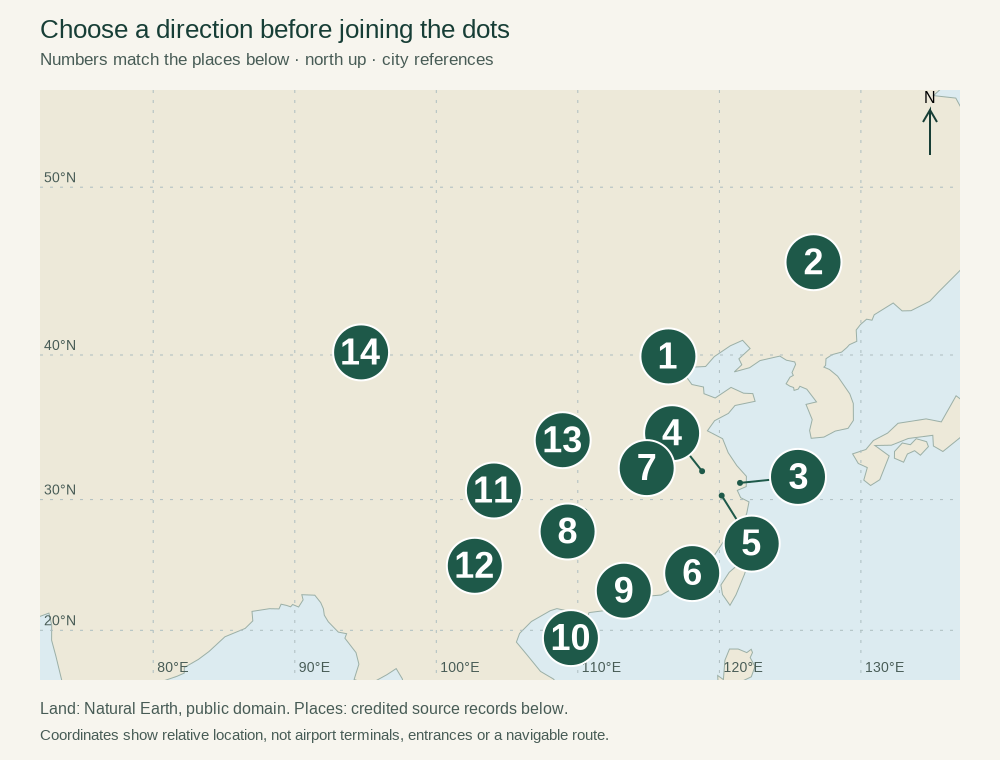
Beijing and Harbin are in the north; Shanghai and its garden/lake neighbours face the east coast. Xi’an lies inland, and Dunhuang is much farther west along the Gansu corridor. Chengdu and Kunming anchor different southwest routes. Guangzhou and Sanya are separate mainland and island stays. Geographic closeness does not prove a direct train, an easy road or an admission right.
North-up geographic orientation from retained Natural Earth land geometry and credited destination coordinates. Numbers identify places, not airport terminals or attraction entrances; lines of longitude and latitude are not travel routes. Open the full-size map with large numbers.
The map locates the destinations discussed here; it is not a complete inventory of China. Hong Kong and Macau crossings have their own entry and onward-transport decision.
Compare the seven mainland travel directions
These are completed planning choices for different interests, not a ranking of all China. Night allocations count arrival and departure separately. A “full day” has no hotel move; a light arrival walk is optional. For each direction, keep the stated scope instead of adding every nearby name.
DirectionNorth: Beijing and a chosen neighbour
The experience
Imperial courtyards, a Great Wall day, then Tianjin’s port-city streets; Shanxi is the alternative for Buddhist sculpture and courtyard towns.
Time that actually fits
Beijing 4 + Tianjin 2 nights = 7 days: three full Beijing days, one transfer day and one full Tianjin day, plus arrival and departure.
Gateway and moving burden
Enter Beijing; leave from the actual Tianjin or Beijing booking. A Beijing return adds its own journey and, for an early flight, a final Beijing night. One hotel change within the region.
Choose it, or change it
Choose this over the northeast for Beijing’s monuments. Choose Datong–Taiyuan–Pingyao instead when old temples and towns are the main purpose. Cold-season outdoor days require shorter blocks; a failed Palace reservation becomes a different city day.
DirectionNortheast: Shenyang and Dalian, or a winter/mountain stay
The experience
Shenyang’s early-Qing palace and regional museum, followed by Dalian’s port architecture and open coast. Harbin’s winter attractions and Changbaishan’s crater lake are separate reasons to travel.
Time that actually fits
Shenyang 3 + Dalian 3 nights = 7 days: two full days in each, one hotel-change day and separate arrival/departure. Harbin or Changbaishan alone can use three nights; the mountain version keeps a spare day.
Gateway and moving burden
Choose the Shenyang arrival and Dalian exit before booking. Returning to the same international gateway needs another transfer. A mountain or far-north detour cannot fit inside the city pair’s existing nights.
Choose it, or change it
Prefer the city pair for history plus coast. For an ice/snow attraction, wait for that operator’s dated opening before making it essential. A closed mountain gives a local/rest day, not a promised lake view; a coastal stay does not promise swimming weather.
DirectionEast: Shanghai, gardens and lakes; separate mountain or Fujian branches
The experience
Shanghai’s riverfront districts, Suzhou’s designed gardens and Hangzhou’s West Lake. Nanjing–Yangzhou changes the emphasis to history; Huangshan/Huizhou to peaks and villages; Fujian to ports, tulou or Wuyishan.
Time that actually fits
Shanghai 3 + Suzhou 2 + Hangzhou 2 nights = 8 days: four full visit days, two moving days, arrival and departure. The complete regional alternatives below protect their own nights.
Gateway and moving burden
Enter Shanghai and end in Hangzhou for this version. If both flights use Shanghai, allow a complete return and final Shanghai night, or cut one base. Two hotel changes; station names and the last hotel rides still matter.
Choose it, or change it
Choose this for gardens and city walks without a cross-country flight. Rain can replace a lake block with an indoor visit; it cannot guarantee a mountain view or ferry. Huangshan and Fujian earn their own travel blocks rather than fitting into the same seven nights.
DirectionCentral: one history, river, mountain or craft thread
The experience
Luoyang for Longmen and ancient-capital history; Changsha plus Zhangjiajie for food and sandstone pillars; Wuhan plus a confirmed Yichang product for river landscapes; Jingdezhen and Wuyuan for craft and villages.
Time that actually fits
Luoyang 3 nights gives two full days. Changsha 3 + Zhangjiajie 4 = 8 days: two city days, three mountain-area days, one transfer, arrival and departure. The Zhangjiajie base split depends on Wulingyuan versus Tianmen.
Gateway and moving burden
Use the selected corridor’s actual gateway. Changsha and Zhangjiajie are two stays; a gorge product must name its boarding and exit points. Do not join all four central-China threads in one short trip.
Choose it, or change it
Choose the mountain route only when walking, weather and the chosen park transport fit the party. If the mountain is not the purpose, keep Luoyang or the craft pair. A cancelled river departure cannot be replaced by an unspecified cruise.
DirectionSouth: Cantonese cities, Guangxi scenery or a Hainan coast
The experience
Guangzhou and Shenzhen for food, old streets and contemporary districts; Guilin and Yangshuo for limestone and river countryside; Sanya for a bay-and-hotel stay.
Time that actually fits
Guangzhou 3 + Shenzhen 3 nights = 7 days, with four full city days and one move. Guilin 2 + Yangshuo 2 = 5 days, with two full visit days and a transfer. Sanya 4 nights gives three complete days at one base.
Gateway and moving burden
Choose the urban, karst or island gateway that matches the actual arrival. Longji adds a separate road/night choice. A Weizhou visit needs both ferry directions and a mainland return buffer.
Choose it, or change it
A southern city stay suits a preference for less winter cold; Guangzhou’s climate is not evidence for a Sanya beach day. Summer heat/rain and boat cancellations change outdoor choices. Check the entry-policy area before a border-side trip such as Detian.
DirectionSouthwest: Sichuan–Chongqing, Yunnan or Guizhou
The experience
Chengdu’s pandas and tea with Chongqing’s river terraces; Kunming–Dali–Lijiang for three different plateau-city and landscape stays; Guiyang–Anshun for city life, Tunpu and waterfalls.
Time that actually fits
Chengdu 3 + Chongqing 3 nights = 7 days: two full days in each and one transfer. Full Yunnan stays need Kunming 4 + Dali 3 + Lijiang 3 = 10 nights / 11 days: seven full visit days and two moves.
Gateway and moving burden
Set each route’s entry and exit first. Yunnan’s 11 days begin in Kunming and end leaving Lijiang; a return via another international gateway adds that journey and a protected night. Remote parks are additional bases, not Chengdu city sights.
Choose it, or change it
Choose the city pair for fewer moves and food. Choose Yunnan for its towns and landscape when the longer allowance works. A mountain outing needs its own operating ticket, return and altitude/walking fit; dropping it does not automatically make a distant highland stop suitable.
Xi’an’s archaeology and walled city; farther west, Zhangye’s landforms, Jiayuguan’s frontier heritage and Dunhuang’s Mogao Caves. Xining and Yinchuan are separate gateway choices.
Time that actually fits
Xi’an 3 nights protects two full days. The Gansu corridor uses Lanzhou 1 + Zhangye 2 + Jiayuguan 1 + Dunhuang 4 = 8 nights / 9 days. Short arrival-side visits are conditional; one-night stops do not create a full sightseeing day.
Gateway and moving burden
Gansu has three hotel changes and a long westward exit. Confirm the actual way out of Dunhuang; any return to Lanzhou or an international gateway adds time. A missing Jiayuguan half-day means another night or removing that stop.
Choose it, or change it
Choose Xi’an for a shorter heritage stay; choose Gansu when caves, desert and frontier history justify the moves. Mogao admission and the final exit determine the order. Qinghai lake or Ningxia desert outings need their own roads, season and return plan.
Choose nights, complete visit days and moving days together
Seven calendar days normally contain six hotel nights. These counts begin on arrival in China or the stated regional gateway and end on departure; they exclude the international flight before arrival. A late flight does not create a spare sightseeing day.
Available time7 days / 6 nights
Use this allocation
One base is the slower default: arrival + five full city days + departure. Choose Beijing for varied heritage days, or Shanghai for urban districts and a separately planned nearby day.
What changes the choice
Two-base alternative: Beijing 3 + Shanghai 3 nights, with two full days in each and one full rail-transfer day. This works with Beijing entry/Shanghai exit; a same-city return consumes more of the allowance.
For gardens and lakes: Shanghai 3 + Suzhou 2 + Hangzhou 2. Arrival, two Shanghai days, move, one Suzhou day, move, one Hangzhou day, departure.
What changes the choice
Two hotel changes buy three contrasting places but leave only one full day each in Suzhou and Hangzhou. Use a single-city extension if you want both Lingyin and a full lake day; protect a separate Shanghai return when needed.
For a first history-and-city trip, keep Beijing and Shanghai: 4 + 4 nights over nine days gives three full days in each; 4 + 5 over ten days adds a fourth Shanghai day.
What changes the choice
Keep one complete transfer day. Replace Shanghai with Xi’an for archaeology only when the departure route changes too. A third city costs another move before it adds a full visit day.
For heritage, mountains and a river city: Beijing 5 + Zhangjiajie 3 + Shanghai 4. Four, two and three full visit days respectively, two complete transfers, arrival and departure.
What changes the choice
The two Zhangjiajie visit days are weather-sensitive; if the mountain is the main purpose, move a city day there. Adding Xi’an takes a third transfer and cuts Shanghai’s full visit time to one day in the linked comparison.
For a slower heritage route, Beijing 5 + Xi’an 4 + Shanghai 4 leaves ten full city days and two transfer days, with separate arrival and departure.
What changes the choice
If pandas justify a fourth base, the alternative is Beijing 4 + Xi’an 3 + Chengdu 3 + Shanghai 3: nine full city days and three transfer days. Keep the final Shanghai night; do not attach a remote arrival to the flight home.
Choose Beijing for palaces, a garden and one Wall outing from one city bed. Choose Xi’an for archaeology and the walled city with fewer city days.
What you gain or give up
For Buddhist sculpture and courtyard towns, choose the Datong–Taiyuan–Pingyao sequence and accept the hotel moves. It replaces another regional thread; it is not an extra Beijing afternoon.
Main interestGardens, streets and local meals
Start here
Choose the Shanghai–Suzhou–Hangzhou corridor for riverfront districts, designed gardens and West Lake. Choose Guangzhou–Shenzhen if Cantonese meals and contemporary neighbourhoods matter more than classical gardens.
What you gain or give up
The eastern corridor changes hotels twice in seven nights; the southern pair once in six. Keep only Shanghai plus one neighbour when packing or luggage is the main constraint.
Main interestLandscape is the reason to fly
Start here
Choose Guilin–Yangshuo for river/countryside choices, or Zhangjiajie for mountain pillars with park transport and walking. Huangshan is a different mountain outing with its own base and descent.
What you gain or give up
Do not call a scenic bus or cableway route step-free. A traveller who cannot use stairs needs the particular route checked before paying; mountain weather can remove the signature view.
Main interestPandas, tea and food
Start here
Choose Chengdu before adding Chongqing. Two full Chengdu days can give the Panda Base and city life their own blocks; a Leshan day needs another day or replaces something.
What you gain or give up
Chongqing adds river views and hillside districts but a hotel move and more vertical walking. Staying longer in Chengdu is the lower-move alternative.
Main interestFamily pace or less walking
Start here
Choose one useful base near the activities you actually want, keep a seated lunch/rest break and leave arrival and departure clear. Beijing or Shanghai can be shortened by choosing specific local routes.
What you gain or give up
A city label does not establish accessibility. Use the named low-walking/limited-mobility plans for the actual party; an accessible hotel room does not prove the daily sights are accessible.
Main interestAlready seen the usual first-trip cities
Start here
Choose a focused thread: Shanxi sculpture and towns, Quanzhou maritime heritage, Jingdezhen ceramics, or Dunhuang caves. Give the main subject a full stay instead of collecting new city names.
What you gain or give up
Pick the subject that remains worthwhile if one booking fails. A craft workshop, special exhibition or cave product needs its own current admission; a general city guide does not guarantee that event.
Your dates or purposeWinter: mild city walks or deliberate cold
A workable choice
For less cold, start with Guangzhou city time; the six-station climate table has January mean daily maximum/minimum of 18.7/10.6°C, versus Beijing’s 2.3/−6.9°C. Harbin is the distinct choice for a winter city and confirmed seasonal ice/snow attractions.
When to change it
Those are 1991–2020 normals, not forecasts. If a seasonal attraction has not announced a usable opening, keep Harbin’s architecture/museum programme or choose the southern city; neither natural snow nor a comfortable beach day is guaranteed.
Your dates or purposeSpring or autumn: city and heritage choices
A workable choice
Compare Beijing–Xi’an–Shanghai, the lower Yangtze and a southern city pair by your actual month. October’s station normals are cooler than July for the northern/eastern cities in the existing comparison.
When to change it
Do not use a whole-month normal to claim a particular week is best. A holiday, museum closed day or missing reservation can reverse the order. Blossoms, foliage and clear views remain uncertain.
Your dates or purposeSummer: coast, city breaks or an operating mountain base
A workable choice
Dalian gives coast and city history; a northern grassland or mountain stay is a separate choice with an operating-site and return check. In a hot city, put exposed walking early, keep a midday rest and use a named indoor alternative.
When to change it
Shanghai’s official guide identifies summer rain and late-summer typhoon exposure. Heavy rain or warnings can stop parks and boats. A closed site is a reason to stay in the safe base, not to find a driver around the closure.
Your dates or purposeA fixed month and a must-see landscape
A workable choice
Keep one landscape anchor with a spare day where the full itinerary allows it: a Zhangjiajie, Huangshan or Changbaishan stay. Keep the signature visit movable only when the actual ticket permits a change.
When to change it
A buffer buys another attempt, not a promise of views or reopening. If there is no acceptable alternative to the closed activity, change the destination or dates before making the branch non-refundable.
Your dates or purposePublic holidays and the travel year
A workable choice
Use the holiday calendar for the year on your ticket. With fixed holiday dates, favour fewer hotel changes and check the scarce attraction/boat and intercity legs before making the rooms non-refundable.
When to change it
The 2026 page is a 2026 calendar. Use the State Council’s notice for any later year; do not carry forward the old dates or treat predictions as official. Operator opening and prices remain separate checks.
Separate a changed direction, an extra base and an extra region
Same available timeChange direction and add a hotel base · 9 days / 8 nights
Keep the simpler arrangement
Beijing 4 + Shanghai 4: six complete city days, one transfer day, two arrival/departure days and one hotel change.
What the added stop changes
Shanghai 3 + Suzhou 2 + Hangzhou 3: five complete visit days, two transfer days and two hotel changes. This changes a north-and-east trip into one eastern corridor and adds a hotel base; it does not add a region. The second hotel move costs a full visit day. You gain gardens and a lake and leave Beijing out. The eastern route ends in Hangzhou; a Shanghai return must be added or take time from another block.
Same available timeAdd a region and a hotel base · 14 days / 13 nights
Keep the simpler arrangement
Beijing 5 + Xi’an 4 + Shanghai 4: ten complete city days and two transfer days.
What the added stop changes
Beijing 4 + Xi’an 3 + Chengdu 3 + Shanghai 3: nine complete city days and three transfers. The Chengdu stay buys pandas and tea; it does not include an extra Leshan day unless another visit is removed or a night is added.
Same available timeReplace an eastern city or enlarge the trip · 7 nights in the east
Keep the simpler arrangement
Shanghai 3 + Suzhou 2 + Hangzhou 2 keeps four complete visit days and two moves.
What the added stop changes
Huangshan needs a mountain base, the rail-to-road approach and a descent/weather decision. Replace a city or add the separately stated mountain nights; do not use a planned lake day as both a mountain transfer and summit visit. Fujian is another journey with its own southern entry/exit.
A two-hour train can use most of a moving day
A filled planning calculation is 45 minutes hotel-to-station + 60 minutes station margin + 120 minutes train + 45 minutes to the next hotel + 30 minutes check-in = 300 minutes, or five hours. These are explicit allowances, not measured travel times or a promised timetable. Select an issued journey that fits; otherwise enlarge the travel block and remove the optional arrival outing. Flights need the actual airline deadline, the two airport journeys and baggage time as well.
Compare the whole cost on the same basis
For two adults sharing six room nights, a city-pair spending envelope with a room allowance of CNY 500/night, food of CNY 250/day for the pair across seven days and local transport of CNY 100/day is 3,000 + 1,750 + 700 = CNY 5,450 before intercity tickets and admissions. It is an arithmetic starting point, not a complete trip total or a current price. The nine-day Beijing–Shanghai plan has a complete itemised example and reserve.
Compare the extra branch’s room nights, all rail/air fares, both local rides, admission, compulsory scenic transport and any car waiting/tolls. A shared room or vehicle is for the party; train and attraction amounts are usually per traveller. If a required fare or room is unknown, leave the total unresolved until quoted. An island return, long rural car or summit room can drive the decision more than the headline entry ticket.
Make the choice you can now act on
Nine or ten days, heritage plus city life: keep Beijing–Shanghai and book the two bases around the actual entry/exit. Gardens and lakes, seven nights: use the full East China plan and keep its return-city condition. A mountain or a special subject: choose one anchor with its required nights and remove a weaker city.
The alternative should solve the condition that failed: a city day for a closed mountain, a mainland day for a cancelled ferry, or one base when an onward ticket cannot be issued. Save the main direction, night split, final departure city and the one booking that can overturn it before paying for the remaining hotels.
Sources and planning boundaries
Regional visit choices reuse the destination guides linked on this page, retaining their individual source dates. The night counts, route cuts and spending inputs are editorial planning decisions, not operator packages or field tests. The six-station climate values retain their 1991–2020 normal period and original source-retrieval history in the climate guide.
Each named place is a route option. Night counts are planning allowances. Use a linked guide for its visit or booking decision; place your actual arrival and return around the chosen base before adding another region.
Start with a capital visit, an old-town and temple route, a coastal stay, or a grassland journey. Those are different trips even when they share a place on a map of the north.
Beijing 北京 · Tianjin 天津 · Chengde 承德
Beijing has the densest mix of imperial sites, neighbourhoods and a Great Wall outing. Tianjin changes the pace to a port city; Chengde puts the Summer Resort and temples at the centre.
Allow: 3–4 nights in Beijing; allow 1–2 nights for Tianjin or three Chengde nights for the full Resort-and-temple plan.Before booking: Use the actual PEK, PKX or named rail arrival; give Chengde its own station pair and nights.
How to connect: Keep Beijing as a base for its city sights. Add Tianjin for a second urban stop, or make Chengde a separate stay rather than counting it as another Beijing sight.
Datong 大同 · Pingyao 平遥 · Taiyuan 太原
Choose Shanxi for Buddhist sculpture, preserved town streets and older architecture. Datong and Pingyao offer different kinds of heritage; Taiyuan can serve as the route's arrival or transfer base.
Allow: Four nights for Datong and Pingyao; six with a compact two-night Taiyuan stop, or seven for the full three-night Taiyuan plan. These totals use a compact two-night Pingyao stay: a full town day; add Shuanglin only if arrival or departure leaves a half-day with confirmed available halls and return. For both outer temples on a separate road-loop day, add a third Pingyao night after confirming their available views and return.Before booking: Read the issued Datong, Taiyuan and Pingyao station names and each final hotel leg before chaining bases.
How to connect: Work through Shanxi as a sequence of stops. Decide whether you want both Datong and Pingyao before adding Beijing or another province.
Qingdao 青岛 · Jinan 济南 · Qufu 曲阜 · Mount Tai 泰山
Shandong is a choice between coast and beer-city streets, spring-city and Confucian heritage, and a mountain ascent. Each changes the amount of moving and walking.
Allow: Qingdao needs around three nights for two city days; Jinan needs three nights for two complete central-city blocks, while Jinan (1) and Tai'an (2) are a compact springs-and-mountain branch; Qufu can use two nights for the Three Kong.Before booking: Choose coast, springs and mountain, or Confucian heritage before booking the actual arrival and exit.
How to connect: Give each chosen branch its own gateway, last local ride and return. Qingdao and Mount Tai need distinct bases.
Hohhot 呼和浩特 · Xilingol 锡林郭勒 · Hulunbuir 呼伦贝尔
Hohhot gives a city and nearby grassland edge; eastern Xilingol's Ulagai and Hulunbuir's Morgele meadow need distinct rural gateways and returns.
Allow: Allow around three nights for one Hohhot, Hailar–Morgele or Holingol–Ulagai base; wider grassland circuits need more nights and their own route.Before booking: Read the actual Hohhot, Hailar or Holingol terminal on your ticket, then confirm the chosen site's season, passport admission, permitted last road leg and return before non-refundable bookings.
How to connect: Choose one branch before booking. Ulagai requires its own eastern Xilingol gateway and nights.
Route decision: For a first northern route, choose Beijing plus one neighbouring thread. A heritage-focused trip can instead give Shanxi its own sequence; coast and grassland each merit a different set of bases. Compare North China routes, overnight bases and return legs →
Closer look: Beijing — experiences and visit guides
Follow the Forbidden City’s courtyards, look across its roofs from Jingshan, and step into the hutong lanes around the lakes. The Summer Palace and a Great Wall outing bring gardens and mountain scenery into a capital-city visit.
Choose Beijing for imperial architecture on a grand scale, with quieter lanes and gardens between the major sights.
The central palace area, western gardens and Great Wall are different outings; build the stay around the places you most want to see.
Northeast China offers city history, coast, mountain nature and winter-focused places. Choose dates and bases around one of those purposes.
Shenyang 沈阳 · Dalian 大连
Shenyang suits imperial and industrial history; Dalian turns the trip toward the coast. They make a Liaoning city pair if you want both themes.
Allow: Default: Shenyang 3 + Dalian 3 nights / 7 days, with two full visit days in each, one complete transfer day, arrival and departure. Compact: 2 + 2 nights / 5 days leaves one full day in each.Before booking: Choose which city is the inbound end and which is the outbound end.
How to connect:
Use them as separate city stays and decide which one is the arrival or departure end.
Next step:
On the compact version, keep Shenyang’s palace and Zhongjie day and drop the separate Liaoning Museum day; in Dalian keep Zhongshan Square and Xinghai, dropping the museum and Fisherman’s Wharf day. Keep each hotel and dated onward journey; neither arrival nor transfer is counted as a full visit day.
Changchun offers palace history, film heritage and a city hotel base. Changbai Mountain is an outdoor destination with its own access and weather decisions. Jilin City and Yanji offer different city and food stops around a Jilin route.
Allow: Three nights for Changbai Mountain, including a weather-spare day; add nights for Changchun, Jilin City or Yanji and the transfer.Before booking: Choose the Changbai Mountain entrance and overnight base; keep access subject to weather.
How to connect:
Set the mountain base and a weather margin before adding city stops; keep a full mountain day.
Next step:
Select the park entrance and overnight town, then confirm its current opening, final road leg and return before adding Jilin City or Yanji.
Harbin 哈尔滨 · Yabuli 亚布力 · Mohe 漠河
Harbin is an urban winter anchor; Yabuli is a ski-oriented choice; Mohe is a far-north journey. Snow activities and event dates require fresh checks.
Allow: 2–3 Harbin nights; give Yabuli or Mohe separate transport and overnight time.Before booking: Confirm the event or ski season and the outward and return rail or air legs for a distant branch.
How to connect:
Choose Harbin city time, skiing or the far north. Give Mohe a separate travel block.
Next step:
Check the event or ski operator for your dates and price the complete outward and return journey before reserving a remote stay.
Route decision: Pick a Liaoning city pair, a Jilin mountain-and-city route, or a Heilongjiang winter route. Then verify the season-specific opening and transport before fixing dates.
Shanghai · Jiangsu · Zhejiang · Anhui · Fujian
East Coast & Lower Yangtze
This region offers an easy-to-understand city-and-garden corridor, but Huangshan's mountain bases and Fujian's coast and inland villages change the shape of the trip.
Shanghai 上海 · Suzhou 苏州 · Wuxi 无锡
Shanghai brings riverfront districts; Suzhou gardens and canals; Wuxi a lake, Huishan heritage and canal walks. Choose the experience you want in each base.
Allow: 6–8 nights for a two- or three-city corridor, with a hotel and transfer for each selected base.Before booking: Use the actual Shanghai airport or station on the ticket; match each onward station to the chosen hotel.
How to connect: Keep Shanghai for its own city stay. Add a Suzhou garden stay or Wuxi lake-and-heritage stay when it earns a separate block.
Choose Hangzhou for a lake-centred stay, Wuzhen for a canal-town night, Shaoxing for literary houses and canals, or Jiaxing and Huzhou for their own city bases.
Allow: Use the 6–8-night allowance for two or three chosen bases, not all five.Before booking: Choose the actual lake, city or water-town hotel and its last local leg before booking the next base.
How to connect: Keep Hangzhou as a city stay. A water town or another Zhejiang city is a separate choice, not an automatic extra on every Hangzhou day.
Nanjing 南京 · Yangzhou 扬州 · Zhenjiang 镇江
Nanjing has a larger history and museum focus; Yangzhou adds gardens and canal history; Zhenjiang offers hills, Xijindu lanes and a river-city stay.
Allow: 6–8 nights for two or three city stays, including the moves between them.Before booking: Match the issued station to each hotel and protect the last transfer to your departure city.
How to connect: Choose the history, gardens or river-city combination you want. Reserve a separate hotel base for each overnight stop.
These are alternatives to the Shanghai–Suzhou corridor. Each linked guide covers that city’s own visits, hotel base and return.
Allow: Choose one city stay first; a second base needs its own nights and a complete transfer.Before booking: Confirm the station pair, last hotel leg and return for the particular city you select.
How to connect: Replace a corridor stop with the city that matches your interest. Do not treat the full Jiangsu list as one short trip.
Ningbo offers heritage, food and city time; Wenzhou old-city streets, a river island and local meals. Taizhou, Jinhua and Quzhou each have a separate city-stay guide.
Allow: Choose one base and its city plan before adding a second stay and transfer.Before booking: Read the exact station and hotel location, then confirm the usable outward and return legs.
How to connect: Choose a particular Zhejiang city instead of adding every place to a Hangzhou stay. Keep coastal and inland moves explicit.
Choose Huangshan for granite peaks, one Yi County village for Huizhou lanes, Hefei for an urban museum, Jiuhuashan for temples, Shexian for an old prefectural city, or Bozhou for northern medicine and old-city heritage.
Allow: For Huangshan, allow two Tangkou nights for one mountain day, or three nights including a summit stay for two mountain days; a village day adds one night. Allow two nights at one other Anhui village, city or temple base.Before booking: Match the issued rail station to its actual last leg and return: Huangshan North/South Gate or Shexian, Yixian East/village, Hefei South/museum, Jiuhuashan Station/visitor centre, or Bozhou South/old city.
How to connect: Start with one 2–3-night base and protect its return. A second Anhui direction needs another block and a confirmed station pair, scenic or local transfer, and exit.
Xiamen 厦门 · Gulangyu 鼓浪屿 · Quanzhou 泉州
Xiamen is a coastal city base, Gulangyu is a ferry-dependent island visit, and Quanzhou rewards time for its port history and streets.
Allow: About three Xiamen nights; add Quanzhou time only if the second city earns a stay.Before booking: Check a dated Gulangyu ferry departure and actual mainland return before buying the island visit.
How to connect: A short Fujian coast route can join the cities. Fit the island visit around a booked outbound ferry and a usable mainland return.
Fujian Tulou 福建土楼 · Wuyi Mountain 武夷山
Tulou villages are inland cultural stops; Wuyi Mountain is a landscape and tea-area stay. Neither is the same task as choosing a coastal city.
Allow: 2–3 nights in one chosen inland base; a second branch adds another transfer and stay.Before booking: Name the exact tulou cluster or Wuyi entrance, plus the road or rail leg back to a useful base.
How to connect: Select a specific village area or mountain base and its way in and out before attaching it to Xiamen or another Fujian city.
Route decision: For a first eastern trip, Shanghai with one or two Jiangsu/Zhejiang stops keeps a coherent corridor. Put Huangshan or Fujian into the plan only when you can give that branch its own base and travel day. Compare East Coast routes and overnight bases →
Closer look: Shanghai — experiences and visit guides
The Bund’s historic waterfront faces the towers of Lujiazui. Away from the river, Yu Garden offers a closer world of rocks, ponds and pavilions, while Wukang and Anfu Roads invite a walk through tree-lined streets.
Choose Shanghai for architecture across eras, neighbourhood walks, art and the changing view from the two riverbanks.
Group nearby streets and sights, and leave an evening for the river. A water town, Suzhou or Disney needs its own place in the itinerary.
The middle of China contains several strong routes: ancient capitals, a river corridor, mountain scenery, and craft or village stays. Choose a thread before counting cities.
Choose Luoyang for Longmen's Buddhist carving and a museum day; switch to Dengfeng for Shaolin, Anyang for Shang archaeology, Kaifeng for a Song-themed city, or Yuntai for gorges. Each is a separate Henan first stay.
Allow: Three Luoyang nights by default, or two nights in one other named base; each is a separate first stay.Before booking: Match the issued rail station to the local visitor gate and secure the reverse: Luoyang Longmen, Zhengzhou East, Anyang East, Kaifeng North or Xiuwu West/Jiaozuo.
How to connect: Choose one hotel base and confirm its station-to-site and site-to-station legs. Add a second Henan base only with new nights and a dated intercity transfer.
Wuhan 武汉 · Yichang 宜昌 · Three Gorges 三峡
Wuhan is a city and transport anchor. Yichang changes the trip toward the Yangtze and gorge landscape.
Allow: 2–3 Wuhan nights; give Yichang or the gorges another travel stage.Before booking: For a gorge trip, name the actual embarkation and exit and whether the product is river or land.
How to connect:
Decide whether the river is a full route component before extending a Wuhan city stay to Yichang.
Next step:
Name a river or land product, its boarding point and exit, then verify the operator's current dates before adding Yichang nights.
Changsha 长沙 · Zhangjiajie 张家界 · Fenghuang 凤凰古城
Changsha adds city and food time; Zhangjiajie is a mountain stay built around Wulingyuan and Tianmen; Fenghuang is a different old-town stop.
Allow: 5–7 nights for the two or three stops you select, including Zhangjiajie weather space.Before booking: Protect the Zhangjiajie mountain base and weather margin, then verify the Fenghuang transfer and overnight.
How to connect: Give Zhangjiajie its own bases and weather margin. Add Fenghuang only after allowing for the transfer and an overnight choice.
Jingdezhen 景德镇 · Wuyuan 婺源 · Mount Sanqing 三清山
Jiangxi can be a ceramics and village route, with a mountain branch for travelers who want hiking or viewpoints.
Allow: 3–4 nights for crafts and villages; a mountain stop needs its own base and time.Before booking: Check any festival or season motive, Sanqing entrance and way back before adding the mountain.
How to connect:
Choose the craft-and-village pair or the mountain focus first; avoid assigning all three to one hurried day.
Next step:
Choose either the ceramics-and-village base or a Sanqing mountain entrance, then confirm its local transfer and dated return.
Route decision: A Hunan route can connect city, mountain and old town, but Zhangjiajie is its own multi-day anchor. Henan history, Hubei river travel and Jiangxi crafts work better as distinct route choices.
Closer look: Zhangjiajie — experiences and visit guides
Wulingyuan’s tall rock pillars rise from forested valleys. Tianmen Mountain is a separate landscape, with cliff-side paths and its great natural opening. This is a stay shaped by time outdoors and the view through changing cloud.
Choose Zhangjiajie when mountain scenery is a reason for the trip, and you can give it more than a hurried stop between cities.
Wulingyuan and Tianmen use different bases and entrances. Compare the walking involved and leave room for weather before booking the sequence.
A Pearl River city route, Guangxi's karst, coast and border-side landscapes, and Hainan's beaches answer different holiday questions. Climate, boats and border-side outings need date-specific checks.
Guangzhou 广州 · Shenzhen 深圳 · Chaozhou 潮州
Guangzhou and Shenzhen form a major-city pair with different food and contemporary-city interests. Chaozhou makes cuisine and older streets a more focused stop.
Allow: Allow six nights for the two basic city stays: three in Guangzhou and three in Shenzhen. Add a night for a full Chimelong day or a separate day with enough overnight time for Dapeng. With only 3–4 nights in total, choose one base or shorten both city visits.Before booking: Match the issued Guangzhou or Shenzhen airport or rail station to the hotel; Chaozhou needs its own stop.
How to connect:
Use Guangzhou–Shenzhen for a two-city urban route, or spend the extra stop on Chaozhou and the eastern Guangdong coast.
Next step:
Choose two city bases and confirm the station-to-hotel and intercity legs. If Chaozhou is the priority, replace Guangzhou or Shenzhen within this allowance.
Guilin is the northern gateway; Yangshuo shifts the focus to Li River countryside; Longji adds a separate terrace and village road branch. A first landscape plan can give Guilin and Yangshuo two nights each, then add a Guilin exit night if needed.
Allow: Two nights in Guilin and two in Yangshuo; exchange a countryside block for one Longji village.Before booking: Use the actual Guilin cruise pier or road departure, Yangshuo arrival point and return night.
How to connect: Choose Guilin–Yangshuo or replace countryside time with one Longji village. Budget a separate road leg and night for Longji; use the booked cruise pier, return road ride and departure point.
Nanning can be a city stay or southwest road gateway; Detian is a border-side waterfall trip. Beihai is a mainland coast base, while Weizhou needs a weather-dependent ferry and a mainland return night.
Allow: 3–4 nights for either the Nanning road branch or the Beihai sea branch.Before booking: For Detian, check the 240-hour transit stay area; for Weizhou, secure both ferries and a mainland return.
How to connect: Give Nanning–Detian or Beihai–Weizhou three to four nights as separate choices. Secure the return coach or both ferries; Detian lies outside the NIA-listed Guangxi area for 240-hour visa-free transit, so that entry basis cannot carry this road branch.
Haikou 海口 · Sanya 三亚 · Wanning 万宁
Haikou is a northern Hainan city entry; Sanya centres a southern beach stay; Wanning offers a different stretch of coast.
Allow: 3–5 nights in one Hainan coast base; add the cross-island move only if it earns a new stay.Before booking: Use the actual Haikou or Sanya airport or rail end and a hotel on the chosen coast.
How to connect:
Choose the coast that fits your stay, then decide whether a cross-island transfer earns its time.
Next step:
Pick one coast and hotel first; check its actual airport or station transfer before deciding whether another island base is worth the move.
Route decision: Pick a Guangdong city-and-food route, one Guangxi branch—karst and terraces, border-side road travel or coast and island—or a Hainan coast stay. Joining all three regions turns a holiday into several long transfers. Compare Guangxi's karst, coast and border-side routes →
Closer look: Yangshuo — experiences and visit guides
Yulong River countryside and Xingping's Li River bend
A Yangshuo town bed keeps meals and coaches close. Yulong River villages suit quieter mornings, while Xingping has its own river reach and the railway station on that side.
Choose Yangshuo for limestone scenery, a countryside day and a base that fits the river product and actual departure.
Start with two nights around town or Yulong. Give Xingping another block when its landscape or station earns the move.
The southwest spans big-city food, mountain parks, karst and highland journeys. Chengdu or Kunming can be an entry point, but neither makes every destination nearby.
Chengdu 成都 · Leshan 乐山 · Chongqing 重庆
Chengdu combines pandas and city life, Leshan can be a separate Buddha outing or a city-and-food overnight, and Chongqing is a hilly river city with its own layout.
Allow: Three Chengdu nights; Leshan consumes a protected day. Plan three Chongqing nights for two full city days, or use a compact two-night stay for one full city day.Before booking: Use the issued rail station and hotel for a Leshan return; a Chongqing stay is a separate city change.
How to connect: Build Chengdu city time first; add Leshan as a deliberate excursion or Chongqing as a second city stay.
Jiuzhaigou 九寨沟 · Huanglong 黄龙 · Mount Emei 峨眉山
These Sichuan landscapes are distinct destinations with their own bases, elevation or walking demands. Pick the one that matches the scenery and effort you want.
Allow: 2–3 nights for one landscape, including access and a weather margin; price its actual legs before committing.Before booking: Confirm the park ticket, elevation and walking fit, and last land or rail leg to and from one site.
How to connect:
Give the chosen park its own travel block and arrange access, weather margin and return around its current operator conditions.
Next step:
Select one park and a nearby overnight base, then use its current operator notice for admission, elevation, last transfer and return.
Guiyang 贵阳 · Huangguoshu 黄果树 · Libo 荔波
Guizhou pairs a city gateway with waterfalls and karst. Kaili and nearby villages are another cultural branch.
Allow: 3–5 nights for Guiyang and one waterfall or southern karst branch.Before booking: Choose the park gateway and return for Huangguoshu or Libo before joining both.
How to connect:
Choose a western waterfall branch or a southern karst-and-village branch before joining multiple sites.
Next step:
Choose Huangguoshu or Libo, not both by default; confirm its gateway, park date and return to the same or next hotel.
Kunming 昆明 · Dali 大理 · Lijiang 丽江
Yunnan's cities can form a multi-stop route, while Xishuangbanna and Shangri-La lead toward very different climates and elevations.
Allow: Allow ten nights for the full stays: four in Kunming, three in Dali and three in Lijiang. With 6–8 nights, choose two cities or cut sightseeing; eight nights across all three requires the two-night Kunming option, which drops Stone Forest and makes a short lake visit depend on arrival time.Before booking: Use the actual Kunming airport or rail arrival and protect each hotel change; elevation differs by stop.
How to connect:
Use Kunming–Dali–Lijiang as one possible spine. Add a southern or highland branch only after checking the extra travel and local conditions.
Next step:
Fix the first arrival and final departure, then price each dated city-to-city leg and hotel change before keeping all three stops.
Route decision: For a first southwest route, choose either a Sichuan–Chongqing city pair or a Yunnan multi-stop journey. Add a mountain park or Guizhou only when its access, bases and return have been checked for that branch.
Closer look: Chengdu, Chongqing — experiences and visit guides
A panda visit is one part of Chengdu. Leave room for tea in People’s Park, the Three Kingdoms history of Wuhou Shrine and a Sichuan meal. Sanxingdui’s ancient bronzes and Leshan’s riverside Buddha offer very different excursions.
Choose Chengdu for the contrast between a panda outing and slower city time, with a nearby cultural trip if it fits.
Keep the Panda Base, city sights and an excursion as distinct blocks rather than treating all of Sichuan as a day trip.
River terraces, hillside streets and old-city layers
Hongyadong's riverside facade, Chaotianmen's river meeting and upper Jiefangbei streets reveal different heights of the same city. Museums, a cableway and a west-side park change the pace.
Choose Chongqing for a city shaped by two rivers and steep streets, with two full days based above the river in Jiefangbei.
Group places by riverbank and height. Dazu and Wulong each need their own outward journey and protected return.
Choose between Xi’an heritage, the Gansu corridor, Qinghai's lake country and Ningxia's Yellow River and desert-edge landscapes. The Silk Road route here ends in Gansu; Qinghai and Ningxia call for separate plans.
Xi’an 西安 · Mount Hua 华山
Xi’an is an archaeology and walled-city stay. Mount Hua changes the trip to a mountain outing with a very different physical and weather profile.
Allow: Plan three Xi’an nights to protect two full sightseeing days. Two nights work only when your actual arrival and departure still leave two full days; reserve another full day or a mountain overnight if Mount Hua is central to the trip.Before booking: Verify Mount Hua’s booked entrance and a usable late return or mountain night.
How to connect: Set Xi’an's city days first; add Mount Hua only if the mountain is a priority and you can plan its access separately.
The Gansu corridor moves from a gateway city to Danxia landscape, frontier history and the Mogao Caves area.
Allow: About 7–9 nights for a true multi-stop corridor; cut endpoints when time shrinks.Before booking: Book Mogao access before fixing Dunhuang dates, then verify issued station pairs and Danxia’s final road leg.
How to connect: Travel the corridor in sequence and choose which stops deserve nights. Zhangye's city base and Danxia visit are separate decisions.
Xining 西宁 · Qinghai Lake 青海湖 · Yinchuan 银川
Qinghai points toward highland lake travel; Ningxia toward the Yellow River and desert-edge sites. Each needs its own gateway and local route.
Allow: About 3–4 nights for either a Qinghai or Ningxia trip, then verify its own return.Before booking: Check elevation and season for the lake, or the real river and desert road return around Yinchuan.
How to connect:
Choose Qinghai's lake country or Ningxia's river and desert-edge sites as a trip in its own right; check altitude and seasonal access where relevant.
Next step:
Choose Xining or Yinchuan as the gateway, then check seasonal site access, the final road leg and its return before fixing nights.
Route decision: For a Silk Road trip, start in Xi’an and give the Gansu corridor its own nights; end that thread in Gansu. Choose Qinghai or Ningxia as a separate trip with its own arrival and return. Compare Gansu's Hexi Corridor route and alternatives →
The Terracotta Warriors make the scale of the Qin imperial tomb tangible. Back in Xi’an, the City Wall and history collections offer different views of an ancient capital, with the city’s streets and meals filling the time between them.
Choose Xi’an when archaeology is a main interest. The army outside the city and the museums within it tell different parts of the story.
Treat the Terracotta Warriors in Lintong as a separate outing from the central city; choose museum time to match your interests.
Use this branch to plan a crossing or a mainland–SAR combined route. Hong Kong, Macau and mainland re-entry each have their own admission decision.
Hong Kong 香港 ↔ mainland
Use a Hong Kong crossing when a mainland route connects through the SAR and the crossing direction matters to your entry conditions.
Allow: A separate crossing and transfer block in the combined itinerary; set any stop duration only after checking the actual transport.Before booking: Check Hong Kong entry for your passport, the chosen port or flight, and mainland re-entry if returning.
How to connect: Identify the exact mainland–Hong Kong connection and its direction before fixing the adjacent mainland city days.
Macau 澳门 ↔ mainland
Use a Macau crossing when a Pearl River Delta route connects through the SAR and requires a separate border decision.
Allow: A separate port and transfer block in the combined itinerary; allow time for each border step before setting mainland visits.Before booking: Check Macau admission, the chosen port and its direction, then mainland re-entry if returning.
How to connect: Map the Macau–mainland crossing onto the adjoining Pearl River Delta leg before fixing onward transport.
Route decision: For a mainland–SAR combination, check each jurisdiction's current entry conditions for your passport and direction, the specific port and onward connection, and any mainland re-entry before booking the route.
Keep each chosen place as a real stay
Beijing and Xi’an both open a door into Chinese history: Beijing through imperial buildings, gardens and the Great Wall; Xi’an through archaeology and an ancient walled city. Shanghai shifts the focus to river views and urban neighbourhoods. Chengdu pairs pandas with tea and Sichuan city life. Zhangjiajie makes the mountain landscape the reason to travel.
Beijing is in the north, Shanghai on the east coast, Xi’an inland to the west, Chengdu farther southwest and Zhangjiajie in Hunan. They are separate stays, so choose a few that belong in your trip and account for the journeys between them.
Put the places together
From a shortlist to a route
A city guide helps you understand one place. An itinerary brings your stops, transfers and overnight bases together. Choose your main experiences before deciding how many places to add.