Mount Emei Climb into the changing sky, then take time for the temples and forest that make the mountain more than a viewpoint.
Mount Emei is most memorable as a change of atmosphere: the inhabited foothills give way to forest temples and finally an exposed summit with monumental Buddhist architecture. On a clear day the Golden Summit offers expansive views; in mist the forests and temple courtyards can be the richer experience. Cloud seas and sunrise are possibilities, not products a ticket guarantees.
Use one full mountain day and two nights as the straightforward first visit: arrive, do the Golden Summit circuit, sleep at the foot again, then leave the following morning. Choose a forest-temple day instead if walking and cultural detail matter more than the summit. A second mountain day is an optional extension only after the operator confirms the exact two-date admission and bus coverage before you prepay the extra night. Trying to add both middle-mountain walks to the summit day makes transport the main experience. For a broader Sichuan city stay, compare Chengdu.
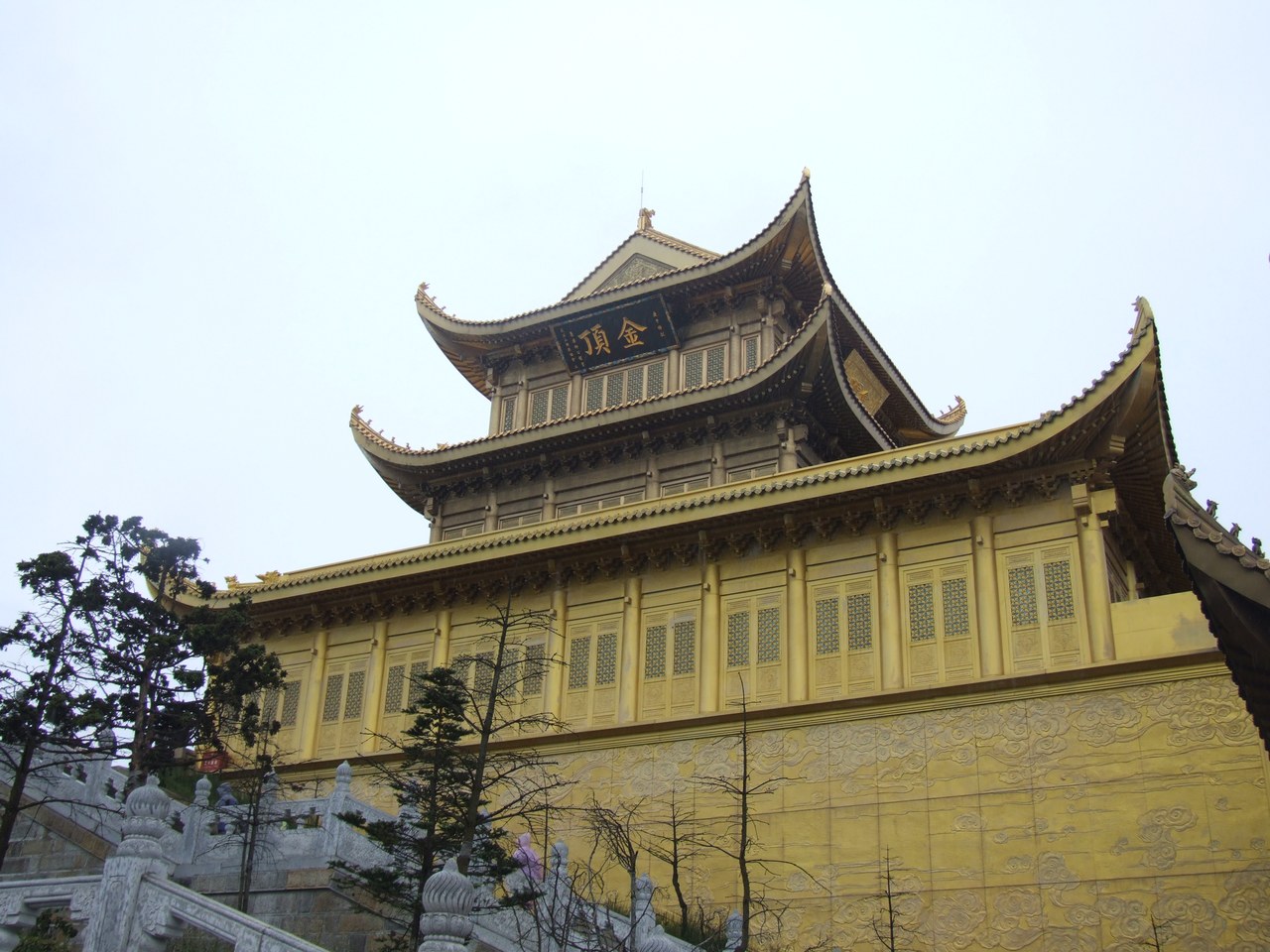
The hall at Mount Emei’s Golden Summit, photographed in July 2009. A historical architectural view.Photo: AlexHe34 · CC BY-SA 3.0 · Image credits
A gentle introduction to the temple landscape and a convenient place to sleep · Mountain foot, near the visitor transport area
An arrival afternoon or a lighter half-day · Ask at the temple for any payable entry; no temple-interior charge is assumed to be included.
The summit and the forest use different approaches
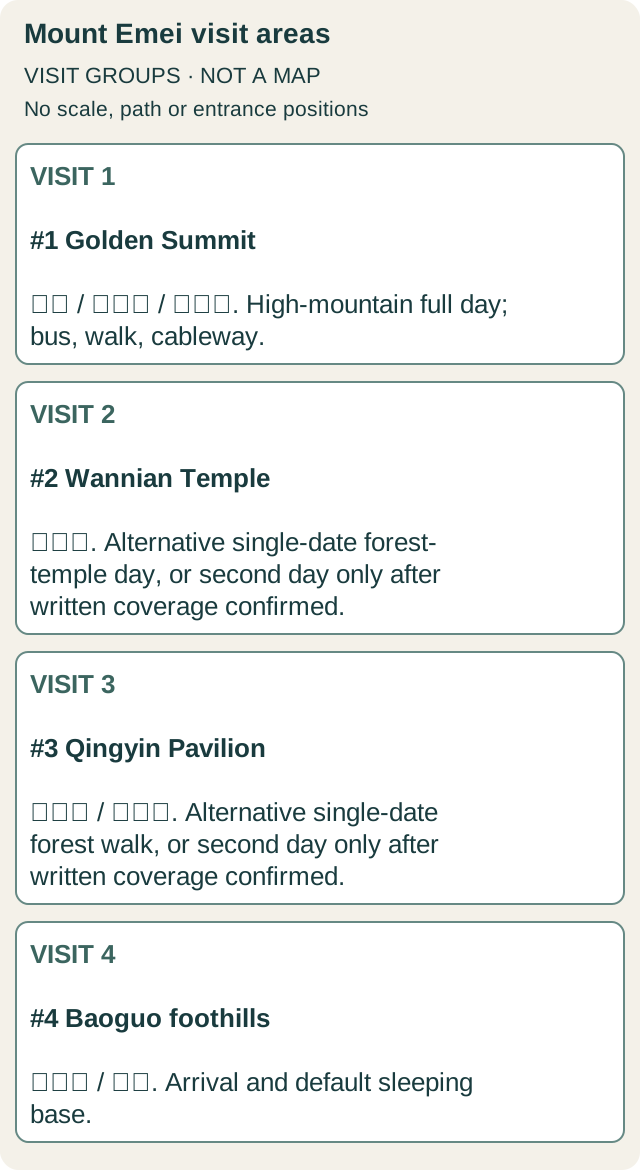
Open full-size area diagram ↗. The numbered places match this guide’s choices. This editorial area diagram groups visits; box position does not encode direction, distance, paths or an entrance. ChinaMile diagram; location sources. Navigation: search the Chinese name in Amap.
The foothill base, the mountain bus road and the walking paths do different jobs. Golden Summit: boarding point → mountain bus → Leidongping → walk to Jieyindian → cableway → summit. Wannian: a bus stop on the middle mountain with its own cableway. Qingyin: a walking approach from Wuxiangang. Neither lower stop puts you at the Golden Summit cableway.
Choose Wannian for a focused temple visit with a cable-assisted return. Choose Qingyin for water, trees and a slower walk. The long pedestrian connection between them is optional. A cableway reduces the ascent but does not remove all walking or steps; travellers needing a step-free visit should resolve the exact access route with the operator before booking.
Stay at the foot unless a summit night is the purpose
Baoguo / Huangwan: the default for this plan, with luggage left in one hotel and access to mountain transport. Pick a property by the actual boarding station for your reservation, not merely a listing labelled “Mount Emei.” Ask how you reach the station for the booked morning slot.
Golden Summit or Leidongping: a deliberate alternative for an overnight mountain experience. These are different locations: a Leidongping bed still leaves walking and cableway arrangements before reaching the summit. Confirm the precise hotel approach, luggage handling, heating, meals and operational access. A mountain room cannot guarantee sunrise and a foothill room cannot deliver it without an overnight ascent plan. The original Leidongping station building is not available for overnight waiting or rest during the works: book an actual accessible hotel rather than planning to sleep in the station.
Open Emeishan accommodation listings, enter two adults and two nights, then compare the Baoguo/Huangwan map areas. This is a booking search rather than a checked room quote. Obtain the Chinese entrance address, passport check-in confirmation and cancellation terms from the actual property.
Where the mountain earns your time
1. Golden Summit · 金顶
Give the summit more attention than a single photograph. The large Puxian monument and Huazang temple buildings make this a religious destination as well as a place to look out across the mountains. Let changing cloud reveal different parts of the scene, but keep the descent time fixed even if the view remains hidden.
Capacity is reduced during major transport works. The operator's May 2026 disclosure says the Leidongping facilities and Golden Summit cableway are being upgraded, with completion expected in 2027 and limited summit admissions during construction. Treat that as an estimate, not a reopening promise. Reserve the appropriate summit product and bus slot before building the trip around it.
Hours
Book the current high-mountain bus slot and check both cableway directions for your date. A last bus is a departure deadline, not a useful time to begin the summit visit.
Tickets
The published regular tariffs are ¥160 scenic admission, ¥90 full-mountain return bus, and ¥65 up / ¥55 down for the Golden Summit cableway per adult. The tariff also lists lower-season rates; buy the actual dated products rather than assuming this sum applies year-round.
Time
Keep the entire daylight day free. Queues, mountain-road travel and the walk between Leidongping and the cableway are additional to summit time.
Chinese address
峨眉山景区金顶;先到预约所示的报国寺站或黄湾站,乘车至雷洞坪
Getting there
Use the booked scenic bus to 雷洞坪, walk to 接引殿, then take the 金顶索道. The cableway does not start beside the railway station or foothill hotel.
How to visit
Carry the same original passport used for the reservation. Follow the current temporary boarding signs around the construction area; bus operating times may change with actual visitor flow. Ascend in the morning, have a simple lunch, see the summit monuments and start down with time for the walk and bus queue.
2. Wannian Temple · 万年寺
Wannian offers a more concentrated cultural visit than collecting several temple names from a bus window. UNESCO identifies its historic Puxian bronze sculpture as one of the mountain's important cultural treasures. Look at how the worship space frames the image, then step outside to appreciate why a temple in this forest feels different from a city shrine.
Hours
Choose a morning entry for a forest-temple day. Obtain the current cableway and return-bus cutoffs from the ticket desk before ascending.
Tickets
Published Wannian cableway regular fares are ¥65 up and ¥45 down; the lower-season tariff is ¥30 / ¥20. Ask which scenic entry and any temple charge your purchase covers.
Time
Allow roughly 3–4 hours including local transfers, queueing and the temple; this is an editorial allowance.
Chinese address
峨眉山万年寺;万年寺车场 / 万年索道下站
Getting there
Take the scenic bus to 万年寺站 and use the Wannian cableway or the signed temple path. This is a different bus destination from 雷洞坪.
How to visit
For the easier version, visit the temple and return by the same cableway. Look for the ancient bronze image of Puxian on his elephant and the relationship between the shrine and the surrounding forest. Do not commit to a long through-walk merely because it looks downhill on a diagram.
3. Qingyin Pavilion · 清音阁
Here the appeal is smaller in scale: water, bridges, trees and temple buildings seen at walking pace. It is a good choice if a quiet forest walk matters more to you than an exposed summit view. Keep to the open visitor path and enjoy the pavilion setting rather than treating an encounter with monkeys as an objective; do not feed or approach wildlife.
Hours
A daylight forest visit. Ask staff whether the specific footpath and the intended exit are open before starting.
Tickets
Buy or confirm the admission covering the Wuxiangang entry. A bus or cableway ticket alone is not scenic admission.
Time
Allow about 3–4 hours with a break and the return to Wuxiangang; shorten the walk if paths are slippery.
Chinese address
峨眉山清音阁;五显岗停车场 / 清音阁入口
Getting there
Ride to 五显岗 and continue on the signed walking approach. Arrange the return from 五显岗, rather than expecting a car to meet you at the pavilion.
How to visit
Choose the pavilion and nearby water-and-forest paths as the destination. Turn back along the signed approach in time for transport. The longer Wannian–Qingyin through-route is an alternative only after staff confirm its condition and you accept the sustained steps.
4. Baoguo Temple foothills · 报国寺片区
The foothills make a useful transition from the train to the mountain. Use the arrival period to notice the temple setting, buy the food you need for the next day and learn where you will board. It is a visit in its own right, but travellers coming only for high-mountain views should not mistake it for a substitute summit.
Hours
Use an arrival afternoon for the foothill lanes; check the temple's own visitor hours at its entrance.
Tickets
Keep any temple-interior payment separate from the mountain transport budget; no current interior tariff was established in this review.
Time
About 1–2 hours, depending on the temple visit.
Chinese address
四川省峨眉山市报国寺片区;报国寺
Getting there
Take a local transfer from 峨眉山站 to the exact hotel or temple entrance. Do not confuse 峨眉山站 with 峨眉站.
How to visit
Walk a short foothill circuit, eat early and confirm the next morning's boarding station. This is the low-effort choice when clouds or transport restrictions rule out a high-mountain trip; it does not reproduce a summit view.
One mountain day with a protected departure
Arrival afternoon · night 1: reach the foothill hotel, leave luggage and make a short Baoguo-area walk if time permits. Have an early dinner. Try 峨眉豆腐脑, a savoury tofu dish, or a shared beef soup-pot meal 牛肉汤锅. Ask about stock, meat toppings and chilli rather than assuming tofu means vegetarian. Buy water and portable food; confirm breakfast before an early departure.
Mountain day · night 2: use the booked morning high-mountain bus, walk from Leidongping to the cableway and visit the Golden Summit. Have a simple lunch, then start the cableway and bus descent with a generous queue allowance. This is the entire day's outing. Eat near the same foothill hotel and keep your luggage there rather than bringing it onto a mountain circuit.
Departure morning: take the separately arranged station transfer after the second night. This keeps a fixed train off the summit afternoon. If the summit is unavailable, a single full-day Wannian visit with the same-route cableway return, or Qingyin out-and-back from Wuxiangang, is a different mountain-day choice; resolve its own dated admission and transport before buying it.
Optional second mountain day · third night: add Wannian or Qingyin only after the operator confirms, before any non-refundable extra room or transport payment, both sightseeing dates, the valid entrance gates, any second-entry registration and whether the first bus ticket covers the second day's legs. Have it itemised in the actual order or written reply. A ¥90 full-mountain return and a ¥40 lower circuit are tariff products, not evidence that both must be purchased or automatically cover two dates. If that coverage cannot be established, retain the complete one-day/two-night plan rather than discovering an entry problem on day two.
For a forest-led stay, use one full mountain day for either Wannian's concentrated temple visit or Qingyin's water-and-forest walk. Have lunch at the selected entry or carry food, and dinner back at the foothills. A longer Wannian–Qingyin traverse needs a confirmed open path, acceptable steps and a real final bus connection; it is not required by the default.
Reserve the mountain journey as well as the train
Search 峨眉山 / Emeishan on China Railway 12306 for your actual origin and travel date. Check the station printed on both tickets: 峨眉山站 and 峨眉站 are different stations. Arrange the hotel transfer separately and save its Chinese address.
For the high mountain, use the official 峨眉山景区 WeChat account or 峨眉山旅游官方平台 mini-program, reached through the official ticket platform. Select the dated scenic product, bus boarding point and time slot, and the cableway directions you need. The March notice explicitly accepts passports for bus prechecks and requires person, document and ticket to match. It gives a 15-day bus booking horizon; the live calendar determines availability.
If the form rejects your passport, call 400-8196-333 before paying for a special ascent. Do not enter a substitute identity number. If you miss a bus slot, ask staff to change it to a later available slot; the official notice supplies an assistance process, but it is not a reason to plan a late ascent. If high-mountain tickets sell out or weather stops transport, retain the forest-temple day or reschedule the summit. If the entire scenic area closes, stay in town and change the journey rather than following an unofficial path.
A two-person budget for one complete summit day
For two adults sharing one room for two nights, with one full Golden Summit day, use 2R + A + ¥1,320–1,640. R is the nightly room quote and A the pair's arrival/departure station transfers. The published regular-fare scenic components total ¥740 for the pair: two ¥160 admissions, two ¥90 full-mountain bus returns and two ¥120 Golden Summit return cableways. The remainder is editorial allowances of ¥400–560 for meals, ¥80–160 for local hotel/boarding transfers and ¥100–180 for water and contingency.
Example R = ¥300 and A = ¥120 gives ¥2,040–2,360 for the pair. Room, road-transfer and meal inputs are not obtained quotes. Use the dated order if lower-season or currently offered products differ. This example requires one paid scenic date and one return mountain-bus circuit; it does not assume repeat-entry validity. Any separately purchased interior, guiding or activity adds its displayed price.
A forest-temple day instead of the summit day needs its selected admission and transport quote; do not add the summit bundle to it. For an extra forest day, add the third room night, its meals and the seller's actual incremental admission/transport amount after the coverage check in the stay plan. The published regular Wannian return cableway is ¥110 per adult if you choose it. Do not automatically add both ¥90 and ¥40 bus products or treat unknown second-entry charges as zero.
Exclude intercity rail, a summit hotel upgrade, guiding, shopping and extra paid experiences. A summit overnight requires its own actual room quote, ascent plan and luggage arrangement; it is not priced as the ordinary foothill stay.
Sources, dates and what has not been tested
Operational sources read on 21 October 2026: the administration's January 2026 tariff, March timed-bus notice and original May visitor-management notice, plus the tourism company's signed construction disclosure. The original May notice's full body was read from the official page's embedded article text after the text-only reader omitted it. It supplies temporary boarding, the unavailable old station rest space and dynamically adjusted bus service. Completion in 2027 is an expectation requiring a later operator update. UNESCO supplies cultural and environmental context; the Commerce Bureau's older account supports local dish identity, not current restaurant hours or prices.
Day lengths, meal choices, accommodation areas and budget inputs are editorial planning suggestions. No passport transaction, hotel stay or mountain journey was field-tested. Final operation, ticket coverage and refunds follow the dated operator order. Short holiday timetables and unverified sunrise forecasts are not treated as permanent rules.