WESTERN FUJIAN · EARTHEN HOMES AND REGIONAL HISTORY
Longyan See how families built a shared world inside earthen walls, then leave room for the everyday city around your railway base.
Longyan works best as a practical base for western Fujian: a full day among Yongding’s tulou, followed by a quieter city day for regional history and food. Hongkeng lets you compare several forms of communal home; Gaobei concentrates attention on the nested rings of Chengqi Lou. The city itself is a useful place to sleep and eat, but its modern streets do not look like a tulou village.
Choose two full days and three nights when you want both the architecture and a relaxed base. With one full day and two nights, make the tulou excursion the priority and use the arrival evening for a meal. If village mornings matter more than city services, stay around Hukeng instead, arranging both transfers in advance. Do not treat all destinations within Longyan’s large administrative area as neighbouring sights.
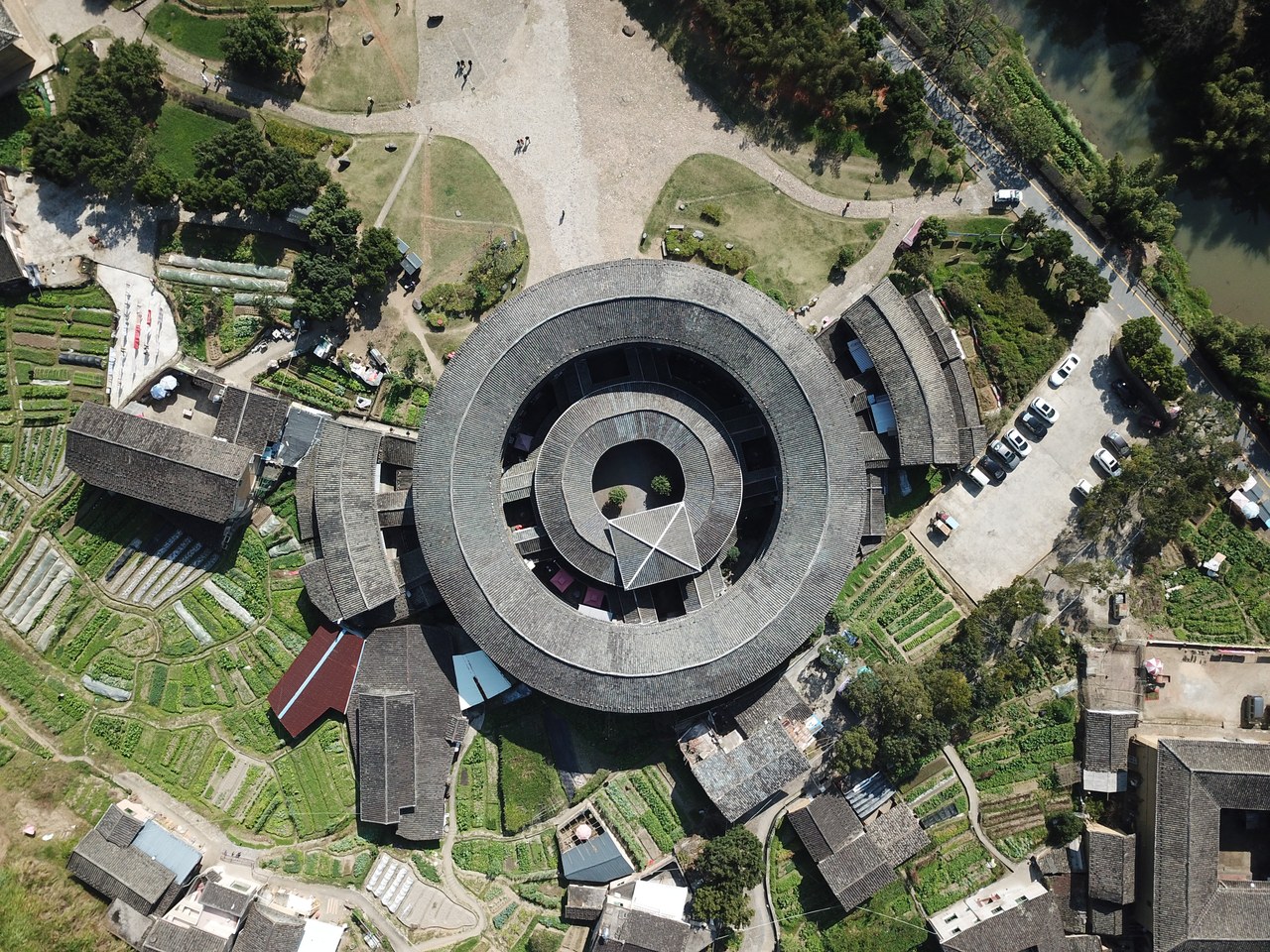
Zhencheng Lou in Hongkeng, Yongding, photographed in January 2019. Historical aerial view, not a visitor viewpoint or drone-use instruction.Photo: Lennartbj · CC BY-SA 4.0 · Image credits
Several forms of earthen family home in a stream-side village · Hukeng town, Yongding; a rural excursion from Longyan city
3–4 hours on site · Published regulator tariff: ¥90 per adult for the Folk Culture Village/Hongkeng product; Hongkeng–Gaobei combination ¥98, valid for two days. Check the operator’s dated product before paying.
The scale and concentric organisation of a major circular tulou · Gaotou area of Yongding, a separate road stop from Hongkeng
1½–2 hours on site · Published regulator tariff: ¥50 per adult for Gaobei alone, or the ¥98 Hongkeng–Gaobei combination. Private extras and guide services are separate.
A short lakeside walk and a look at the modern city · South of the older urban centre, around Longyan Avenue
1–2 hours · The plan uses the public park paths and requires no boat or event ticket. Any separately operated activity has its own charge.
One rural day, one city day
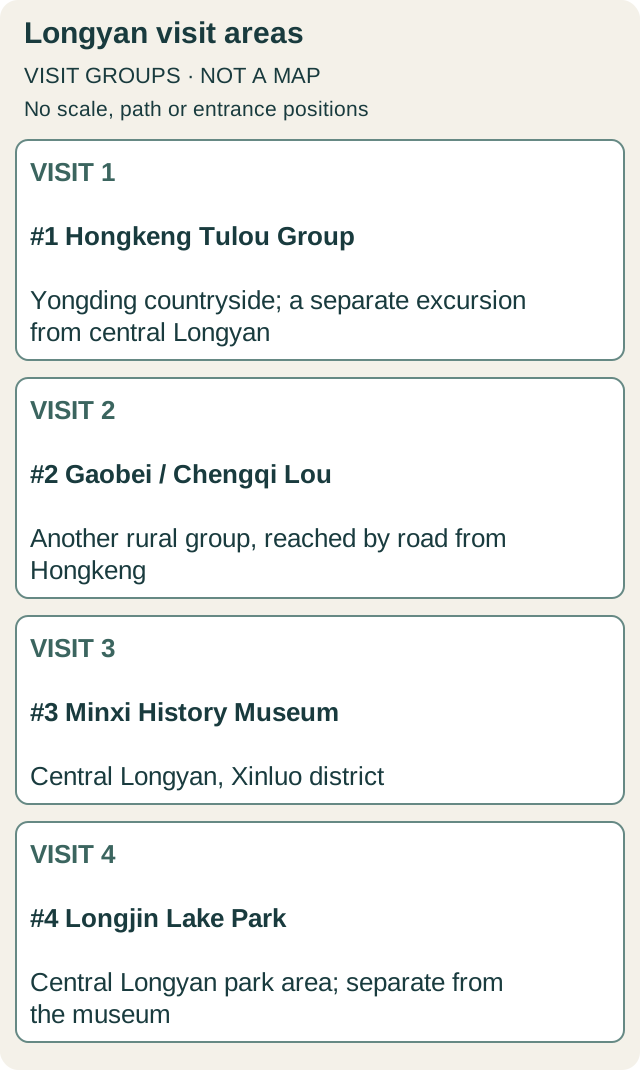
Open full-size map ↗. Not to scale or for navigation. Hongkeng and Gaobei are separate countryside groups, not adjoining city blocks. The museum and lake park form a separate Longyan city day. Groups do not certify bus routes or walking access. This is an editorial relationship diagram, not a navigation map; box position does not encode distance or an entrance. ChinaMile diagram; location sources. Navigation: search the Chinese name in Amap.
Default: Hongkeng is the main tulou visit, with Gaobei as the second group only when you have a reliable return vehicle. Put the history museum and Longjin Lake on the other day.
A booking that says “Yongding” can refer to a broad district. Specify 湖坑镇洪坑游客服务中心 for Hongkeng and 高北土楼群 for Chengqi Lou. Nanjing County’s Tianluokeng cluster is another destination; it is not included in the Hongkeng–Gaobei ticket or this route.
Choose city convenience or a village stay
Central Xinluo: the default for three nights. Look around the central food and shopping streets with a road-accessible hotel entrance. This makes the city day and meals straightforward, while the tulou outing remains a booked return excursion.
Near Longyan station: useful for an early departure, though you will still transfer for city sightseeing. Check the exact station-side address instead of relying on a broad “railway area” label.
Hukeng near Hongkeng: choose this if seeing the village early and late is the main attraction. Confirm your actual room, bathroom, luggage access, meals and passport check-in; a tulou-style listing does not establish quietness or an inside-the-monument location. Arrange the next transfer before committing. For the default city-based plan, keep one room and leave large bags there.
Give the earthen buildings an entire day
Arrival evening · night 1: reach Longyan, check in and have a local dinner. Confirm the driver, stops, ticket product and return pickup.
First full day · night 2: leave after an early breakfast. Spend the morning at Hongkeng, eat a simple village lunch, then add Gaobei if road conditions and your energy allow. Return to the same city hotel for dinner. Do not tie the last village stop to a tight evening train.
Second full day · night 3: on a normal opening day, use 09:00–11:00 for the museum, followed by a long lunch. Take a short Longjin Lake walk later in the afternoon. If this is Monday, exchange the two full days; if the museum is unavailable, retain the food-and-park version.
Departure morning: collect luggage and travel to the exact station. With one full day and two nights, omit the city sightseeing day. During a serious rain or road warning, cancel the rural outing instead of choosing another distant valley.
Compare village forms, then change pace
1. Hongkeng Tulou Group · 洪坑土楼群 · 振成楼
Hongkeng is the best first choice if you want variety rather than one celebrated circular building. Compare round Zhencheng Lou with the multi-courtyard Fuyu Lou, then notice how paths, streams and smaller houses fit around the large structures. The buildings make more sense as homes and village infrastructure than as isolated monuments.
Concentrate on two or three buildings and the connecting village paths. Upper floors and domestic areas may be restricted even when a courtyard is open. Ask before photographing residents, entering a room or paying a resident for an extra view; a scenic-area ticket is not blanket permission to enter private space.
Hours
Plan a morning arrival and a daylight visit. Use the official 土楼景区 account’s current notice and selected ticket entry window; do not rely on an old 08:00–17:00 listing.
Tickets
Published regulator tariff: ¥90 per adult for the Folk Culture Village/Hongkeng product; Hongkeng–Gaobei combination ¥98, valid for two days. Check the operator’s dated product before paying.
Time
3–4 hours on site
Chinese address
龙岩市永定区湖坑镇洪坑游客服务中心;洪坑土楼群
Getting there
For the two-group plan, book a licensed vehicle with driver from your hotel for the full return journey, naming 洪坑游客服务中心 and 高北土楼群 separately. Confirm waiting, tolls, parking and return destination in the quote.
How to visit
Begin at the visitor centre, walk the selected building circuit and meet the same driver at the agreed exit. A vehicle pickup in Longyan city does not imply transport inside the pedestrian visitor area.
2. Gaobei and Chengqi Lou · 高北土楼群 · 承启楼
Choose Gaobei to see Chengqi Lou’s concentric rings and understand the striking difference between a plain outer wall and a densely organised interior. Walk slowly enough to notice shared circulation, roofs and the central gathering space instead of trying to duplicate an aerial photograph from ground level.
With a prearranged vehicle, this makes a useful second group after Hongkeng. With public transport, limited mobility or a preference for a slower visit, stay with Hongkeng. Chuxi is another separate group, not a small extra stop on this two-group day.
Hours
Use a confirmed daytime ticket window. Leave time to exit and return to Longyan; a later scenic closing time would not guarantee a bus home.
Tickets
Published regulator tariff: ¥50 per adult for Gaobei alone, or the ¥98 Hongkeng–Gaobei combination. Private extras and guide services are separate.
Time
1½–2 hours on site
Chinese address
龙岩市永定区高头镇高北土楼群;承启楼
Getting there
Transfer by the booked road vehicle from Hongkeng. The official road plan establishes that the groups are separate; do not interpret a map line as a village footpath.
How to visit
Ask which buildings the selected product includes, respect blocked stairs and return to the agreed pickup. Drop this stop if the first group takes longer or road conditions worsen.
3. Central Soviet Area (Minxi) History Museum · 中央苏区(闽西)历史博物馆
This is the city’s strongest choice for readers interested in the revolutionary period and the role of western Fujian. Historical documents and objects are presented within the museum’s official interpretive framework. Expect substantial Chinese-language material; a translation tool or a prearranged guide helps if you want detail.
Choose it for the subject, not as a generic rainy-day collection of ancient art. The visit pairs well with a slow lunch and an urban park. Travelling to Gutian or Changting would be a different excursion and should replace a day, not be added after this museum.
Hours
Normally closed Monday. The museum’s service and contact pages disagree on exact sessions; 09:00–11:00 sits within both published morning windows. Confirm your date with +86 597 2291479, especially around holidays.
Tickets
The museum publishes free admission. Bring an original identity document; a foreign-passport admission process was not field-tested.
Time
1½–2 hours
Chinese address
龙岩市新罗区北环西路51号
Getting there
Take a local taxi to the full museum name and 北环西路51号. Save your hotel address for the return rather than relying on the English name alone.
How to visit
Ask the visitor desk how to register if your passport cannot use an automated entry channel. If closed or entry cannot be arranged, keep the city food and park day; do not assume another museum has the same admission rules.
4. Longjin Lake Park · 龙津湖公园
Use Longjin Lake for an easy change of pace after the tulou day: water, planting and open views replace enclosed courtyards and dense interpretation. It is a modern urban park, so the pleasure is in the walk rather than in expecting a preserved ancient landscape.
Choose one section near your arrival entrance and turn back when ready. Markets and performances are occasional events, not a guaranteed daily feature. A walk in comfortable weather is enough to justify the stop.
Hours
Daylight or early evening in suitable weather; respect local closures and barriers.
Tickets
The plan uses the public park paths and requires no boat or event ticket. Any separately operated activity has its own charge.
Time
1–2 hours
Chinese address
龙岩市新罗区龙津湖公园
Getting there
Transfer by road from the museum or central hotel. Choose and save a named park entrance for drop-off and pickup.
How to visit
Keep the route close to the selected entrance if rain threatens. Skip the park in heavy rain and use a longer meal or rest at the hotel.
Separate Xinluo snacks from the wider Hakka table
清汤粉 clear-broth rice noodles are a sensible city breakfast or lunch; specify the meat topping you want. A clear-looking broth is not necessarily vegetarian. 客家牛肉丸 Hakka beef balls are another useful order, as a small soup or shared dish.
For two people having dinner, choose one shared meat dish such as 笋干扣肉 pork with dried bamboo shoots, one vegetable and rice. You do not need a whole regional banquet. Menus draw on several western Fujian counties, so a regional speciality is not proof that every ingredient or recipe comes from central Longyan.
On the tulou day, eat in the village before the second group and agree the portions and price first. Ask whether a dish contains offal, bone-in meat or alcohol if that changes your choice. The plan does not depend on a particular restaurant opening or on buying a tea-shop package.
Book the rural return before leaving the city
Search Longyan 龙岩 on 12306 for the actual date and origin. A ticket to another station in the wider region is not interchangeable. Take a taxi from the station to your hotel using its Chinese address.
For Hongkeng plus Gaobei: obtain a whole-day return quote from a licensed transport provider through your hotel or travel provider. Write both scenic visitor centres, the number of passengers, luggage, waiting time, tolls, parking and the city return address into the booking. Tickets and a guide may be separate. This is the default because it avoids depending on an unverified last rural bus.
If using public transport: make Hongkeng your only group. Before buying the outward leg, have the staffed station or official ticket seller confirm the exact departure terminal, Hongkeng/Hukeng arrival stop, return departure and final city arrival. If a same-day return cannot be confirmed, book a village night and its onward transfer or choose the city day instead. Do not assume any service labelled 永定 reaches the tulou entrance.
For current scenic products and document questions, use the 土楼景区 official WeChat account named by the Yongding authority. Ask the scenic visitor centre to resolve a passport or ticket mismatch before entering; never invent an identity number.
Two adults sharing one room for three nights
For both full days, calculate 3R + A + C + ¥896–1,176. R is the actual nightly room quote, A covers the pair’s station transfers, and C is the quoted full rural return vehicle including the agreed waiting and road charges.
The remaining amount includes 2 × ¥98 = ¥196 for the published Hongkeng–Gaobei combination tariff, plus planning allowances of ¥480–640 for meals, ¥100–160 for city rides and ¥120–180 for drinks and contingency. The tariff is the regulator’s published standard, not a promise of the price of every current online package. Optional scenic shuttles, guide services and performances are extra.
Example inputs R = ¥300, A = ¥100 and C = ¥700 give ¥2,596–2,876 for the pair. Replace all three example quotes before booking. Intercity trains, shopping and any extra village night are excluded.
For one full day and two nights, use 2R + A + C + ¥596–776, including the same two-group tickets, meals ¥280–380, city rides ¥40–80 and contingency ¥80–120. The example becomes ¥1,996–2,176. If visiting Hongkeng only at its published ¥90 tariff, subtract ¥16 for the pair and recalculate the vehicle quote.
Know what the published evidence establishes
Sources were read on . Government sources establish the distinct tulou groups, their road relationships and the published tariff. A road-improvement plan is used only for geography, not as proof that every proposed visitor service now runs.
The museum’s own service and contact pages conflict on session times. The suggested 09:00–11:00 visit lies within both morning windows; the current date and passport handling still need the museum’s confirmation. The tulou operator’s website could not be reliably opened during this check, so current entry windows should come from its official account before travel, rather than an asserted new timetable.
Durations, itinerary grouping, transport choices and budget allowances are editorial estimates. No rural bus schedule, hotel, driver quote or foreign-passport admission was field-tested.