SOUTHERN JIANGXI · A RIVER CITY WITH SONG-DYNASTY ROOTS
Ganzhou Follow the rivers and old streets, with time for Hakka food
Ganzhou rewards a city walk that follows the water. Old walls run beside the rivers, a floating bridge still gives the east bank a distinctive view, and the lanes behind them lead to food and an unusually revealing story about urban drainage. The attraction is the combination of surviving infrastructure, rebuilt landmarks and present-day city life.
Give the old city two relaxed days if you want to pause over Hakka dishes and explore beyond one evening street. With only a day, choose the river-wall and old-street route. Add Tongtianyan for rock carvings and a hillier excursion; distant Hakka villages elsewhere in southern Jiangxi require a separate route rather than a spare hour in town.
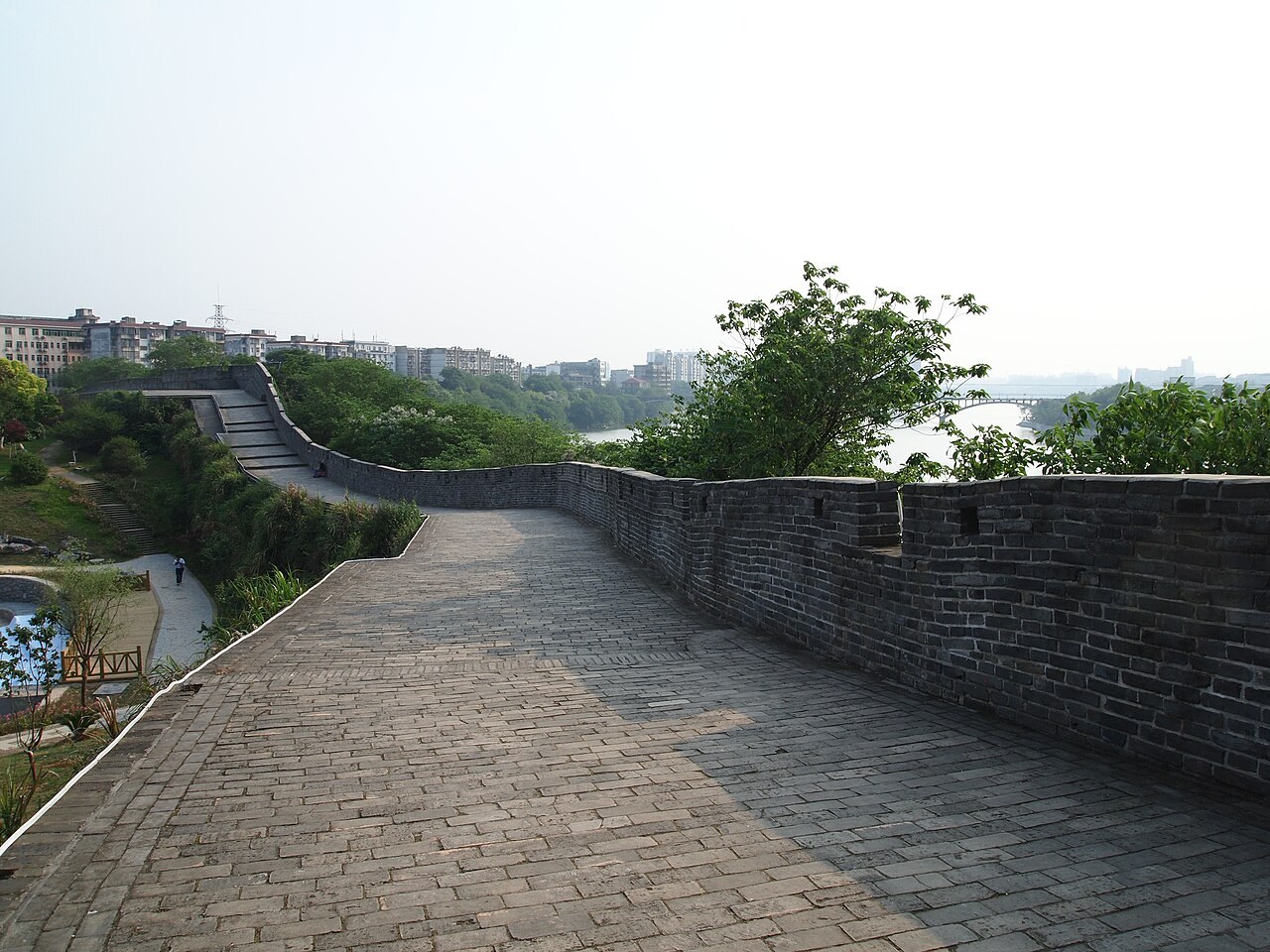
Ganzhou’s wall near Yugu Pavilion, photographed in April 2014. The image illustrates the riverside setting; current access and surrounding buildings may differ.Photo: Underbar dk · CC BY-SA 4.0 · Image credits
The engineering story beneath Ganzhou’s old streets. · Old city · Houde Road / Haihui Road area
1–1½ hours when open · Check the venue’s current admission and registration notice.
Two old-city days, or swap one for rock carvings
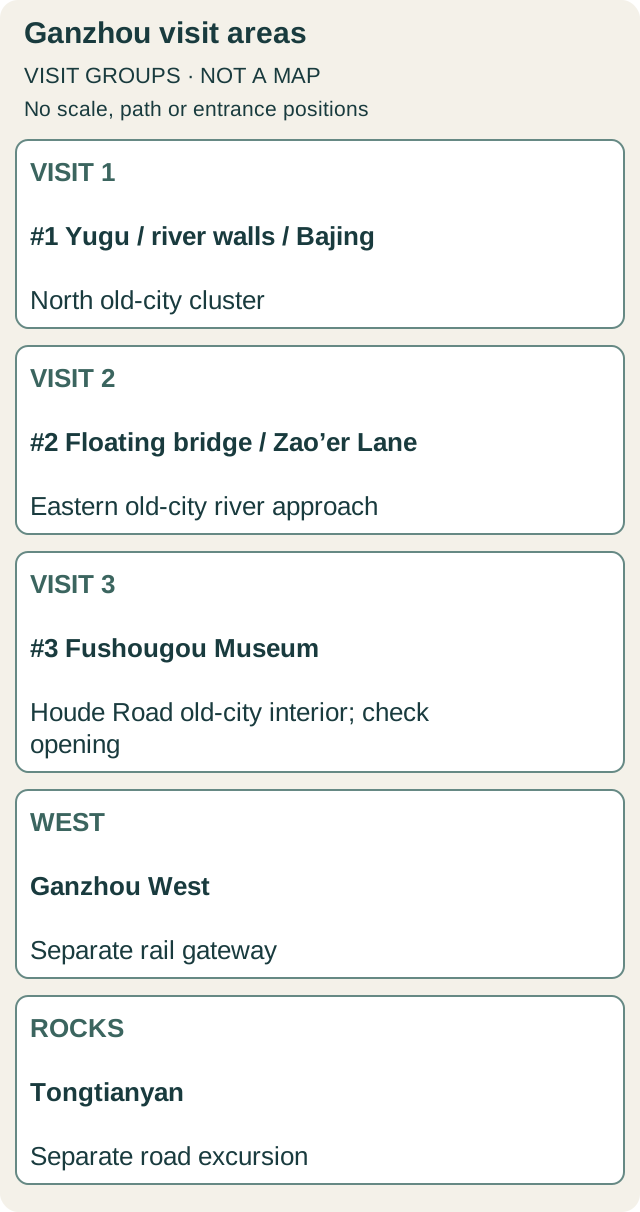
Open full-size map ↗. North old-city cluster. Eastern old-city river approach. Houde Road old-city interior; check opening. Separate rail gateway. Separate road excursion. This is an editorial relationship diagram, not a navigation map; box position does not encode distance or an entrance. ChinaMile diagram; location sources. Navigation: search the Chinese name in Amap.
Arrive in the evening, check in and have dinner. On the first full day, visit the Yugu district and a selected wall section, have lunch, then continue to Bajing Park after a rest. Return to the old streets for dinner; no scheduled light show or performance is needed.
On the second full day, use Fushougou Museum if its opening is confirmed, then visit Zao’er Lane and the eastern riverbank. Keep the floating-bridge section to daylight and finish with a Hakka meal. Depart the following morning: that is three nights for two full days. For one full day and two nights, choose the first-day route and add the bridge only if energy and river conditions allow.
Tongtianyan / 通天岩 is the important alternative: Buddhist rock carvings and a sandstone landscape outside the old-city cluster. Replace the second city morning with a separate half-day or longer visit if that interests you. Arrange both directions of road transport, confirm the scenic-area entry product and current open paths, and leave room for steps. It is not a walk-on continuation from Yugu Pavilion.
Dry, milder days suit the old-city route. In summer, use the morning and late afternoon for exposed walls; during heavy rain, shorten riverside walking. A flood-related bridge closure is a reason to use the city streets, not find another informal crossing.
Use the old-city fringe for the first visit
Default: Zhanggong near Yugu Pavilion, Wenqing Road or the old-city commercial streets. You can return between walks and reach dinner without a long transfer. A hotel just outside a pedestrian lane is easier with luggage; check the actual vehicle entrance and street noise.
Zhangjiang New District suits larger modern hotels and road access, with transfers into the old city. Ganzhou West station is useful for an early train but is a different base from the historic river peninsula. Choose Tongtianyan-area lodging only if your plan centres on that excursion.
After choosing the area, use Trip.com hotel search with Ganzhou, your dates, two adults and one room, then check the exact address near Yugu Pavilion or Wenqing Road. Confirm the property can complete check-in with your original foreign passport, the cancellation terms and the vehicle entrance. See the foreign-passport hotel check-in guide if the property gives conflicting instructions.
Make the main meal a small Hakka spread
Ganzhou stir-fried fish / 赣州小炒鱼 and stuffed tofu / 酿豆腐 give two people a useful start, with vegetables and rice. Ask about chilli and bones; stuffed tofu commonly contains pork. Ningdu three-cup chicken / 宁都三杯鸡 is another regional choice, served on the bone.
Four Stars Around the Moon / 四星望月 is a larger presentation associated with Xingguo, centred on steamed fish and accompanying dishes. It suits a group better than a solo snack; agree portion size and total price before ordering. You do not need to travel to another county just to complete a meal in Ganzhou.
For breakfast or a smaller stop, try rice noodles, tangpi / 烫皮 rice-sheet preparations, or huangyuan rice cakes / 黄元米果. Fillings and broth vary, so check ingredients rather than assuming a rice-based dish is vegetarian. Choose food around the day’s district and leave a seated break between the wall and river walks.
A compact city stay with optional interiors
For two adults sharing one room, three nights and two full days, use 3R + F + T + X. Example editable inputs: R = CNY 300 per room-night; F = CNY 460–660 for meals from arrival dinner to departure breakfast; T = CNY 130–230 for city travel and two city-station transfers; X = CNY 0–160 for optional interiors or activities. Total: CNY 1,490–1,950 for two, or CNY 745–975 each.
These are planning allowances, not live prices. X = 0 means the public-street, park and river approach route, without paid extras. Exclude intercity fares, airport transfers, private guides, shopping and the Tongtianyan excursion. If adding it, replace the relevant city transport allowance with the actual round-trip quote and add its dated admission cost.
Read the river city through three visit groups
1. Yugu Pavilion district, river walls and Bajing Park · 郁孤台历史文化街区 · 古城墙 · 八境公园
Begin in the Yugu Pavilion district for the lanes, courtyard façades and view up toward the pavilion. The name carries literary associations, especially with Xin Qiji. The commercial street setting is restored in places; let the surviving walls and river geography provide the historical context rather than treating every façade as ancient.
Continue toward Bajing Park and the confluence of the Zhang and Gong rivers, choosing an open wall or riverside section along the way. Bajing Pavilion is a reconstructed landmark, not an intact Song-era tower. You can understand the meeting of the waterways from the park without making an interior climb compulsory.
Hours
Use daylight for river and wall sections, then return to the streets for dinner. Each pavilion or cultural interior sets its own hours.
Tickets
No district-wide ticket is needed for ordinary public street walking. Confirm posted access and any interior charge at Yugu or Bajing Pavilion; the core route works from the streets and open park.
Time
Half a day with breaks
Chinese address
江西省赣州市章贡区郁孤台历史文化街区、八境公园。
Getting there
Taxi to 郁孤台历史文化街区, then use marked walking paths toward 八境公园. If the full link is too far in heat, take a short road transfer and save energy for the river view.
How to visit
Yugu district → selected accessible wall/river section → Bajing Park and confluence → road pickup or return to the hotel. Do not climb closed stairs or walk on unguarded wall edges.
2. East River floating bridge and Zao’er Lane · 东河古浮桥 · 灶儿巷
The floating bridge is Ganzhou’s most immediately distinctive piece of river infrastructure: linked boats carry a wooden walkway. Look first from the bank so you can see how it works. If access is open and the surface is safe, a short crossing gives a different perspective; crossing is optional, not necessary to appreciate it.
Combine the river with Zao’er Lane and the area around the old Standard Clock. The lane is compact, so slow down for doorways, building details and a snack instead of expecting a whole afternoon inside one street. Current businesses share the historic setting; ask before photographing inside private premises.
Hours
Daylight is best for the bridge and uneven surfaces. Flood, weather or maintenance closures override any map route.
Tickets
The plan uses the ordinary public river approach and streets. Follow the actual bridge access notice. Do not pay someone promising entry through a closed riverside section.
Time
2–3 hours including a snack
Chinese address
赣州市章贡区建春门附近东河古浮桥;灶儿巷、标准钟周边。
Getting there
Use 建春门古浮桥 as the river destination and 灶儿巷 for the lane. Walk the actual street connection or take a short taxi; the bridge’s opposite bank is not your default hotel side.
How to visit
Bank view → optional permitted bridge walk → return to the old-city bank → Zao’er Lane and a meal. If the bridge is closed, keep the bank view and street route; a crossing is not part of the onward transport plan.
3. Fushougou Museum · 福寿沟博物馆
This museum makes a practical city question interesting: how did an old river city manage rainwater and prevent backflow? Displays explain the Fushougou drainage system, and the venue incorporates an exposed section of the historic drain. It is a more distinctive indoor choice than adding another general-purpose shopping stop.
Choose it if engineering or the old city’s workings interest you. It is a managed exhibition, not permission to explore drains or tunnels independently. Treat it as a useful second-morning addition; the surrounding lanes and river route provide an easy replacement if it is closed.
Hours
Current regular hours were not established from a reliable operational notice in this check. Confirm the same-day opening at the official 江南宋城 visitor service point before setting out; do not rely on contradictory third-party evening hours.
Tickets
Ask the official visitor service or venue desk for the current entry/registration arrangement and carry your original passport. No tested foreign-passport booking flow or guaranteed free interior entry is claimed.
Time
1–1½ hours when open
Chinese address
赣州市章贡区厚德路、海会路附近,福寿沟博物馆。
Getting there
Use the exact museum name for a short city taxi or map-assisted walk. It is in the old-city area, not the separate Ganzhou municipal museum in the newer city.
How to visit
Confirm opening → museum displays and permitted historic-drain viewpoint → return to nearby streets. If unavailable, use Zao’er Lane and the open riverfront rather than waiting for an unconfirmed reopening.
Ganzhou West and Ganzhou are different stations
Ganzhou West / 赣州西 is the high-speed gateway to compare for many intercity journeys; Ganzhou / 赣州 is a separate station. Search the actual date and station on 12306, then use a licensed taxi or current city bus to the exact hotel address. Neither the city name nor a station-area hotel guarantees a short walk to the river walls.
Ganzhou Huangjin Airport / 赣州黄金机场 requires a road connection. Check an operating airport bus for your arrival time or use a licensed transfer. Late arrivals should go to the hotel; the next morning remains the first full sightseeing day.
Save the hotel and departure station names in Chinese. Allow for the road journey, station security and passport handling before the train departs. For Tongtianyan, arrange a pickup location and return time before leaving town; do not depend on finding an empty taxi after the visit.
Choose a different city experience
Nanchang adds the provincial-capital setting; Chaozhou adds a different southern trading city and food tradition. Compare actual train routes and transfer needs before choosing the order.
History checked; optional museum operations remain conditional
Sources checked on . Government sources establish the old-city groups, floating bridge, Fushougou displays and regional food. Current Fushougou interior hours and passport registration were not verified; the main plan retains a complete public-street alternative. No future bridge opening, performance, hotel transaction or exact taxi fare is guaranteed. Durations and budget inputs are editorial judgments.