Meizhou Understand the Hakka story, eat well, and leave time for the arcades and the river.
Meizhou suits travellers who enjoy connecting a museum to the streets and meals around it. The Hakka Museum explains a community shaped by migration, language and family ties; the arcades of Jiaying’s old city show a lived-in trading centre; breakfast noodles and a slow Hakka dinner make the visit more than a heritage checklist. The Mei River gives the day a gentle end.
Choose one full day and two nights for a first city visit. Secure the museum visit, stay in central Meijiang and keep the rest of the day flexible. This is an urban introduction, not a route through every Hakka village in the wider prefecture. If enclosed houses and rural landscapes are your priority, add a separately arranged countryside day and return transport; a city taxi drop-off is not a complete rural itinerary.
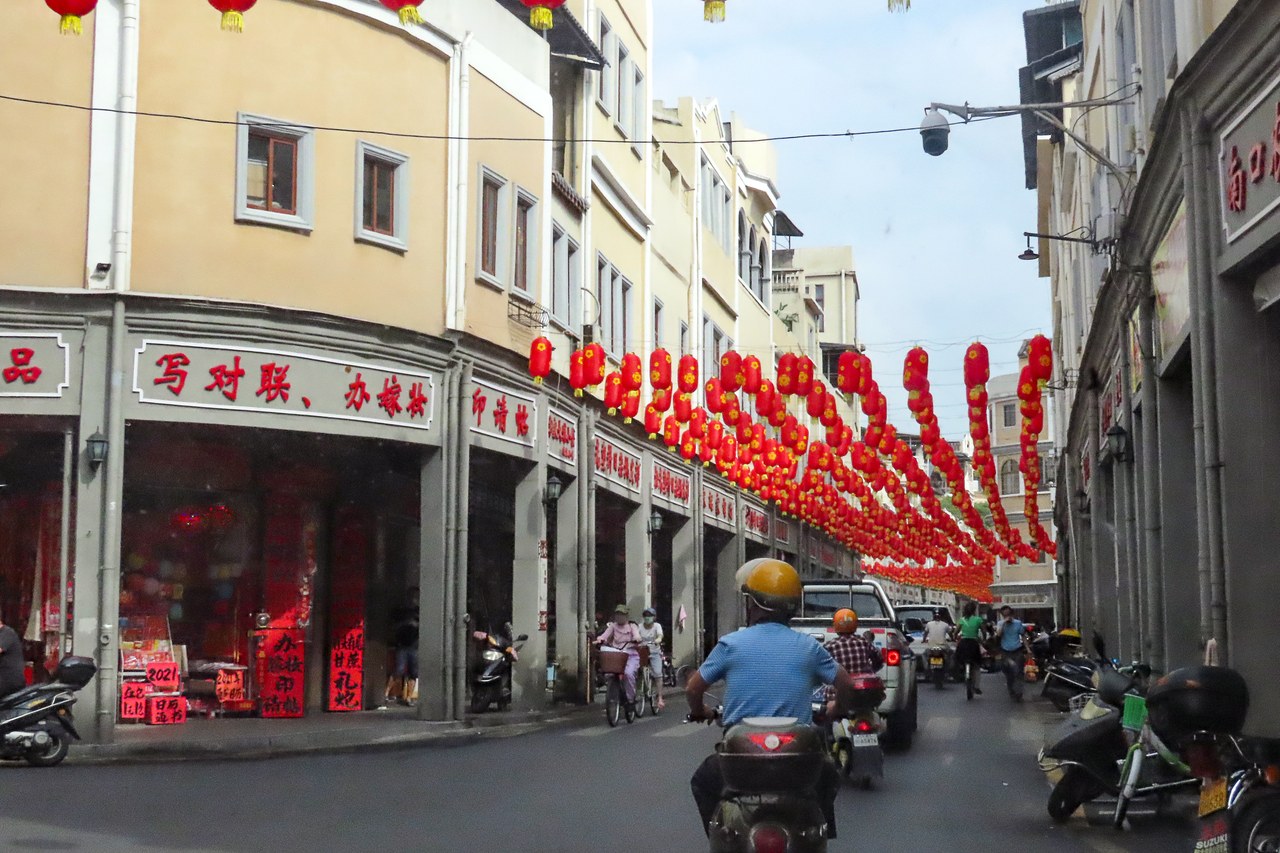
Youluo Street in Meizhou’s old city, photographed on 29 September 2020; storefronts and decorations may differ today.Photo: N509FZ · CC BY-SA 4.0 · Image credits
A riverside break among residents walking, resting and watching the water · South-bank riverside in the central city, separate from the old-city lane walk
45–90 minutes · This plan uses the public park and riverside paths; no boat or attraction product is needed.
Museum first, north-bank lanes next, river last
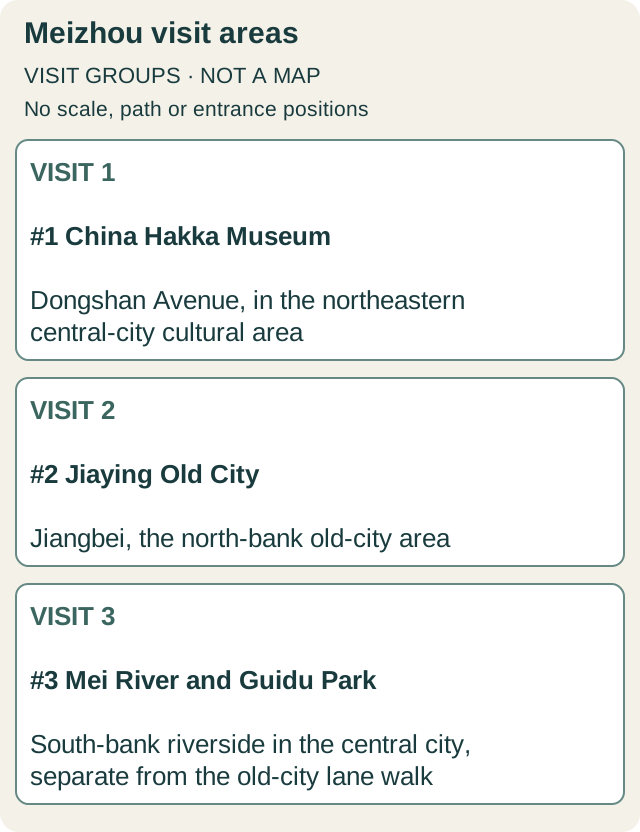
Open full-size map ↗. Museum, Jiaying old streets and Guidu Park are separate stops. Guidu Park is on the south-bank riverside. Not to scale; group layout does not imply an open floating bridge or a walkable shortcut. This is an editorial relationship diagram, not a navigation map; box position does not encode distance or an entrance. ChinaMile diagram; location sources. Navigation: search the Chinese name in Amap.
The Hakka Museum and Jiaying old city are separate central-city stops. The Guidu Park walk is on the south-bank riverside and needs its own transfer. The diagram shows relationships, not a walking route or bridge status.
For a food-and-architecture trip with more coastal connections, compare Chaozhou or Shantou. Choose Meizhou for the Hakka focus. A rural Hakka-house excursion can deepen that focus, but should replace a day or add one rather than being squeezed into this city circuit.
Start with noodles; save the shared dishes for dinner
腌面 yanmian are noodles tossed with a fragrant dressing, commonly using lard, garlic and sometimes fish sauce. They are a breakfast choice, not a pickled-noodle dish despite the literal character. The familiar partner is 三及第汤, a soup of pork, liver and intestine; say plainly if you do not eat offal.
For a shared dinner choose 盐焗鸡, salt-baked chicken, or 梅菜扣肉, pork belly with preserved mustard greens, then add 酿豆腐 and greens. Stuffed tofu commonly contains meat; it is not a vegetarian default. Two adults do not need all three rich dishes: pick one main protein, one smaller dish and vegetables with rice.
Have breakfast near the hotel before the museum, lunch or snacks around the old streets, and dinner near the hotel after the river. Ask the portion size and whether half a chicken is available before ordering. The budget below is a planning allowance, not a quote from a named restaurant.
Culture, streets and water at different speeds
1. China Hakka Museum · 广东中国客家博物馆
Begin with the main museum’s Hakka People and Meizhou History exhibitions. The combination helps distinguish the wider Hakka community from the history of this particular city. Family, movement and cultural life are the themes to carry into the afternoon walk.
The institution also manages the Huang Zunxian memorial and other branches. They are additional choices with their own access arrangements, not proof that a single main-hall booking admits you everywhere. For a first short stay, a considered main-museum visit is enough.
Hours
Tuesday–Friday 09:00–17:00, last entry 16:30; weekends, statutory holidays and school winter/summer holidays 09:00–17:30, last entry 17:00. Monday is normally closed except statutory holidays; current special notices take priority.
Tickets
Free entry, but official WeChat real-name reservation and the selected entry window are required.
Time
2–2½ hours
Chinese address
梅州市梅江区东山大道2号;广东中国客家博物馆
Getting there
Take a taxi or current bus route to 广东中国客家博物馆 on 东山大道. Save the main-museum address so you do not accidentally navigate to a branch.
How to visit
Use the museum’s official 中国客家博物馆 WeChat account to reserve the actual date and slot. Its published rule refers to real-name ID registration but does not establish a foreign-passport online route. If your document cannot be entered, call 0753-2253668 before travelling and ask how staff can admit your party with original passports. Do not assume the phone call itself guarantees entry. If not confirmed, retain Jiaying’s public streets and the river, or change the museum day.
2. Jiaying Old City · 嘉应古城 · 凌风东西路
Use Lingfeng East and West Roads as the backbone. Arcades shelter the shopfronts, while the side lanes reveal a smaller scale of everyday trading and residential life. Choose a few details to follow—shop signs, columns and the gaps between older facades and renovated buildings—instead of expecting a sealed museum town.
Yuancheng Square and its octagonal pavilion make useful landmarks. Look at the entrance of Meizhou Xuegong, the old Confucian school on Lingfeng West Road; enter only if its current opening and admission are confirmed. The public-street walk remains worthwhile without relying on that interior.
Hours
Plan daylight for building details, with an optional early-evening return. Individual shops and historic interiors do not share a guaranteed opening schedule.
Tickets
The walk uses public streets. Museums, private premises and any special activities have their own admission.
Time
2–3 hours with food stops
Chinese address
梅州市梅江区凌风东路、凌风西路;元城广场;梅州学宫
Getting there
Transfer by taxi from the Hakka Museum to 元城广场. Then explore the old streets on foot, keeping a road-accessible pickup point for the next transfer.
How to visit
Start at 元城广场, walk a chosen stretch of Lingfeng Road and return through one or two open side lanes. Allow scooters and deliveries to pass. If wet stone or crowding makes the walk unpleasant, shorten it and have a seated meal rather than chasing every lane.
3. Mei River and Guidu Park · 梅江 · 归读公园
Use the river as a change of pace after the museum and old streets. Guidu Park’s planted paths, river views and everyday evening activity give a sense of how the city lives. It is a good finishing walk, rather than another major sight to hurry through.
Choose a short out-and-back section from a convenient entrance. There is no need to cover the entire riverside or cross every bridge. Keep the path optional when weather or water conditions are poor; dinner is a better substitute than trying to find an unverified cruise.
Hours
Daylight or early evening in comfortable weather. Respect any flood, maintenance or storm closure and stay on open land paths.
Tickets
This plan uses the public park and riverside paths; no boat or attraction product is needed.
Time
45–90 minutes
Chinese address
梅州市梅江区归读公园;梅江南岸
Getting there
Use a local road transfer from Jiaying to 归读公园, choosing the entrance nearest your hotel or dinner. Do not assume a particular floating bridge is available as a shortcut.
How to visit
Save the entrance and pickup location, walk one section and return. If access is barred, leave the waterfront and use streets or an indoor meal away from the river; never cross a closure for the planned route.
Keep the base in central Meijiang
Near Jiaying’s old city in Jiangbei: choose this for morning food shops and immediate access to the arcades. Check whether the hotel entrance is on a car-accessible road and whether the room faces a noisy street. Older buildings may have stairs.
Near the central Mei River in Jiangnan: the default if a modern hotel and a gentler evening walk matter more. Check the exact river section: a river-view label does not mean the hotel is next to the museum or the old-town lanes. Use taxis between the three sightseeing groups.
Meizhou West station area: useful for a difficult early departure, but a transport base rather than the historic centre. This guide compares areas, not named properties. Confirm the room, lift access, passport check-in and actual nightly rate with the chosen hotel before paying.
One complete day, with a slower two-day version
Arrival evening · night 1: check in, have a small Hakka dinner, and confirm the museum slot and any passport-related instruction.
Full-day morning: noodles for breakfast, then roughly 09:30–12:00 at the main Hakka Museum, subject to the booked slot. Take a local road transfer to Jiaying rather than using the lunch break for a long walk between areas.
Afternoon · night 2: lunch, Lingfeng Road and a few lanes, then a rest. If weather is comfortable, transfer to Guidu Park for a short river walk before dinner. If tired, omit the river first; keep the museum and old-city pair as the core.
Departure morning: breakfast, bags and the transfer to the exact station. For two full days and three nights, give the museum and a slow meal the first day; use the old city and river on the second. This is the better pace for limited walking. If Monday is the only available day, use the outdoor city-and-food plan or shift the dates: do not arrive expecting the normally closed museum to be your rain shelter.
Use Meizhou West as the rail search starting point
Search Meizhou West 梅州西 on 12306 using your actual origin and date. It is different from Meizhou 梅州 station. Current seats, routing and fares come from the selected train, not from an old city-level timetable.
Take the signed taxi service or a matched app pickup to your hotel’s full Chinese address. If choosing a bus, check the current route and service window after fixing the station; no last-bus promise is made here. For a late arrival, agree a workable hotel transfer before boarding your intercity train.
Within the city, pair separate taxi rides with short walks. Keep 元城广场 as the old-city pickup reference and a specific 归读公园 entrance for the river. If mobile booking fails, ask your hotel or the staffed museum desk to help arrange a licensed taxi. Do not finish at a remote village before a tightly timed train: leave the departure morning for the station and boarding buffer.
A small city break, with the assumptions visible
For two adults sharing one room, one full day and two nights, calculate 2R + A + ¥540–780. R is the booked room price per night; A is the pair’s station-to-hotel and hotel-to-station transfer total. The planning allowance contains ¥360–500 for meals from arrival dinner to departure breakfast, ¥100–160 for local sightseeing transfers and ¥80–120 for drinks and contingency.
With illustrative inputs R = ¥280 and A = ¥120, the stay is ¥1,220–1,460 for the pair. These hotel and transfer inputs are examples, not verified quotes. The core museum exhibition is free and the remaining route uses public streets and park paths; private tours, paid activities and any additional ticket must be added at its actual price.
For the slower two-day, three-night version, use 3R + A + ¥880–1,260: meals ¥600–820, sightseeing travel ¥140–220, drinks and contingency ¥140–220. With the same example R and A this is ¥1,840–2,220. Both totals exclude intercity travel, shopping and countryside excursions.
Museum rules have a documented recovery path
Sources were read on . The museum’s current visitor and reservation pages provide hours, free entry, the official WeChat requirement and the main-hall phone number. Its own collection description supports the exhibition overview. Municipal newspaper reporting documents the old-city walk, local dishes and Guidu Park.
We have not tested the museum booking form with a foreign passport, made a hotel reservation or checked a live train quote. Call the museum before making its entry the reason for travel if online booking fails. Visit durations, meal combinations, areas and budgets are editorial planning judgments; temporary exhibitions and holiday events are not promised.
.jpg)