WESTERN YUNNAN · A LIVING OLD TOWN AND GEOTHERMAL LANDSCAPES
Tengchong Follow the lanes and overseas connections of Heshun, then see the earth's heat at Rehai without turning a restful stay into a driving marathon.
Tengchong combines two experiences that feel quite different. In Heshun, stone lanes, courtyards and a library funded by emigrants speak of families whose connections reached beyond Yunnan. At Rehai, steam and bubbling water make geothermal activity immediate. A slow old-town day and a separate geothermal outing give the visit a clear shape without filling every hour.
Use two full days and three nights for Heshun and Rehai, including time to eat, rest or book a bath. Add a full day and a night for Volcano Park if crater landscapes are a priority. It is a distinct northern outing, not another stop inside Rehai. Seasonal ginkgo colours and hot-air-balloon rides are optional reasons to tailor a longer trip, not promises of this year-round plan.
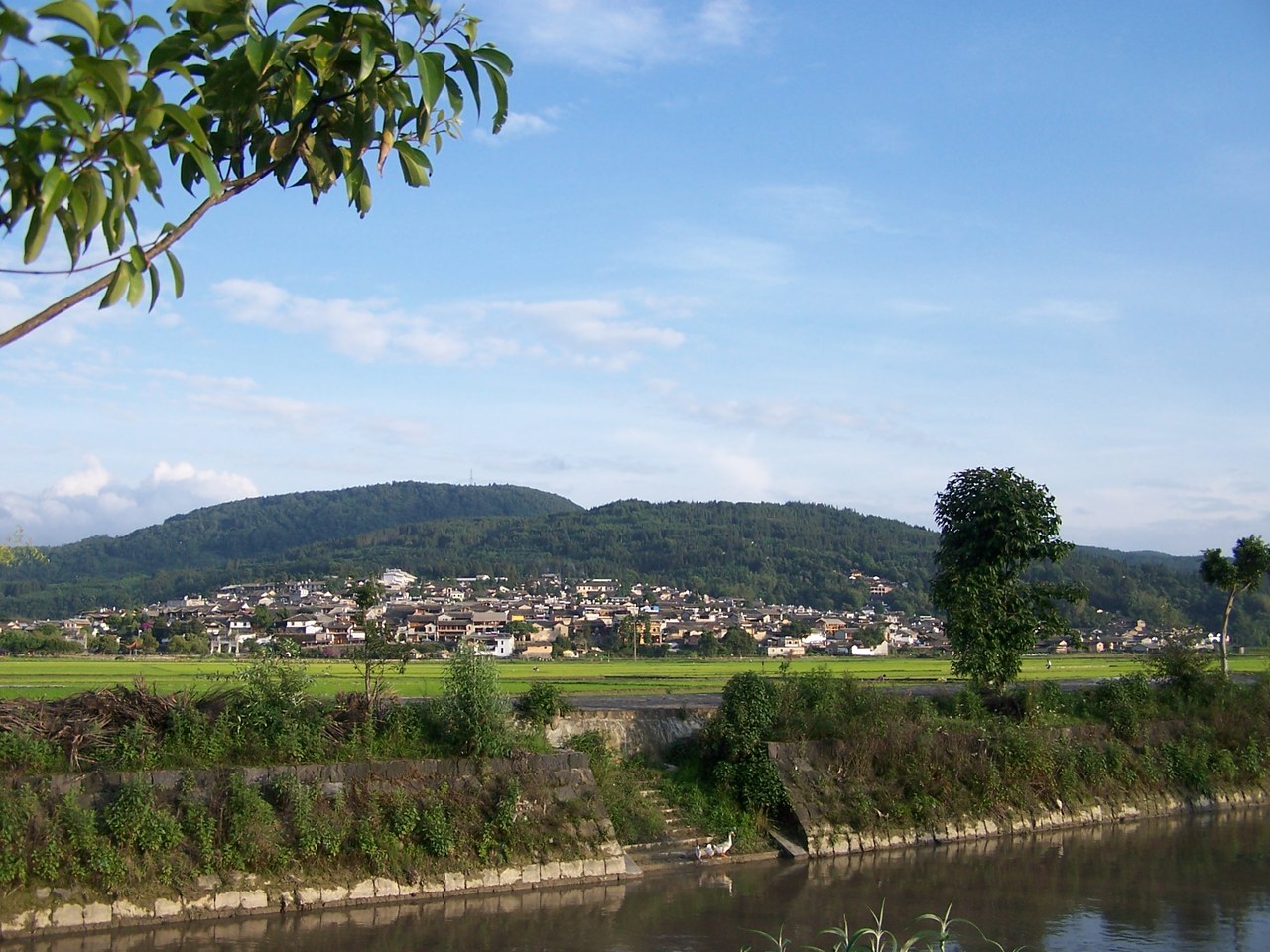
Heshun Old Town and the fields around it, photographed in June 2011. An archival view of the town’s setting.Photo: oldhouse.yin · CC BY-SA 3.0 · Image credits
Stone lanes, courtyards and an emigrant community's remarkable library · Southwest of central Tengchong; a distinct old-town base
One relaxed full day, with meals and pauses · A scenic ticket is required under the operator's rules; a room booking is not proof that admission is included.
Volcanic cones and crater forms instead of Rehai's boiling springs · Mazhan, north of Tengchong city
A half-day visit within a separately planned excursion day · Buy the current park admission; ballooning and other activities are separate and not guaranteed.
Do one direction at a time
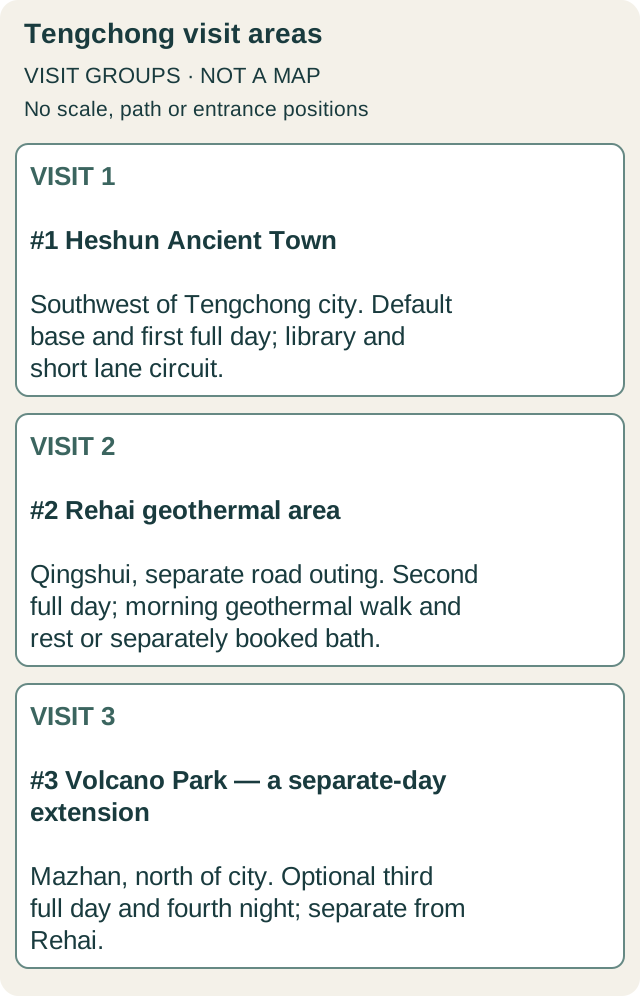
Open full-size area diagram ↗. The numbered places match this guide’s choices. This editorial area diagram groups visits; box position does not encode direction, distance, paths or an entrance. ChinaMile diagram; location sources. Navigation: search the Chinese name in Amap.
Heshun sits southwest of the central city and can be your overnight base. Rehai is a separate geothermal area on the Qingshui side; allow a return road trip. Volcano Park is in Mazhan, north of town. Going from one to the other involves real road travel, even though volcanoes and hot springs share a tourism brand.
For two full days, give Heshun one day and Rehai the other, with the rest of that second day free. For three full days, put Volcano Park on its own excursion day. Do not use a small diagram to infer that every named crater, river, wetland and hot-spring resort is covered by one admission or clustered around a single entrance.
Choose atmosphere or easy vehicle access
Heshun: choose this if you want to step out into lanes in the morning and return slowly after dinner. Ask the inn to mark its actual entrance, the car drop-off, steps and luggage arrangement. A photogenic courtyard room may be noisy beside a café or involve a steep approach; request the particular room's position and heating or cooling details.
Central Tengchong: choose a road-accessible hotel if straightforward pickups, city meals and an onward transfer matter more. You will then make Heshun a separate visit. A hot-spring resort: choose it deliberately for the resort stay; ask which pools, sessions and transfers the quoted room includes. A place described as “Tengchong” can be far from the old town.
Open Tengchong accommodation listings, enter two adults and three nights, and compare Heshun with the main urban area on the map. This is a booking search, not a verified room quote. Confirm passport check-in, the Chinese address, cancellation terms and whether Heshun scenic admission is actually included; obtain written confirmation rather than assuming it from the hotel's location.
Three different reasons to leave the hotel
1. Heshun Ancient Town · 和顺古镇
Start with Heshun Library to understand why this is more than a backdrop of old roofs. Founded in 1928 with support from emigrants in Burma, it gives a concrete form to the community's investment in education. Look at the building and permitted displays, then see the surrounding lanes as part of a place whose residents have maintained long-distance family and trading connections.
Allow a lane walk to stay small. Courtyard doorways, stone paving and the changing edge between buildings and fields repay close attention more than checking off every interior. Have lunch, pause for tea and leave room for an ordinary evening meal. This is still a lived-in community; a ticket does not turn homes and religious spaces into unrestricted visitor interiors.
The operator's statement rejects unofficial claims that certain hours provide free scenic entry. Early or late arrival is not an admission exemption. Its broad scenic visiting period also does not mean the library stays open until the town's final closing time. Call the library at +86 875 5150182 if that interior is essential.
Hours
The operator lists the scenic visiting period as 07:30–22:00, subject to site notices. Individual libraries, museums and houses have shorter hours; do their interiors during the day.
Tickets
The posted rules say one personal ticket is valid for seven days. They describe Chinese resident-ID purchase and entry, so passport holders should obtain the operator's assisted procedure before committing. Do not invent an ID number or assume a hotel booking removes the ticket requirement.
Time
Allow a full day for the library, a short lane circuit, lunch and a long pause; this is a suggested pace rather than a compulsory route.
Chinese address
云南省腾冲市和顺古镇景区;和顺图书馆位于水碓村上8号三社
Getting there
Take a road transfer to the entrance or the accommodation's permitted luggage pickup. An inn deep in the lanes may not have door-to-door car access.
How to visit
Collect the current visitor map, visit the library while its interior is open, then choose a short signed circuit of lanes and courtyards. Ask before entering a residence or photographing its occupants. Return to the known entrance instead of treating private courtyards as shortcuts.
2. Rehai geothermal area · 腾冲热海景区
The pleasure of Rehai is in watching differences: a spring that bubbles quietly, another that releases steam, and the much larger boiling pool at Dagunguo. The township's account describes Dagunguo, Hamazui and Zhenzhu Spring as different geothermal features. Follow the operating visitor circuit rather than trying to find a route to every spring named in an old guide.
A geothermal sightseeing visit and a hot-spring bath answer different wants. The first is a walking-and-observation trip; the second is time in a managed facility with a separate product, changing arrangements and admission rules. Decide on bathing before adding it to the day, and use the venue's suitability guidance. No health benefit or treatment result is claimed here.
Hours
Use a morning scenic visit and confirm the current final admission and return transport with the ticket office. Do not use a spa's evening opening as proof that the geothermal walking route is still admitting visitors.
Tickets
Obtain the dated scenic-admission total and ask what any transport or bathing package includes. A 2024 local government list gives ¥50 as a historical scenic-admission reference; it is not claimed here as a confirmed current charge.
Time
About 3–4 hours for the scenic outing with a break, plus the road transfer. Bathing needs separate time and a separate purchase decision.
Chinese address
腾冲市清水镇热海景区游客中心;大滚锅
Getting there
Use a return road booking to the Rehai visitor centre. Confirm the last public service in both directions if choosing a bus; the plan does not depend on an unverified departure timetable.
How to visit
Follow the signed geothermal visitor path towards the operating spring viewpoints and Dagunguo, the “Big Boiling Pot.” Remain behind barriers and never touch or enter a natural boiling spring. If choosing a bath, use a managed bathing facility and its own visitor rules; scenic pools are not bathing pools.
3. Volcano Park — a separate-day extension · 腾冲火山公园 · 马站火山景区
Volcano Park adds the shape of the land to the story of its heat. The local government identifies the Mazhan volcanic area and features including Dakongshan and Xiaokongshan. Choose it if you enjoy geological forms, a crater-area walk and reading the landscape, rather than expecting an erupting volcano or a guaranteed balloon flight.
Do not mistake a list of regional geological sites for one park circuit. Ask at the gate what the purchased admission and current path cover. A separately advertised river or columnar-jointing excursion may need another road journey. One well-chosen crater walk with lunch and a calm return is enough for the extension day.
Hours
Make it a morning outing after checking that day's park and path access. Optional aviation activities have their own operating and weather conditions.
Tickets
The government's older inventory lists ¥35 for the volcano area; use the current dated quote, not that older figure as a promise. Ask whether shuttle rides or other activities are extra.
Time
Allow about 3–4 hours at the park for one manageable crater-area visit and a break, adjusted to the open trail and your walking ability.
Chinese address
腾冲市马站乡火山景区;火山公园游客入口
Getting there
Book a separate northern road outing to 马站火山景区. Rehai is a different destination; the shared “volcano and thermal sea” branding does not make them one walkable park.
How to visit
Ask which crater-area path is open and select one appropriate circuit before starting. Treat a climb as a proper walking activity, not an automatic addition after a long spa afternoon. No hot-air-balloon departure is included in this plan.
A relaxed stay from arrival to the last transfer
Arrival afternoon or evening · night 1: transfer to the chosen base, settle in and confirm the Heshun ticket process if staying inside. Have a simple dinner rather than trying to combine a flight arrival with a full scenic outing. Save the next day's entrance and the Rehai return arrangement.
Heshun day · night 2: eat breakfast nearby, visit the library during its actual interior opening, then walk a short lane circuit. Have lunch inside or near the town, rest, and continue a second short walk only if you feel like it. This is a full unhurried day, not a claim that every hour requires another paid sight.
Rehai day · night 3: travel after breakfast for a morning geothermal walk. Have lunch before returning, or return to the base for lunch if the available choices do not suit you. Keep the afternoon for rest or a separately booked managed bath. Do not add the northern volcano area simply because the scenic walk ended early.
Departure morning: leave with the confirmed airport or intercity-road transfer. Avoid putting a fixed flight immediately after an optional volcano outing. If your arrival is late, the two full days still work; if you have only one full day, choose Heshun for culture and a slow stay, or Rehai for the geothermal landscape, rather than promising both with leisurely time.
Volcano extension · extra full day and night: have breakfast, take the northern road outing, choose one open crater-area circuit and have lunch before returning. Keep the final airport or Baoshan transfer for the following day. This makes the expanded trip three full days and four nights.
Let the meals explain another side of Tengchong
Start the Heshun or Rehai morning with 饵丝 ersi, rice strips served with broth and chosen toppings. The local account describes meat-topped, sour-soup and tofu variants; ask what the particular bowl contains, especially its stock. Order breakfast before a road outing rather than relying on an unverified early scenic-area kitchen.
For a shared lunch, try 大救驾 Dajiujia, stir-fried pieces of rice cake commonly cooked with egg, meat and vegetables. Two adults can share a plate with vegetables and a soup, then add more food if needed. It is a dish name, not a guarantee of a vegetarian preparation.
A city-base evening can include 二十四食城, the old ersi-factory food quarter beside the north gate of 文星楼, described by the local authority. Browse actual menus for rice dishes, snacks or 稀豆粉 before choosing; no named restaurant, price or nightly event was checked. If staying in Heshun, a local meal near the inn may be a better evening than another city round trip.
Check the airport or finish the road connection from rail
Book the actual dated flight to Tengchong Tuofeng Airport 腾冲驼峰机场 if it fits your route. Confirm the terminal, arrival time and hotel pickup in the airline and hotel records. Mangshi and Baoshan airports are alternatives with onward road journeys; they are not terminals of the same airport.
For a rail-led journey, the Heshun operator describes Baoshan 保山站 followed by a substantial road transfer, roughly two hours in its planning guidance. Search the actual train on 12306, then separately resolve the coach or licensed road transfer. Its guidance identifies 保交行 for onward-road booking and Baoshan's passenger station opposite the railway station. Confirm the date, last departure, luggage and destination before paying. Do not treat a rail ticket to Baoshan as arrival at the Tengchong hotel.
For Heshun, use the operator's website and 和顺古镇景区 official WeChat account, or call +86 875 5158369. Its online rules describe resident-ID entry; ask specifically how a passport holder buys and checks in. For Rehai and the volcano-area product, use the scenic ticket office and contact +86 875 5133333 before committing to a special visit; confirm which site, date and extras the quote covers. No foreign-document payment flow was tested.
If weather closes the geothermal path or a road, move the Heshun day and contact the original seller about a change or refund. If only a bathing facility or balloon activity is unavailable, retain the open scenic visit; they are different products. If a Heshun form fails, obtain assisted ticketing or change the plan before paying, rather than relying on a supposed free-entry time.
A two-person budget with admission and bathing separated
For two adults sharing one room for three nights, use 3R + A + H + G + ¥920–1,320. R is the room's nightly quote, A the pair's airport or other arrival/departure transfers, H the actual Heshun admission total for both adults, and G the pair's Rehai scenic-admission and chosen internal-transport total. The allowance contains ¥560–720 for meals, ¥240–400 for the Rehai return road trip and other local rides, and ¥120–200 for water and contingency.
Example R = ¥350, A = ¥160, H = ¥110 and G = ¥100 gives ¥2,340–2,740 for the pair. These are planning inputs, not checked room or taxi quotes. H and G illustrate the local government's June 2024 reference admissions of ¥55 and ¥50 per adult, with no internal transport. They are not verified current payable prices; replace them with the dated operator order and add any shuttle. More recently updated general tourism material lists different prices, so publication date alone is not used to settle the tariff.
A managed bath adds its actual two-person admission and any changed transport, not a presumed benefit of scenic admission. The volcano extension adds one room night, another day's meals, the quoted northern return journey and actual park products for both adults. Intercity flights/trains/coaches, shopping, optional guiding, ballooning and resort upgrades are excluded. No uncertain price is silently counted as zero.
Sources read, and the remaining price limits
Sources read on 21 October 2026. Heshun's operator supplies the ticket rules and contact; its official statement image was read directly and rejects unofficial free-entry-window claims. The cultural bureau's library profile supports its emigrant-funded history and visitor contact; the individual interior's current opening should be confirmed separately. The operator's transport guidance supplies the Baoshan connection, while its reference fares and travel times remain estimates.
Local government material supplies the volcano location, geothermal features and food identity. The admission inventory is dated 2024 and is retained only as a labelled example, not refreshed into a current tariff. A 2026-updated general tourism page carries conflicting thermal/volcano prices; the operator's dated sales quote must resolve that purchase. Visit lengths, bases, day plans and allowances are editorial. No hotel, meal, passport checkout or vehicle journey was field-tested.