Lianyungang Give the mountain one day and the island another, with dinner back on the mainland.
Lianyungang combines the mountain associated with the Monkey King with a working port city and an island beach landscape. It suits travellers who enjoy a mixed outdoor stay: one day among wooded slopes and Journey to the West references, another beside the sea. The urban area is spread out, so a hotel chosen only for the city name can leave you far from the part you came to see.
Use two full days and three nights for Huaguoshan and Liandao. For a shorter trip, choose either the mountain or the coast and keep a mainland shore walk as the easy extra. Sea swimming is optional and seasonal; this guide does not depend on a bathing beach being open.
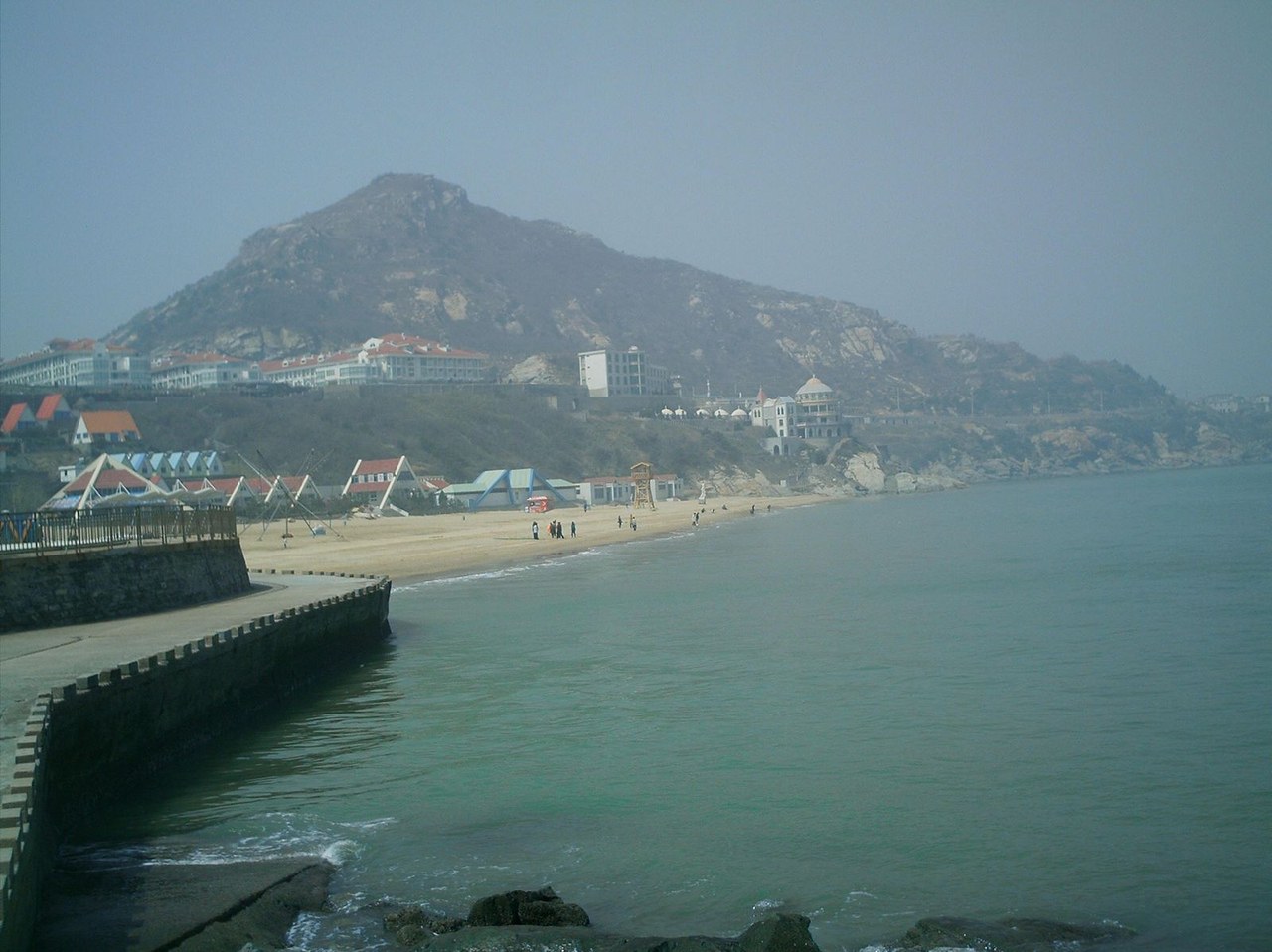
An undated archival view of Liandao’s beach and hilly coast; present facilities may differ.Photo: 赵文博 · CC BY-SA 3.0 · Image credits
An easy promenade and open sea views without an island itinerary · Mainland coast near the Xugou visitor base
45–90 minutes for a selected section · Use the promenade; check notices for any restricted or paid sections
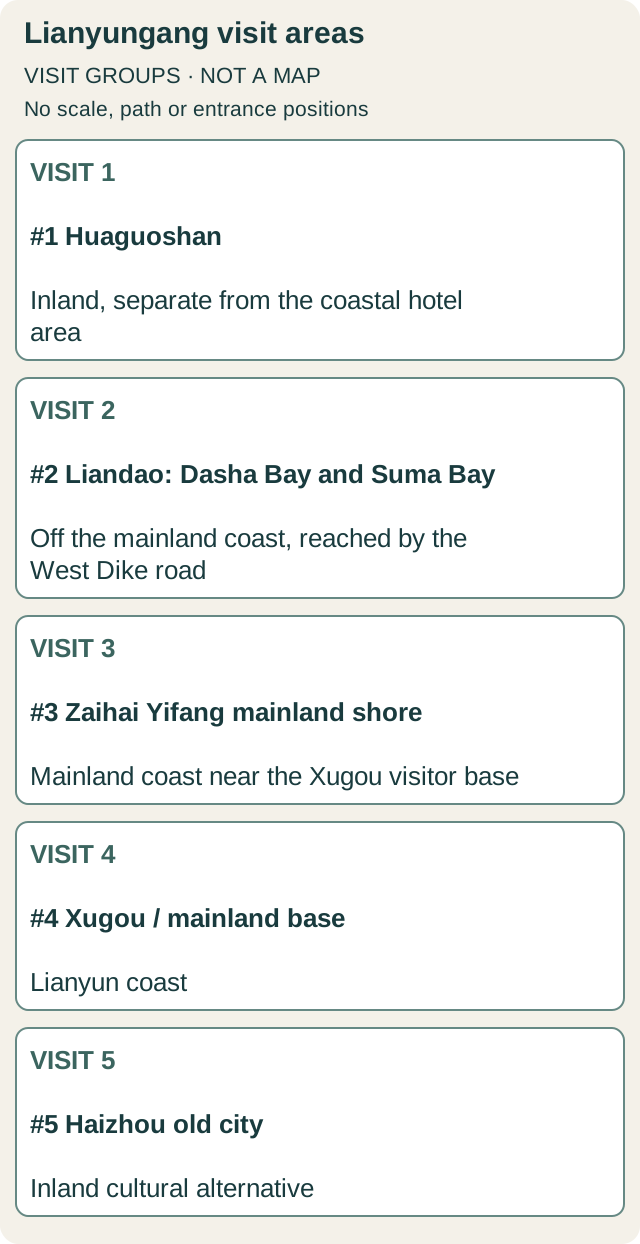
Mountain, island and mainland are three separate groups
Open full-size map ↗. Inland, separate from the coastal hotel area. Off the mainland coast, reached by the West Dike road. Mainland coast near the Xugou visitor base. Lianyun coast. Inland cultural alternative. This is an editorial relationship diagram, not a navigation map; box position does not encode distance or an entrance. ChinaMile diagram; location sources. Navigation: search the Chinese name in Amap.
Two full days, three nights: one Huaguoshan day and one Liandao day, sleeping on the mainland throughout. A brief Zaihai Yifang walk fits around arrival or dinner. Swap the full days according to weather and actual scenic operation.
One full day, two nights: choose Huaguoshan or Liandao. Keep the other for a later trip rather than crossing the city repeatedly. If you want port panoramas more than Monkey King associations, Haishang Yuntaishan 海上云台山 is a distinct mountain alternative; compare its current access and return transport and substitute it for Huaguoshan.
Haizhou old town 海州古城 and the Kongwangshan 孔望山 heritage area offer an inland cultural direction. They make more sense with an inland hotel or an extra day. They are not next-door stops to add after a full island outing.
Choose the mainland for a mixed visit
Xugou / Lianyun coast: the default for this mountain-and-sea plan, with mainland dining and a shorter start toward Liandao. Confirm the precise hotel location: “sea view” may face a working port, and a broad district label does not mean a walk to the shore.
Haizhou / the central urban area: choose this for city food, inland heritage or a rail-led short stop. Expect a longer road journey for the coast. Liandao itself: worthwhile when the beach atmosphere is the purpose of the stay; first confirm food availability and your arrival and departure transport, especially outside the busy season.
Keep one hotel for the two-day mixed plan. Ask the property to confirm passport check-in and its vehicle-access address before paying.
Seafood with clear prices, plus a local staple
A coastal dinner is a good opportunity for seafood, but ask for the price unit, weight and cooking charge before ordering. A displayed amount may be per jin, per portion or per animal. Choose fully cooked dishes; do not assume shellfish or seafood is suitable for an allergy-sensitive diner.
Look for 板浦凉粉 Banpu liangfen, a local mung-bean jelly served cold with seasonings or pan-fried. Garlic, vinegar and chilli can change the flavour considerably, so request the version you want. It is a useful small dish rather than a reason to travel to Banpu just for lunch.
Eat a straightforward breakfast before the mountain trip and carry water and a snack. Save the longer shared meal for the mainland after returning; this makes the sightseeing order less dependent on a particular scenic restaurant being open.
Two adults sharing one room for three nights
Use 3R + A + H + L + S + ¥960–1,360. R is the nightly room quote; A is the pair’s arrival and departure transfers; H and L are the pair’s actual Huaguoshan and Liandao admissions; S is the total for selected scenic shuttles or cableways.
The remaining allowance is ¥480–680 for food from arrival dinner through departure breakfast, ¥320–480 for local sightseeing transfers, and ¥160–200 for drinks and contingency. These are planning allowances, not current taxi or restaurant tariffs. Replace the transfer allowance if a booked car costs more. Intercity tickets, premium seafood, boats, shopping and guides are excluded.
Example inputs of R = ¥360, A = ¥160, H = ¥200, L = ¥100 and S = ¥160 produce ¥2,660–3,060 for the pair. H, L and S are deliberately editable sample totals, not published ticket prices. A one-day coastal version removes the mountain admission, adjusts S and uses two room nights; price its actual local journeys separately.
Make the mountain and sea days work independently
1. Huaguoshan · 花果山
Huaguoshan combines a real mountain with the imagined home of the Monkey King in Journey to the West. Yunu Peak 玉女峰 is the upper landscape stop; Water Curtain Cave 水帘洞 is the central literary landmark; Sanyuan Palace 三元宫, also called Haining Temple 海宁禅寺, adds an older temple setting among the trees. Give these three places priority over trying to cover every named rock.
Default: ride up, then make a selected downhill visit
Enter at the main visitor area and take the scenic bus to Yunu Peak. The operator’s bus route links Xianren Lake 仙人湖, Jiulong Bridge 九龙桥, Sanyuan Palace and Yunu Peak. Buy the segment you need; a scenic admission ticket does not establish that bus travel is included.
See Yunu Peak, then walk toward Water Curtain Cave on the signed visitor path. Start with the upper viewpoints and surrounding hills; this is the panoramic part of the visit. Carry water and a snack so a lunch queue does not decide the whole route. The downhill link remains a mountain walk with steps, not a paved vehicle ride between the sights.
Visit the cave area, then Sanyuan Palace. At the cave, the narrow passage and water-curtain setting explain the Monkey King association. Follow the signed entry queue: when crowd controls are in use, the operator directs visitors around via Xianren Chuang 仙人床 to the lower cave mouth. The temple’s halls, wooded setting and old ginkgo trees give a quieter change of pace. Keep clear of monkeys and do not feed or touch them.
Descend by scenic bus from Sanyuan Palace, returning to the lower visitor area. Save the actual stop and final downbound time before walking away from the transport area. Rejoin the booked road transfer to Xugou for dinner.
When the cableway is worth adding
The operator identifies three cableway stations: Jiulong Bridge 九龙桥站 at the bottom, Water Curtain Cave 水帘洞站 in the middle, and Yunu Peak 玉女峰站 at the top. For aerial views with less downhill walking, take the scenic bus to Jiulong Bridge, ride the cableway to Yunu Peak, then take the scenic bus down to Sanyuan Palace for the cave/temple visit and another bus down. Alternatively, after the default summit-to-cave walk, use the middle station down to Jiulong Bridge and the scenic bus back out. Price each required leg before buying; do not assume one ride covers unlimited reboarding.
Shorten before the upper mountain if necessary. Take the bus to Sanyuan Palace, visit the temple and the open cave area, and bus back down from the same stop; omit Yunu Peak. If the cave is closed, retain the temple and outside scenery instead of waiting for an unpromised reopening. Wind or maintenance can stop the cableway independently of the buses. If both the road transport and your required paths are unavailable, change to the city/coastal plan rather than relying on an unfamiliar full descent on foot.
Hours
Check the day’s entrance, path, cave and transport notices before departure. Start in the morning.
Tickets
Use the official operator channel. Confirm the current admission, internal shuttle or cableway products and accepted identification.
Time
Keep the full day, including coastal transfers. Allow roughly 4–5 hours inside for the bus-assisted summit, cave and temple plan; this is an editorial allowance, and long queues require dropping a stop.
Chinese address
连云港市郁林路5号;花果山景区
Getting there
Use 花果山景区游客中心 as the destination, not 花果山机场. Arrange a current public-transport route or a taxi with a clear return pickup.
How to visit
Default: scenic bus to Yunu Peak, walk down to Water Curtain Cave and Sanyuan Palace, then bus down from Sanyuan Palace. The cave-area cableway to Jiulong Bridge is an optional alternative with its own ticket. Confirm the last service for the chosen descent; operator information: 0518-85723837 / 0518-85723839.
2. Liandao: Dasha Bay and Suma Bay · 连岛 · 大沙湾 · 苏马湾
Liandao is an island with a road connection. You do not need to book a ferry for the ordinary visit. Dasha Bay is the main beach-side visitor area; Suma Bay gives a second coastal setting when its access and onward transport are operating. Choose the open shore sections you want instead of assuming the whole island is one beach.
Treat swimming as a separate decision made on the day. Enter the water only where staff explicitly permit it and supervision is operating; a scenic-area ticket is not a guarantee of safe bathing conditions. In cool or windy weather, a shore visit and lunch can be enough.
Hours
Confirm scenic opening, last admission, beach restrictions and internal transport on your date.
Tickets
The government’s older guide contains historical prices; use the present operator product before payment. Consultation: 400-828-2898.
Time
Half a day for one shore area; a full day for a slower visit with both bays when open.
Chinese address
连云港市连岛景区;大沙湾游客中心
Getting there
Travel by road over 西大堤 to the official visitor arrival point. Verify the current bus or taxi drop-off rules and any onward scenic shuttle.
How to visit
Save the return stop or pickup before entering. Check the last mainland-bound service before travelling to the second bay; return earlier or arrange a licensed car if evening transport is uncertain.
3. Zaihai Yifang mainland shore · 在海一方公园
This public coastal park is a useful arrival-evening walk or a simpler alternative to a ticketed island day. Stay on the established promenade and look out toward the port and island landscape; you need not make a long beach excursion to enjoy the coast.
Choose a short out-and-back walk with a known road exit. Exposed shore, tidal flats and wet structures need different judgement from a paved promenade. Keep the visit on dry established paths if wind, tides or conditions are poor.
Hours
Use daylight for unfamiliar sections and follow local weather closures.
Tickets
The plan uses a short promenade walk. Check posted access notices and any charge for a chosen activity; skip restricted or paid sections you do not want.
Time
45–90 minutes; shorten it for wind or limited mobility.
Chinese address
连云港市连云区在海一方公园
Getting there
Walk from a genuinely nearby hotel or use a current local route to the park entrance.
How to visit
Use the same access point for the return if unfamiliar with the waterfront. This is a mainland walk, not the Liandao bathing area.
Two full days with a weather swap available
Arrival evening · night 1
Check in on the mainland, eat nearby and confirm the next day’s scenic operation. If daylight remains, take a short Zaihai Yifang promenade walk.
First full day · night 2
Leave for Huaguoshan in the morning. Use the scenic bus to Yunu Peak, walk the signed downhill connection to Water Curtain Cave and Sanyuan Palace, and descend by bus from Sanyuan Palace. Choose the bus/cableway alternative if you want aerial views, or omit the peak and start at Sanyuan Palace when a shorter day is needed. Keep a snack break and the downbound cutoff within the day; eat dinner back at the mainland base.
Second full day · night 3
Cross to Liandao by road. Start at the main arrival area, then add Suma Bay only if conditions and the return timetable support it. Leave before the final practical mainland connection; keep the evening for dinner rather than relying on a late island departure.
Departure morning
Travel to the station or airport named on your ticket. If mountain operation is suspended, replace that day with an inland city visit or a longer coastal rest; if dangerous weather affects both, follow closures and use indoor city time instead of forcing an exposed outing.
The coast, main station and airport are not one location
Check Lianyungang 连云港 and Lianyungang East 连云港东 separately on 12306; use whichever actually serves your chosen train and compare the hotel transfer. Do not infer a fast train from the station name. Lianyungang Huaguoshan Airport 连云港花果山机场 is also a separate ground transfer, not the entrance to the mountain scenic area.
Between the coast and mountain use a current route planner or a pre-agreed taxi journey. The city’s 智慧港城 transport service can help check operating buses; a past holiday shuttle timetable is not a year-round promise. For Liandao, save both the outward road stop and the mainland-bound return stop before entering.
On departure day, allow for the full road journey plus station or airport procedures. Do not place an island or mountain visit immediately before a tight long-distance departure.
Choose history or another coastal city
Xuzhou shifts the trip toward Han tombs, a city museum and hearty food. Qingdao offers a different coastal stay with urban architecture and its own beaches. Compare actual rail services before fixing the order.
Use present operation for the final route
Sources reviewed on . The city’s current scenic directory supplies official operator links and consultation numbers. Older municipal articles support the island’s physical layout, the road connection and local food, not current ticket prices or today’s bus departures. The 2026 coastal article supports the Zaihai Yifang shore-walk setting; its summer activities and extended hours are not treated as year-round services.
Passport ticket purchase, hotel check-in, bathing supervision and last internal services were not field-tested. Confirm these for the actual date. Visit lengths, base choices and budget allowances are editorial planning judgments; the ordinary island plan does not require a ferry.
The Huaguoshan route and transport comparison were reviewed on against the operator’s published transfer diagrams and visitor advice. They identify the bus stops, cableway stations and two mixed-transport routes; the municipal temple description supports the Sanyuan Palace stop. Short-lived holiday performances and past one-day maintenance dates are not standing promises or closures. These additions do not refresh the unrelated island, hotel or food checks.