JILIN · A VOLCANIC LAKE ABOVE FORESTS AND HOT SPRINGS
Changbai Mountain Choose one mountain approach, stay in its gateway town and leave room for the weather.
Changbai Mountain is a volcanic landscape with several distinct experiences: the high crater rim around Tianchi, a waterfall and steaming spring zone below it, and forest paths where the mountain feels close rather than panoramic. The lake is the famous image, but cloud, ice and operating conditions decide what a visit can show.
For a first visit, choose the North Slope, stay three nights in Erdaobaihe and keep two full days: one paid mountain day and one town day that can also protect against a weather cancellation before entry. The North Slope has more varied lower sights and vehicle access toward the summit. It still involves walking, steps and exposed conditions; it is not a step-free itinerary.
Choose a West Slope stay around Songjianghe instead when the wider crater view and a demanding stair ascent are your priority in the walking season. That is a different base and ticket, not another stop on the same mountain day. If you searched for Changbaishan, Mount Changbai, Baekdu or Paektu, this page covers the Chinese visitor approaches; it does not describe or provide entry to the North Korean side.
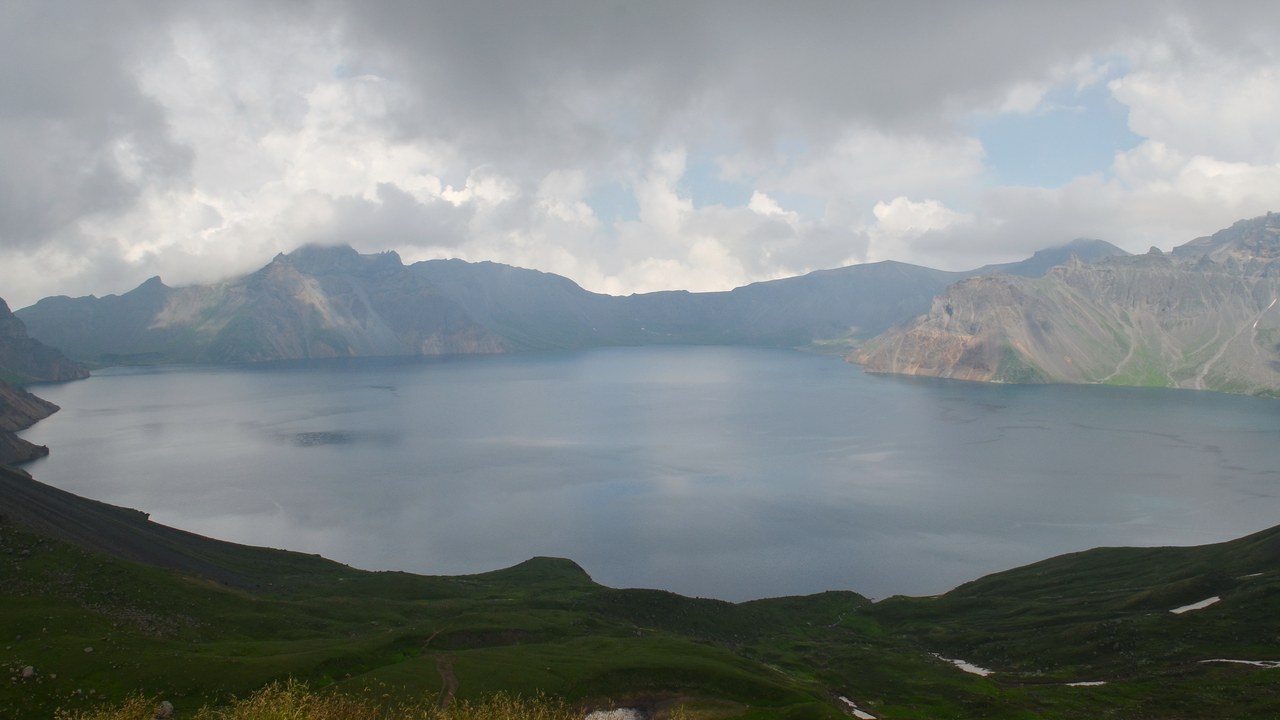
Heaven Lake from the west slope of Changbaishan, photographed in July 2013. This historical clear view is not a promise of current visibility or viewpoint access.Photo: 颐园新居 · CC BY-SA 3.0 · Image credits
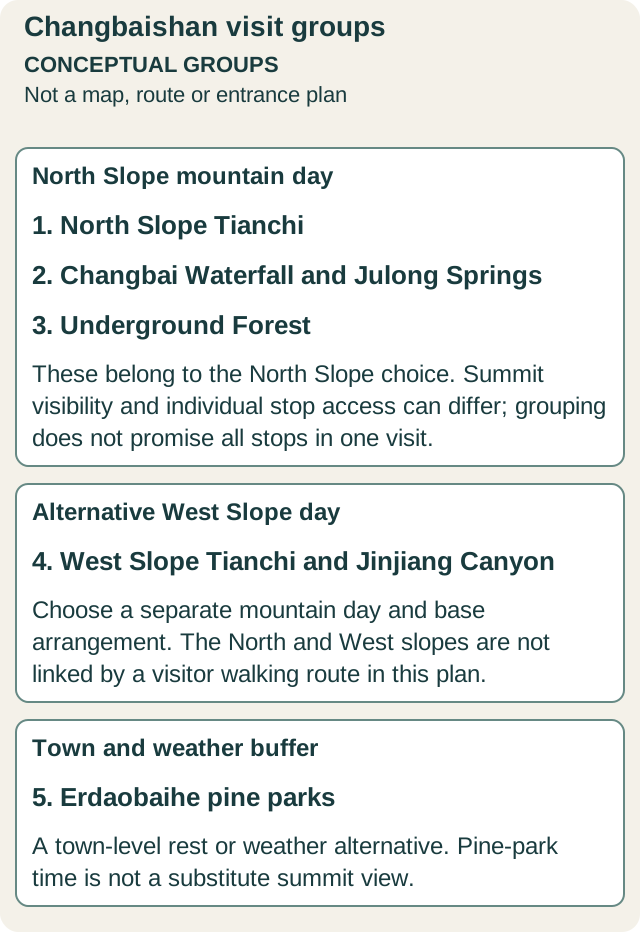
North Tianchi, 1, the waterfall/springs, 2, and Underground Forest, 3, are one North Scenic Area choice based in Erdaobaihe / 二道白河, also Chibei / 池北区. West Tianchi and Jinjiang Canyon, 4, belong to the different West choice, based around Songjianghe / 松江河, also the Chixi / 池西 side. The pine parks, 5, are at town level. The diagram groups alternatives, not a walking route between slopes.
The useful railway names are Changbaishan / 长白山 for the North-side town and Changbaishan West / 长白山西 for Songjianghe. The administration’s 2026 information identifies both stations and trains between them. Older pages naming Dunhua as the nearest high-speed gateway predate this rail network and should not choose your hotel or transfer.
The South Slope and North Korean visitor side are outside this short plan. Pick the approach you can actually reach, book and complete. A Chinese North or West ticket is not a cross-border visitor permission or a pass to every part of the massif.
The crater rim, lower landscapes and a real town day
1. North Slope Tianchi · 北坡天池 · 北景区主峰
Tianchi sits within the volcanic crater, with dark or pale rock framing the water when the rim is clear. The North view can be partly screened by the surrounding peaks; its attraction is the dramatic high setting rather than a guarantee of the widest possible panorama.
The summit vehicle reduces the long road ascent, but the last exposed approach, steps and weather still matter. Choose it for a first visit that combines a possible lake view with worthwhile lower sights. The blue-water photograph represents a particular season and moment; ice, cloud or a closed rim produces a different day.
Follow the staff’s open rim route and turn around when required. Do not leave the visitor boundary to seek a clearer photograph or a cross-border path. If the summit is closed before you enter, use the ticket/weather recovery plan below; if only lower stops operate, decide whether they are worth the actual charge before using the order.
Hours
Book the actual North Scenic Area time slot and check the day’s summit notice. The final ticket slot and current announcement determine entry, not a fixed opening-hour line copied from an old guide.
Tickets
The July/August 2025 official references give ¥105 admission + ¥35 Chibei approach shuttle + ¥85 internal bus + ¥80 summit vehicle = ¥305 per full-price adult, with the vehicle products described as returns. Use this as a dated reference and confirm the current combination before paying.
Time
Keep the entire day clear. The official FAQ gives a peak-season North visit of about 6–8 hours before queuing, so an onward train that afternoon is a poor default.
Chinese address
长白山北景区游客集散中心(池北区 / 二道白河);按订单预约入口检票乘车
Getting there
Reach the named North visitor distribution centre from the Erdaobaihe hotel, take the booked approach service and internal bus, then the separate summit vehicle when it operates. A rail-station taxi does not replace the scenic transport chain.
How to visit
North distribution centre → booked approach/internal services → summit-vehicle interchange → signed rim viewpoint → return to interchange → permitted lower stops → distribution centre → hotel. Ask staff which lower-stop sequence fits the day and leave time for every return vehicle.
2. Changbai Waterfall and Julong Springs · 长白瀑布 · 聚龙泉
The waterfall and spring zone make the North Slope more than an ascent to a viewpoint. The water’s movement and the visible steam show another part of the volcanic system, with forest and rock giving a changing scale as you walk.
Look for the contrast between the spring area and the colder landscape around it. This is an observation visit from a managed path. The presence of hot water does not make the river or pools a public bath, and a separate hotel spa elsewhere is a different purchase.
Choose a modest permitted approach and keep time for the bus. When ice or weather restricts the path, accept the available viewpoint or omit it. A closed summit is not a reason to push farther along a lower trail against barriers.
Hours
Use only the open walkway and current bus-stop sequence. Summit closure does not establish whether the waterfall or spring paths are safe or open.
Tickets
Treat this as a North Scenic Area stop within the product you actually bought. A named spring landscape is not a bathing or spa admission.
Time
About 1½–2 hours is an editorial walking allowance. Ice, weather, crowds or a shortened path can change it; do not wait here until the last downhill transport.
Chinese address
长白山北景区长白瀑布;聚龙泉景点
Getting there
Use the operator’s internal bus and signed visitor approach. Confirm the returning bus bay before walking away from the stop.
How to visit
Open bus stop → permitted spring-viewing path and waterfall approach → marked viewpoint → reverse or follow the signed visitor exit → return bus. Stay behind geothermal and water barriers; these springs are for viewing on this plan, not for dipping hands or feet.
3. Underground Forest · 地下森林 · 谷底森林
The Underground Forest offers a close, quiet counterpoint to the rim: trunks, moss, shade and a depression shaped by volcanic processes. It appeals most to travellers who enjoy forest texture and a slower boardwalk rather than another distant panorama.
The official landscape account describes a volcanic hollow and a boardwalk through the trees. Use that background to understand what you are seeing, then follow the current signs. Old distances and branches in an information article are not a turn-by-turn route after years of weather and maintenance.
Make this the flexible extra on a successful North day. If the summit or waterfall has taken longer, skip the forest without regret and protect the complete descent. A rushed final walk that ends at a missed bus is a worse visit than a shorter, finished day.
Hours
Ask which forest route is open and when the final bus leaves. Daylight or an old boardwalk photograph does not prove all branches are accessible.
Tickets
Confirm inclusion and the operating bus stop in the actual North product. No separate new ticket price is invented here.
Time
About 1–1½ hours if an appropriate open loop or out-and-back is available; shorten or omit after a slow summit day.
Chinese address
长白山北景区地下森林(谷底森林)
Getting there
Take the signed internal service to the operating forest stop. The visitor route is inside the managed scenic area, not an independent trailhead reached by a private car.
How to visit
Operating bus stop → authorised boardwalk → chosen forest viewpoint → signed return → bus. Keep to the current signs rather than following the 2017 source’s old distance-by-distance description. If time is tight, omit this stop and finish the return chain.
4. West Slope Tianchi and Jinjiang Canyon · 西坡天池 · 锦江大峡谷
The West Slope gives a broader crater perspective in suitable visibility, but asks more from the walking visitor. The familiar 1,442-step ascent is the key choice: you must also descend it, at altitude and in changing weather. A panoramic photograph does not show the effort or conditions.
Jinjiang Canyon / 锦江大峡谷 adds a different scene, with forest above steep volcanic rock formations. Treat it as an available separate stop within the West day, not a canyon-floor hike. Remain on the managed visitor route and accept closures or shortened sections.
Choose West for the view-and-stairs preference, then sleep around Songjianghe and use the precise visitor centre named on your order. Resort hotels, the town and the Baixi centre are not interchangeable locations. Trying both slopes calls for another full mountain day, a base transfer and a separately priced ticket; it is not the default three-night plan.
Hours
Choose the actual West slot and the current summit operation. The usual walking-season ascent and a winter snowmobile product are different visits; neither is guaranteed in severe weather.
Tickets
The August 2025 FAQ lists ¥105 admission + ¥85 internal bus, with a choice of ¥19 Chixi or ¥14 Baixi approach shuttle. It separately lists a ¥165 winter summit-snowmobile component. These are dated product references, not a promise that a motorised summit service is operating on your date.
Time
Keep a full day. The FAQ gives about 5–6 hours before queues in peak season, and the walking-season lake approach has 1,442 steps up plus the return.
Chinese address
长白山西景区游客中心,或长白山西景区白溪游客中心;以已购订单的入口为准
Getting there
Use a Songjianghe/Chixi-area base and book the named West or Baixi visitor centre. The two approach shuttles are alternatives; do not buy both merely because both prices appear in the FAQ.
How to visit
Booked West visitor centre → approach/internal services → permitted Tianchi stair route in the walking season → same stairs down → Jinjiang Canyon if open and time permits → booked visitor centre → hotel. If the stair ascent is unsuitable, choose the North Slope before booking; do not assume a winter vehicle will provide an off-season substitute.
5. Erdaobaihe pine parks · 二道白河美人松公园
Erdaobaihe is a useful part of the stay, not just a bed before the mountain. The tall beauty pines / 美人松, river edges and small urban parks give a quieter scale after the bus-and-queue mountain day. A short pine walk and a longer meal can make the second full day feel like a visit rather than a wait.
Choose a safe open ground-level route. An elevated bridge or glass viewing platform is optional and may have a separate operating condition; the pine experience does not depend on it. For another gentle pause, ask the hotel for the nearest open riverside section that suits your walking limit.
This day is also a scheduling buffer, but it cannot manufacture better weather or a new ticket. If the first mountain day succeeds, enjoy the town. If it is cancelled before entry, a new booking may use this day when inventory and conditions permit. If the whole region is under severe weather, stay indoors rather than substituting another exposed excursion.
Hours
Use open town paths in suitable daylight. In severe weather, choose an indoor pause instead of treating every town park as a safe outdoor fallback.
Tickets
This plan does not require an elevated glass platform, show or commercial activity. Check a separate product only if you actively want it.
Time
A relaxed half-day divided between a short pine walk, town riverside and a meal. The spare day need not be filled with extra driving.
Chinese address
吉林省长白山池北区二道白河镇美人松公园;按当天开放公共步道游览
Getting there
Walk or use a short licensed city ride from the verified Erdaobaihe hotel. Show 美人松公园 and confirm the particular park entrance rather than asking for the mountain scenic gate.
How to visit
Open pine-park path → town riverside section suitable for the weather → lunch or tea → hotel. Use the time to slow down, not to buy an unplanned second scenic-area day. A town walk does not replace a crater-lake view.
Use Erdaobaihe for North; choose Songjianghe for West
Erdaobaihe town near ordinary restaurants and the North distribution-centre connection: the default for three nights. A central town address gives something useful to do on the spare day. Confirm the exact morning ride to 长白山北景区游客集散中心; a room marketed “near Changbai Mountain” can still involve a significant road leg.
Closer to the North mountain entrance or in a spa hotel: choose this only for the property’s own setting or a confirmed service that matters to you. Check dinner, luggage transfer, passport registration and the actual ticket-centre route. A hotel package or shuttle claim does not automatically include the ¥35 approach service, scenic admission or summit transport.
Songjianghe/Chixi for the West alternative: use a town or resort property only after identifying whether your order starts at 长白山西景区游客中心 or 白溪游客中心. Airport proximity, a resort ski shuttle and the West Scenic Area ticket shuttle are different things. Avoid three nights on the wrong side followed by two long return drives.
For North, use Erdaobaihe accommodation listings, enter two adults, one room, three nights and inspect the map against the actual town and distribution-centre approach. For West, start with Songjianghe listings and inspect the actual map location; the destination, not an automatically filled date or broad resort label, is the useful starting point.
Confirm the full Chinese address, bed type, total taxes, heating, cancellation, breakfast timing and passport check-in before paying. No named hotel or live rate was reviewed here. Keep the same base for the three-night single-slope stay; changing slopes deserves an extra transfer and overnight decision.
Use town dinners and a simple mountain-day lunch
Eat breakfast before the booked entry and carry water plus a simple lunch or substantial snack. Bus queues and weather make a fixed mountain restaurant reservation an awkward anchor. Have the slower dinner after returning to the town, and ask the hotel what is serving at your expected return time.
Korean-style cold noodles / 冷面, bibimbap / 拌饭, soybean-paste soup / 酱汤 and rice cake / 打糕 are useful choices documented in the town’s tourism information. Cold noodles are intentionally cold; choose a hot soup and rice instead if you want a warming meal after the mountain. Ask what meat, egg and broth the specific dish contains rather than treating the style as a vegetarian guarantee.
Northeastern iron-pot stew / 铁锅炖 is a slower shared meal. For two, ask for the smallest suitable pot and agree the fish, chicken or other meat, staple, serving size and total before cooking begins. A large pot is not automatically good value if most of it cannot be eaten. A simpler shared cooked vegetable with rice works better on a tired arrival evening.
The region’s mushroom and wild-vegetable dishes can be interesting, but choose a normal cooked dish from an established kitchen rather than buying an unknown foraged ingredient to prepare yourself. Check meat stock or animal fat if relevant. Keep expensive ginseng products, alcohol and large gift boxes outside the ordinary meal budget.
On the town day, give lunch time to be the main activity between pine-park and riverside walks. The food suggestions come from published local styles; no restaurant meal, current menu, portion price or kitchen practice was field-tested.
Three nights, one paid mountain day and one flexible town day
Arrival evening · first Erdaobaihe night: reach the correct town, eat locally and confirm the booked North time slot, passport details, weather notice and morning ride. A late train is a reason to go directly to the hotel, not attempt a mountain entry after the last service.
First full day · second night: use the confirmed North distribution-centre arrival, approach shuttle and internal transport. If the summit operates, use the booked summit vehicle and signed Tianchi viewpoint, then return for the waterfall/spring area. Add the Underground Forest only if the open route, energy and final transport leave a comfortable margin. Return to the same town hotel for dinner.
Second full day · third night: walk the open beauty-pine parks and a suitable town riverside section, take a longer lunch and rest. An optional spa or indoor attraction needs its own current price, operating condition and booking; it is not included simply because a hotel advertises hot springs.
If the first mountain day is cancelled before entry: inspect the official order’s unused-ticket refund options immediately and ask the operator about the next day. Rebook the actual next-day slot only if stock and weather permit, then exchange the mountain and town days. Do not assume the original ticket becomes a free second-day pass. If you already used part of the order, obtain the applicable component decision from the operator rather than applying an unused-order rule to the whole visit.
Departure morning: travel to the exact station on the ticket. Keep a mountain visit off the departure day; the official full-day duration excludes queuing and cannot protect a tightly timed train.
West instead: use the same three-night structure in the Songjianghe area, with one full West day and a local rest/buffer day. In the walking season, plan the 1,442-step ascent and full descent before adding the canyon. If a winter summit vehicle is the reason you can attempt West, obtain that specific operating product before booking; the North plan’s summit-vehicle assumptions do not transfer to West.
Both slopes: add a separate full mountain day, another ticket and a deliberate base transfer with an extra night. Do not cross the mountain by foot or try to fit North and West into one day. A weather buffer is a scheduling choice, not guaranteed visibility or spare admission.
Book the official product with the same passport and time slot
The province’s official August 2025 FAQ names 长白山 on WeChat and the 长白山一机游 mini program as booking channels. Select the actual North or West Scenic Area, date, entry time, full-price adult product and the correct gateway. Do not confuse the scenic ticket with an independent hotel transfer, ski-resort bus or generic tour reservation.
For a foreign passport, enter the traveller’s document details exactly and retain the resulting order. The official FAQ says passport users enter with the electronic QR code carrying the booked document number, without exchanging for a paper ticket. Carry the original passport used to book and the accessible order/QR. That rule is published evidence; this guide did not test your passport, foreign phone registration, payment card or mini-program checkout.
The published reservation pattern is up to seven days ahead, with a new date released at 18:00. Treat the live mini program as the inventory authority. A sold-out official slot is not a reason to pay someone promising an internal ticket; an older government notice says online and distribution-centre inventory are the same. If document entry or payment fails, keep the error/order number and contact 400-000-6789 through the official visitor service before making a non-refundable trip to the gate.
Tickets are for the booked day and visit, with separate reservations for each scenic area. The 2025 FAQ does not support an old multi-day, cross-slope reuse assumption. For weather or another cancellation, open the original official order: it states that unused tickets/vehicle products can be submitted for a fee-free refund before 24:00 on the booked visit date. Used components need the operator’s actual ruling. A forecast alone is not a cancellation decision and a summit closure need not close every lower stop.
Check 长白山气象台 for the mountain forecast and the official scenic channels and on-site announcements for the actual opening. Agree which return vehicles you must catch before leaving each stop. If you want an accessibility-sensitive trip, ask the operator about that exact route rather than inferring step-free access from a bus or cable icon in an old guide.
Choose 长白山 or 长白山西 before arranging the last road leg
For the North default, search Changbaishan / 长白山 on 12306 and arrange the road leg to the Erdaobaihe hotel. For West, search Changbaishan West / 长白山西 and arrange the Songjianghe-area hotel or its exact visitor centre. The administration’s January 2026 report records a traveller confusing the two stations; its March 2026 account places the West station in Songjianghe.
A February 2026 official reply confirms trains between the two stations, and identifies the 吉林省景区直通车 mini program and 长白山交通 information channel for road services. Use the dated rail search or current transport notice for your actual connection; this guide does not carry forward that reply’s specific daily bus departure times as an evergreen timetable.
At the rail station use the official taxi queue, a supported app ride or a licensed hotel-agreed pickup, showing the complete Chinese address. For arrival at Changbaishan Airport / 长白山机场, agree whether you are going to Erdaobaihe, Songjianghe or a particular resort. An airport transfer is distinct from admission and the scenic shuttles.
The North hotel-to-distribution-centre leg is outside the four component prices unless a real hotel service explicitly includes it. Confirm both morning drop-off and afternoon pickup, the legal meeting place and the full road quote. In the scenic area, private cars do not replace the managed transport services.
If you arrive at the wrong station, stay at the staffed service desk and show the intended Chinese station and hotel address. Ask for the currently available train or licensed road option; a report of one traveller receiving help is not a universal promise of a free replacement train. If a delayed descent breaks a connection, contact the original booking channel and remain at a staffed point while rearranging transport.
A North Slope budget for two, with the buffer priced honestly
For two full-price adults sharing one room, three nights, one North mountain day and one town day, use 3R + 2P + T + M + A + X. R is the actual nightly room quote; P is the selected full North admission/vehicle combination; T covers both gateway road legs, the hotel-to-distribution-centre return and town rides; M covers food from arrival dinner to departure breakfast; A is a town-activity allowance; X is water and contingency.
With R = ¥350, P = ¥305, T = ¥180, M = ¥640, A = ¥80 and X = ¥160, the result is ¥1,050 + ¥610 + ¥180 + ¥640 + ¥80 + ¥160 = ¥2,720 for the pair. The ¥305 is a published July/August 2025 tariff reference, not a 2026 checkout. Room, roads, meals, activity and contingency are illustrative inputs. Replace them with your dated order and agreed quotes.
The North reference is ¥105 entry + ¥35 approach shuttle + ¥85 internal bus + ¥80 summit vehicle, with the transport components described as return trips. Do not add a second return fare or another identical summit component. If Tianchi is unavailable, obtain the actual unused-component refund decision; do not assume every part of a used scenic visit becomes refundable.
The town/buffer day does not include a second paid park attempt. If a new North ticket is needed after a used visit, the same reference adds ¥610 for two before additional hotel-to-centre road costs. If a wholly unused first order is refunded and replaced, reconcile the actual net payment rather than paying for two attempts in the calculation by mistake.
For a walking-season West alternative, the 2025 reference gives ¥105 + ¥85 + ¥19 = ¥209 through the Chixi centre, or ¥204 through Baixi using the ¥14 approach choice. Replacing P with ¥209 while leaving the other illustrative inputs unchanged gives ¥2,528 for two; the real West hotel/road inputs may differ. Do not mix this with the separately listed ¥165 winter summit-snowmobile component, whose price, sale and operation must be confirmed for the actual winter product.
Exclude intercity rail/flights, extra mountain days, inter-slope moves, skiing, guiding, spa treatments, winter equipment hire, shopping, alcohol and activities beyond A. Add any insurance you actually choose after checking whether it is already included. A second hotel night or different season is a new input, not a free consequence of the same destination name.
Dated official ticket rules and what this guide has not tested
Sources were read on 22 October 2026. The full ticketing FAQ was published on 12 August 2025 by the Jilin Provincial Department of Culture and Tourism’s official People’s Daily account, with the scenic operator named as source. Its passport/QR procedure, component tariffs, time slots, current-day validity and unused-order refund rule are reported as dated official references. The administration’s July 2025 reply independently lists the same North components. None is presented as a completed 2026 purchase.
The 2026 official rail information establishes the two station names and the West station’s Songjianghe location; live departures remain date-specific. The October 2026 scenic account supports the lower sights and West steps. The 2017 forest/canyon pages are landscape background, not current route directions. The 2025 district park account and 2022 town account support the spare-day experience and food styles, not today’s access to an elevated platform or a particular restaurant.
Visit durations, the three-night shape, base advice and sample cost inputs are editorial planning judgments. No phone call, foreign-passport checkout, rail/road ride, hotel check-in, meal, winter vehicle, trail or weather condition was field-tested. A historical West Slope photograph is labelled as such and does not promise the North view, blue water, clear sky or an open rim. Follow the live official order and on-site closure instructions.