Libo Give the small waterfalls a full day; keep the great gorge a separate choice.
Libo’s best-known landscape is water moving through limestone: a calm blue-green pool, a curved cascade, trees against wet rock and the old seven-arched bridge that gives Xiaoqikong its name. Nearby Daqikong is a different experience, with a deeper gorge and a natural rock arch. Give them room to feel different rather than treating every water feature as the next photograph on one forced march.
For a first stay, use three nights near the east gate at Mengliu for two complete visiting days. Keep the first full day for Xiaoqikong, with scenic transport and a selection of walks. Use the next morning for Daqikong when open; take a long lunch, then choose an arranged Yaoshan village visit or a quiet afternoon. Two nights are enough for a Xiaoqikong-focused visit, but do not turn the arrival or departure transfer into another complete day.
Choose Libo for pools, forest and accessible portions of a managed scenic landscape. It is not a guarantee of clear turquoise water after heavy rain, an all-step-free park or permission to wade anywhere. If a road or gorge closes, the useful response is to change the day and its return, not to find a way around a barrier.
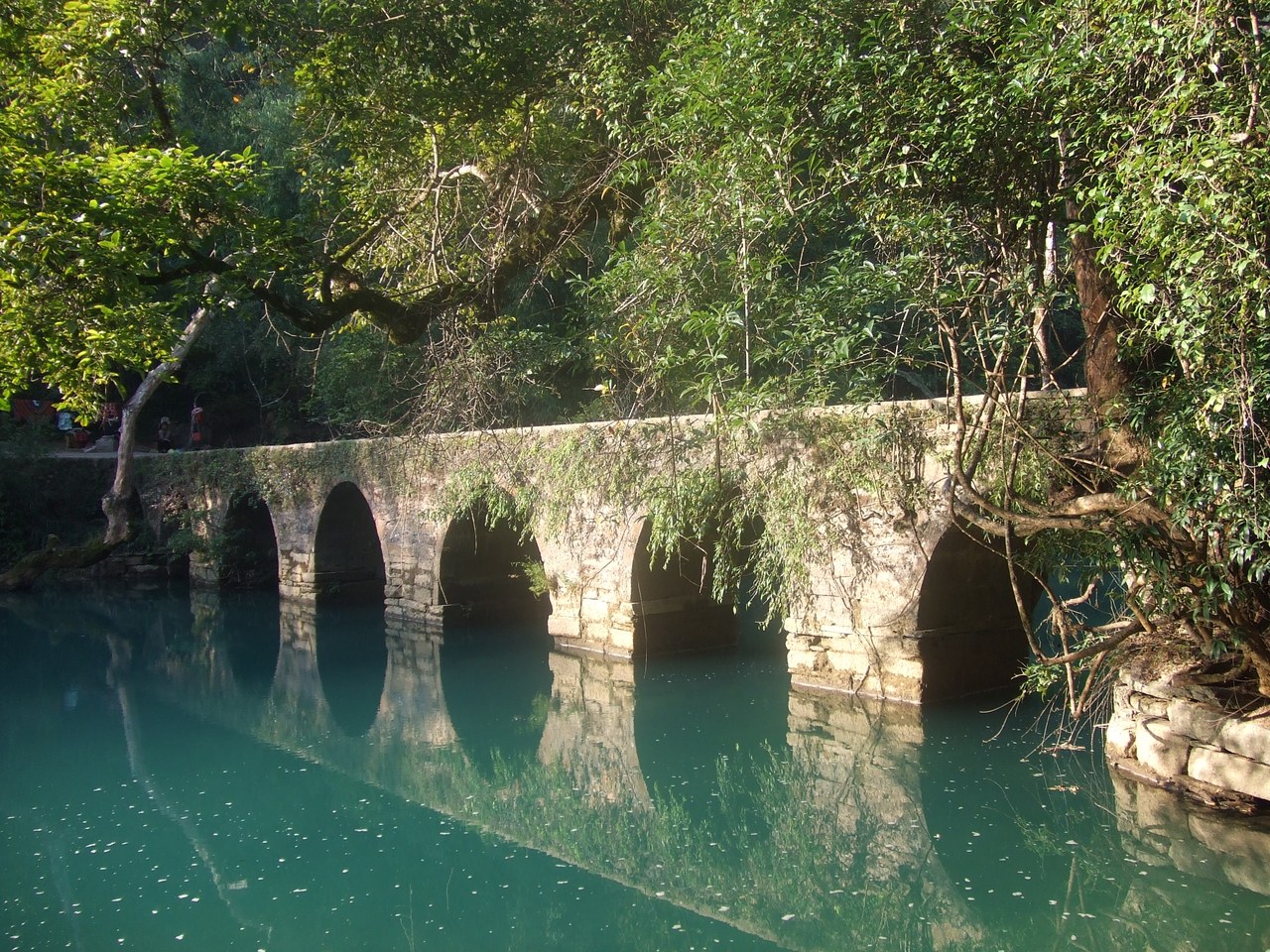
The small stone-arch bridge at Xiaoqikong in Libo, photographed in October 2010. This is Xiaoqikong, not Daqikong; the historical photograph does not establish today’s water, path access or visitor arrangements.Photo: Nyx Ning · CC BY-SA 3.0 · Image credits
Turquoise pools, a seven-arched old bridge and cascades within a long karst valley · The main scenic area, with separate east and west gates
One complete day, using scenic vehicles and chosen walks · Management notice reference: ¥120 admission plus ¥40 scenic transport per ordinary adult; confirm the dated product.
A higher-walled gorge and a massive natural rock arch, distinct from Xiaoqikong’s old stone bridge · A separate east-side scenic visit
Allow a half day including the agreed return · Confirm whether the issued product covers Daqikong on the intended day; boats and other paid activities have their own terms.
White Trouser Yao village architecture, granaries, textiles and an available craft experience · A separate road outing from the east-gate or town base
An optional half day, with transport and any programme arranged · Ask for the actual village-entry and chosen workshop or performance price; it is not included here as a free add-on.
Keep the station, town and two gates distinct
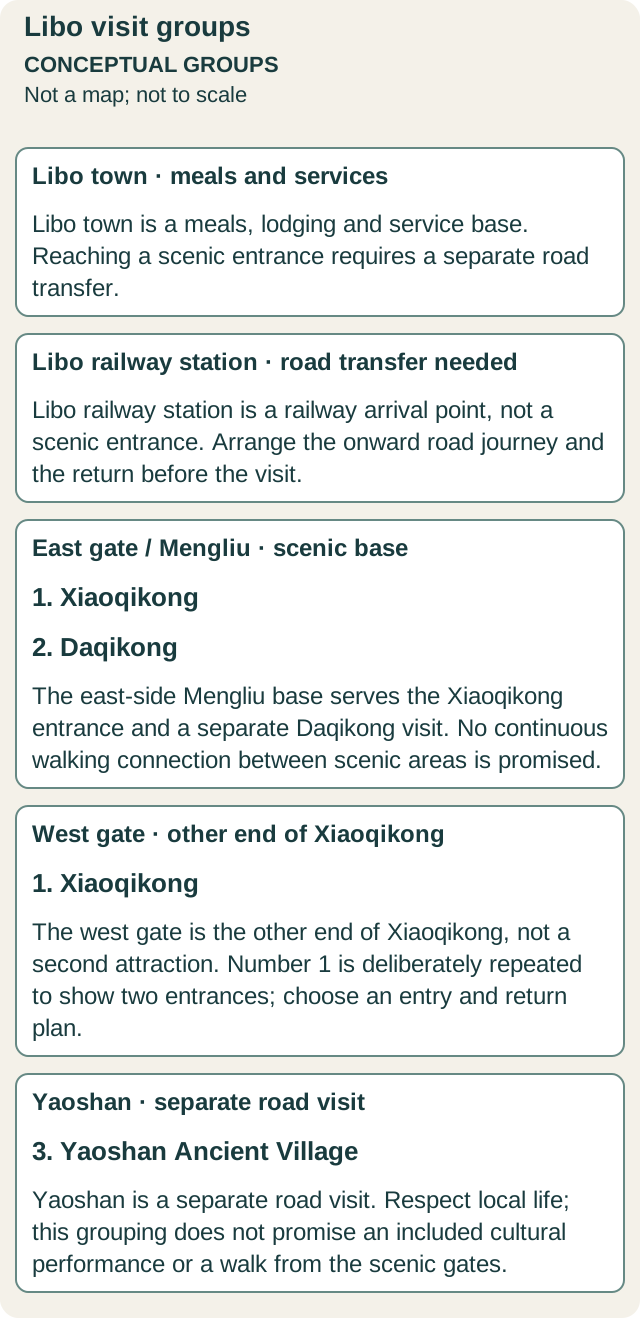
Open full-size area diagram ↗. The numbers match this guide’s choices. These editorial groups explain combinations, not scale, distance, a walkable route, an entrance plan or current operation. Sight 1 is repeated at its two alternative entrances. ChinaMile editorial diagram; guide sources. Navigation: search the Chinese name in Amap.
Libo station / 荔波站 is the rail arrival, followed by a road transfer. Libo county town / 荔波县城 is the service-and-dining choice. East gate / 小七孔东门, beside Mengliu / 梦柳, is the default scenic base for 1 and 2. West gate / 小七孔西门 is the other end of Xiaoqikong, useful when a property or transport booking specifically serves it. Yaoshan, 3, is a separate driven visit. The diagram groups these choices; it is not to scale or a surveyed path map.
Keep the same entry and return gate in the first plan. From an east-gate base, ask staff for the operating scenic-vehicle sequence toward the Wolong Pool side, then work back through selected open sights toward the old bridge and the east-side exit. Transfers can involve queues and changes. Do not assume a single direct vehicle, a through-ticket that permits any route, or a footpath connecting every attraction.
A west-in/east-out visit can be sensible when transport is arranged at both ends. It is inconvenient if your suitcase, car or room is still at the west gate. Set the exit before buying the external transfer. Libo town and the rail station are not alternative names for either scenic gate.
Three choices with different rewards
1. Xiaoqikong · 小七孔
At Wolong Pool / 卧龙潭, slow down for the colour, still water and the line where it spills over the curved edge. Cuigu Waterfall / 翠谷瀑布 is a different setting: water dropping across a green hillside and a more open wetland scene. The 68-tier cascades / 六十八级跌水瀑布 reward a measured walk beside successive falls, while Xiaoqikong Old Bridge / 小七孔古桥 brings a small built structure into the forest-and-water composition.
These are the core choices; you do not need every cave, lake boat or paid activity. Use the authorised scenic vehicles between areas, then walk only the sections you can comfortably finish. The cascades and bridge side still contain walking and wet steps; a vehicle ticket does not make that section step-free. Ask at the gate which stops have a short reversible approach before committing a visitor with limited walking ability.
Water Forest / 水上森林 is not promised in this route. The management notice published on 19 July 2026, for reopening from 20 July, excludes it for ecological restoration and gives no reopening date. No later official reopening was established in our 22 October 2026 source check; this is not a same-day operating or field check. Do not infer reopening from a general “open” badge or an older whole-park plan. Ask visitor service for its actual status; use the other open pool and cascade sections if it remains unavailable. Wading, boating and rafting are separate permissions and products, never implied by admission.
Hours
The platform lists ordinary 08:00–16:30 opening with 16:00 admission cutoff when read. Use the booked slot and the management’s current notice; the last vehicle is a separate question.
Tickets
The management’s reopening update quotes ¥120 admission and ¥40 scenic transport. It does not establish every future seasonal fare, combined admission, re-entry term or optional activity.
Time
Give the day to selected pools and cascades, lunch, queues and the return to your actual gate. Do not plan to walk the entire valley.
Chinese address
贵州省黔南布依族苗族自治州荔波县;小七孔景区东门/西门
Getting there
Default: arrive at 小七孔东门 / 大小七孔游客集散中心 from the east-gate base. Ask staff for the operating transfer toward 卧龙潭 and the return-to-east-gate service.
How to visit
East gate → operating scenic vehicle toward Wolong Pool → chosen open stops at Cuigu and the cascades/old-bridge side → scenic vehicle or signed exit arrangement back to the east gate. This is an order of visits, not a continuous walking trail.
2. Daqikong · 大七孔
Daqikong is worth adding when you want the scale of a gorge after Xiaoqikong’s more intricate water scenes. Look upward as well as along the river: vegetation clings to limestone walls, and the natural arch is part of the rock landscape. It is not the man-made seven-arched bridge photographed in Xiaoqikong.
Choose the permitted out-and-back walk, or a specifically operating boat where it reduces a suitable section. A boat is not a promise of no walking, access through every gorge section or a return after its final departure. Establish both directions before paying. If high water or maintenance closes the gorge, keep the visit out of the itinerary; another river activity is not automatically a safe substitute.
Hours
Use the current Daqikong entry slot and staff’s turnaround instruction. A general Xiaoqikong listing does not prove a gorge path or boat is operating.
Tickets
Before buying, name both 大七孔 and 小七孔, each visit date, any required vehicle, optional boat and passport procedure. Keep the operator’s issued admission terms.
Time
Allow a half day; stop at the furthest permitted safe point and return without trying to cross a closed arch-side section.
Chinese address
贵州省黔南布依族苗族自治州荔波县;大七孔景区入口
Getting there
Use the east-side visitor hub, then the signed Daqikong entrance and any current local access arrangement. The natural arch is not Xiaoqikong’s seven-arched old bridge.
How to visit
Daqikong entrance → permitted gorge path, or the chosen operating boat plus its necessary walking section → the accessible natural-arch view → return to the same agreed east-side pickup. Do not infer a through-route beyond the arch.
3. Yaoshan Ancient Village · 瑶山古寨
Yaoshan adds people, materials and craft to a water-led stay. The village’s White Trouser Yao heritage is visible in granaries, clothing and textiles; an available bamboo, textile or spinning-top session can make the visit more meaningful than watching a short show and leaving. Book interpretation if understanding those objects is your priority.
Choose one available activity and give it time. A past festival or photographed welcome does not prove that a performance happens every afternoon. Ask before photographing people, entering homes or taking part in work. Buy a craft because you want it, agree any lesson or photo charge first, and keep the village visit separate from the scenic admission and return-car agreement.
Hours
Arrange daylight village access and the actual craft or performance session, if wanted. A past festival is not a daily operating schedule.
Tickets
Entry, guiding, a craft session and an organised meal may be different products. Obtain the total, language, duration and cancellation terms before adding them.
Time
Keep a half day for the chosen village visit and road legs, rather than squeezing it into the final hour of Xiaoqikong.
Chinese address
贵州省黔南布依族苗族自治州荔波县瑶山瑶族乡;瑶山古寨
Getting there
Ask the accommodation to book a licensed out-and-back vehicle to 瑶山古寨, with a named pickup and waiting or a separate return. Do not rely on an unverified last public bus.
How to visit
Village reception → permitted lanes and granaries → an agreed textile, bamboo or spinning-top activity if available → the same reception pickup. A demonstration is a booked experience, not an entitlement to enter a home.
East gate for the scenery, town for a service-led stay
East gate / Mengliu: choose this for the default three nights. It gives a practical base for Xiaoqikong and a separate Daqikong morning, without repeating a town-to-gate transfer for both days. Mengliu is a visitor-service town, not a promise of an untouched historic village. Select a room with nearby dinner and a clearly described route to the east visitor hub.
Libo town: choose it for more evening dining, shopping and ordinary town services, especially if only one complete scenic day is planned. The trade-off is an external road journey to and from the correct gate. West gate: choose a property there deliberately for the Xiaoqikong approach it supports; it is less useful as a default label for an east-side Daqikong-and-village plan. An isolated scenic hotel can mean extra vehicle legs for dinner and each outing.
Open Libo accommodation search with two adults, one room and three nights. Use the map or name search for 小七孔东门 / 梦柳, or 荔波县城 for the town alternative. Check the actual pin, passport check-in, car endpoint, remaining steps, breakfast timing and cancellation terms directly with the property. A listing that says “Libo” or “Xiaoqikong” does not place the room at your chosen gate. No named hotel or room rate was tested.
Eat near the base; take a proper walking lunch
On arrival, settle in before choosing dinner near the hotel. Sour-soup fish / 酸汤鱼 is a useful shared local-style meal if you enjoy its sour broth: agree the fish’s weight or fixed portion, total price and chilli level before ordering. For two, a modest fish pot or a cooked meat/tofu dish, vegetables and rice is more manageable than collecting several large “specialities”. Do not assume a sour broth or vegetable dish is vegetarian; ask about stock, fish and cooking fat.
Have breakfast before the Xiaoqikong transfer and carry water plus a simple lunch or substantial snack. Buy an available cooked meal at an open service area if it fits the route; do not make the day depend on a remote stall’s opening. Eat after the Daqikong morning, before the optional village outing. At Yaoshan, an organised banquet is a separate product, not a necessary part of understanding the village.
Choose dinner back at the same base so a relaxed meal does not compete with the final public vehicle. The meal amounts in the budget are spending assumptions, not sampled menus, and no restaurant or allergy handling was field-tested.
Three nights, two complete days and a shorter honest version
Arrival day · first east-gate night: travel to Libo station, take the pre-agreed external transfer to the east-gate property, settle in and have dinner nearby. Use any remaining daylight for a short town walk. A late arrival is not a reason to buy a rushed scenic admission.
First complete day · second night: breakfast, arrive at the booked Xiaoqikong entry slot and ask staff for the current shuttle sequence. Prioritise Wolong Pool, a suitable Cuigu stop and the open cascades/old-bridge area, using vehicles between them. Take lunch and rest breaks. Return to the east gate by the agreed service before its cutoff, then to the same room for dinner. Skip optional boating or a long wet section when queues or energy make the return tight.
Second complete day · third night: make Daqikong a morning out-and-back visit when its admitted route is open. Have lunch near the east-side hub. If a real Yaoshan entry or craft session and the complete car return have been arranged, use the afternoon for that separate visit; otherwise keep an unhurried afternoon at the base. The plan remains worthwhile without a performance or another paid activity.
Departure day: breakfast, collect all luggage and take the reserved transfer from the named property or hub to Libo 荔波 station. Build in the provider’s current road allowance and railway check-in time. Do not use an unverified first shuttle or add a gorge visit before a tight train.
Only two nights? Keep the same arrival, complete Xiaoqikong day and departure shape. Omit Daqikong and Yaoshan, or exchange the main day for those two only if that is genuinely your priority and both operations are confirmed. Only one night? You have two travel-affected days, not an uninterrupted full day; shorten the scenic choice and return rather than promising the entire valley. A same-day train excursion needs a dated outward and return chain that leaves a useful visit, not just a fast train on paper.
Longer stay: add another night only for a definite extra purpose, such as a properly arranged Yaoshan activity or a separate specialist nature visit. Maolan is a different landscape and access task; it is not included as a casual final stop in this short plan.
Book the rail-to-room chain and the return before arrival
Rail: use 12306 for Libo / 荔波 on your actual dates, comparing the station named in your Guiyang or Nanning order. Buy the onward leg with a road-transfer margin. The scenic area is not the station forecourt.
Station to base: tell your property the train number, arrival date, passenger count, luggage and east gate / 梦柳 or Libo town. Station signs and the Libo publicity report identify scenic coaches, buses, licensed taxis and booked-car options, but no current fare or last departure was verified. Use a service sold to your actual endpoint; if the next coach is unsuitable, use the official taxi queue or the licensed pickup already agreed with the property.
Gate and hotel: establish whether the vehicle ends at the east visitor hub, a parking area or the property. Save the remaining approach and hotel contact offline. A transfer to 小七孔西门 is not the same booking as 小七孔东门.
Return: confirm the pickup place, date, time, destination station and price with the same specificity. An optional Yaoshan car must include its return or waiting; the scenic shuttle inside Xiaoqikong does not bring you back from another village.
A Guiyang base is an alternative for a fully sold, dated return excursion, but Libo’s station-to-gate legs and queues still consume time. For a self-arranged first visit, the overnight plan above is the more forgiving choice. Add Guiyang or Nanning as separate wider-trip stops rather than turning either city into a local scenic shuttle endpoint.
Buy the product for the visit you will actually make
The management’s published update gives a ¥120 admission plus ¥40 scenic-vehicle reference per ordinary adult. This is not a verified future quote or proof of all combined-ticket, insurance, re-entry, boat or craft inclusions. Before paying, name Xiaoqikong on the first complete day and Daqikong on the next morning, ask whether one issued admission covers both dates, and request the actual total. If it does, do not buy another admission merely because the visits are separate.
Recognised channels in the management notice include 云游荔波 on WeChat or Alipay and 一码游贵州, alongside authorised platforms. Enter your real date, visitor count and document type, then check the named scenic area, entry slot, refund terms and extras. Ctrip’s platform information describes special-document windows at the east and west gate halls for passport holders. This is a platform description, not our tested purchase.
If the online form will not accept your passport, do not substitute an ID number. Call the management’s published visitor service, +86 854 3516115 or +86 854 3516116, before committing to the non-refundable trip. Ask which supported channel or staffed window handles the original passport and how to secure the required entry slot. Carry the original document and the confirmed order. Save this request: 两位成人持外国护照,想预约小七孔和次日大七孔,请确认购票渠道、入园时段、证件窗口和两天费用。
The old scenic website did not provide a usable securely verified page in our direct check; no password, passport or payment data was entered there. No available inventory, successful foreign-passport checkout, phone conversation or guaranteed same-day window allocation is claimed.
Let the water and the operating boundary change the day
Heavy rain can change water colour, raise levels and close paths or the whole scenic area. The default visit does not depend on water being turquoise, on a boat operating or on Water Forest reopening. If the scenery is merely cloudy but the admitted routes are safe, keep a shorter pool-and-cascade visit and return on time. If the operator closes the route, stay out: use an open town meal-and-rest day, a genuinely operating Yaoshan cultural visit with its own safe road access, or change the date through the original booking channel.
Do not use Daqikong, rafting or a stream walk as an automatic flood-day fallback. They can be affected by the same weather. Before leaving Guiyang or Nanning after a severe-weather warning, contact the property and scenic visitor service, resolve refunds and onward travel, and remain at the rail gateway if safe access is not confirmed.
For limited walking, ask at the actual gate for a short reversible pool or waterfall approach and its steps, then choose that instead of the complete cascade walk. Wheelchair availability does not establish an accessible through-route. If the required transfer, boarding or steps are unsuitable, choose the town day or another destination. Carry grippy footwear and rain protection; follow open-route signs and avoid barriers, fast water and unofficial shortcuts.
A complete local budget for two, with uncertain charges visible
For two ordinary-fare adults sharing one room, three east-gate nights and two complete days, use 3R + 2A + 2V + D + T + M + X. R is the nightly room input; A is Xiaoqikong admission; V is its scenic vehicle; D is any additional Daqikong admission required by the actual issued product; T covers both adults’ station-to-base and base-to-station external road legs; M covers arrival dinner through departure breakfast, including both visiting-day lunches and dinners; X covers water and a small contingency. Intercity trains or flights are outside this local total.
Worked inputs: R = ¥300, A = ¥120, V = ¥40, D = ¥120 for the pair, T = ¥300, M = ¥600 and X = ¥140. The calculation is ¥900 + ¥240 + ¥80 + ¥120 + ¥300 + ¥600 + ¥140 = ¥2,380 for two. A and V use the management’s posted references. D is an editable allowance for an unverified extra charge, not a published Daqikong tariff; all room, road and meal amounts are planning inputs, not sampled quotes. If the issued admission already covers Daqikong on that date, set D to the confirmed ¥0, making this example ¥2,260. Unknown coverage alone is not grounds to set it to zero.
The two-night Xiaoqikong-only example uses two ¥300 room nights, the same ¥240 admission and ¥80 vehicle inputs, ¥300 return road transport, ¥420 meals and ¥120 contingency: ¥600 + ¥240 + ¥80 + ¥300 + ¥420 + ¥120 = ¥1,760 for the pair. For the optional Yaoshan half-day, an example allowance of ¥160 for two admissions or a chosen programme plus ¥180 return road transport adds ¥340, making the three-night example ¥2,720 when D remains ¥120, or ¥2,600 when D is confirmed included. These optional figures are not verified village prices or a car quote.
Boats, rafting, cave products, guiding, purchases, a banquet, parking not included in a vehicle order and disruption nights are excluded unless explicitly added. If a package already includes a scenic vehicle or road leg, remove that duplicate input. Retain separate funds for an actual extra room and meals if weather delays departure.
What the sources establish, and what was not tested
Sources were read on . Management notices carried by Guizhou Broadcasting establish the posted price reference, recognised channels and the specific Water Forest exclusion; the later update takes priority over the earlier whole-park reopening plan. Neither announcement guarantees today’s individual path or future ticket inventory. The culture ministry and government village reports support the landscapes and Yaoshan’s cultural substance. The Libo transport report establishes available mode categories, not a current bus schedule.
The selected bases, stay lengths, visit order, lower-walking version and budget allowances are editorial planning. Ctrip’s admission description and hotel search are platform material, not operator or field-test evidence. No hotel, meal, driver, boat, craft session, passport purchase or phone call was tested. Historical photograph dates remain historical; they do not establish current water levels or access.