JIANGSU · TEMPLE HILLS, OLD FERRY STREETS & VINEGAR
Zhenjiang Choose one hill, then enjoy the old port streets
Choose Zhenjiang for a compact Jiangsu stop built around Jinshan’s temple hillside, Xijindu’s old ferry streets and a good noodle meal. One full day gives you that combination without racing through every sight. Add a second full day if local history collections and Beigu Hill’s river outlook matter to you.
You do not need to collect all three famous hills. Jinshan is the default for architecture and the White Snake legend; Beigu suits poetry, Three Kingdoms stories and views; Jiaoshan is the more conditional island choice for trees and stone inscriptions. A first visit can work entirely on land, with an evening in Xijindu and no ferry deadline.
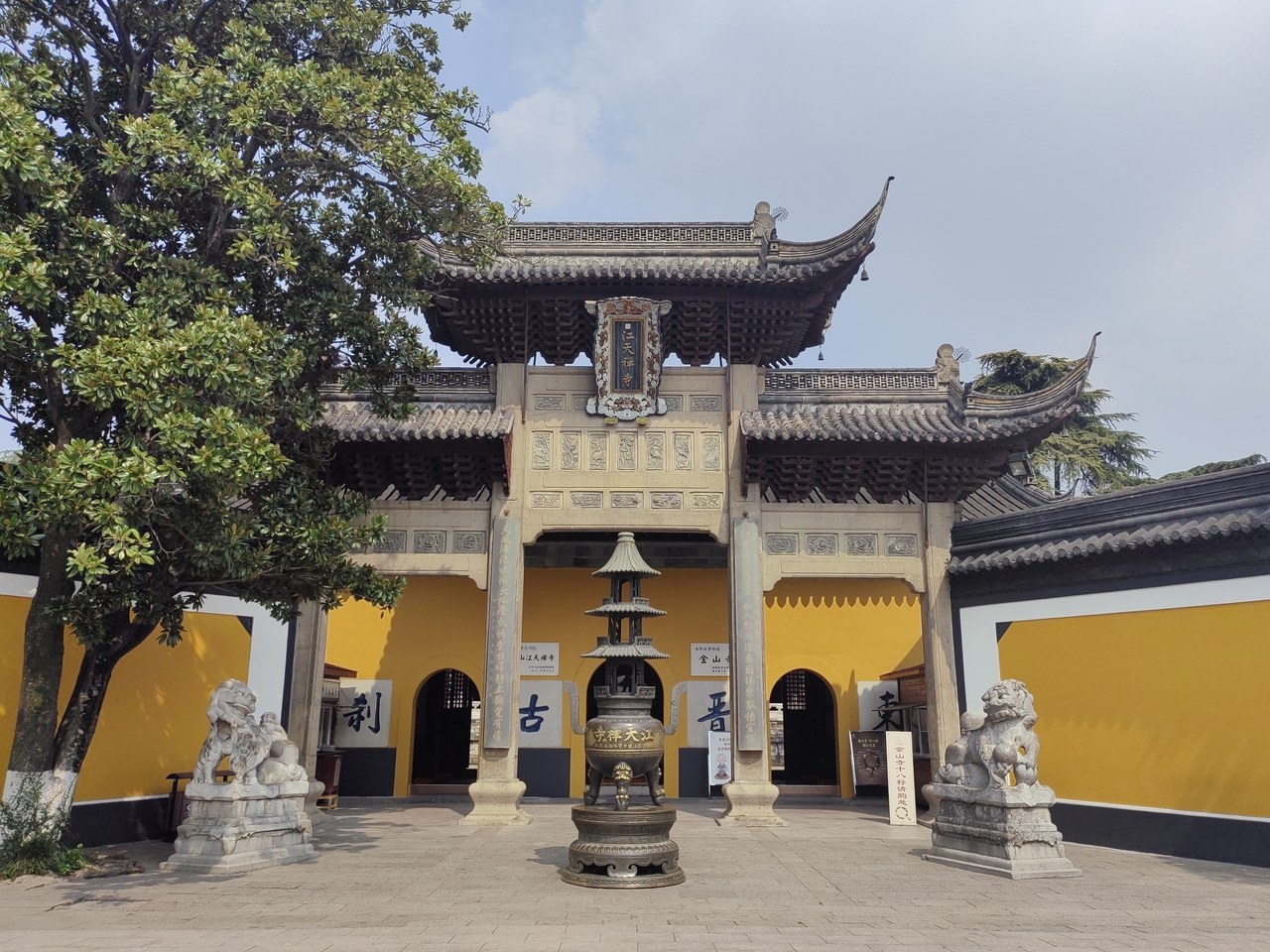
Jiangtian Temple at Jinshan, photographed in August 2024; the historical image does not establish present-day entry conditions.Photo: Yumeto · CC BY-SA 4.0 · Image credits
River views, a compact climb and sites associated with poetry and Three Kingdoms stories. · Northeastern side of the central city · between Jinshan and Jiaoshan along the river
About 2 hours · Operator reference: CNY 30 in low season; CNY 40 in high season.
One useful full day, or a second day for history and river views
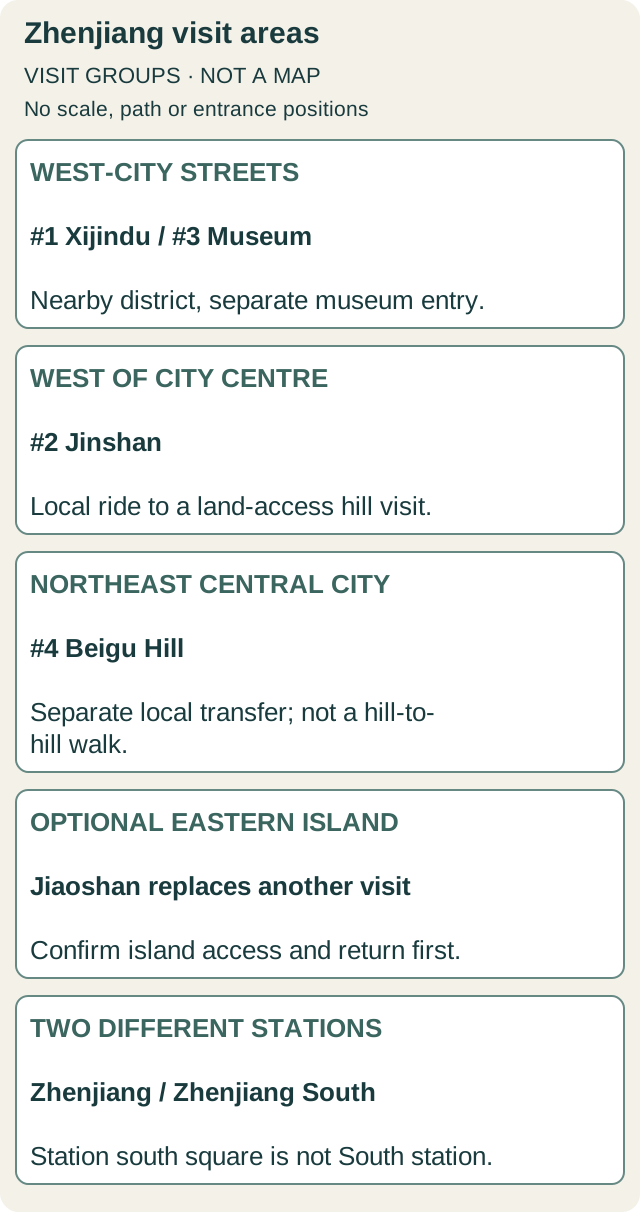
Open full-size map ↗. Xijindu and the museum share a district; Jinshan and Beigu require separate local journeys. Jiaoshan is an optional island replacement. Zhenjiang station’s south square is not Zhenjiang South station. This is an editorial relationship diagram, not a navigation map; box position does not encode distance or an entrance. ChinaMile diagram; location sources. Navigation: search the Chinese name in Amap.
One full day: Jinshan and Xijindu
Arrive the previous evening and stay near Xijindu or in the central city. After a noodle breakfast, visit Jinshan in the morning. Transfer to Xijindu for lunch, rest, then walk the historic streets and keep dinner there. Depart the following morning. That arrangement is two nights and one full sightseeing day, with no ferry or evening admission deadline.
Two full days: add the museum and Beigu
Keep the first day above. On the second, visit Zhenjiang Museum in the morning, eat lunch near Xijindu, then transfer to Beigu for an early-afternoon visit. Return for dinner and depart the next morning: three nights and two full days. Switch the days if the museum would otherwise fall on its ordinary Monday closure; current holiday notices can alter that rule. If rain rules out the hills, use the museum on an open day and shorten the street walk.
Choose Jiaoshan only if its island setting is the point
Jiaoshan / 焦山 offers wooded paths, Dinghui Temple and stone inscriptions. It is the alternative for a visitor interested in calligraphy and a river-island excursion. It adds boat-service and return constraints that Jinshan and Beigu do not. Replace one hill half-day rather than stacking all three into the main route.
Before choosing it, call the operator’s Jiaoshan desk, +86 511 88817103, and confirm the current south-entrance boarding point, whether the chosen ticket includes both crossings, the last return boat and foreign-passport handling. The published attraction reference is CNY 50 in the low-season months listed below and CNY 65 in the high-season months; this is not proof of a particular boat-inclusive product. A current ferry timetable and passport transaction were not verified for this guide. If both entry and return cannot be confirmed, keep the land-based Jinshan/Beigu plan. Never make the final boat your connection to a fixed train.
A day trip needs a narrower choice
From a nearby city, an early train and a suitable booked return can support Jinshan plus a shorter Xijindu walk and meal. Compare the actual arrival station and road transfers before buying. Do not label a late arrival and early departure a full city day; choose Xijindu and the museum instead if their opening fits better.
Stay beside the old streets, or choose a practical central hotel
Default: the Xijindu / 西津渡 and Boxian Road / 伯先路 edge. It gives the short stay an evening on foot and pairs naturally with the museum. Check the hotel’s exact entrance, road pickup and steps: an atmospheric lane address can be awkward with luggage, and restaurants or bars can create evening noise.
Dashikou / 大市口 is a practical central alternative for ordinary meals and local transfers, with a different experience from sleeping beside the old ferry lanes. Zhenjiang railway-station area / 镇江站 suits a morning departure. A hotel by Zhenjiang South / 镇江南 serves that station, not the southern entrance of the central station, and needs separate transfers for these sights.
Search Trip.com hotels or your preferred provider for the actual dates and two adults, then filter the map to your chosen base. Compare all nights, bed type, cancellation and the final room total. Confirm foreign-passport check-in, late arrival and car access directly before paying a non-refundable rate. This is a neighbourhood comparison, not a claim that a particular hotel has been inspected.
Start with noodles, then try the vinegar with a small pork plate
Guogai mian / 锅盖面, or pot-cover noodles, make the simplest local breakfast or lunch. Choose a shop near your base rather than making a long detour for a name; confirm the topping and portion before ordering. The same noodle name can come with different meat toppings, broth and prices. A plain-looking bowl is not automatically vegetarian.
Yaorou / 肴肉 is a cold pork speciality, often described as crystal pork because of its set, translucent jelly. Order a small shared plate if you eat pork. Zhenjiang aromatic vinegar / 镇江香醋 is the local condiment to try alongside it or with another suitable dish; taste a little before adding it to the whole bowl.
Have noodles before the morning hill, then take a seated lunch or dinner around Xijindu. On the longer stay, use Dashikou for an ordinary city meal rather than repeating every meal in the visitor streets. For a fuller dinner, add vegetables and a cooked main dish; the budget assumes modest local meals, not a banquet. If buying vinegar as a souvenir, check the sealed bottle size and your onward luggage rules rather than carrying a large liquid through airport security.
Count nights and chosen hills, not an unused attraction bundle
For two full-price adults sharing one room, two nights and one full day, use 2R + A + 2J + CNY 500–750. R is the actual nightly room total, A is both arrival and departure transfers for the pair, and J is each person’s Jinshan admission. The CNY 500–750 is an editorial allowance: CNY 350–500 for ordinary meals over the stay and CNY 150–250 for local sightseeing transport. Xijindu’s public street walk does not require an attraction ticket.
The operator’s published tariff gives J = CNY 50 in January–February, June–August and December, or CNY 65 in March–May and September–November. Worked inputs only: R = 350, A = 100 and J = 65 produce CNY 1,430–1,680 for the pair, or CNY 715–840 each. The room, transfer and meal values are calculation inputs, not current bookable quotes.
For the second full day and third night, add R + 2B + CNY 200–320. B is Beigu’s adult reference, CNY 30 in the same low-season months or CNY 40 in the high-season months. The CNY 200–320 is an extra food-and-local-transfer allowance for the pair. Main museum galleries add no admission charge; the optional consulate interior adds its actual ticket, with CNY 20 per adult as the published reference.
Both examples exclude trains or flights to reach the city, shopping, guides, paid Xijindu interiors, performances and Jiaoshan boat products. If swapping a hill, subtract the unused admission and add the actual replacement ticket and both transfers. Compare bundle terms only after deciding what you will visit; an unused attraction is not a saving.
Make the west-city cluster the anchor, then choose a second hill
1. Xijindu old ferry district · 西津渡
Xijindu works best as a walk through a former river gateway rather than a checklist of ticketed rooms. Look for the layered stone streets, covered passages and the Zhaoguan stone pagoda over the lane. Shops, cafés and restored buildings are part of the present-day district; the old ferry history does not mean you need to take a boat here.
Come in daylight to see the street details, pause for dinner and keep a short evening walk if the weather suits. Steps and sloping stone paving make a light bag and a modest route more useful than trying to drag luggage through every lane.
Hours
Street access and shop hours differ from the opening hours of individual venues. Use daylight for the historic lanes and late afternoon for a meal; do not assume interior exhibitions or hill paths remain open after dinner. Current operator notices override the usual route.
Tickets
The basic street walk is free. The operator distinguishes paid interiors and viewpoints from the open district. This itinerary and budget do not require a Xijindu exhibition bundle, Yuntai Pavilion or a performance. Ask the visitor centre for the exact product and passport process if adding one.
Time
Allow 2–3 hours for the lanes and stops, plus a seated meal. The museum deserves its own time rather than being squeezed into that same allowance.
Chinese address
西津渡历史文化街区,镇江市润州区西津渡街、伯先路一带。
Getting there
Use 西津渡游客中心 or your hotel’s confirmed roadside entrance as the car destination. Leave luggage at the hotel before the street walk and save a pickup on an accessible road outside the lanes.
How to visit
Visitor centre → signed historic street route and Zhaoguan stone pagoda → a rest and meal → return to the roadside pickup or hotel. Stay on open paths; if rain makes the steps slippery, shorten the outdoor section and use the museum during its own opening hours.
2. Jinshan and Jiangtian Temple · 金山 · 江天禅寺(金山寺)
Jinshan is the strongest first choice among the three hills if you want a recognisable architectural experience. Its temple buildings wrap around the hillside, so the visit unfolds through courtyards, stairs and changing views of roofs. The White Snake story adds a cultural layer; it is folklore, not a claim that the events occurred.
Although older imagery shows an island, the visitor approach is now by land. Give the temple area time rather than treating it as a photo stop before two more hills. The upper sections involve steps; a shorter lower-level visit is possible, but this is not a promise of a fully step-free temple circuit.
Hours
Plan a morning visit, preferably starting around 09:00. The operator’s general website and individual ticket products publish differing opening windows, so confirm the current entrance and last-admission time with Jinshan service, +86 511 85512992, or your dated ticket. This route does not rely on early dawn access or a late entry.
Tickets
The operator’s seasonal reference is CNY 50 in January–February, June–August and December; CNY 65 in March–May and September–November. The official online instructions specify a Chinese second-generation ID card. Foreign-passport purchase and gate handling were not tested: contact the scenic-area service number or staffed ticket office with the original passport before paying for a non-refundable product. Do not enter another person’s ID or assume a multi-hill bundle solves the document issue.
Time
Allow 2–3 hours for the main temple/hill visit, with breaks on the steps. Add time if selecting extra areas or if queues are long.
Chinese address
金山风景区,江苏省镇江市润州区金山路。
Getting there
Show 镇江金山风景区 to the driver, not a generic “Jinshan” that could refer to another city. Use a taxi or a current city-bus route from your hotel; Xijindu and Jinshan are separate stops. No ferry is needed for this planned approach.
How to visit
Ticket office/document check → open temple courtyards → upper paths only if comfortable → exit and road transfer to Xijindu for lunch. Follow restrictions on worship spaces and photography. If admission cannot be arranged, use Xijindu and the museum, subject to its own entry rules, instead of buying an unverified reseller ticket.
3. Zhenjiang Museum · 镇江博物馆
The museum turns the port-city setting into a fuller story. Choose the ancient collections for bronzes, ceramics and metalwork, or spend more time on the modern-history display to understand the city’s changing connections. It is a substantial stop rather than an entrance lobby to the old streets.
The museum complex includes the former British consulate, but free access to the main galleries does not mean every building is free. The core plan uses the permanent collections and leaves the consulate interior as an optional extra.
Hours
Ordinary hours are Tuesday–Sunday 09:00–17:00, with Monday normally closed. Published official pages differ on last entry, giving 16:00 or 16:30; arrive in the morning rather than relying on either cutoff. Holiday or temporary notices on the museum notice page take precedence.
Tickets
The museum’s published admission guidance identifies free relic galleries in Building 6 and the modern-history gallery in Building 8. It directs overseas visitors to manual registration at the cultural-products desk in Building 6’s lobby. Bring the original passport and ask staff to confirm the current process; this route was not field-tested. The former British consulate is a separate paid ticket, with a published full-adult reference of CNY 20. Confirm its current opening and ticket at the desk if adding it.
Time
Allow 2–3 hours for selected permanent displays. Do this before lunch, then leave the afternoon for Beigu or another unhurried Xijindu walk.
Chinese address
镇江博物馆,镇江市伯先路85号。
Getting there
Use 镇江博物馆(伯先路85号) as the destination. It can be paired with Xijindu, but the museum’s entrance and opening hours remain separate from the public street route.
How to visit
Building 6 lobby registration → selected relic galleries → Building 8 if time and access permit → lunch near Xijindu. For clarification call +86 511 85285032. If closed or registration cannot be completed, retain the old-street walk when conditions permit; no museum admission is needed for that alternative.
4. Beigu Hill · 北固山
Choose Beigu when the view and literary associations are more interesting to you than another large temple visit. Ganlu Temple and the hill’s pavilions are linked to stories of Liu Bei and Sun Shangxiang; treat the narrative as part of the cultural experience rather than a guarantee of surviving Three Kingdoms buildings.
This is the best second hill for the land-based itinerary. Save it for a clear morning or early afternoon and allow for the climb. If haze or rain removes the view, more time with the museum collections or a meal is a better use of the second day.
Hours
Use a morning or early-afternoon visit, with a target arrival around 13:00 in the two-day plan. Confirm that day’s gate and indoor-area hours with Beigu service, +86 511 88858088, or the actual ticket. Do not use the general three-hill website’s late closing as a promise of last admission.
Tickets
Published seasonal adult reference: CNY 30 in January–February, June–August and December; CNY 40 in March–May and September–November. For foreign passports, ask the official service desk to confirm a manual ticket and entry route; the common online instructions require a Chinese ID. Concessions and combined-ticket terms are not assumed for this plan.
Time
Allow about 2 hours, longer if climbing slowly or pausing often. This is an editorial planning allowance.
Chinese address
北固山风景区,镇江市京口区东吴路3号。
Getting there
Take a local road transfer to 北固山风景区 from the museum or hotel. It is a separate stop from both Jinshan and Xijindu, not a continuation of their pedestrian lanes.
How to visit
Confirm ticket/entry → follow the open paths toward Ganlu Temple and the hill viewpoints → descend before closing → return to your hotel. In thunderstorms, strong wind or slippery conditions, omit the climb. The same-evening departure should still have its own station-transfer margin.
Read the whole station name, including the South suffix
Rail is the straightforward arrival for this city stay
Use China Railway 12306 to compare Zhenjiang / 镇江 and Zhenjiang South / 镇江南 for the actual date. They are separate stations. Zhenjiang is the useful first search for this central-city itinerary; a better train at Zhenjiang South can still work after allowing its own hotel transfer.
镇江站南广场 means the south square of Zhenjiang station. It does not mean 镇江南站. Send a driver the exact station name and pickup/entrance shown on your ticket and map. At arrival, follow the signed licensed-taxi queue and show the full Chinese hotel address. Save the correct station as a separate destination for departure rather than selecting the first search result containing “south”.
After a flight
A flight to a neighbouring city creates a separate airport-to-Zhenjiang journey. Use an airport transfer to an operating rail station and a dated onward train, or obtain a confirmed through-car quote for your party and luggage. Do not assume a direct airport coach exists at your arrival time. If you land late, an airport-city night is more useful than a tight final-train connection.
Move between clusters, then walk within them
Use a taxi or the current city-bus route for hotel ↔ Jinshan and for the transfer to Beigu. Walk within Xijindu and between nearby open parts of the museum district. Keep the Chinese place names saved offline. There is no need to arrange a ferry for the default visit; optional Jiaoshan requires its own confirmed boarding and return information.
Keep the departure morning free of a hill visit. Allow the road transfer and the railway’s required station lead time separately, adding margin for rain, traffic and holiday queues. If an attraction runs late, shorten that visit rather than cutting the station margin.
Use Zhenjiang as its own stop between larger city stays
Nanjing adds a larger historical city with its own full days. Yangzhou changes the emphasis to gardens, canals and a different food tradition. Suzhou is another onward choice along the wider regional rail network. Use actual trains and stations to choose the transfer; none of these cities is included in the one-day Zhenjiang budget.
Operator references and the checks left to your travel date
Sources reviewed on . Seasonal admission references and contact numbers come from the Three Hills operator. Its general opening window is broader than some individual product listings, so the guide uses morning or early-afternoon visits and does not promise a late entry. The operator’s online instructions describe Chinese-ID entry; foreign-passport purchase and entry were not field-tested.
The museum’s ordinary schedule, collection descriptions and published overseas-registration guidance are separate from temporary holiday extensions. Check the current notice for your date and confirm the Building 6 registration desk on arrival. Xijindu’s public-street/paid-interior distinction is supported by its operator; older health-code rules and expired events are not used here. Jiaoshan’s current boat timetable and inclusions remain unverified, so the main itinerary is entirely land-based. Durations, meal allowances and hotel-base choices are editorial planning judgments.