Nanjing tulou: choose a village, then slow down南靖土楼 · 田螺坑与云水谣
For a first visit from Xiamen, choose the Tianluokeng circuit and book the whole return journey. It combines the hillside cluster, Yuchang Lou and Taxia village. Choose Yunshuiyao instead for two contrasting buildings linked by a streamside walk. To see both without rushing, sleep one night in a named village and arrange the transfer between them.
This is Nanjing County / 南靖县 in Fujian, near Zhangzhou. It is not Nanjing / 南京 in Jiangsu. “Fujian tulou” describes a wider group of places; a Nanjing ticket does not cover Yongding.
Choose between two circuits, not six separate excursions
Tulou are large earthen buildings organised around shared internal spaces. Here the interest changes with scale: a cluster in the landscape, the timber structure of one building, a family hall, then the village outside its walls. Keep time to look, rather than spending the whole visit photographing identical entrances.
| Choice and time | Plan and conditions |
|---|---|
| One full excursion, same Xiamen bed: | #1–3, the Tianluokeng circuit. Choose this for the recognisable five-building view and varied stops. A confirmed car or suitable organised trip matters more than saving a few minutes on the train. |
| One full excursion, gentler village rhythm: | #4–6, Yunshuiyao. Choose it for a longer lunch, riverside pauses and two different building shapes. Uneven paving and thresholds still make it unsuitable to assume step-free access. |
| One village night: | one circuit before the overnight, the other in the next usable daylight period. Choose Taxia for the Tianluokeng side, or Yunshuiyao for a walk from your room. Book both road legs; do not change hotels merely to see the second circuit. |
| Two village nights: | worthwhile for a slow stay, photography, hotel activities or reduced walking. Keep the same lodging and make the other circuit a return outing. Late arrival plus an early departure does not supply two sightseeing periods. |
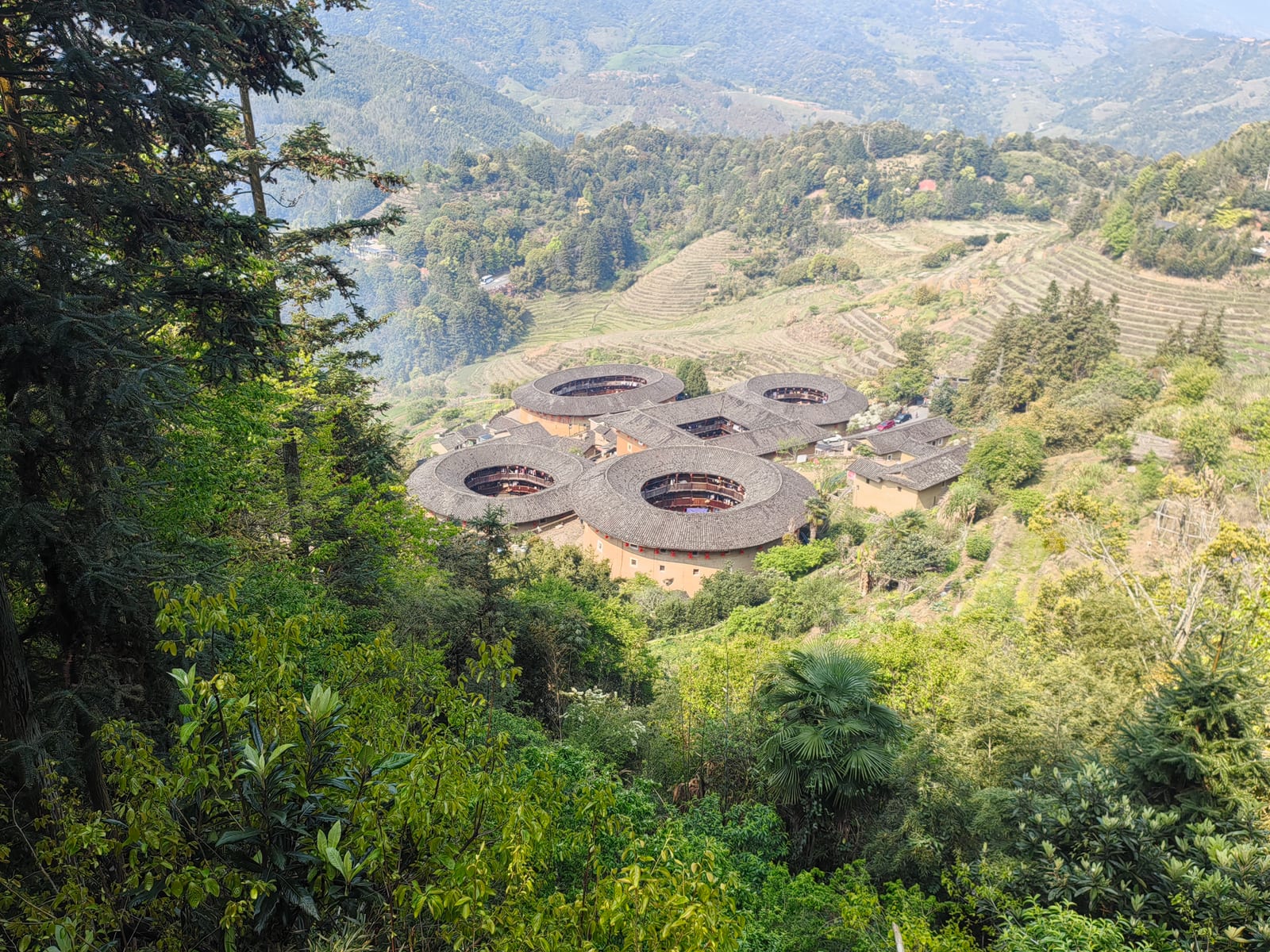

Tianluokeng: landscape, structure, village
- 1. Tianluokeng cluster · 田螺坑土楼群
The best first choice for the landscape photograph: five buildings gathered on a terraced hillside, then a closer look at their shared courtyards.
- Area
- Tianluokeng circuit · Shuyang
- Time
- 1–1½ hours; allow extra for both viewpoints
- Entry
- Tianluokeng circuit admission
- 2. Yuchang Lou · 裕昌楼(东倒西歪楼)
A single round building rewards looking closely: the leaning timber columns are more interesting here than another distant panorama.
- Area
- Tianluokeng circuit · Xiaban
- Time
- 40–60 minutes
- Entry
- Included in the Tianluokeng circuit
- 3. Taxia village and Deyuan Hall · 塔下村与德远堂
The circuit’s change of pace: a streamside village and a clan hall explain more about settlement and family life than a sequence of round buildings alone.
- Area
- Tianluokeng circuit · overnight option
- Time
- 1–1½ hours, or longer with lunch
- Entry
- Included in the Tianluokeng circuit
Yunshuiyao: a square building, riverside walk and round building
- 4. Hegui Lou · 和贵楼
A tall square earthen building: the useful counterpoint to the circular buildings and hillside cluster.
- Area
- Yunshuiyao circuit · southern anchor
- Time
- 35–50 minutes
- Entry
- Yunshuiyao admission
- 5. Yunshuiyao village walk · 云水谣古道(官洋村)
A stream, old paving, banyans and village businesses make this a slower visit. Choose it when an easy meal and pauses matter more than the five-roof panorama.
- Area
- Yunshuiyao circuit · between the buildings
- Time
- 1–1½ hours plus a meal
- Entry
- Part of the Yunshuiyao circuit
- 6. Huaiyuan Lou · 怀远楼
A round building with a compact inner hall: a good place to compare the scale of shared living space with the detail of carved wood and masonry.
- Area
- Yunshuiyao circuit · northern anchor
- Time
- 45–60 minutes
- Entry
- Included in the Yunshuiyao circuit
The station, visitor centre and villages are different places
Nanjing Railway Station / 南靖站 is an arrival gateway, not a tulou entrance. The villages lie farther west in the hills. The Tianluokeng circuit uses separate road stops; Yunshuiyao has a walking core between Hegui Lou and Huaiyuan Lou. Moving between the two circuits is another vehicle leg, even if a map makes the points look close.
The official transport tariff refers to the reception centre at Xiatiancun / 下田村停车场 for scenic services. Do not ask to be dropped simply at “Nanjing Tulou” and assume you will be beside the building or hotel you chose. Give the full Chinese name, village and confirmed meeting point.
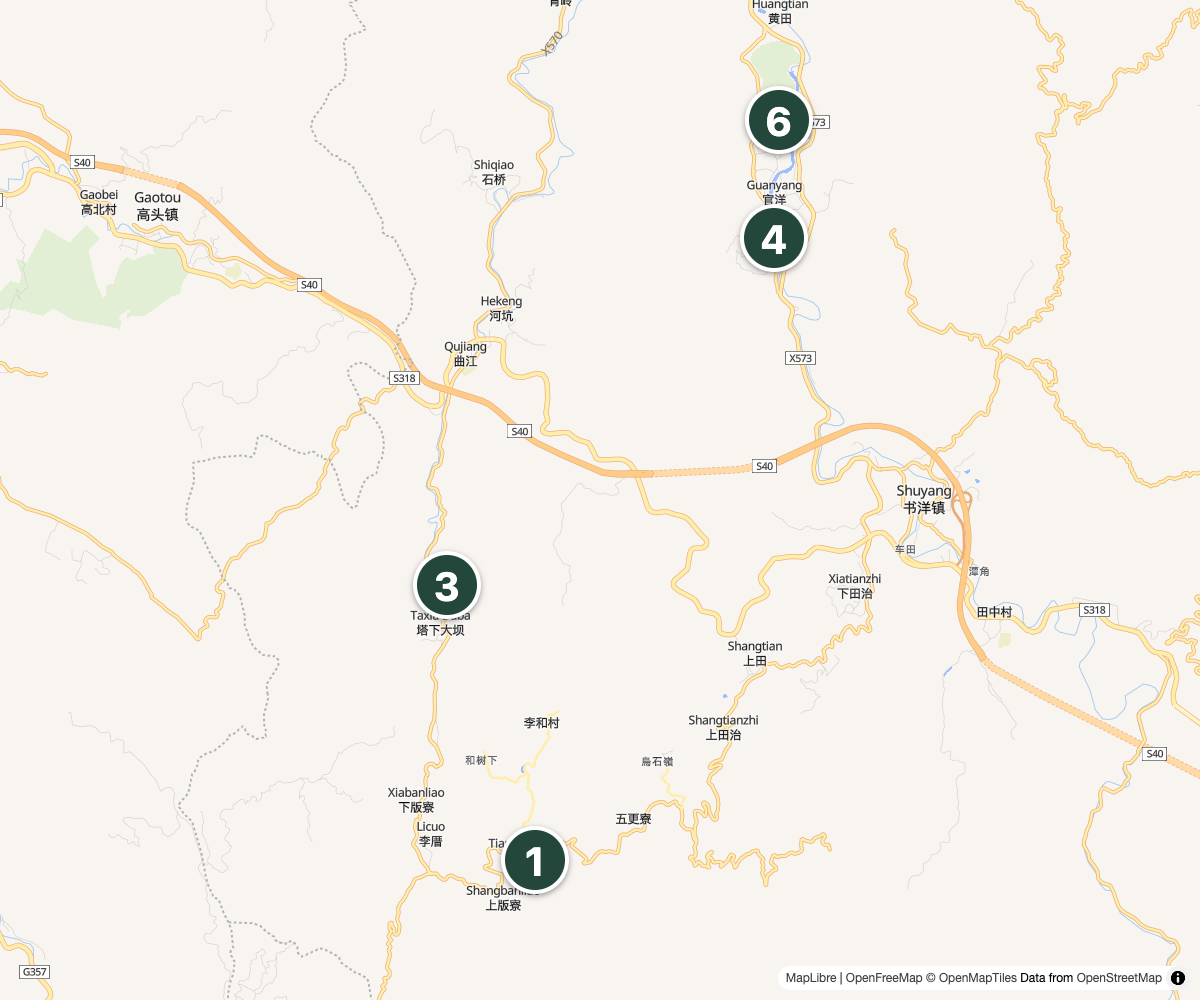
Hekeng / 河坑 is an additional Nanjing cluster, separately ticketed. Add it only if tulou architecture is the purpose of a longer stay; it should replace a second circuit when time is short. Chengqi Lou / 承启楼 and Hongkeng / 洪坑 are in Yongding, a separate operator and ticket area. A tour combining them may be legitimate, but it is a different route from the two Nanjing circuits on this page. Check the actual stops before buying a product labelled only “Fujian Tulou”.
Make the return journey part of the choice
Xiamen return: one circuit and your existing hotel
Keep the Xiamen room for the night after the excursion. Leave your main luggage there, carry your passport and a day bag, and meet the confirmed vehicle at the agreed road entrance. For Tianluokeng, use hotel → #1 viewpoints and permitted courtyard → #2 Yuchang Lou → #3 Taxia and a meal → the same Xiamen hotel. The operator or driver may reverse stops for access or crowds; retain the three named places, a meal and a fixed return pickup.
Allow a whole day: an editorial planning envelope is about 10–12 hours door to door, including several hours on the road, sightseeing, lunch and margin. This is not a current timetable. If a quoted pickup is late enough to leave only a short village visit, reduce to one area or choose another date. Avoid a flight or inflexible onward train immediately after the excursion.
For Yunshuiyao, agree Hegui-side arrival → #4 → open #5 village path and lunch → #6 → the booked collection point → Xiamen hotel. Confirm the full walking path before making an opposite-end pickup depend on it. If access is interrupted, use the open section and a road transfer; do not cross barriers to complete the sequence.
One night in the villages: two circuits, one lodging
Default for an architecture-focused stay: arrive early enough for #1–3, leave bags at a Taxia hotel, eat and sleep there. In the next daylight period, collect the bags, take a booked car to Yunshuiyao for #4–6, then continue to your issued train at Nanjing station or your next Xiamen hotel. Have the hotel confirm where bags stay securely during the walk. If that onward chain is too tight, return to the Taxia hotel after Yunshuiyao and leave the following morning.
Default for a relaxed village evening: stay in Yunshuiyao. Walk #4–6 around arrival and an early morning pause; make #1–3 a booked car outing. With two nights, return to the same Yunshuiyao room after that outing. With one night, settle checkout, luggage storage and the final station transfer before leaving. An overnight is valuable for quiet village time; it does not include unrestricted after-hours building access.
Two admission products; transport is a separate decision
The provincial price notice publishes ordinary admission at RMB 90 per person for Tianluokeng and RMB 90 for Yunshuiyao; Hekeng is RMB 40. Its two scenic transport circuits are separately priced at RMB 15 each, chosen voluntarily rather than compulsorily bundled. The notice is a published tariff basis, not a check of today’s sale inventory, departures or promotions.
For two full-price adults, one admission circuit is 2 × 90 = RMB 180; both circuits are 2 × (90 + 90) = RMB 360. If both people use both separately priced scenic circuits, the published transport component would be 2 × (15 + 15) = RMB 60. Add inter-village or station transport, accommodation and meals. This is a tariff calculation, not a package quote. A promotional bundle or concession must match your dates, documents and actual inclusions.
Do not buy transport twice. Ask a car provider whether its vehicle reaches each stop under current access controls or whether scenic vehicles are additionally required. A 15-yuan scenic circuit is not a transfer from Nanjing station, an all-day private car or a guaranteed late hotel shuttle.
Foreign-passport booking: settle the validation point before payment
Call the scenic service number 400 888 5111, published in the operator’s notice reproduced by Fujian Daily, or ask your confirmed hotel to call with you. Ask for the current official sale channel, named circuit, visit date, passport booking route, staffed validation point and last admission. A Chinese 400 number may be easier to reach from a domestic phone; the hotel is the practical fallback.
- Select Tianluokeng or Yunshuiyao by name; check whether a combined product actually lists both.
- Check the identity-document selector. If it offers a passport, use the name and number requested from your original document. If it accepts only a mainland identity card, stop and obtain the manual or alternative booking instructions.
- Confirm any advance-purchase lead time, cancellation terms and how a closure changes the order. Do not assume a village room includes its surrounding scenic ticket.
- Save the confirmation, meeting point and operator contact offline; bring the original passport. A screenshot of an attempted purchase is not an admission confirmation.
Useful request: 我持外国护照,要买田螺坑/云水谣门票。请确认购票渠道、人工验票地点、当天最后入园时间,以及能否再次入园。 “I hold a foreign passport and want the Tianluokeng / Yunshuiyao ticket. Please confirm the purchase channel, manual validation point, today’s last admission and whether re-entry is allowed.” No foreign-passport transaction was completed for this guide; the current online document fields and re-entry rule remain unverified.
1. Tianluokeng cluster田螺坑土楼群
The best first choice for the landscape photograph: five buildings gathered on a terraced hillside, then a closer look at their shared courtyards.
- Hours
- Visit in daylight. Confirm the current ticket desk, building-entry and sightseeing-car hours through the scenic service contact. A lit exterior after dark does not establish interior opening.
- Tickets
- Part of the Tianluokeng ticket, alongside #2 and #3. See the published tariff and transport distinction; do not buy three separate circuit admissions.
- Time
- 1–1½ hours; allow extra for both viewpoints (editorial allowance)
- Address
- 福建省漳州市南靖县书洋镇上坂村田螺坑自然村,田螺坑土楼群. The provincial heritage account places the cluster in Shangban Village.
- Getting there
- By confirmed car from your village hotel, or the Tianluokeng scenic transport arranged at the Xiatiancun reception centre / 下田村游客接待中心. Set the upper-viewpoint drop-off and the final collection point before separating from your driver.
- How to visit
- Begin at an open upper viewpoint for the five-building arrangement. Descend only as far as your party can comfortably return, then see a courtyard open to visitors. Compare the enclosing walls from outside with the timber galleries inside. The lower view is a different angle, not a second tulou village; keep it optional if steps are difficult. Continue by car to #2, rather than walking mountain roads between sites.
2. Yuchang Lou裕昌楼(东倒西歪楼)
A single round building rewards looking closely: the leaning timber columns are more interesting here than another distant panorama.
- Hours
- Choose a daytime interior visit and follow the current staffed entrance. Access to an occupied building can be narrower than the village’s visiting hours.
- Tickets
- The official Tianluokeng tariff names Yuchang Lou. It does not give blanket permission to use private stairs or enter residents’ rooms. Decline an unofficial upstairs offer if permission is unclear.
- Time
- 40–60 minutes (editorial allowance)
- Address
- 福建省漳州市南靖县书洋镇下坂村,裕昌楼(东倒西歪楼). Show the village and nickname together: another building called 裕昌楼 appears in the separate Hekeng cluster.
- Getting there
- A road stop within the #1–3 car circuit. Ask your driver for “下坂村东倒西歪楼”, not merely a map search for Yuchang Lou. Keep the same car waiting at the agreed parking area.
- How to visit
- Step into the public courtyard, look up at how the galleries and columns meet, and take time to understand the shared space around you. Keep the visit on permitted ground; people’s washing, kitchens and upstairs rooms are part of a home. Ask before photographing residents. Return to the agreed car, then continue to Taxia.
3. Taxia village and Deyuan Hall塔下村与德远堂
The circuit’s change of pace: a streamside village and a clan hall explain more about settlement and family life than a sequence of round buildings alone.
- Hours
- Walk by daylight; the hall’s interior depends on its actual opening. For an evening village stroll, stay close to your lodging and use lit public paths.
- Tickets
- Taxia and Deyuan Hall are named in the Tianluokeng admission scope. Do not assume a hotel booking waives scenic entry or permits re-entry: settle the lodging and ticket relationship before arriving.
- Time
- 1–1½ hours, or longer with lunch (editorial allowance)
- Address
- 福建省漳州市南靖县书洋镇塔下村,德远堂. The official village conservation plan identifies the hall and streamside buildings as part of its historic core.
- Getting there
- Continue here from Yuchang Lou with the same vehicle. An overnight guest should be dropped at the hotel’s accessible pickup point; the scenic bus terminus is not automatically the hotel door.
- How to visit
- Follow a short streamside walk, then visit Deyuan Hall when open. Notice the stone memorial columns and the relationship between the hall, homes and water. Eat here if your timing and an open kitchen suit, then return to Xiamen with the booked driver or walk back to your Taxia lodging. Do not finish at a different village without a return arrangement.
4. Hegui Lou和贵楼
A tall square earthen building: the useful counterpoint to the circular buildings and hillside cluster.
- Hours
- Daytime interior access; confirm last admission separately from the village’s evening access. A platform’s “open all day” description of Yunshuiyao is not a 24-hour building ticket.
- Tickets
- One Yunshuiyao admission covers this building, #5 and #6. Keep the admission record through the circuit rather than discarding it after the first check.
- Time
- 35–50 minutes (editorial allowance)
- Address
- 福建省漳州市南靖县梅林镇璞山村,和贵楼. Tell the driver “云水谣和贵楼入口”, then use the entrance confirmed by staff for your date.
- Getting there
- For a car-based visit, agree a Hegui-side drop-off and a Huaiyuan-side pickup only if the current walking route is open. A hotel in Yunshuiyao can instead advise which end fits its own location.
- How to visit
- See the square courtyard and the building’s height from within the permitted ground-floor area. Its wet-ground foundation is part of the story; do not stamp, bounce on protected paving or copy an old demonstration. Continue towards the village only along the open signed route. If paths are closed, use an authorised road transfer to the other open section.
5. Yunshuiyao village walk云水谣古道(官洋村)
A stream, old paving, banyans and village businesses make this a slower visit. Choose it when an easy meal and pauses matter more than the five-roof panorama.
- Hours
- Daylight for the paths and river; shops set their own hours. A village overnight lets you enjoy an early or late stroll without assuming that both ticketed buildings remain open.
- Tickets
- Included with #4 and #6. Meals, drinks and any separately sold activity are additional; do not buy an extra “ancient town” ticket without checking what your existing order covers.
- Time
- 1–1½ hours plus a meal (editorial allowance)
- Address
- 福建省漳州市南靖县梅林镇官洋村,云水谣古道. The provincial village guide describes this streamside core and the connection towards Huaiyuan Lou.
- Getting there
- On the permitted village path from either building, or from a nearby Yunshuiyao hotel. Save the hotel entrance and accessible road pickup separately: a waterside photo spot is a poor vehicle meeting point.
- How to visit
- Walk the open riverside section, pause around the waterwheel area when accessible, and use a seated tea or lunch stop to make this a village visit. Protected trees and river paths may be cordoned off; stay outside the barriers. Avoid stepping-stone crossings when wet or fast-flowing. Continue to #6, or turn back to the same lodging if that makes a more comfortable loop.
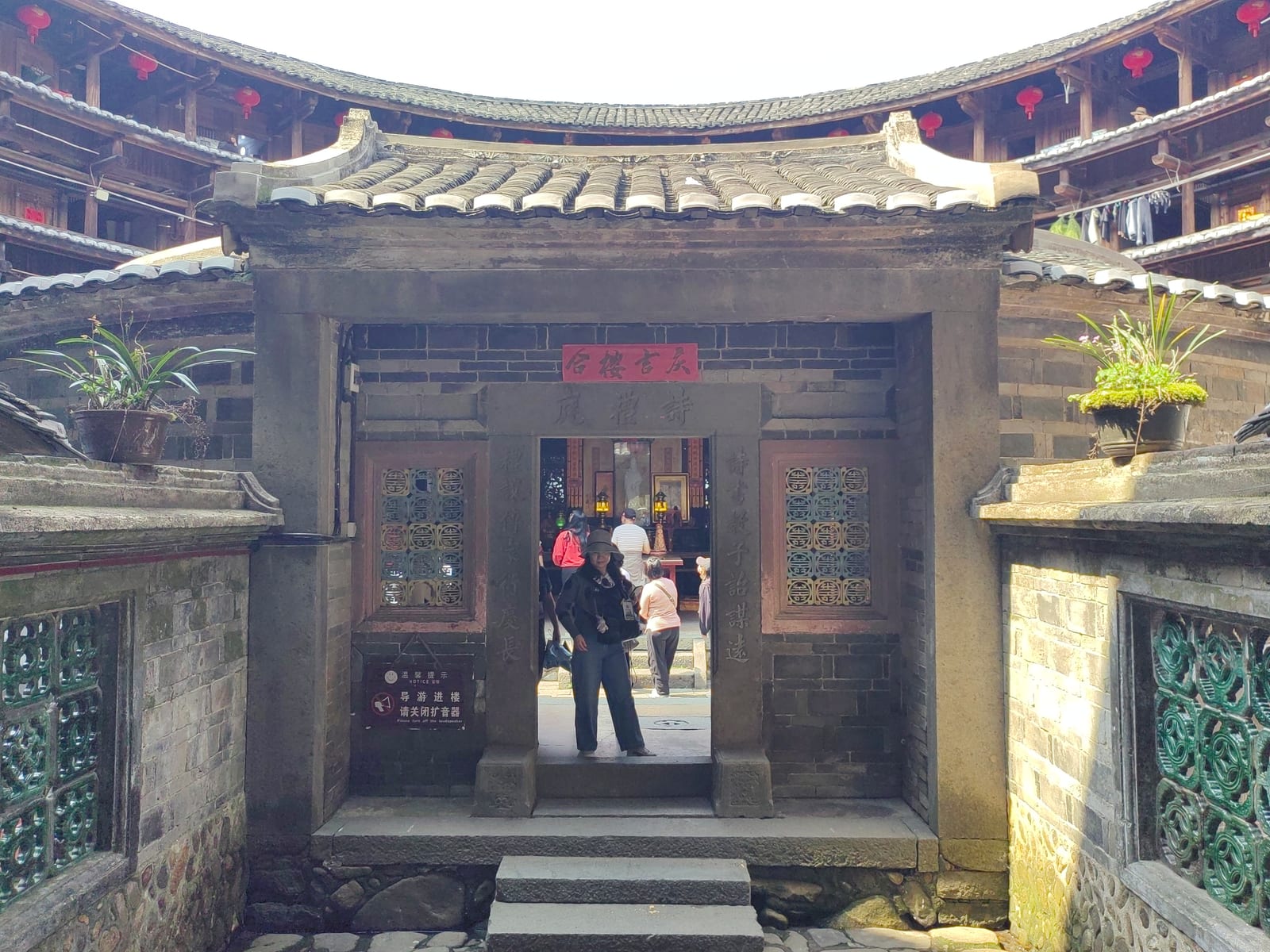
6. Huaiyuan Lou怀远楼
A round building with a compact inner hall: a good place to compare the scale of shared living space with the detail of carved wood and masonry.
.jpg)
- Hours
- Plan the interior before the operator’s current last-entry time. Ask about any closure of the inner hall or galleries rather than relying on a village-wide hours listing.
- Tickets
- Included in Yunshuiyao admission. Follow the permitted visitor route; admission to the courtyard does not establish permission to climb residential galleries.
- Time
- 45–60 minutes (editorial allowance)
- Address
- 福建省漳州市南靖县梅林镇坎下村,怀远楼. This is the Nanjing County tulou, not a similarly named building elsewhere.
- Getting there
- From the open Yunshuiyao village path, or by prearranged car to its designated parking area. If ending here, photograph and agree the precise collection point with the driver before the walk begins.
- How to visit
- Look at the outer ring first, then the inner hall and its decorative details where entry is allowed. Notice how smaller ceremonial spaces sit inside the large domestic enclosure. Return on the open village route to your lodging, or meet the booked car here; do not count on an unconfirmed late scenic bus to rescue a missed train.
Book to the village, not just to Nanjing station
From a Xiamen hotel
For a single-day visit, a confirmed return vehicle is the simplest default. Compare the final all-in quote with a suitable organised trip, not a train fare alone. Send the precise circuit and stops, hotel address, passenger and luggage count, need for child seats, pickup and return location, and whether you need an English-speaking guide. A driver and an English-speaking guide are different services.
Zongsifang’s own vehicle-booking site provides a concrete enquiry route: +86 592 840 0866. Its Tianluokeng product advertises Xiamen island hotel pickup and return, but retains an old pandemic-era Taxia restriction in its itinerary. Treat that page as a contact lead, not proof that the displayed schedule, price or all stops are currently operating. Obtain a written dated confirmation of #1–3, pickup area, return, inclusions and cancellation before paying; if the provider cannot resolve the obsolete wording, use a confirmed hotel-arranged vehicle instead.
A Gulangyu room introduces a ferry before and after the road excursion. For an early pickup, sleep on the Xiamen mainland the preceding night, or choose a later private pickup whose sightseeing window still works. Xiamen North / 厦门北站, the airport and an island hotel are different starting points; none is automatically included in an “island hotel pickup” offer.
Rail to 南靖站, then a booked road transfer
Use China Railway 12306 to search the actual departure station, 南靖 / Nanjing in Fujian, and travel date. Confirm the Chinese characters on the issued ticket. Choose the departure station you can actually reach from your Xiamen hotel: Xiamen / 厦门 and Xiamen North / 厦门北 are not interchangeable. Fare, running time and the last suitable return train depend on that exact search.
Before buying a restrictive train, settle the onward pickup with your chosen lodging. For Taxia, give “书洋镇塔下村” plus the hotel name; for Yunshuiyao, give “梅林镇官洋村” or the hotel’s full address. Send train number, arrival time and a contact method that works in China. Ask the hotel to return the driver’s number, station meeting point, whole-vehicle quote, waiting allowance and late-train policy. For Sanqiu Mo, the platform lists paid station transfers; use the contact below to confirm an actual booking, not just the existence of that amenity.
For initial planning, reserve roughly 1½–2 hours for the station–village road leg, plus meeting and traffic margin; this is a cautious editorial allowance, not a timed route measurement. The confirmed driver’s pickup and travel estimate control the final train choice. For departure, book the pickup before the village stay, then work backwards from your railway reporting time. A car quote that omits the return leg leaves the most important connection unresolved.
Public bus: possible, but confirm the exact departure and return
The provincial village guide documents a direct Yunshuiyao bus from outside Nanjing station, but it is an older publication. We could not verify a current official Route 6 timetable, whether every departure calls at the railway station, the fare, or the last return. Do not plan a tight same-day return around an online timetable copied from an earlier year.
At the staffed station or bus counter, ask: 今天从南靖站到云水谣/下田土楼游客中心的车几点发?回南靖动车站的末班几点、在哪里上车?是否直达动车站? “When is today’s bus from Nanjing station to Yunshuiyao / Xiatiancun Tulou visitor centre? When and where is the last return, and does it actually go to the railway station?” Board only after both directions and your precise stop are confirmed. For Tianluokeng, the visitor-centre arrival still needs scenic transport or a booked car to #1–3. If the confirmed service leaves inadequate sightseeing or return margin, use the prearranged car or stay in Xiamen; do not improvise several late connections.
Choose Taxia for the circuit, Yunshuiyao for the village walk
Book one village base. A room advertised as “Nanjing” may be in the county town, far from either circuit. A “tulou view” room is not necessarily inside a tulou. Decide whether you want historic architecture as the accommodation itself or a conventional private room near it; bathrooms, sound insulation, stairs and luggage access are more useful distinctions than a romantic listing title.
Taxia: Tsingpu Nanjing Tulou Retreat / 青普文化行馆(南靖土楼)
福建省漳州市南靖县书洋镇塔下村大坝耀东楼. Choose this for a stay centred on restored historic buildings and the Tianluokeng side, with time at the property. The provincial housing department identifies the Taxia Tsingpu project as adaptive reuse of tulou buildings. It is a different proposition from simply buying a room with a distant tulou view.
The Trip.com room listing distinguishes a Wu Xiang Mountain-View Twin Room, two single beds on floor 1, a Zui Xiang Mountain-View Room, one queen bed on floor 2, and a two-bedroom Family Suite with two queen beds. Two travelling friends should select an actual twin category, not assume “double” means two beds. For a family, verify the suite’s exact layout, occupancy and stair arrangement; a listed floor does not prove a step-free route.
Book through the brand’s official channel or the named property listing; brand customer service is 400 0625 166. Confirm foreign-passport registration, meals and activities included in your specific rate, station pickup and the return transfer. Do not assume an “all-inclusive” package covers a private inter-circuit car or all attraction admissions.
Yunshuiyao: Sanqiu Mo Inn / 云水谣三秋·末民宿
福建省漳州市南靖县梅林镇官洋村大厝13号. Choose this for access to the Yunshuiyao village walk and a room-based rest between outings. The platform listing names Panorama Room (Double Bed), one king bed, and Featured Loft (2 Beds), one single plus one queen bed. The latter is not a pair of equal single beds and the loft layout needs checking for anyone avoiding internal stairs. This guide does not describe this inn as a room inside a historic tulou.
The listing says guests from all countries/regions are accepted and lists paid station pickup/drop-off, a restaurant and café. Confirm these directly for your stay through the booking message channel or +86 596 767 2678; arrange the accessible car meeting point and luggage help. These are platform-displayed services and room types, not a test booking or a promise of today’s availability.
The room-and-return checklist that matters here
Give both properties the number and ages of guests, passport nationalities, exact beds required, private-bathroom requirement and any stair limit. Ask for a dated total with breakfast or dinner, cancellation conditions and all vehicle legs separately stated. For a one-night stay, settle bags after checkout and the next train pickup before arrival. For a day excursion, keep your Xiamen hotel and its Chinese address saved; return there for dinner and the same bed.
Build in a village meal, not a shopping detour
For #1–3, pause in Taxia or eat at your confirmed lodging; for #4–6, use a Yunshuiyao village restaurant between the two buildings. An overnight guest can ask the hotel kitchen for dinner before going out, then return on a short familiar path. At Sanqiu Mo the listing includes a restaurant; at Tsingpu confirm which meals your rate supplies. A kitchen being on-site does not guarantee late service after a delayed train.
Local village food can be straightforward and satisfying: ask what vegetables, tofu, mushrooms or bamboo shoots are being cooked that day, add a meat or egg dish if wanted, and share rice. The provincial agriculture department’s nearby Shiqiao village introduction includes sour bamboo-shoot dishes among its local food examples; this is a food lead, not a claim that every village restaurant serves the same menu. Ask the total before ordering fish, tea or anything sold by weight.
Two people can begin with one substantial main, one vegetable dish and rice, then add more if needed. Ask whether a soup, tofu dish or “vegetable” uses meat stock, lard or dried seafood; an English vegetarian label is not enough. Use a precise translated allergy card for an actual allergy. If the kitchen cannot confirm ingredients, use food you can identify or your own suitable supplies rather than accepting a guess.
Tea offers a pleasant seated pause, but agree whether a tasting is free or paid before starting. Buying tea is optional. Do not let a sales stop replace the circuit’s included places or consume your departure margin. Carry drinking water and a small snack, especially when relying on a confirmed bus connection.
Keep weather and the road return above the checklist
A dry daylight visit is more useful than chasing a fixed “best month”. In warm, wet weather, plan shaded pauses, water and shoes with grip; rain changes the village paths and mountain drive. In cooler weather, ask about room heating and bring a layer for an early village walk. Spring and autumn can suit longer walks, but neither removes the need to check weather and access. Holiday road congestion is a reason to allow more margin or stay overnight.
Before leaving Xiamen or the station, have your driver or hotel confirm the intended road and scenic area are operating. During heavy rain or a typhoon warning, follow official closures, stay away from rivers and closed slopes, and postpone the mountain excursion if access is uncertain. An indoor courtyard is not a fallback for an unsafe road. Keep an extra city or village night as a priced option rather than making the last train your only exit.
If the driver cancels: contact the booked property or provider immediately and ask for a replacement with the same named pickup and return. At Nanjing station, remain at the staffed transport area while arranging it. If neither a confirmed bus nor a legitimate replacement car provides enough time, change the visit or return by an available issued train; do not leave with a stranger solely because they say the last bus has gone.
If the return car is delayed: remain at the agreed staffed or occupied pickup point, tell the hotel/provider the train deadline, and use 12306’s actual ticket conditions to change the train when needed. Do not rush a mountain drive to save a booking. If you must stay, obtain a confirmed room and next pickup before wandering to another village.
With limited walking: choose one circuit, a vehicle between its separate stops, and fewer interiors. For Tianluokeng, discuss the accessible viewpoint approach before assuming a panoramic platform has no steps. For Yunshuiyao, replace a full village traverse with shorter out-and-back sections when paving, thresholds or weather make the link difficult. Neither historic buildings nor these suggested hotels have been audited as wheelchair accessible.
Next stop: return to your Xiamen base, or use the exact rail connection onward after allowing the station road leg. An early Xiamen flight is best protected by a final mainland-city night. To compare this village stay with coastal or mountain time, return to the Fujian route guide.
Sources and what remains a live check
Reviewed 4 October 2026. This guide is desk research, not a personal visit, timed drive or completed passport booking. Visit durations, night counts, circuit order and travel margins are editorial planning judgments. Only the specific support described below is attributed to each source.
- Fujian Development and Reform Commission tariff notice: separate admission scopes and regulated scenic-transport prices. It does not establish today’s sale inventory, concession eligibility, bus departures or vehicle access rules.
- Provincial heritage description, Taxia conservation plan and Guanyang tourism guide: place identity, settlement character and regional relationship. The last source’s old transport timetable was not carried forward as current.
- Scenic operator notice carried by Fujian Daily: the service telephone and an example of path restrictions. Its past repair period is not asserted to remain in force. Use the contact and provincial tourism updates for current notices.
- Zongsifang’s Tianluokeng product and vehicle enquiry channel: a service-provider contact, not a scenic authority. Its retained pandemic wording prevents treating its complete itinerary as verified current operation.
- Tsingpu brand, Tsingpu property listing and Sanqiu Mo property listing: contact, named room and bed choices, platform-displayed services. No room availability, transfer booking or hotel check-in was tested.
- Current scenic opening and last-entry hours, direct station-bus timetable/fare/last return, passport sale fields, re-entry, road access and live lodging prices remain date-specific checks. None is filled with an invented number.