Jingzhou Read the objects first, then see the city wall—and add the burial landscape only if archaeology is your reason to stay.
Jingzhou is a strong stop for travellers interested in the Chu world: lacquer, bronze and archaeological objects give the museum its character, while the city gates and wall put the later city’s history into a visible setting. A first stay can be satisfying in one full day and two nights, with a museum morning and an unhurried east-gate afternoon.
Add another full day if you want the excavated chariot-and-horse burial site at Xiongjiazhong. It is outside the urban circuit and needs a return journey. The famous Three Kingdoms associations are part of Jingzhou’s appeal, but the surviving wall and modern displays should not be presented as unchanged relics from that period.
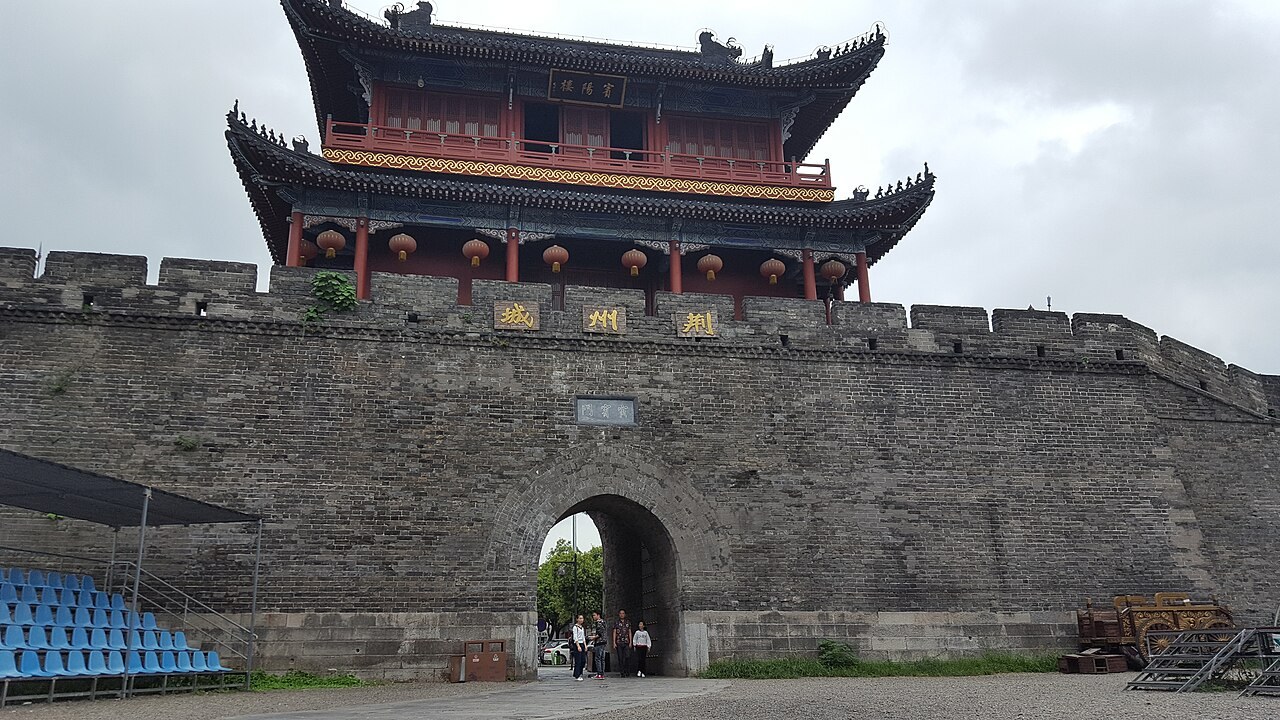
Jingzhou’s Binyang Tower in August 2017; present visitor arrangements may differ.Photo: Fxqf · CC BY-SA 4.0 · Image credits
Excavated Chu and Han objects, especially lacquer and bronze traditions · Western part of Jingzhou’s old city
2–3 hours, adjusted to the galleries actually open · Basic museum visit is free under published guidance; special exhibitions or guiding may cost extra.
Layered gate defences, brickwork and a short elevated city view · Eastern edge of the old city, separate from the museum
1½–2½ hours with surrounding streets · Select the wall/Binyang Tower admission you want; boats, sightseeing vehicles and other buildings are separate or bundled products. The operator’s published support number is 0716-8455077; ask for the current Binyang Tower / wall product.
An excavated burial landscape with chariot-and-horse remains · Outside the city, northwest toward Chuandian
A separate half-day outing plus round-trip road travel · Paid archaeological-site admission; confirm the current open halls, price and entry time before booking a return car.
A complete city day; archaeology earns a second
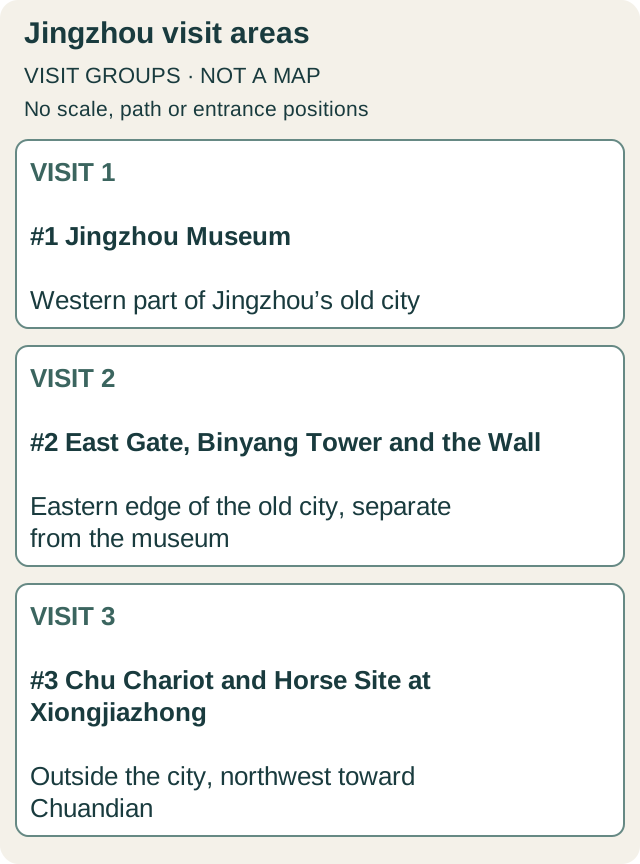
Open full-size map ↗. Not to scale. Museum and east gate are in the old-city group. The chariot site is outside town toward Chuandian; this line is not a walk or a checked bus route. This is an editorial relationship diagram, not a navigation map; box position does not encode distance or an entrance. ChinaMile diagram; location sources. Navigation: search the Chinese name in Amap.
The museum and east gate are the two main pieces of a first city visit, on different sides of the old city. Use a local transfer between them if a cross-city walk would consume your energy. The chariot site is a separate rural excursion with its own transport agreement.
Choose one full day and two nights if you want an introduction to Chu culture and the wall. Choose two full days and three nights if archaeology is a primary interest. Shashi’s modern commercial and riverfront area is another part of Jingzhou; it is not the old-city hotel district used in this plan.
Choose the old-city edge for this visit
East gate / old-city edge: useful for an evening view of the fortifications and a straightforward road pickup. Check noise near busy roads or event areas before choosing a room.
Near the museum in the western old city: useful when the museum is your main priority and you want a quiet morning start. Compare nearby dinner options and the hotel’s actual entrance.
Shashi: choose for modern commercial facilities or a different purpose, accepting extra transfers for this historic itinerary. Jingzhou railway station is practical for an early train. These are area choices, not named hotel endorsements; confirm passport check-in and room access with the property.
A local breakfast and a shared Hubei dinner
Try a bowl of 早堂面 zaotang mian if you enjoy a substantial savoury breakfast; broth and toppings vary and can contain pork, chicken, freshwater fish or eel. Order a small portion before a museum morning.
For dinner, consider 荆州鱼糕 fish cake, a steamed preparation commonly combining fish with other ingredients, alongside a vegetable dish and rice. It is not automatically suitable for someone avoiding pork or egg, so ask the kitchen. A cooked freshwater-fish dish is another option: confirm species, price per weight and portion before ordering.
Eat near the old-city base after the wall. For the chariot excursion, have breakfast first and carry drinking water; agree whether your return plan includes a lunch stop instead of depending on an unknown rural restaurant.
One room, two adults and explicitly priced transfers
For two adults sharing one room, one full day and two nights, use 2R + A + T + ¥480–720. R is the nightly shared-room quote, A is the combined arrival/departure ground transport, and T is the actual pair’s selected wall/interior tickets. Basic museum admission is free; special exhibitions and guiding are not assumed free.
The editorial allowance is ¥300–440 food from arrival dinner to departure breakfast, ¥80–120 local transfers and ¥100–160 drinks/contingency. Exclude intercity rail or flights, shopping, boats, performance tickets and paid guides.
With example inputs R = ¥300, A = ¥100 and T = ¥100, the pair’s total is ¥1,280–1,520. These are planning examples, not live hotel or attraction quotes.
For two full days and three nights including the chariot site, add R + C + X + ¥240–360: C is the agreed return car total and X the two archaeological-site admissions. If R = ¥300, C = ¥300 and X = ¥170, the addition is ¥1,010–1,130 and the full stay becomes ¥2,290–2,650 for the pair. Replace C and X with actual quotes; they are not verified tariffs.
Objects, defences and burial archaeology
1. Jingzhou Museum · 荆州博物馆
Use the museum to understand what makes this region distinct before looking at its city wall. Focus on a few galleries rather than every label: bronze vessels, lacquered objects and writing on bamboo or wood can show different aspects of ritual, daily life and administration. The exact works available depend on the current displays.
A recent museum notice restricted most of the main exhibition building for renovation; its exceptions were the Phoenix lacquer-mural hall in part, the prehistory exhibition and the bronze exhibition. Do not assume the full older exhibition list has reopened simply because an announced work period ended. Check the 荆州博物馆 official WeChat notice before travel and ask which galleries are available. If only a small section is open, shorten the visit and give the old city more time; serious archaeology visitors can instead use a confirmed-open chariot-site day.
Hours
Published regular hours are Tuesday–Sunday 09:00–17:00, with Monday closure except public holidays. Plan morning entry; verify current last entry and gallery restrictions rather than arriving near closing.
Tickets
Basic museum visit is free under published guidance; special exhibitions or guiding may cost extra.
Time
2–3 hours, adjusted to the galleries actually open
Chinese address
荆州市荆州区荆中路166号
Getting there
Take a local taxi or current bus to 荆州博物馆 on 荆中路, not an unrelated city museum in another district.
How to visit
The published directory says individuals need no advance reservation, while groups must arrange entry. Passport processing was not tested: carry the original document and ask the museum at 0716-8494808 if advance handling is needed. Paid English guiding is advertised, but availability requires confirmation, not assumption.
2. East Gate, Binyang Tower and the Wall · 荆州古城东门 · 宾阳楼
The east-gate area gives the most immediate sense of Jingzhou’s fortifications. Look at the relationship between gate openings, enclosing walls and the space around them, then climb the authorised tower or wall section when open. A short, attentive visit is more useful than treating the entire circumference as a compulsory walk.
Binyang Tower was rebuilt in the modern period in a historical style, so distinguish the present tower from the much longer story of the defences. Nearby Zhang Juzheng’s former-residence attraction is an optional separate interior for visitors interested in the Ming statesman; it should not displace the museum by default.
Hours
Use daylight for the wall and stairs. Check the operator’s current admission window and open sections; shows and evening activities have separate schedules.
Tickets
Select the wall/Binyang Tower admission you want; boats, sightseeing vehicles and other buildings are separate or bundled products. The operator’s published support number is 0716-8455077; ask for the current Binyang Tower / wall product.
Time
1½–2½ hours with surrounding streets
Chinese address
荆州市荆州区荆州古城东门;宾阳楼
Getting there
Transfer from the museum to 宾阳楼 / 东门. Choose walking only if the weather and your energy suit the distance across the old city.
How to visit
At the official ticket desk, ask which wall section is included and where to descend. Stay within authorised sections. If stairs are unsuitable or the upper section is closed, use the ground-level gate and moat-side views, followed by a seated meal.
3. Chu Chariot and Horse Site at Xiongjiazhong · 楚王车马阵 · 熊家冢
This is the extra visit for people who want archaeology beyond museum cases. The chariot pits and horse remains are evidence of burial practice and rank; they are not another terracotta army. Look at the arrangement of the pits and the relationship between burial structures, rather than expecting a series of intact underground rooms to enter.
The distance from the old city is the main trade-off. Keep the excursion on a separate day so you can spend time at the displays and return without rushing for a train. Outdoor portions can be exposed, while the excavated remains are protected; choose footwear for the whole site, not just a museum floor.
Hours
Plan a morning visit after confirming same-day operation. This guide does not assert a checked seasonal timetable or a guaranteed tourist shuttle.
Tickets
Paid archaeological-site admission; confirm the current open halls, price and entry time before booking a return car.
Time
A separate half-day outing plus round-trip road travel
Chinese address
荆州市荆州区川店镇张场村;楚王车马阵景区
Getting there
Arrange a licensed car with an explicit round-trip quote through your hotel or a recognised booking service. Set 楚王车马阵游客中心 as the meeting point and include the return to your hotel.
How to visit
Before leaving, agree pickup time, waiting arrangement, total charge and a reachable contact. If admission or a reliable return cannot be confirmed, keep the old-city day; do not travel out expecting a taxi to be waiting at the gate.
Let museum access determine the order
Arrival evening · night 1: check in, have dinner and confirm the museum’s available galleries and current entry arrangement.
First full day · night 2: visit the museum in the morning, have lunch, then transfer to the east gate for Binyang Tower / the authorised wall section and surrounding streets. Return to your base for dinner. On a museum closure day, switch the order only if the following day has enough time; otherwise choose the old-city exterior plan with an accurately reduced museum expectation.
For the short version, depart the next morning. For the extended version, second full day · night 3: take the confirmed round-trip car to the chariot site, visit the open displays and return to the old city. Keep the afternoon flexible for rest, a meal or a previously missed interior.
Departure morning: collect luggage and transfer to Jingzhou station or the exact airport on your ticket. The countryside excursion does not belong immediately before a tightly timed departure.
Save 荆州, not a similarly named station
Search Jingzhou 荆州 on 12306 and check the train for your date. Jingmen 荆门 is a different city. For an available flight, Jingzhou Shashi Airport 荆州沙市机场 is an outside-city arrival; compare its full ground transfer with rail before choosing.
Use a licensed taxi with the hotel’s Chinese address for the first arrival. Within the city, use walking for a selected gate/streets section and taxis or current buses between the western museum and east gate. A sightseeing vehicle is an optional operator product, not essential transport for this itinerary.
For the rural site, the same-day return must be arranged before departure from town. For intercity departure, ask the hotel to arrange pickup to the station on your ticket, allowing time for road conditions, security and platform access.
Museum access is narrower than a collection list
Sources were read on . The ancient-city operator establishes the gate and wall choices; the Hubei tourism authority describes the excavated chariot site. The museum’s published guidance and recent restriction notice support a morning visit with explicit gallery confirmation.
The museum homepage could not be retrieved reliably in this check. We therefore do not claim that its full galleries have reopened or that a foreign-passport entry or guide booking was tested. Use the official 荆州博物馆 account and published phone for those details. Day order, visit lengths and all sample budget inputs are editorial estimates.