Yuncheng Understand the salt city, then spend a separate day with its great temple.
Yuncheng is a practical base for southern Shanxi’s architecture, but the city deserves a day of its own. Its museum places the region’s early cultures, salt economy and timber buildings in context. At the southern edge, the salt temple and the open lake explain why settlement and trade grew here. A bowl of local noodles or lamb soup brings the history back to everyday life.
Choose two full days and three nights: one for the city and salt lake, another for the Guandi ancestral temple at Jiezhou. This suits travellers interested in Chinese material culture who are comfortable using taxis and some translated booking help. For a more compact historic town that you can explore largely on foot, compare Pingyao; for a larger collection and a broader urban base in Shanxi, consider Taiyuan. Yuncheng’s famous county monuments are spread over a wide area, so adding more names without more days mostly adds driving.
A major temple axis, roof details and the long cult of Guan Yu · Jiezhou town, southwest of central Yuncheng
2.5–3 hours at the temple; reserve a separate excursion day · Published April–October ordinary adult admission ¥60; other Guandi sites are separate.
Keep one city day and one Jiezhou day
The city day links Yuncheng Museum with Chishen Temple, the salt museum and a short lake viewpoint stop. These are urban and lake-edge clusters connected by road, not one continuous pedestrian trail. The Jiezhou day gives the ancestral temple a full morning, a local lunch and an uncomplicated return to the same hotel. You keep two evenings for ordinary city meals rather than returning from a county circuit after dark.
With only one full day: choose the main museum in the morning and either the salt-culture pair or Jiezhou after lunch. The city-and-salt choice is the default because it leaves more room to understand Yuncheng itself. If the temple is your principal interest, make it the day’s focus and accept that the museum-and-lake route is a separate visit. Do not promise all four numbered stops between two trains.
With an additional day and night: Yongle Palace in Ruicheng offers a different reason to extend the stay—Yuan-period architecture and wall paintings. It is a county road trip, not a city sight or a spare hour after Jiezhou. Use the municipal Yongle Palace profile to identify the correct site, then secure its current ticket and a full return before adding the day. The two-day budget below excludes that excursion. Yongji’s monuments and farther county temples need their own choices too.
Season: spring and autumn are the most comfortable editorial choices for courtyards and exposed lake viewpoints. Summer needs water, shade breaks and a shorter lake stop; winter calls for warm layers and an earlier return. Treat lake colour, migratory birds, flowers and festival programmes as bonuses, not guaranteed reasons for a fixed date.
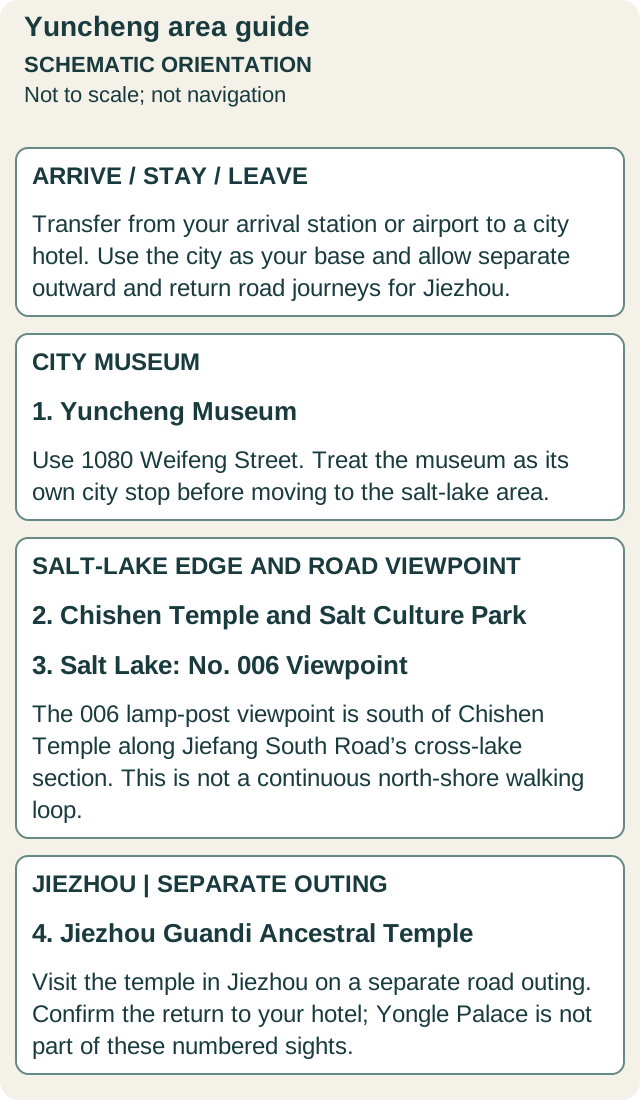
Open full-size area diagram ↗. Numbers match the guide. Named directions show broad areas; box positions do not encode geography. This schematic is not to scale or suitable for navigation, and does not prove access or current operation. ChinaMile editorial diagram; guide sources. Navigation: search the Chinese name in Amap.
Base yourself in central Yanhu, not at a remote monument
Central Yanhu around Nanfeng Square 南风广场 and the established city streets is the default for three nights. It gives you a choice of meals and straightforward taxi pickups for the eastern museum, southern lake and southwestern temple. The sights are spread out, so a central base is a compromise for the whole stay rather than a promise of walking to everything.
Near the museum and eastern urban avenues suits a modern hotel and a museum-led visit, at the cost of longer rides to the salt lake and Jiezhou. Near Yuncheng North station only wins for a very early departure. Jiezhou town or Ruicheng makes sense for a longer architecture-focused itinerary with several days in that area; changing hotels for this two-day plan adds packing and does not remove the need for transport.
Use the Yuncheng hotel search with three nights, two adults and one room. Keep the map in central Yanhu District: search results can include hotels far out in Yuncheng’s counties. Compare the total room price, cancellation and the actual entrance. Confirm passport registration with the property and ask for a Chinese address and a morning car pickup point. No individual property is endorsed or inspected here.
Eat in the city, and save the lamb soup for Jiezhou
For a city breakfast, Donghu morning market 东湖早市 is an optional place to see buns, fried cakes and filled flatbreads being sold. Go for a modest breakfast rather than a checklist of snacks; exact stall hours are not fixed in this guide. If it is inconvenient from your hotel, a nearby noodle or bun shop keeps the museum morning simple.
In Jiezhou, look for yangrou pao 羊肉泡: lamb and broth with pieces of flatbread, eaten as a substantial meal. Ask how the bread is served and whether chilli is added. Do not assume it will match the denser version you may have eaten in Xi’an. This is a sensible lunch after the temple, before your arranged return.
For a city dinner, Yuncheng-style dapanji 大盘鸡 combines chicken, potatoes and noodles in a shared dish. Two people should ask for the smallest suitable portion and its price before ordering; a large plate plus several other main dishes can be excessive. A simple noodle meal with a vegetable dish is the easier alternative. Wenxi zhubing 闻喜煮饼, a sweet sesame-coated local pastry, makes a small take-away purchase; ask about ingredients and buy a small pack first. Food names do not establish vegetarian or allergy suitability, so confirm the preparation that matters to you.
The numbered places, with time to look
1. Yuncheng Museum · 运城博物馆
Start here to make sense of the places beyond Yuncheng. The main permanent display, East of the Great River 大河之东, moves through the region’s archaeology, material culture, salt industry and architecture. The “river” is the Yellow River, and Hedong—east of the river—is the historical regional name that appears repeatedly on local signs.
Choose the early archaeology, salt and building sections for this itinerary. Models help you understand the timber structures you will later see at Jiezhou, while objects and reconstructions connect the lake to a long history of production and administration. Do not confuse a model or reconstruction with the original monument, and do not assume that a branch exhibition described on the website is housed in the main museum.
The official visitor guide lists English audio devices for hire at the desk and accessible circulation. Ask what is available that day before committing to a rental or guide. The museum’s main-city context is useful even if you add no further county excursion.
Hours
Tuesday–Sunday 09:00–17:00, last admission 16:00. Normally closed Monday except national holidays. A specific current museum notice can change this pattern.
Tickets
Basic admission is free. The older general visitor rules list valid documents, including passports; more recent museum notices require real-name timed reservation. Carry the passport and reserve rather than interpreting the older page as permission to walk in.
Time
2–2.5 hours
Chinese address
运城市盐湖区魏风街1080号 运城博物馆
Getting there
Take a taxi or booked ride from central Yanhu to the Weifeng Street museum. The main museum is separate from the salt museum by Chishen Temple and from the Guandi and Yongle Palace branches outside the city.
How to visit
Find 运城博物馆 on WeChat and open 运城博物馆实名制分时预约系统; choose the intended date and time. If the document field will not accept your passport, contact the published visitor desk at +86 359 6359888 during Tuesday–Sunday 09:00–16:00 for the accepted assistance procedure. A passport is explicitly a valid admission document, but that does not prove every online field or an unreserved entry will work.
2. Chishen Temple and Salt Culture Park · 池神庙 / 河东池盐文化博览园
The temple is the clearest expression of the lake’s importance to the city. Its setting above the salt water and its ritual architecture make sense once you recognise salt as a commodity that generated wealth, taxes and a need for administration. Take time with the courtyards and views; this is a different subject from Guan Yu’s military and moral reputation at Jiezhou.
The adjacent salt museum explains production techniques, trade and the changing management of the lake. Look for how divided salt pans and controlled evaporation changed the landscape, then compare those explanations with the actual water outside. The wall and museum component is a modern visitor offering alongside the historic temple, and the various tickets do not all include the same spaces.
The two city museums overlap on salt history but have different roles. Yuncheng Museum gives the regional overview; this stop concentrates on the salt landscape itself. If you are tired of galleries, select the temple alone and spend the saved time outdoors. A Monday visit needs that deliberate choice because the salt museum’s routine closure applies even though the surrounding city remains open.
Hours
The published April–October policy is 08:30–18:00, last ticket check 17:30. The salt museum normally closes Monday; that closure is distinct from the temple’s schedule. For a winter visit, obtain the current gate hours rather than carrying the summer evening closing into winter.
Tickets
The ordinary adult combination is ¥50 in the published summer policy; temple alone ¥35, salt museum with wall ¥40. Buy the combination only if the museum and wall are operating and you want both. Special events and other experiences are separate.
Time
1.5–2 hours; shorten for temple-only access
Chinese address
运城市盐湖区解放南路386号 池神庙 / 河东池盐文化博览园
Getting there
Take a taxi from the main museum or lunch area to the currently operating visitor entrance. Tell the driver 池神庙, not 运城博物馆; these are separate institutions. Ask the ticket desk which exit gives the easiest road pickup.
How to visit
The operator policy offers a staffed ticket office as well as commercial platforms. Ask for 池神庙和池盐博物馆联票 if doing both; show the original passport and confirm the document procedure before payment. The Ctrip temple listing gives +86 359 6391269 for visitor enquiries. If the museum is closed, choose temple-only admission or move the combined visit to a different day.
3. Salt Lake: No. 006 Viewpoint · 运城盐湖006号灯杆观景台
After the salt museum, the lake gives the story scale. The mountain backdrop, separated pools and broad sky are the experience. At ground level, the colours can be subtle; strongly coloured aerial photographs are not a promise of what every visitor will see from a roadside platform. Light, water conditions and season change the view.
No. 006 is a specific stop on the publicly described Jiefang South Road sightseeing route. It is useful precisely because you can make one short visit and return, without confusing a large lake with a walkable single park. Keep water, sun protection and an extra layer appropriate to the weather; there is little reason to stay exposed if the wind is unpleasant.
East-shore duck-pond wetlands, tourist trains, boats and commercial bathing facilities are different choices. Their tickets, entrances and operating conditions are not included in this short viewpoint visit. Stay out of the water and restricted production or conservation areas.
Hours
Visit in daylight at an open, permitted platform. Weather, barriers or temporary traffic restrictions override the plan. This is not an enclosed attraction with a verified daily admission timetable.
Tickets
No paid boat, train, bathing or evening-show product is required for the viewpoint stop described here. Do not buy a broad ‘salt lake’ package thinking it is necessary just to look at the lake from the public route.
Time
45–60 minutes
Chinese address
运城市解放南路跨湖段 盐湖006号灯杆观景台
Getting there
Arrange a taxi or car from the Chishen Temple area to a legal stopping place at the viewpoint, with waiting and the return to your hotel agreed. The official sightseeing route continues toward No. 22 dyke and another viewing platform; this short plan stops at No. 006.
How to visit
Use the permitted platform and nearby open paths, returning to the same agreed pickup. Do not walk the full cross-lake road to collect every viewpoint, stop in a traffic lane, or enter closed salt pans. If your driver cannot make a legal stop or the platform is closed, keep the lake view at the salt-culture park and return to town.
4. Jiezhou Guandi Ancestral Temple · 解州关帝祖庙
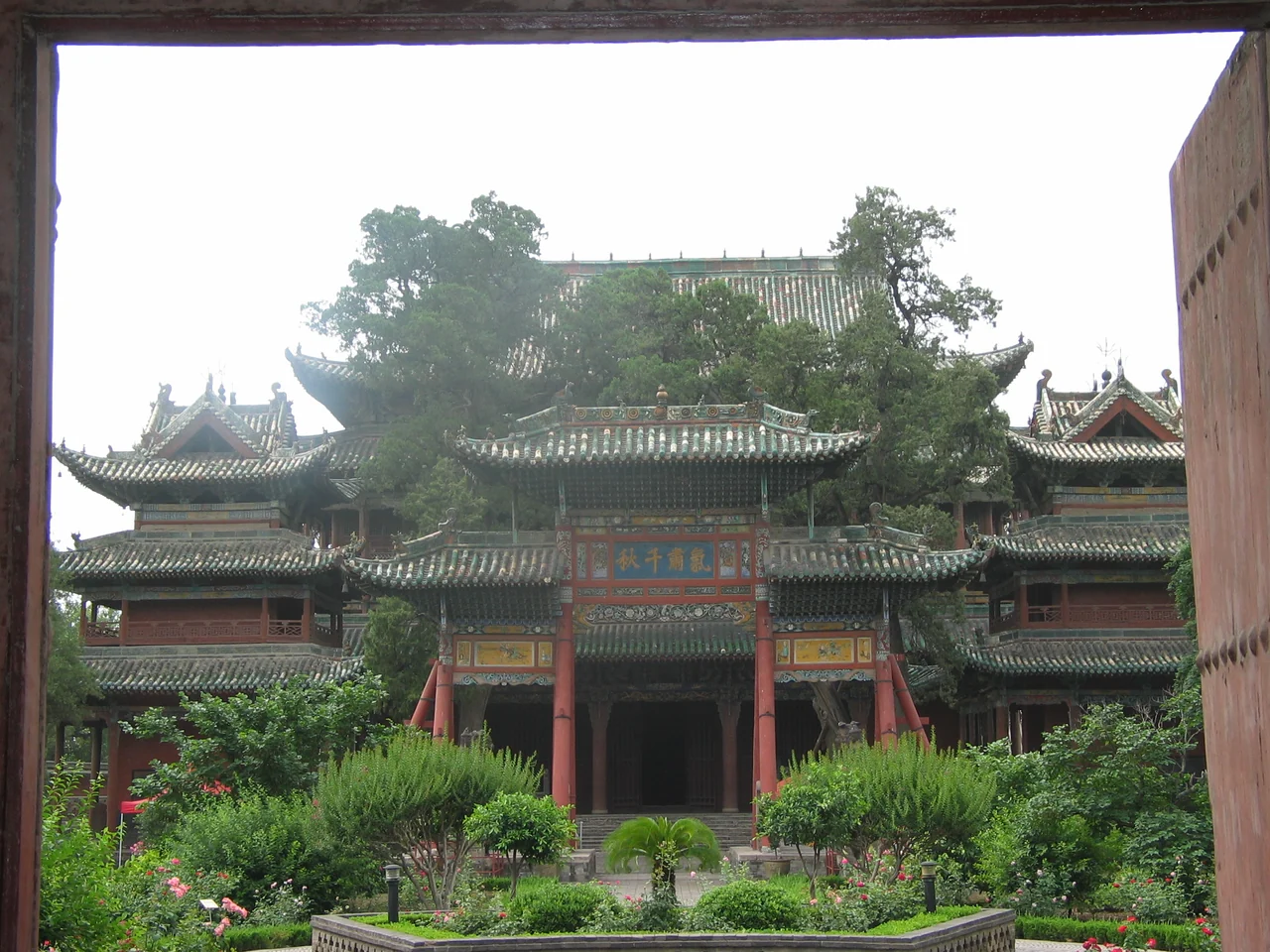
The temple turns the story of Guan Yu into architecture on a grand scale. The historical general became a widely worshipped figure associated with loyalty and righteousness. Walk the main sequence slowly: the gathering spaces and gates, the halls and the more concentrated detail around Chongning Hall and Chunqiu Tower.
Look up at the roof ridges and timber brackets, then down at carved stone and inscriptions. The founding tradition is much older than the buildings now standing: the visible complex carries substantial Ming and Qing rebuilding. Treat it as an accumulated sacred landscape rather than an untouched building from its earliest recorded foundation.
Allow enough time to look from more than the central axis, but follow the open visitor route. Access to an upper storey, a special hall or a separately sold experience should not be assumed from the basic ticket. Ask at the gate if one of those is important to you. The ordinary temple visit is already the reason for the excursion; the giant statue and Changping family temple are optional separate destinations, not compulsory parts of a single entry.
Have lunch in Jiezhou before returning to the city. This gives the visit space without forcing another distant monument into the afternoon. A separate day is also easier to swap with the museum day if your stay crosses a Monday.
Hours
Published April–October hours are 08:00–18:00. The earlier operator winter policy uses 09:00–17:00 in November–March; reconfirm the current seasonal notice. The route targets 09:30 and finishes well before either closing, rather than relying on a disputed last-entry minute.
Tickets
The published summer ordinary adult ticket is ¥60. A previous winter operator policy lists ¥50; treat that as the published seasonal baseline and confirm your dated purchase. Changping family temple, the giant statue site, shows and any optional interior experiences are different products.
Time
2.5–3 hours
Chinese address
运城市盐湖区解州镇五一路145号 解州关帝祖庙
Getting there
Book a round-trip car from the same central Yanhu hotel, with waiting and the lunch stop included. The municipal visitor page also lists bus 11 from 运城火车站 toward the temple, at a published ¥3 fare; that is the central conventional station, not 运城北站. Current departures and the final return must be checked at the stop before relying on the bus.
How to visit
Use the WeChat mini program 运城关公故里文化旅游景区, the Guandi scenic-area ticket listing, or the staffed ticket office. Select ordinary entry for 解州关帝祖庙. The operator-published ticket number is +86 359 2808369; ask how your passport will be recorded if an online form fails. Carry the original document and settle admission before paying for a non-refundable car booking.
Two full days without a county-to-county race
Arrival evening: settle into the central Yanhu hotel, eat nearby and save the museum booking. Confirm the Jiezhou ticket method and round-trip car total. Put the city museums on an ordinary Tuesday–Sunday. If the first full day is Monday, do the already-confirmed Jiezhou day first; a holiday opening notice may alter that order.
City day: have breakfast near the hotel or at Donghu morning market, then take a taxi to Yuncheng Museum for a 09:00 slot. Give it 2–2.5 hours. Eat lunch in town, then reach the salt-culture park around 13:30 for the temple and salt museum. Around 15:30–16:00, take the prearranged ride to the No. 006 viewpoint for 45–60 minutes, returning from the same legal pickup to your hotel. In winter, shorten the park visit or omit the viewpoint if daylight or wind makes it unsuitable. Have dinner in the city and keep your second night there.
Jiezhou day: choose a hotel pickup that the driver confirms will reach the ancestral temple around 09:30; allow the actual road time when quoting. Spend 2.5–3 hours inside, have lunch in Jiezhou and meet the driver at the agreed visitor-centre pickup around 14:00. Return directly to the city. The afternoon then belongs to a rest, a short neighbourhood walk or an early dinner, rather than an unplanned transfer to Ruicheng. Keep the third night and leave by rail the following morning.
If the main museum reservation fails: ask the official desk for passport assistance before travelling across town. If no slot is available, start with the salt-culture park around 09:30, eat lunch in the city, rest, and make the short viewpoint visit while daylight remains. That is a slower salt-focused city day; move the main museum to a confirmed later slot only if your stay allows. It is not an automatic substitute for an archaeology-led visit.
If the salt museum is closed: buy temple-only entry if the temple is open, then keep the viewpoint and city meal. If neither indoor visit is available and the weather is poor, use the confirmed Jiezhou day first or shorten the visit; do not turn an exposed lake circuit into an all-weather replacement. If a viewpoint is closed or there is no safe legal stop, retain the lake view from the salt-culture park instead. A transport cancellation means staying with the city plan until a full return is secured.
Distinguish Yuncheng North, the city station and the temple bus
Yuncheng North 运城北 is the high-speed railway gateway used for this plan. Yuncheng 运城 is the separate central conventional station. Search both accurately in China Railway 12306 using your origin, date and destination; inspect the actual departure station at the other end too. Do not confuse Shanxi’s 运城 with similarly romanised destinations elsewhere.
From Yuncheng North, use the official taxi rank or a booked ride to the central Yanhu hotel. The driver needs the hotel’s Chinese address, not just “city centre”. For departure, allow the actual road journey plus a station margin; aiming to arrive about an hour before the train is a useful planning allowance for security and possible passport assistance, not the official boarding cutoff. Book with the passport identity you will carry. If 12306 identity verification or payment fails, use railway assistance or a staffed station counter.
For Jiezhou, the default is a prearranged return car. Send 运城城区酒店 → 解州关帝祖庙 → 解州午餐 → 运城原酒店. Ask for a written total covering both directions, waiting, tolls, parking, the exact pickup and an end time. Keep the driver’s number. A one-way taxi quote does not reserve the ride home. Do not schedule a same-day departing train against an assumed road time.
The public-bus alternative: the municipal profile lists bus 11 from 运城火车站 toward 解州关帝祖庙 at ¥3. This is not a direct departure from the high-speed North station. At the central station stop, show the temple name and have staff or the driver confirm the right direction, alighting stop and that day’s final return to the city. The profile’s timetable is not treated as a live dispatch record. If the return is unclear, use the quoted round-trip car or postpone the temple excursion.
For the lake: agree a short return ride with waiting to 盐湖006号灯杆观景台. The city museum, salt park and lake viewpoint each need a separate pin. Save the legal pickup before getting out; the cross-lake road is not a convenient place to wait for an uncertain late-evening ride.
A worked three-night budget, with the temple car visible
For two adults sharing one room, three nights and two full days, use 3R + C + 2G + 2S + ¥780–1,080. R is the actual nightly room price; C the agreed Jiezhou return-car total; G the ancestral-temple ticket per adult; S the salt-culture ticket you choose per adult. The allowance covers ¥420–560 for meals from arrival dinner through departure breakfast, ¥240–360 for station transfers and city/lake rides, and ¥120–160 for drinks and contingency. All transport and meal allowances are estimates, not verified quotations.
Using illustrative inputs R = ¥300 and C = ¥300, with the published April–October ordinary tariffs G = ¥60 and S = ¥50 for the salt combination, the total is 3 × ¥300 + ¥300 + 2 × ¥60 + 2 × ¥50 + ¥780–1,080 = ¥2,200–2,500 for two. The official tariffs and the sample hotel/car inputs are deliberately separate. Replace C with the full accepted quote; if the quote is ¥150 higher, add ¥150 to the total.
Yuncheng Museum’s basic admission is free. Choosing only Chishen Temple at the published ¥35 instead of the ¥50 salt combination reduces the pair’s example by ¥30. A winter trip needs the current seasonal ticket totals entered in G and S. The viewpoint plan does not require a paid lake activity.
Intercity transport, guides, optional tower or hall experiences, performances, bathing, boats, shopping and Yongle Palace or other county excursions are excluded. An extra Ruicheng day adds another room night, meals, its own admission and a separate return-car quote; it is not covered by the Jiezhou allowance.
Reserve the museum, then settle the correct temple ticket and return
For Yuncheng Museum, use its WeChat real-name timed system and carry the original passport. If the online form fails, the official visitor-help number is +86 359 6359888. Ask: 我们持外国护照,无法在线分时预约。请问可用的预约和人工核验方式是什么? — We hold foreign passports and cannot complete the timed booking; what reservation and staff-verification method can we use? The general guide’s passport list establishes a valid document, not a successfully tested online reservation or permission to ignore current booking notices.
For Jiezhou, select 解州关帝祖庙普通成人票 in the official scenic mini program or the commercial ticket listing. The operator’s ticket phone is +86 359 2808369. Ask for the current seasonal ordinary fare, passport procedure and visitor entrance before confirming the car. The published policy also provides on-site ticket purchase with an identity document; the desk must confirm how your passport is handled. A Changping family-temple or giant-statue ticket does not book the ancestral temple.
For the salt-culture park, the published policy provides on-site ticket sales. Choose temple-only or the temple/museum/wall combination according to what is open. If a commercial form rejects your passport, use the staffed desk and ask for ordinary admission before paying another seller. If admission cannot be issued, return to the city meal and permitted lake-view plan; do not buy an unrelated spa or night-show package.
Once tickets are workable, confirm the driver’s complete return and the hotel dates. If no acceptable temple ticket method or return transport is confirmed, keep the city route and shorten the stay. A published telephone number is a place to get help, not evidence that this guide has made a call or secured a reservation for you.
Sources and operating boundaries
Sources reviewed on . The museum’s official visitor guidance supplies 09:00–17:00 hours, the 16:00 cutoff, passport recognition and the help number. More recent museum notices supply the timed-reservation requirement; the older general rules are not used to waive it. The official museum description distinguishes the city collection from its separate Guandi and Yongle Palace branches.
The summer tariffs come from the operators’ published policy and the municipal tourism department’s route information. The earlier winter Guandi policy is identified as an older seasonal baseline, not a newly verified winter announcement. Commercial listings supply specific ticket/contact options. No telephone call, foreign-passport transaction, hotel registration or live bus departure was tested. Route durations, base choices, seasons and budget allowances are editorial judgments; current notices and issued bookings control your actual visit.