Yuanyang Rice Terraces Choose one mountain base and let the light, crop and roads set the pace.
Yuanyang’s terraces are not a single lookout. Fields contour whole mountain basins, with villages between forest above and water-fed cultivation below. A fine morning can turn flooded plots into a patchwork of sky; another season brings growing rice, harvest or bare working fields. The lasting interest is how people keep that landscape alive, not whether one sunrise resembles a brochure.
For a first independent visit, stay three nights near Duoyishu or Pugaolaozhai for two complete days. Use one morning for Duoyishu, an afternoon for Bada and a separate daylight visit for Qingkou village, with meals and rest at the base. Leave the other morning flexible for a clearer safe view. Choose Shengcun for a more service-oriented mountain base, accepting driven morning visits; use old-town Xinjie when town services matter more than a view at the door.
This is a road-linked landscape visit, not a compulsory long trek or a claim that the named viewpoints connect by easy terrace paths. Nansha, the lower new county town, is different from old-town Xinjie and the high terrace lodging areas. Laohuzui is an optional, separately confirmed outing; the default plan does not depend on it opening.
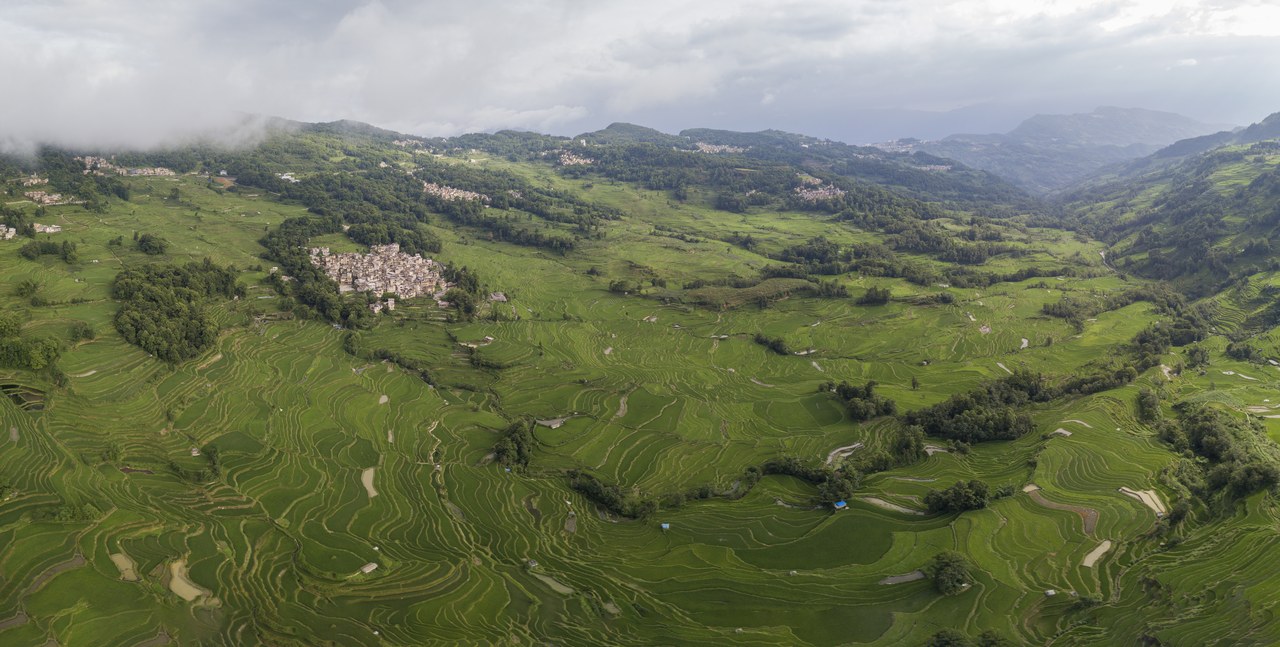
The Bada area of Yuanyang’s Hani rice terraces, photographed in June 2018. This historical green-season panorama is not Duoyishu or Longji and does not promise today’s crop colour, water or visibility.Photo: Chensiyuan · CC BY-SA 4.0 · Image credits
Layered fields, morning light and a mountain basin dotted with Hani and Yi villages · The morning-view side; Duoyishu / Pugaolaozhai is the default overnight area
One unhurried morning, then breakfast and village time · Use the issued Hani terrace admission and confirmed gate procedure; a room’s view does not include a paid platform.
A broad panorama of terraces descending across a much larger valley · A separate road visit from Duoyishu or Shengcun
A half-day outing or a deliberately arranged late-afternoon visit · Confirm this viewpoint is covered by the issued admission and the current final-entry/return arrangement.
Village lanes, traditional building forms and the relationship between forest, settlement, water and fields · The Qingkou / visitor-centre side; a distinct village visit
Allow a half day including road travel and interpretation · Ask which village areas, displays or guide services operate and whether any separate payment is required.
A sharply dropping basin of cultivated terraces and a different late-light composition · Another road branch; conditional access, not a required stop
A separate half-day or an alternative late-afternoon outing · Confirm the actual platform or path open to visitors on your date; do not assume all historic levels operate.
Separate the county town, mountain bases and viewpoints
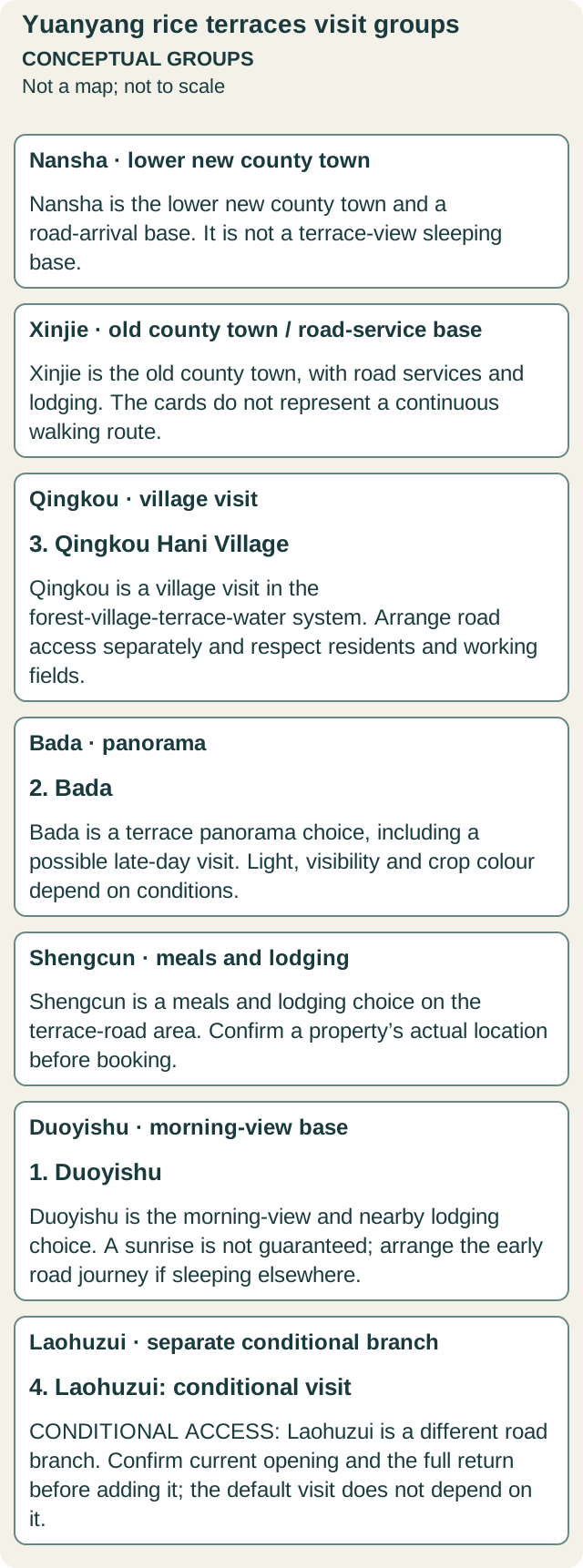
Nansha / 南沙 is the lower new county town and a possible intercity transfer point, not the default terrace-view overnight. Xinjie / 新街 is the old county town on the mountain road network, with a different lodging and service role. Qingkou, 3, is a separate village visit near the visitor-service side. Bada, 2, supplies a broad valley panorama. Shengcun / 胜村 is a mountain service-and-lodging choice. Duoyishu / 多依树 and Pugaolaozhai / 普高老寨, 1, suit a morning-view stay. Laohuzui, 4, lies on a different road branch and requires an operating-access check.
The area diagram names choices, not a scale route or a hiking network. Give the driver the Chinese viewpoint name and the actual hotel pin, then agree the return. Terrace banks are farm structures, not public shortcuts. Do not turn a map line, a hotel’s approximate distance or an old route blog into permission to walk through fields between basins.
Keep one base for the short stay. Moving from Xinjie to a terrace room can be worthwhile on a longer visit, but luggage, check-out and road time belong in the plan. A Nansha booking is not a cheaper equivalent of a Duoyishu room when pre-dawn views are the purpose.
Four choices, with one optional branch
1. Duoyishu Rice Terraces · 多依树梯田
Duoyishu is the first choice when you want a morning view over a basin of curving terraces. Watch how the narrow strips of field change with light and cloud rather than waiting only for a round sun to clear the horizon. A modest view from an appropriate room or signed nearby viewpoint can be more satisfying than a crowded platform when walking, timing or visibility is poor.
Use the previous afternoon to locate the real entrance and return. Have the property explain whether there is road access, a stepped approach or another final walk. Carry a light and warm layer for any agreed pre-dawn approach, but do not set off onto an unfamiliar terrace path in darkness. If the admitted platform is not opening before the light you want, use the property’s lawful view or a later morning visit; do not bypass the gate.
Hours
Ctrip lists the Duoyishu platform separately from the general scenic area. Confirm the actual first entry, sunrise-date timing and staffed admission before arranging a pre-dawn pickup. No fixed departure minute is promised.
Tickets
The price authority publishes a ¥70 ordinary-adult scenic reference. Confirm actual covered viewpoints and the issued validity dates; hotel balconies, guiding and vehicles are separate.
Time
Use one suitable morning, allowing for cloud, a comfortable breakfast and a rest afterwards. Clear sunrise, reflections and a front-row position are not guaranteed.
Chinese address
云南省红河哈尼族彝族自治州元阳县;多依树梯田观景区
Getting there
From a Duoyishu/Pugaolaozhai property, confirm the actual platform entrance and the road or stepped approach. A room with “Duoyishu” in its name is not necessarily at the admitted viewpoint.
How to visit
Confirmed property pickup or safe described approach → open staffed viewpoint → return to the same base for breakfast. A hotel panorama can be the better choice if early platform entry or access is unsuitable.
2. Bada Rice Terraces · 坝达梯田
Bada’s reward is the breadth of the cultivated valley: layer after layer reveals how the fields follow slopes and settlements. Compare the view with Duoyishu instead of expecting the same composition. Late afternoon is a useful option, but a clear, safe daylight window is more valuable than insisting on sunset in dense cloud.
Eat before leaving or carry a snack and keep dinner at the base. Book the return with a licensed driver who knows the actual pickup. If you do choose sunset, agree the return after viewing and the road’s current condition in advance. Anyone unwilling to use a mountain road after dark should visit earlier and be back before dark; the guide does not promise a last public shuttle timed to every sunset.
Hours
Confirm current admission hours and last entry with the staffed point. A general all-day landscape description is not permission for night access to a paid platform.
Tickets
Retain the actual ticket for checks at separate viewpoints. A priced admission does not supply a vehicle back to the room.
Time
Allow a half day including road travel, walking, viewing and the agreed return. Choose a safe daylight viewing window if a night road return is unsuitable.
Chinese address
云南省红河哈尼族彝族自治州元阳县;坝达梯田观景区
Getting there
Book a licensed out-and-back road service to 坝达观景台 from the actual hotel, with waiting or an exact return pickup. It is not offered as a through-field walk from Duoyishu.
How to visit
Hotel → Bada admitted entrance → open signed viewing areas → same vehicle or booked return → same hotel. Pick this or Laohuzui for one late-light outing rather than chasing both at sunset.
3. Qingkou Hani Village · 箐口哈尼民俗村
Qingkou changes the question from “where is the best photograph?” to “how does the place work?” Look at village building forms, paths and the position of water and fields. Interpretation, when available, makes the relationship between forest, village, terraces and irrigation much easier to understand. Living households are not automatically museum rooms.
Choose a modest permitted village circuit, with a guide or explanation arranged if that matters to you. Ask what is open and what the payment actually includes. Do not promise an interior, a water-powered mill demonstration, singing or a ceremony just because it appears in older descriptions. Ask permission for personal photographs and do not enter fields, alter water channels or climb a granary for a viewpoint.
Hours
Visit in daylight and ask the reception which permitted lanes, displays and interpretation are available. A heritage designation does not guarantee a daily performance.
Tickets
No free museum, house interior or guided tour is assumed. Request the village entry and selected interpretation total separately from scenic viewpoints.
Time
Allow a half day, including the road legs and time to listen. Shorten the visit rather than running across cultivated fields to save time.
Chinese address
云南省红河哈尼族彝族自治州元阳县新街镇;箐口哈尼民俗村
Getting there
Use the named Qingkou village/reception drop-off and arrange a return. The visitor-service area and a particular village entrance need to be distinguished in the car agreement.
How to visit
Reception → permitted village lanes and building details → a signed field-edge view if open → the agreed return. Ask before entering a home or photographing residents; leave channels and banks intact.
4. Laohuzui Rice Terraces · 老虎嘴梯田
Laohuzui gives a different, more sharply dropping terrace basin. It is a useful choice for a longer stay or an alternative late-light outing, only after its actual admitted viewing area and road approach are confirmed. A county report describes ticket assistance and visitors there in 2025, so a blanket claim that it has remained entirely closed for years is not a sound current conclusion.
That report is not today’s opening notice. Historic paths or lower levels may have different conditions from the admitted point. If visitor service or the driver cannot establish a safe, operating visit, omit it and use Bada or the near-base view. Do not make all four selections a completion challenge, and do not ask a local driver to find an unofficial way into a closed slope.
Hours
Access is conditional. A 2025 county operating report describes visitors and ticket assistance, so old blanket closure statements are insufficient; it does not prove every platform is open now.
Tickets
Ask which viewing level is admitted, whether steps are necessary, the last entry and the exact ticket coverage before travelling out. No reopening date or current lower-platform access is invented.
Time
Use a separate agreed outing or replace Bada’s late-light visit. Do not add it after a full Bada sunset.
Chinese address
云南省红河哈尼族彝族自治州元阳县;老虎嘴梯田景区
Getting there
Ask for 老虎嘴景区, name the actual hotel and confirm the permitted approach with visitor service and the driver. Do not follow an old path into a closed slope.
How to visit
Confirmed operating entrance → only the admitted viewing level → the same pickup → hotel. If closed or unsafe, keep Bada or a near-base view; do not seek an unofficial descent.
Choose reflections, growing rice or village life deliberately
The county’s recurring guidance favours November to April for terrace viewing. In the watered period, open plots can reflect the sky and make the lines particularly clear. Water management is agricultural and varies by basin and plot; the same week does not guarantee the same reflection in every photograph. For a reflection-led trip, ask the chosen property for a recent dated view of its exact area before choosing non-refundable room terms.
During planting and the growing season, expect a working rice landscape rather than a continuous mirror. Green rice and village life can justify the visit even when the geometry is less visible. Around harvest, colour and cutting vary with the crop; do not import an exact annual harvest date from a previous year. Rain can bring lush growth and also poor visibility, slick steps or road disruption.
Sunrise, sunset and a sea of cloud are weather outcomes. Keep a second morning flexible, use the clearest safe opening for a view, and keep a village visit and meals in the plan. If only a perfect reflected sunrise would make the long road journey worthwhile, wait for the right seasonal evidence and flexible terms rather than accepting a guaranteed-photo promise.
Sleep near the view you want, with meals and a real final approach
Duoyishu / Pugaolaozhai: the default for three nights when a relaxed morning is the priority. Choose a property whose actual room or common area faces the fields you want. Confirm the vehicle endpoint, remaining steps, breakfast and dinner, heating or warm bedding, and the approach to the admitted platform. A panoramic label does not promise a particular season, sunrise angle or step-free arrival.
Shengcun: choose it for village services and meals with a mountain base, then book the Duoyishu and Bada road legs. Xinjie: choose old-town services and a clear road meeting point when those matter more than a view at the door; allow separate journeys to the main viewpoints. Nansha: use it deliberately as a lower-town or transit night, especially after a late arrival or before onward travel. It adds an ascent to a morning terrace visit and is not the default photography base.
Open Yuanyang accommodation search with two adults, one room and three nights. Filter the map or names for 多依树 / 普高老寨, or the specific alternative above. Check that you have Yuanyang in Yunnan / 云南元阳, not a similarly named place elsewhere. Before paying, contact the property about passport check-in, location, steps, meals, road pickup, room view and cancellation. No named property or room was tested.
If a vehicle cannot get to the room, arrange luggage help and its price in advance. When that final approach is unsuitable, choose a property at an accessible road endpoint or the Xinjie service base with suitable outings. A high room with a dramatic view can be the wrong choice for someone who needs an easy daily return.
Make the base part of the visit, rather than another transfer
Have dinner at or near the accommodation on arrival and confirm the next morning’s breakfast. On a Duoyishu morning, a warm breakfast after viewing is part of the reward. For a local-style shared meal, ask about Hani dipping-sauce chicken / 哈尼蘸水鸡 and red rice / 红米饭, with a cooked vegetable dish. The sauce can be pungent or hot; ask for it separately and agree the chicken portion and total before ordering. A whole bird may be too much for two.
On the Qingkou outing, return for lunch at the base or agree an actually operating village meal; do not assume every house serves food. Eat before a late Bada outing and keep dinner for the return. If a property cannot provide dinner, select one with an accessible nearby restaurant before committing to the room, rather than adding an unplanned night mountain drive.
For vegetarian needs, ask about stock, meat, lard and fish-based sauces even when ordering vegetables or rice noodles. Carry water and a snack for road visits. Food figures below are spending inputs, not sampled menus; no restaurant or allergy process was field-tested. Do not treat an invitation to a family meal or a festival banquet as a daily purchasable product.
Three nights for two complete days, with useful shorter choices
Arrival day · first terrace-base night: make the agreed intercity road journey, complete any actual visitor-service or admission step, reach the booked Duoyishu/Pugaolaozhai property and settle in. Take a short permitted daylight look near the base, locate the next morning’s meeting point and have dinner. Do not promise sunset after a variable long-distance arrival.
First complete day · second night: use Duoyishu’s confirmed platform or the property’s lawful view for a morning light window, then return for breakfast and rest. Keep the middle of the day modest: permitted village lanes near the base, lunch and time to understand the cultivated landscape. Use Bada for the afternoon’s separate road outing, with a return already booked; return before dark if that is your road-travel limit. Eat at the same base.
Second complete day · third night: keep another morning near Duoyishu if the first was clouded, or have a slow breakfast. Make Qingkou a separate daylight village-and-interpretation outing with its road return. After lunch, keep a near-base afternoon or, if access is confirmed and you want another driven view, choose Laohuzui instead of a second Bada evening. Do not attempt to walk all the numbered places.
Departure day: breakfast, luggage and the reserved road pickup to the named onward town or station. Keep the whole journey free of sightseeing detours when a fixed train matters. A vehicle sold only to Nansha has not completed a transfer to Jianshui station, Kunming station or an airport.
Two nights: one complete day is still useful. Keep Duoyishu in the morning, rest and lunch, then Bada with a complete return. Omit Qingkou or replace Bada with the village if culture is the priority. One night: it is an evening and a morning between road journeys, with a weather-sensitive view; it does not offer a full day or reliable recovery after a poor sunrise. For a first trip, three nights are more forgiving than chasing four viewpoints in one travel day.
Longer stay: add a night for interpretation, agricultural context or another safe viewing window, not to collect all photographic labels. An Azheke / 阿者科 village visit is a distinct paid and transport choice that can replace Qingkou or occupy an extra day; no automatic inclusion, daily programme or cross-field walking link is promised here.
Arrange the long road journey and every local return
Use Jianshui as a practical rail-and-town gateway if it fits the wider journey, then continue to the actual mountain accommodation by a licensed pre-booked car, or use a dated coach whose endpoint and onward connection you have established. The Jianshui guide makes a useful separate town stay. Use 12306 for the real Jianshui / 建水 rail order; there is no rail arrival at a terrace viewpoint in this plan.
Choose the endpoint: give the provider 云南元阳多依树 / 普高老寨 plus the property pin, or the deliberately chosen Shengcun/Xinjie base. State passengers, luggage and date. A service advertised simply as “Yuanyang” may mean Nansha, not your room.
For the simplest chain: ask the booked property to arrange or recommend a licensed Jianshui-to-room pickup and a separately priced return. Get the meeting point, driver contact, vehicle, total, tolls, parking, waiting and final room approach in writing. The budget uses an editable complete-return input, not a quoted fare.
For a public coach: ask the staffed Jianshui passenger station / 建水客运站 for the actual date’s service to 元阳南沙 or 元阳新街, distinguish the endpoint and reserve its separate onward mountain transfer before buying. Government reports establish road services, not a current departure board. Do not use an old “rolling departures” claim as today’s timetable or assume a coach passes the hotel.
For local visits: book Duoyishu, Bada or Qingkou from the actual base, each with waiting or a named return pickup. A pre-dawn service and a late-light return need express agreement. A daylight admission does not include a car home.
For departure: name the onward station or town, allow the provider’s current road margin plus rail check-in, and avoid a tight same-day flight. A night in Jianshui or Kunming before a fixed international departure is the more forgiving arrangement.
The county’s old scenic-bus trial explanation separates transport from admission. It does not establish that its historic route, first departure or fare still operates. Use a current staffed sales point’s confirmed service if it meets your visit; otherwise retain the licensed-car plan. A different route from Nansha can reach the scenic area without passing every old-town stop, so let the licensed provider choose the currently permitted road to your exact destination.
One admission reference; verify its coverage and passport process
The price authority’s published ordinary-adult reference is ¥70. Its rule sets a validity framework of at least three days in principle, with the operator fixing the actual issued period. Keep the ticket’s real dates and named included areas; do not turn that older rule into an unconditional promise that every platform, village, vehicle or repeat entry is included today. Ordinary adult budgeting does not establish child, student or overseas-senior eligibility.
Before buying, ask the scenic visitor service for two ordinary adults, original foreign passports, three nights, the intended Duoyishu and Bada visits, any Qingkou charge and conditional Laohuzui access. Ctrip’s first-party platform listing supplies ticket-enquiry numbers +86 873 5620163 and +86 873 5768035. They were read as platform-published contacts, not confirmed by a call. Ask which official or supported channel accepts the documents, where the staffed issue/validation point is, and whether admission can be completed before the desired early visit.
If an online form rejects the document type, stop before payment and arrange the supported staffed process with visitor service and the property. Do not enter a substitute Chinese ID, buy an unrelated local-discount ticket or expect an unstaffed early gate to resolve the order. Save: 两位成人持外国护照,住多依树三晚,请确认官方购票渠道、证件办理地点、门票有效日期、多依树早晨入园及坝达和老虎嘴开放范围。
Book the room, full road chain and admission as separate products unless an actual order states the inclusions. We did not complete a passport checkout, secure inventory, enter payment details or telephone the operator. If a necessary early admission cannot be confirmed, use a lawful room/common-area view and a later admitted platform visit, or change the room terms before paying.
A safe view and a complete return take priority over a photograph
Dense cloud: wait for a safe clearer window near the base and use the village visit for the day’s substance; do not race between basins because a distant camera feed looks brighter. Rain or slippery steps: ask for the shorter admitted viewpoint approach, use the same return and avoid terrace banks. A road-accessible platform can still have steps and queues; confirm the particular approach for the person who will use it.
Road restriction, landslide warning or closure: contact the property and booked provider before leaving the gateway. Stay in Jianshui, Kunming or the lower town if the safe onward chain is unavailable. Already in a village, follow staff and local instructions, arrange the next permitted departure or a real extra room, and change onward bookings through their original channel. Do not demand an unofficial road, cross a closure or use a field path as a detour.
Laohuzui cannot be confirmed: remove it and retain Bada or a near-base view. Walking or steps are unsuitable: choose the hotel’s accurately described lawful panorama and suitable short admitted visit, or a service-led Xinjie stay with a provider who can meet the access need. If no suitable access is established, the Jianshui town stay is the usable alternative. No accessible-through-route, guaranteed dawn transport or every-season mirror effect is claimed.
Price the entire road-and-room stay for two
For two ordinary-fare adults sharing one room, three mountain-base nights and two complete days, use 3R + 2A + T + V + Q + M + X. R is the actual nightly room rate; A is per-person scenic admission; T is both adults’ complete Jianshui-to-room and room-to-Jianshui road agreement; V is the chosen local viewpoint return-vehicle agreement; Q is any extra Qingkou entry or selected interpretation; M covers arrival dinner through departure breakfast, with both complete-day lunches and dinners; X is water and a small contingency. Rail or flights to Jianshui, Kunming stays and other wider-trip costs are outside this local total.
Worked inputs: R = ¥320, A = ¥70, T = ¥1,200, V = ¥600, Q = ¥160 for the pair, M = ¥640 and X = ¥160. The result is ¥960 + ¥140 + ¥1,200 + ¥600 + ¥160 + ¥640 + ¥160 = ¥3,860 for two. A uses the older published ordinary-adult price reference, assuming one issued admission covers the selected stay; confirm the actual product. All other amounts, including Q, are editable planning allowances, not verified hotel, vehicle, village or guide quotes. Replace them with dated orders. A car quote may charge by day or trip, so V must actually cover your selected journeys and returns rather than being assumed unlimited.
The two-night, one-complete-day example keeps T = ¥1,200 and two admissions at ¥140, uses two ¥320 rooms, V = ¥400 for the selected Duoyishu/Bada local return arrangement, Q = ¥0 only because Qingkou is omitted, M = ¥440 and X = ¥140: ¥640 + ¥140 + ¥1,200 + ¥400 + ¥440 + ¥140 = ¥2,960 for the pair. If a room’s lawful view needs no local morning car, remove that charge only when it is actually outside the order. Unknown transport is not free.
A separately selected Laohuzui outing with an example ¥240 additional return-car allowance makes the default example ¥4,100 if the actual scenic ticket already covers the admitted visit; add any confirmed extra admission otherwise. A weather-delay night with a ¥320 room, ¥160 meals and ¥40 water/incidentals adds ¥520, making ¥4,380 before any changed vehicle or rail charges. Neither is a quote. Guiding beyond Q, Azheke, performances, shopping, parking outside the car agreement and disruption changes remain excluded unless added. Remove a duplicate leg if T or V is sold as an inclusive package.
Source dates, operating uncertainty and the limits of this guide
Sources were read on . The Honghe tourism bureau establishes distinct viewpoint areas; county material supports the recurring viewing season, Xinjie/Nansha distinction and Hani food. The price authority supplies an ordinary-adult reference and validity framework, not current online stock. The 2025 county operating report contradicts an assumption of total ongoing Laohuzui closure, but does not certify today’s platform or path. Current admitted access is therefore a booking condition, with a complete default route that does not depend on it.
Government road reports establish the need and existence of road services, not a live timetable. The scenic-bus trial is kept historical. Platform phone numbers, accommodation search and viewing-hour information are platform descriptions. No telephone call, room stay, driver hire, ticket purchase, trail survey or meal was field-tested. The base choices, visiting-day order, reversibility and sample budgets are editorial planning. A historical photograph shows the named landscape at its capture time, not a promised planting stage or safe path today.