Dazu Rock Carvings Monumental scenes and finely worked figures make two distinct visits; stay in Dazu when you want time to look closely.
Dazu makes religious ideas visible in stone, often through bodies, gestures and recognisable scenes of ordinary life. Baodingshan offers the larger visual statements: a cliff that becomes an extended field of stories. Beishan rewards close looking at smaller niches and elegant figures. A museum visit helps connect the images to the wider history of cave art. You do not need specialist knowledge to enjoy the contrasts, but interpretation gives the visit more meaning.
For an art-focused visit, stay three nights in Dazu town and use two full days. Give Baodingshan and its museum one day, Beishan a separate morning and a relaxed afternoon. With one available day, choose Baodingshan and the museum; it is a complete first encounter. A Chongqing day trip suits that shorter choice when the outward and return journey are already arranged. Do not treat the railway station or a general “Dazu” bus arrival as a scenic gate.
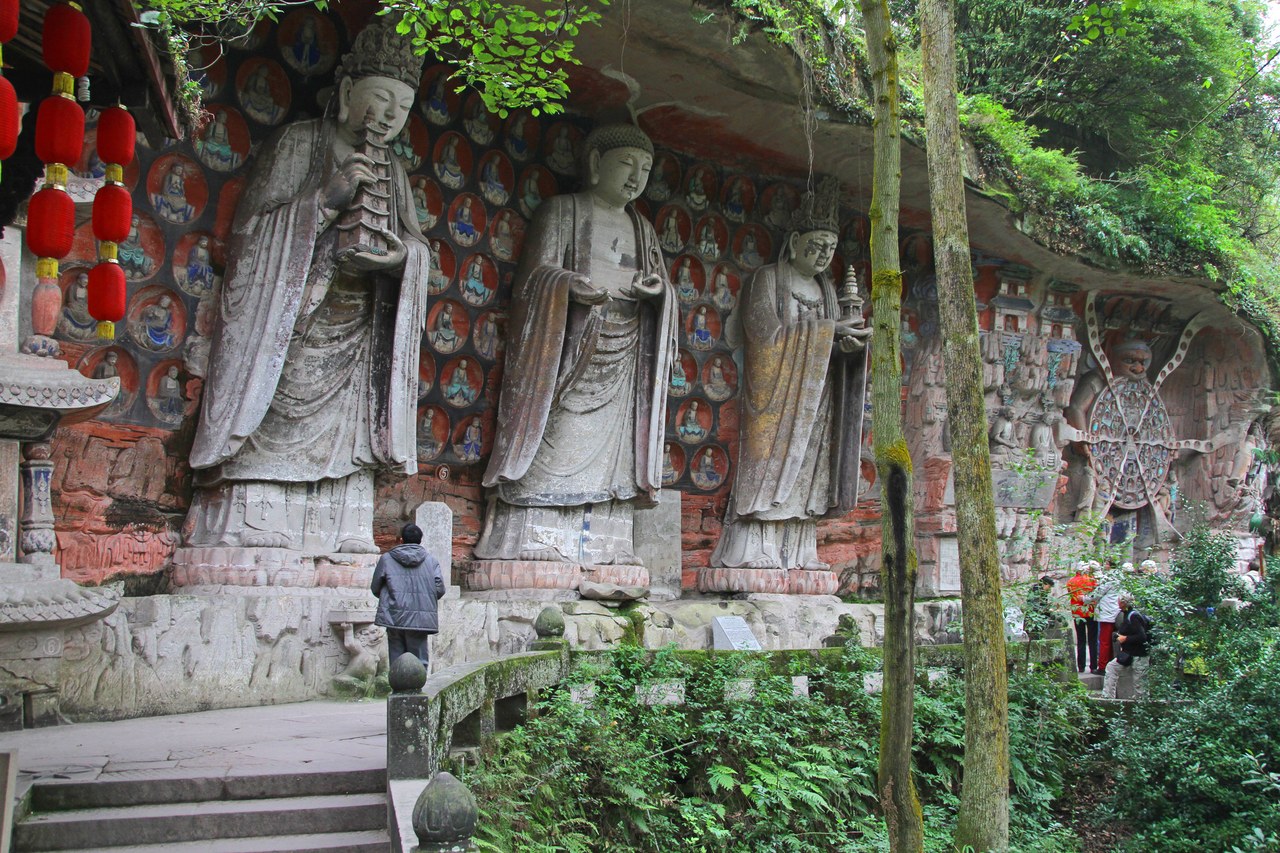
Cliff carvings at Baodingshan in Dazu, photographed in November 2012. This historical view does not establish current conservation access or admission arrangements.Photo: Gerd Eichmann · CC BY-SA 4.0 · Image credits
Large narrative carvings, a monumental reclining Buddha and the many-armed Guanyin · Baoding town, a road journey northeast of Dazu town
Give the scenic visit and museum a full day · Published March–November reference: ¥115 admission, or operator B package ¥130 including return scenic transport; film extra.
Compare finely worked niches, Guanyin figures and the turning-wheel sutra repository cave · Near the northern side of Dazu town; separate from Baodingshan
Allow 2–3 hours for careful viewing · Published March–November reference: ¥70 alone; operator D package for both sites plus Baodingshan return transport is ¥150.
A quieter indoor account of cave art and Dazu’s sculptural context · In the Baodingshan visitor circuit, not a city-centre museum
Allow about 1 hour, more if the displays hold your interest · Follow the current museum admission and checking arrangement within the Baodingshan visit; a digital-film product is distinct.
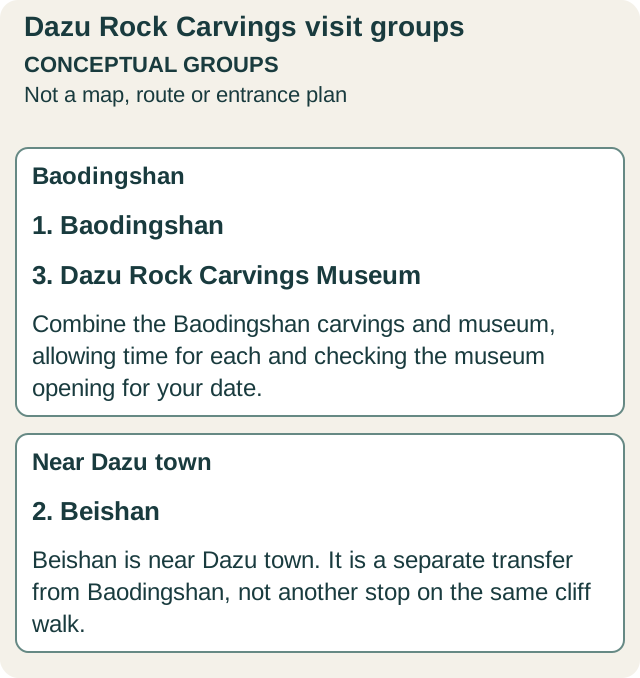
Numbers 1 Baodingshan and 3 museum belong to the Baodingshan circuit. 2 Beishan sits nearer Dazu town. The diagram is an area-and-choice aid, not a scale map, bus schedule or walk connecting all three. The Institute describes Baodingshan as northeast of the urban area and Beishan near the town’s northern side.
Dazu South 大足南 railway station is another location. The official directions use a bus into town and a second service or taxi for Baodingshan. Do not choose a room by a station pin expecting to stroll to the carvings. Stay in town for meals and both outings, or base a dedicated single-site stay near Baodingshan only after arranging the arrival and dinner.
The numbered places
1. Baodingshan · 宝顶山石刻
Baodingshan is the choice when you want one powerful first encounter. The cliff feels like an extended illustrated argument: large bodies, clustered figures and episodes sit next to one another, so the walk becomes a sequence of comparisons rather than a hunt for one “best” statue. The reclining Buddha and many-armed Guanyin are visual anchors, while scenes concerning parental care make the everyday dimension easier to recognise.
Stop at one scene and look for faces, hands, clothing and the relationship between figures. An official guide can explain the subject without you attempting to decode every inscription. Ask the interpretation desk for the available language, duration and charge before agreeing; an English-language service was not booked or confirmed.
The heritage designation contains multiple clusters, but the visitor’s task is to see a meaningful selection. This guide does not add Nanshan, Shimenshan and Shizhuanshan to the same day merely because they are also inscribed. Their separate access and opening arrangements require another plan.
Hours
The Institute lists Baodingshan 09:00–18:00 with last entry 16:30, but its visitor centre stops ticket checking earlier at 16:10. Arrive in the morning and check current notices.
Tickets
Passport holders are directed by the official booking instructions to the visitor centre’s manual sales desk. Select 宝顶山 or a combination that actually includes it.
Time
Allow 3–4 hours for the carvings and admitted temple surroundings, with museum, lunch and transfer time additional.
Chinese address
重庆市大足区宝顶镇 · 大足石刻游客中心
Getting there
Arrive at 大足石刻游客中心, complete checking there and take the official scenic transport on the signed visiting route. A taxi destination at the old carving-side street is not the booking default.
How to visit
Use the interpretation service if desired, then the open museum / carving sequence shown that day. Pause at the large scenes and their individual figures. Follow the designated exit to the return bus rather than improvising across community-controlled gates.
2. Beishan · 北山石刻
Beishan is the stronger choice for a second, more concentrated look. The scale encourages attention to a niche, pose or carved ornament rather than the sweep of a whole monumental scene. The Institute identifies Water-Moon Guanyin, the turning-wheel sutra repository cave and other Guanyin subjects among its defining works.
Approach this as a comparison with Baodingshan rather than a lesser copy. Sit down for a break before starting if the first day involved extensive standing. Stay within the admitted route; a pagoda visible elsewhere on the hill is not a promise of an open climb or access on your ticket.
Hours
The listed daytime visit is 09:00–18:00, with ticket sales ending 16:00 and checking ending 17:00. Night visiting is a different session; the itinerary uses daylight.
Tickets
Select 北山日间 or an appropriate combination. Before buying a combined product, confirm the permitted dates for your two-day visit; the price table alone does not establish a two-day validity.
Time
Allow 2–3 hours rather than treating it as a quick photograph after a late Baodingshan return.
Chinese address
重庆市大足区龙岗街道 · 北山石刻景区
Getting there
Use a licensed taxi from the Dazu-town hotel to the actual 北山石刻 entrance and agree the return pickup. From Baodingshan this requires another road journey, not a connecting footpath.
How to visit
Follow the admitted niche sequence, comparing the small sculptures and decorative detail. The route is a close-viewing experience; keep barriers between yourself and the carvings. If your combined ticket is not valid on a second day, buy the correct separate dated ticket instead of assuming it will scan.
3. Dazu Rock Carvings Museum · 大足石刻博物馆
The museum changes the pace after travel and before the outdoor carvings. Its subject is cave-temple art and the particular character of Dazu. Use that context to choose what to notice outside, rather than attempting to read every display in sequence.
The Institute’s current published circuit puts it before Dafowan, which makes a morning visit practical. Keep the film optional: a digital presentation is a separate choice of time and money. If you particularly want the museum, verify that it is admitting visitors on your date before fixing a non-refundable driver booking.
Hours
The Institute lists 09:00–17:00 and last checking 16:30. Confirm any current closure or entry arrangement separately from the outdoor site.
Tickets
Ask the visitor centre to confirm museum access within your Baodingshan order. No assumption is made that a paid digital-film ticket is required to see the physical carvings.
Time
About 1 hour is an editorial starting allowance. This need not become another full museum day.
Chinese address
大足石刻宝顶山景区 · 大足石刻博物馆
Getting there
The current operator sequence places the museum before the main Dafowan carving visit, after the scenic transport and interpretation hall. Follow the signed flow that is operating.
How to visit
Use the displays to establish what different carved figures represent, then compare those ideas outside. If it is closed, keep the main carved site and use official interpretation or the Institute’s digital material; do not claim the indoor exhibit was included in the visit.
Dazu town for two sites, Baodingshan for a single focus
Default: Dazu town / Longgang urban area. Choose a hotel with road access, reception and nearby dinner options, using a separately quoted journey to Baodingshan and a shorter local outing to Beishan. This suits the three-night version and leaves room for rest between art visits.
Baodingshan village / scenic area: choose it if the main carvings and quiet evenings are the priority. Confirm dinner, breakfast, luggage arrival and how to reach the official visitor centre; accommodation inside a broad “scenic area” label does not replace admission. Chongqing: retain your city hotel for a single organised day trip if you prefer not to change rooms, accepting the longer outward and return road journey.
Open Chongqing hotel listings, enter three nights, one room and two adults then search Dazu / 大足 within Chongqing and set the map to the actual Dazu urban centre, not Chongqing downtown or Dazu South station. Check passport registration, room and cancellation terms, breakfast and written transport quotes. This is a base recommendation, not a named-property comparison.
A local lunch, then dinner near the hotel
Put lunch on the Baodingshan visitor-centre / town route rather than travelling back into Dazu between the museum and carvings. A simple rice, vegetable and protein meal keeps the afternoon manageable. Carry water so that a slow viewing stop does not depend on finding the next stall.
For the town evening, 邮亭鲫鱼 is the regional crucian-carp dish described by the district government, often prepared with a strong, spicy sauce. Choose it only if bones, fish and chilli suit you; ask the total price and portion for two. Pair it with a vegetable and rice, or choose tofu, eggs and ordinary stir-fries instead.
The dish’s origin in Youting does not make a separate Youting restaurant trip necessary. Keep dinner near the hotel unless food is a distinct purpose of your stay. No listed restaurant, menu, current meal price or cooking demonstration was visited.
Choose one complete encounter or a two-site stay
Arrival · night 1: reach the Dazu-town hotel and eat nearby. Resolve the next morning’s ticket product, original-passport desk and the car or bus connection to 大足石刻游客中心.
First full day · night 2: reach the visitor centre in the morning, complete ticket checking and follow the current Baodingshan circuit. Allow the museum and a proper, interpreted look at Dafowan, with lunch and pauses. Return for dinner in Dazu town. With a two-night / one-full-day stay, depart the following morning; this shorter visit deliberately leaves out Beishan.
Second full day · night 3: take a separate morning outing to Beishan, with time for close viewing. Return for a town lunch and an easy afternoon. Leave the next morning. This slower version avoids depending on a last-entry sprint after Baodingshan.
One day from Chongqing: agree an early pickup and the complete return to the city hotel, including waiting, tickets and whether an actual guide is provided. Choose Baodingshan plus the museum, not all five heritage clusters. Add Beishan only if the transport and remaining daylight genuinely permit it; otherwise retain the original return.
Ticket validity for the longer visit: the Institute publishes a combined tariff, but its price table is not evidence of your product’s permitted second-day entry. Ask the desk before buying. If it must be used on one day, buy separate dated admissions for this two-day itinerary; include the difference in the budget.
The railway and bus both leave a local transfer
Search Dazu South 大足南 on China Railway 12306, compare actual connections and allow the local transfer into town. The Institute’s Baodingshan directions list 204 to 电信局 or 206 to 宏声广场, then 205 / 2015 scenic service where operating, or taxi, to the visitor centre. Check the current stop and final return with staff; this is a transfer, not a direct train-to-carvings service.
For road coaches, search 大足汽车站 and your actual origin/date on Chongqing’s road passenger booking service. From the bus station, the Institute lists 205 or taxi for Baodingshan. A ticket only to Dazu does not include the last leg. For Beishan, use the stated town stop plus taxi or a pre-arranged local ride.
A licensed driver is the straightforward option when two people want a particular pace. Obtain a quote naming hotel → 大足石刻游客中心 → hotel, wait time and return; arrange Beishan separately for the second day. A Chongqing quote must explicitly include the city round trip, not merely a local Dazu car.
Save the return pickup and a reachable contact. If a bus is missed, remain at the staffed centre and request a licensed ride through the desk or hotel. Do not allow a hopeful last connection to determine an irreversible entry into another site; keep the railway departure morning free of visits.
Passport holders use the official manual desk
The Institute’s booking instructions specifically direct passport holders to the visitor centre’s manual ticket desk. Bring the original passport used for purchase. The published checking process includes the ticket, document and facial verification; do not assume a foreign passport can use an identity-card-only online form or self-service gate. This is an official instruction, not a completed purchase test.
Choose the exact places and whether you want the film. In March–November, published references are Baodingshan ¥115, Beishan ¥70 and both admissions ¥140; December–February references are ¥100, ¥50 and ¥120. The separate Baodingshan return vehicle reference is ¥22. The operator also publishes cheaper named packages: B, Baodingshan plus return transport, ¥130 / ¥115; D, both sites plus that transport, ¥150 / ¥130. Check what is actually offered on the date before adding separate components.
For the two-day plan, ask the desk to confirm each site’s valid visit date in writing on the order. The official unused-ticket rules distinguish online, self-service and manual purchases; after a combination is first used, abandoning another included site normally does not create a partial refund entitlement. Decide which places you truly want before scanning.
The Institute publishes Baodingshan ticket enquiries +86 23 4378 5339, Beishan +86 23 4372 1274 and interpretation enquiries +86 23 4378 5531. No call or English-language support was tested. Use the official site’s current notices to resolve an unusual document, closure or access requirement before a dedicated journey.
Interpretation and careful looking matter more than extra sites
The sites involve outdoor paths, steps and prolonged standing. Ask for the exact currently usable access route if mobility is limited; a scenic vehicle does not establish access to every niche or museum room. Bring grip for rain and protect yourself from heat while waiting.
Do not touch stone figures, lean on carving surfaces or cross barriers for a photograph. Follow current flash and photography instructions at each space. If conservation work restricts a key scene, establish what remains visible before paying; a partial restriction and an entire-site closure are different decisions.
If Baodingshan is fully closed, do not sell Beishan as the same monumental experience. Beishan can still be a worthwhile separate visit, but revise the length of stay or move the main booking. If the museum alone closes, keep the outdoor visit and use the official interpretation service or digital material.
Two adults, every local night and road leg counted
For two ordinary adults sharing one room, three nights and two full visiting days, calculate 3R + 2P + T + M + X. With R = ¥280, P = the ¥150 peak-season D package if valid for your two dates, T = ¥400 for the station transfers and separate local drives, M = ¥520 meals and X = ¥100, the result is ¥840 + ¥300 + ¥400 + ¥520 + ¥100 = ¥2,160 for the pair.
If the combination is not valid across two days, replace it with the published Baodingshan B package ¥130 + Beishan ¥70 = ¥200 per adult. The same illustrative stay then costs ¥2,260. This explicitly budgets the extra ¥100 for the pair instead of treating an unverified second-day scan as free.
For the shorter two-night / one-full-day Baodingshan-and-museum stay, illustrative inputs are rooms ¥560, two B packages ¥260, transport ¥350, meals ¥360 and contingency ¥100: ¥1,630 for the pair.
Published tariffs are references, not a checked sale. Room, road, meals, contingency and visit lengths are editorial inputs; replace T with the written total quote. Exclude intercity rail/coach fares, a Chongqing city-to-city charter, interpretation, optional film, shopping and any added heritage cluster. For a Chongqing day trip, obtain a complete city round-trip quote and budget it instead of the local T figure.
Official rules, authored choices and limits
Sources actually read on 22 October 2026. The Research Institute supplies the current guide, published package table, passport desk instructions, visiting sequence and ticket conditions. Its two separate site descriptions and UNESCO explain why the carvings differ. The district food description supports the dish context; it is not a restaurant recommendation based on a visit.
The two-day combination’s validity, live inventory, exact local bus operations, room and car quotes remain order-specific. The budget provides a fully costed separate-ticket alternative. No ticket purchase, facial-checking process, phone enquiry, guide service, hotel registration, local ride or meal was field-tested.