GUANGXI · GREEN HILLS, BRONZE DRUMS & SOUR-SPICY NOODLES
Nanning Give Guangxi’s capital more than a transfer night
Choose Nanning for green gardens, an introduction to Guangxi’s cultures and meals that revolve around sour, spicy flavours. Qingxiu Mountain is a landscaped hill and botanical outing; the Anthropology Museum of Guangxi gives the city stop cultural substance; the restored lanes near Chaoyang Square make room for an unhurried evening. Two full days let these experiences breathe.
This is a useful beginning or end to a Guangxi journey. If your only goal is river-and-karst countryside, reserve more nights for Guilin and Yangshuo. In Nanning itself, keep the eastern hill-and-museum outings separate from the old-city food walks, and avoid treating a distant waterfall trip as another city stop.
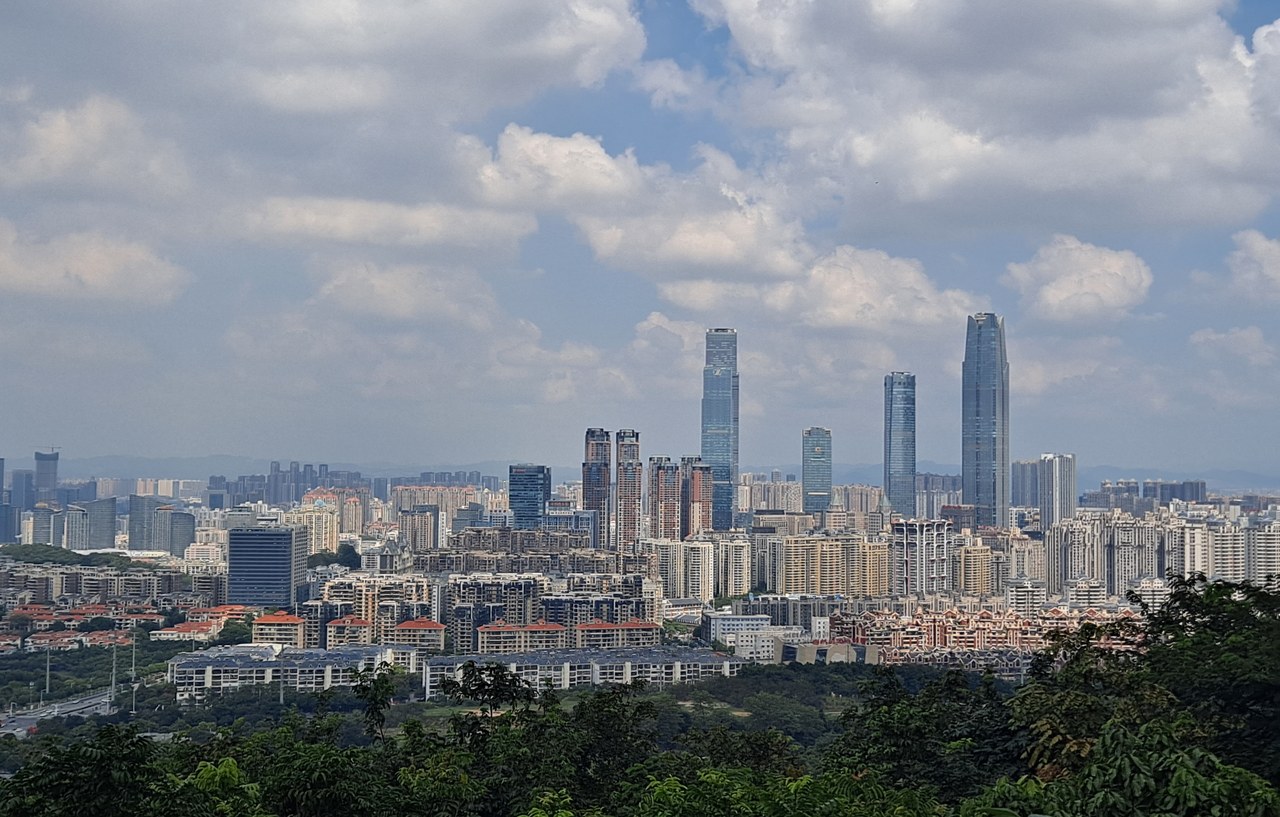
Nanning seen from Qingxiu Mountain in October 2022; this historical photograph illustrates the setting, not current visitor facilities.Photo: EditQ · CC BY-SA 4.0 · Image credits
Bronze drums, textiles and displays introducing Guangxi’s diverse cultural traditions. · Qinghuan Road · a separate road transfer beyond the hill’s visitor gates
2–3 hours · Free general admission; personal visits do not require advance reservation under the newer notice.
Restored commercial lanes, arcades, snacks and an evening in the old centre. · Chaoyang Square and Minsheng Road · central Nanning
2–3 hours with a meal; add nearby streets on another evening · Public street walking; meals, shops, performances and indoor venues are separate.
Two full days, divided between green spaces and the old centre
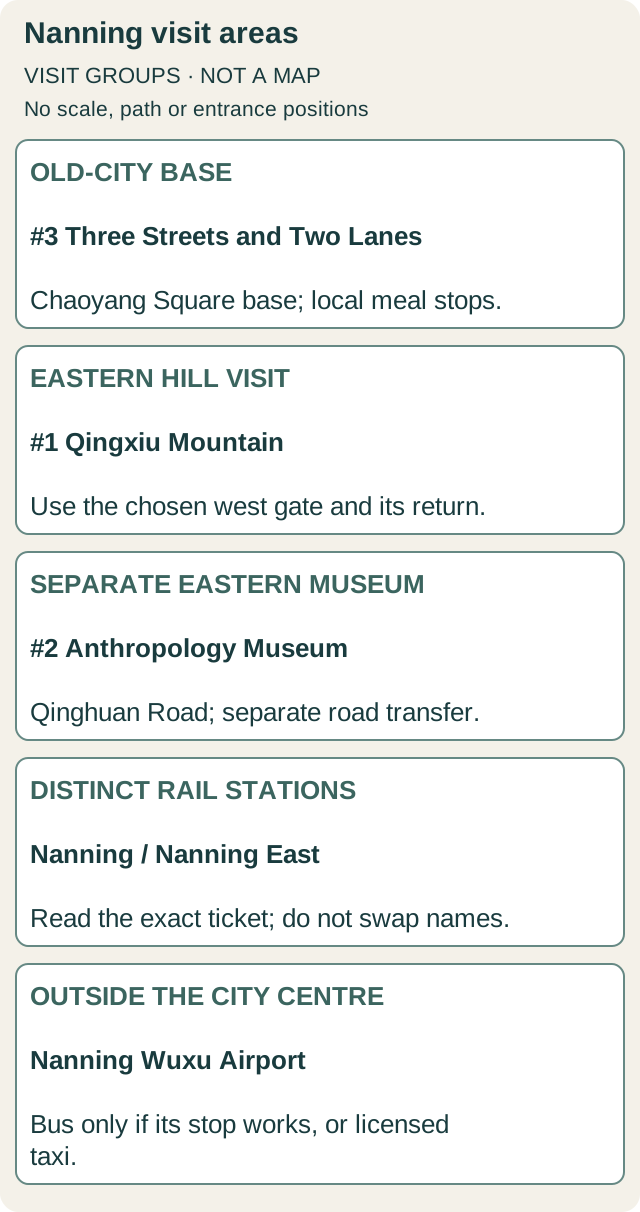
Open full-size map ↗. The old-city base, Qingxiu Mountain and Anthropology Museum are separate visit blocks. Use the hill gate actually chosen and give the museum its own transfer; airport and stations are transport references. This is an editorial relationship diagram, not a navigation map; box position does not encode distance or an entrance. ChinaMile diagram; location sources. Navigation: search the Chinese name in Amap.
A practical first stay
Arrive, settle into a Chaoyang Square hotel and eat nearby. On the first full day, visit Qingxiu Mountain in the morning, take a proper lunch break, then rest before an early evening around Three Streets and Two Lanes. On the second full day, visit the Anthropology Museum in the morning, return to town for lunch, and leave the afternoon for a slower old-city walk, shopping or a café. Use Zhongshan Road or Water Street for a different dinner area rather than repeating the whole first evening.
An evening arrival, two complete sightseeing days and a morning departure require three nights. Swap the two full days if the museum would otherwise fall on a normal Monday closure or if one day has better outdoor weather. A hill closure or heavy rain should reduce the outdoor programme, not send you searching for a substitute exposed viewpoint.
If you have only one full day
Choose Qingxiu Mountain plus an old-city evening for gardens and views, or the museum plus an old-city afternoon for culture and a gentler pace. Do not force both large eastern visits into a rushed transfer stop. If you add a third full day, give it to a separate regional excursion with transport already arranged or to the part of the city you enjoyed most. Detian Waterfall and the border-country scenery belong to a separate journey; they are not within this city itinerary.
Stay near Chaoyang Square for a short food-and-culture visit
Default: Chaoyang Square / 朝阳广场, near Minsheng Road. The old-city meals are close and Lines 1 and 2 make rail connections manageable. Choose a hotel with a vehicle-accessible entrance if you have luggage; being inside a busy pedestrian lane is less useful for a late arrival, and street-facing rooms can be noisy.
Jinhu Square / 金湖广场 is the practical alternative for a modern commercial base and the Line 1/3 interchange. It reduces the friction of going toward Qingxiu Mountain but moves your evening meals away from the old lanes. Nanning East station / 南宁东站 suits a very early train; it is a transport choice, not the best base for both city days. Keep one hotel for the short stay.
At Trip.com hotels, search Nanning for every night and all guests, then use the map around the chosen metro station. Compare the exact entrance, room type, cancellation terms and total rather than a district label alone. Confirm foreign-passport check-in and any late arrival directly before paying a non-refundable rate. These are area recommendations, not inspected hotel endorsements.
Start with laoyoufen, then make room for a shared dinner
Laoyoufen / 老友粉 is the characteristic sour-spicy noodle choice. The flavour commonly comes from sour bamboo shoots, fermented black beans, garlic and chilli, with meat added to the broth. Ask for 少辣 / less chilli before cooking; it does not turn the dish into a bland broth. A noodle lunch near the old centre is more useful than crossing town for a single famous shop.
Juantongfen / 卷筒粉, steamed rice-sheet rolls with fillings, makes a lighter breakfast or snack. Ask what is inside: a vegetable-looking roll or topping need not be meat-free. Suanye / 酸嘢 is tart seasoned fruit or vegetables. Order a small amount, establish whether it is sold by portion or weight, and have chilli added separately if you prefer.
For one seated dinner, share lemon duck / 柠檬鸭, vegetables and rice. The preserved-lemon and pickled-vegetable flavour is part of the attraction; check the half- or whole-duck portion and the listed price. Eat near Three Streets and Two Lanes on the hill day, then try a different old-city food area after the museum day. Pack water and a modest snack for Qingxiu Mountain; do not count on a particular garden café being open.
For food restrictions, ask about broth, meat, peanuts, soy and sauces as well as the visible topping. A freshly prepared egg-and-vegetable dish with confirmed ingredients is easier to adapt than a premixed noodle broth. For allergies, carry a clear Chinese statement of the ingredient and the severity; a translated dish name alone is not enough to establish what is in its broth.
A transparent two-person city budget
For two adults sharing one room, three nights and two full city days, calculate 3R + CNY 40 + F + T + V. R is the actual nightly room total; CNY 40 is two standard CNY 20 Qingxiu Mountain tickets; F is meals, T is city transport including the two rail-station transfers, and V is any internal park-vehicle tickets. The museum and ordinary public-street walks have no general admission charge.
Example planning inputs: R = CNY 350, F = CNY 480–700, T = CNY 120–240 and V = CNY 0–100. The total is CNY 1,690–2,130 for two, or CNY 845–1,065 each. The low V input means walking the selected circuit; it is not a free-ride claim. Room, food, transport and ride allowances are editable budget assumptions, not live quotes. A two-person budget with one shared room does not describe the cost of travelling alone.
This excludes travel to/from Nanning, airport transfers, private guides, shopping, alcohol, performances and regional day trips. Add the actual airport-bus or taxi total if flying. Peak holiday room prices or repeated taxis can raise the total, so replace R and T before treating this as your spending plan.
Three visits that give the city a useful shape
1. Qingxiu Mountain · 青秀山
Qingxiu Mountain rewards a slower visit: palms and cycads, pockets of shade, the Longxiang Pagoda and glimpses of the growing city beyond. It offers a botanical landscape close to the city rather than a wilderness hike. Choose a few gardens and a viewpoint; trying to cover every named garden turns a pleasant outing into a long transport exercise.
For a first visit, use the west gate and aim for the Longxiang Pagoda–Tianchi area, with a garden stop as energy allows. The pagoda’s steps are optional. Visitors more interested in plants than hilltop views can choose the north gate and its garden areas instead. Neither plan requires a night event or an uninterrupted circuit of the whole mountain.
Hours
The operator’s current gate schedule gives 08:00–18:00 for the north gate and West Gate 1, and 06:00–23:00 for the east gate. Other gates have different sessions. Individual gardens, internal vehicles and special events can close earlier; arrive in the morning for this daytime route and return to your chosen exit before its cutoff.
Tickets
Standard adult admission is CNY 20 per entry. Buy through the official WeChat account 青秀山 → 票务服务 → 购买门票, or at an official entrance ticket window. The operator confirms window purchase and paper-ticket admission, but this does not itself verify foreign-passport processing. Ask visitor services or the ticket window to confirm how your original passport is handled before travelling or paying. Neither online nor window foreign-passport purchase was tested. If no usable admission route is confirmed, keep the museum and old-city alternative. Check any concession with staff before payment. Internal sightseeing vehicles, optional experiences and separately sold night products are not assumed included.
Time
Allow 4–5 hours for a selected hill-and-garden visit, with shade and water breaks. This is an editorial visiting allowance, not a promise that every garden fits. Reduce the route in hot weather; wear shoes suited to slopes and steps.
Chinese address
青秀山风景区西门,南宁市青秀区凤岭南路6-6号。北门与东门是不同入口。
Getting there
The official access page directs west-gate visitors to Metro Line 3, 青秀山 / Qingxiushan station, Exit B, then the signed walk. From the Chaoyang Square base, take Line 1 to 金湖广场 / Jinhu Square and transfer to Line 3 toward Qingxiushan. A taxi is simpler for a north-gate garden visit; enter 青秀山北门 explicitly. Keep the same gate for the return unless staff confirm another open exit and onward transport.
How to visit
West gate → check the day’s site map and vehicle stops → selected garden paths → Longxiang Pagoda and Tianchi area → return toward the west gate. Confirm the return vehicle’s destination and last service before riding outward; allow for the walk back if you skip it. In thunderstorms or a park closure, move this day and use the museum during its opening hours.
2. Anthropology Museum of Guangxi · 广西民族博物馆
This is the strongest cultural introduction in the city plan. Start with the bronze drums: their cast surfaces, patterns and scale are more rewarding than trying to read every panel. Continue into the Zhuang-culture and textile displays to connect objects with clothing, craft, music and everyday life.
The name matters: 广西民族博物馆 is the Anthropology Museum on Qinghuan Road, not the separate Guangxi Museum in the central city. It is also not an attraction reached simply by walking out of Qingxiu Mountain’s main gate. Give it its own morning and return to town for lunch; the visit can be worthwhile without booking a live performance or paid guide.
Hours
Normally Tuesday–Sunday 09:00–17:00, last entry 16:15 and gallery clearance from 16:45; normally closed Monday. Holiday openings, replacement closure days and temporary notices override that pattern. Check the museum’s official announcements or 广西民族博物馆 WeChat account before travelling.
Tickets
General admission is free. The museum’s newer personal-visit notice removes advance reservation for individuals; bring an original valid identity document. Its official visitor rules explicitly allow overseas visitors unable to use online booking to present an original passport for staff checking and registration. Go to the staffed entrance instead of assuming a Chinese-ID turnstile will read a passport. For document or capacity problems, visitor service is +86 771 2024599, extension 9. This is a published route, not a field-tested guarantee of admission. Group visits and paid guide bookings are separate.
Time
Allow 2–3 hours. Arrive in the morning so a document question does not consume the last-entry window. Paid interpretation is optional and needs its own confirmation; do not assume an English session runs automatically.
Chinese address
广西民族博物馆,南宁市青秀区青环路11号。
Getting there
A taxi to the exact Chinese name and 青环路11号 is the straightforward option. The museum’s transport page gives Metro Line 3 to 青秀山, followed by a road connection; it lists bus 69, but check the live stop and operating service before waiting. Do not mistake the metro station for the museum entrance. Save the museum gate as your return pickup.
How to visit
Staffed entrance and document check → bronze-drum displays → Zhuang-culture and selected textile/craft galleries → return taxi to lunch in town. If admission or a temporary closure prevents entry, use the old-city streets and return on another open day; no pre-paid museum product is necessary for the main plan.
3. Three Streets and Two Lanes · 三街两巷 · 邕州古城
The appeal here is the change of pace after the hill: small lanes, restored facades, food stalls and shops, with places to sit instead of another large attraction. Look for the contrast between the lane courtyards and the surrounding commercial streets. The district is actively managed and restored; it is not an untouched historic town.
Use Sanjie Liangxiang as the anchor. Zhongshan Road / 中山路 and Water Street / 水街 are further old-city food options within the wider Yongzhou Ancient City regeneration, not alternate names for the same lane. Visit one extra area if you still want to eat or walk. A particular stall, light display or show is a bonus, not the reason the evening works.
Hours
The outdoor street walk has no single museum-style session; individual restaurants, shops and displays set their own hours. Late afternoon into the early evening suits this plan. There is no promised performance or late-night transport connection.
Tickets
No combined attraction admission is needed for the ordinary public-street route. Pay separately for food, purchases, performances or an indoor venue you choose. Check the posted menu and full portion price before ordering.
Time
Allow 2–3 hours including dinner or substantial snacks. Keep Zhongshan Road or Water Street for a second evening if the first walk already fills your appetite.
Chinese address
老南宁·三街两巷,南宁市兴宁区民生路、兴宁路周边;朝阳广场为附近地铁锚点。
Getting there
Use Metro 朝阳广场 / Chaoyang Square on Lines 1 and 2, then the street signs toward 三街两巷 and 民生路. From another district, show a taxi the exact street name; agree a roadside pickup outside the pedestrian lanes for the return.
How to visit
Chaoyang Square area → Minsheng Road and the restored lanes → one seated meal → optional nearby old-city stroll → return to the hotel. In heavy rain, shorten the exposed walk and choose a restaurant or café with an indoor table. Keep off closed riverside paths during high water.
Match the station name before booking the hotel transfer
Rail: Nanning East and Nanning are different stations
Search China Railway 12306 for the actual date and train. Nanning East / 南宁东 is the major eastern high-speed rail gateway; Nanning / 南宁 is closer to the old centre. Both have Metro Line 1 access, with 火车东站 and 火车站 respectively as the metro names. Line 1 reaches 朝阳广场 for the default base. Check the exact departure station on the return ticket; do not tell a driver only “the train station”.
Use the Nanning Rail Transit network and service notices for the current route, fare and last train. With luggage or after service finishes, use the signed licensed taxi pickup. For a departure, budget the hotel-to-station journey plus time for security and passport checking; an arrival-minute estimate is not a boarding deadline.
Nanning Wuxu International Airport / 南宁吴圩国际机场
The airport is outside the city, so a late flight should lead to the hotel rather than a timed attraction. The airport group’s city-bus page publishes its current route timetable. At the staffed airport-bus counter, show your hotel address and confirm the destination stop, last departure and fare. A central-city bus can be useful when its actual stop fits; it is not automatically a direct ride to Chaoyang Square or your hotel.
The simpler luggage or late-arrival alternative is the signed licensed taxi queue. Keep the hotel name and entrance in Chinese. For the outbound flight, prearrange the transfer or confirm the actual city-bus departure, then add your airline’s airport lead time. This plan does not depend on a proposed metro or airport-rail extension.
Inside the city
Use metro for station and commercial-area journeys, and a local road transfer for the Anthropology Museum. Walk within the old lanes; treat the hill’s different gates as separate destinations. Save the exact return entrance before leaving a vehicle. If an app payment or account fails, take the Chinese destination to a station service desk or use a licensed taxi and confirm payment before departure.
Add another city with its own nights
Liuzhou adds river-bend city views, industrial history and luosifen. Guilin and Yangshuo give a stronger landscape focus. Choose the actual rail service and arrival station before allocating the transfer day; a travel day is not a full sightseeing day in either city. For a cross-border continuation, use a separate transport and entry-rule plan rather than inferring it from Nanning’s position on the map.
What is confirmed, and what still depends on your visit
Sources checked on . Qingxiu Mountain’s operator supplies the gate-specific hours, standard ticket and west-gate metro access. The museum’s current public notices supersede older reservation instructions for individual visitors; its passport-help rule is published but was not tested in person. Its usual hours are separated from temporary holiday changes. Airport-bus information is date-specific; no unverified departure time or taxi fare is promised. Accommodation transactions, attraction checkout and hired transport were not field-tested. Visit lengths, combinations and budget allowances are editorial planning judgments.