Puer Use a city base for tea hills, old streets and coffee; keep distant Jingmai separate.
Puer is both a tea name and a very large administrative region. For a short visit, base yourself in Simao / 思茅, the main urban area. Its attraction is a manageable contrast: a morning among tea slopes or an old trading-route landscape, then a bowl of local rice noodles and a carefully chosen coffee in town. It rewards attention to flavour and ordinary city life more than a race between distant villages.
Choose three nights and two full days. Keep one day for the Tea Horse Road and old streets, and one for the Yingpanshan tea garden with a lake walk if time and weather allow. This suits travellers who want a gentler southern-Yunnan stop and are curious about both tea and coffee. An extra day is useful for a confirmed coffee-estate visit; it is not required to taste local coffee.
Jingmai Mountain is not a Simao side trip after lunch. The UNESCO tea-forest landscape is in distant Lancang County and needs its own road transfer, village base and return. Choose Jingmai when the living tea-forest villages are the purpose of the journey. Choose this Simao stay for an easier city base with nearby tea and coffee experiences. Xishuangbanna offers a different, more tropical garden-and-Dai-culture stay farther along a southern-Yunnan route.
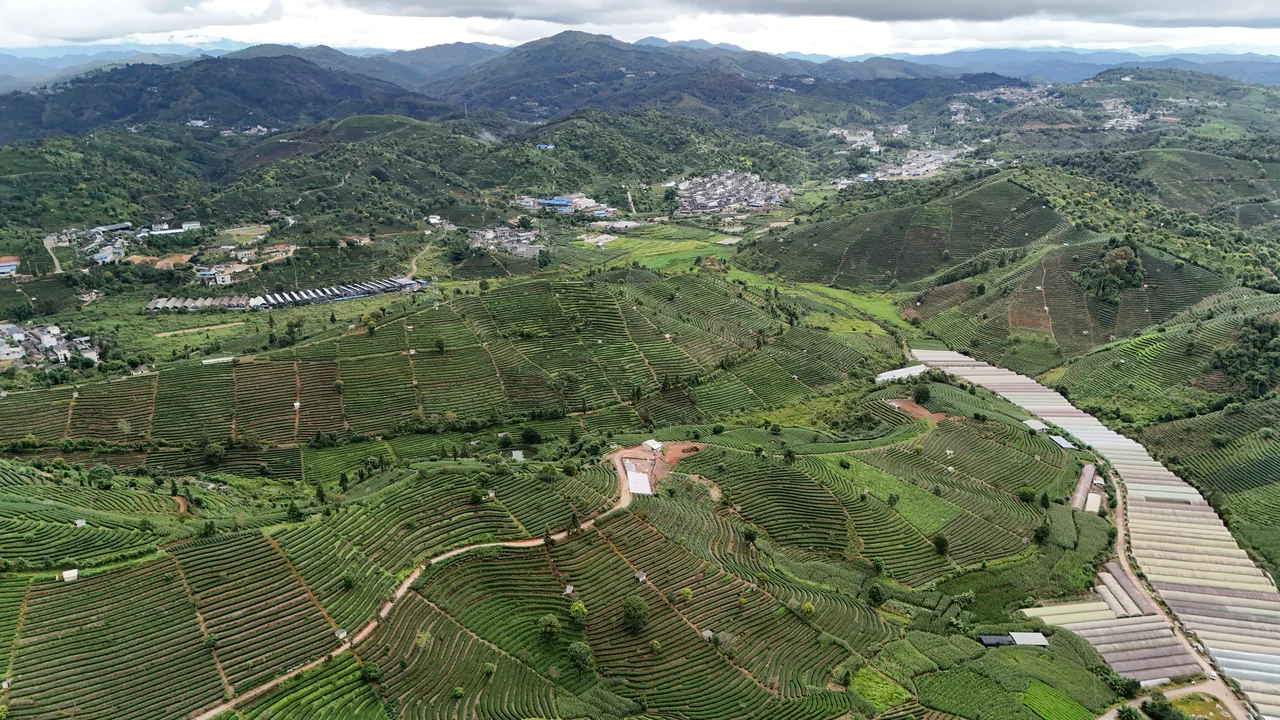
Tea fields around Yixiang near the China Puer Tea Expo Garden, photographed on 26 July 2026. The source identifies the surrounding landscape, not a specific ticketed path or tea-picking activity; this is not Jingmai Mountain.Photo: User:CatOnMars · CC BY 4.0 · Image credits
A wooded historic-route setting and tea-trade interpretation, with optional paid activities · North of central Simao, beside the Tea Horse Ancient Town area
A half-day with a modest walk · Walking access and cable/boat/show packages are different products.
A short lakeside walk with water and wooded slopes · Southern Simao
1–2 hours for a reversible section · Use the permitted public path; optional services are separate.
Simao is the base; Yingpanshan is the planned road outing
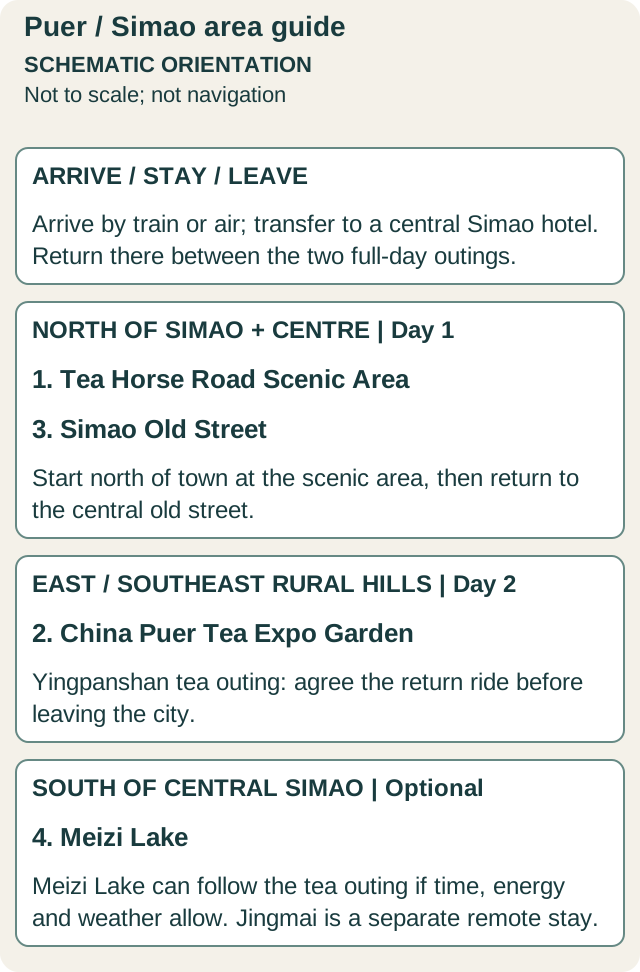
Open full-size area diagram ↗. Numbers match the guide. Named directions show broad areas; box positions do not encode geography. This schematic is not to scale or suitable for navigation, and does not prove access or current operation. ChinaMile editorial diagram; guide sources. Navigation: search the Chinese name in Amap.
1, the Tea Horse Road, is north of the centre. 3, Old Street and Daijia Lane, anchor the city meals and café time. 2, Yingpanshan, needs its own outward and return road legs; 4, Meizi Lake, is a separate southern-city walk. The diagram expresses those choices, not an all-day walking loop.
Puer’s county-level names matter. Ninger, Lancang and Simao are different bases. A hotel sold under Puer may be far outside this city plan. UNESCO describes Jingmai’s forest-and-village tea landscape; an attraction carrying the word tea does not make it close to Simao. This guide does not sell a Jingmai day trip or include its costs.
Keep the two full days interchangeable. In heavy rain, shorten the historic-path and lake walks and spend time in the city. If a rural road is affected, cancel the tea transfer through the original provider and use the old-street/café alternative; a hired car does not override a road closure.
Four places and how to visit them
1. Tea Horse Road Scenic Area · 普洱茶马古道旅游景区
The Tea Horse Road gives tea a journey as well as a taste. Focus on the route landscape and the explanation of how goods moved, then look closely at the open historic-path section. The modern visitor park contains staged and commercial experiences too; do not mistake every picturesque structure for an untouched caravan-era building.
A modest walk is the best default. At the visitor centre, ask for the available route that fits your walking limit and returns without relying on the final cable or boat. The longer marked hiking options need their own distance, gradient and weather decision.
The nearby Tea Horse Ancient Town / 茶马古城 is a commercial dining and evening setting. It can be enjoyable after the park, but it is not the historic-route walk itself. A show is an optional ticket, and the city plan does not depend on a performance taking place.
Hours
Plan a morning. The linked booking-platform listing publishes 08:30–17:00; that is a platform schedule, not a guarantee that every paid ride or show runs throughout those hours.
Tickets
The platform distinguishes free entry from paid internal products. Inspect the dated product before buying: cable car, boat, riding and performances are not interchangeable with a simple walk.
Time
Allow a half-day including the ride from town, an unhurried short walk and a drink; a published long hiking route is not the default here.
Chinese address
云南省普洱市思茅区普洱大道;普洱茶马古道旅游景区游客中心
Getting there
Ask for the scenic-area visitor centre beside the tourism-ring-road bridge, not simply 茶马古城, which can put you in the neighbouring commercial town.
How to visit
Visitor centre → a confirmed open historic-path section and interpretation → the same known return route. Ask how much ascent the route involves before committing. If a cable or boat is not operating, choose a walking route you can reverse; do not buy an activity as the only way back.
2. China Puer Tea Expo Garden · 中华普洱茶博览苑
At Yingpanshan, tea becomes a cultivated landscape: rows tracing the slopes, the changing scale between a leaf and a hillside, and views across the tea-growing setting. Choose this for the plantation landscape and a structured introduction. It is distinct from Jingmai’s tea trees growing within a forest cultural landscape.
If you want to make or press tea, reserve that specific activity, including language, duration, materials and what you take home. Leaf picking is not a year-round entitlement attached to every entrance ticket. A tasting can still be useful outside a picking session: compare the teas presented, ask what processing distinguishes them, and note the producer and product before buying.
Do not add an unbooked coffee estate simply because both appear in the same rural area on a tourism list. One well-arranged tea visit and a reliable return are enough. If you prefer coffee production to tea, replace this day with a confirmed estate visit instead of stacking the two.
Hours
The linked Ctrip listing publishes 08:00–18:00, last entry 17:30. Confirm the actual activity session before leaving town; a general admission window is not a tea-making appointment.
Tickets
Use the exact 中华普洱茶博览苑 product and select the date and two adult entries. Ask whether tasting, pressing a tea cake, materials and take-home tea are included. The budget uses an allowance, not an asserted current tariff.
Time
Reserve half to most of a day including travel, 2–3 hours at the garden and an arranged meal or return lunch.
Chinese address
云南省普洱市思茅区倚象镇营盘山;中华普洱茶博览苑
Getting there
Book a licensed return car from the Simao hotel to the visitor entrance, with waiting time or a fixed pickup agreed. This is a rural tea hill, not a walk from the station.
How to visit
Entrance → a permitted tea-slope walk/viewpoint → a pre-confirmed interpretation or tea session → same entrance and agreed pickup. If no session is available, decide whether the landscape alone justifies the trip before paying for the car.
3. Simao Old Street and Daijia Lane · 思茅老街 · 戴家巷
Simao Old Street is useful precisely because it is part of an inhabited city. Look at the street proportions and building details, then stop to eat. Restored premises and new cafés are part of the present-day experience; the interest is not a promise that every shop is unchanged from an earlier century.
Daijia Lane adds a small-scale tea-and-coffee setting. Order a local-origin coffee with the bean information available, or a clearly priced tea service, and sit long enough to notice the flavour. A fashionable photograph or a bag marked Yunnan says little about a particular farm, processing method or cup.
This is also the weather fallback. A morning of food, sheltered streets and a longer drink can be a complete worthwhile visit when the hills are wet. Choose the actual open café rather than expecting a named festival, temporary exhibition or performance.
Hours
Use breakfast and daylight for streets, then a tea or coffee pause. Individual cafés and historic interiors set their own hours.
Tickets
No blanket ticket is required for the street plan. Agree the drink, tasting or tea purchase price before a lengthy hosted tasting.
Time
Allow 2–3 hours across a meal, streets and a drink; it can be split between arrival and the first full day.
Chinese address
云南省普洱市思茅区思茅老街;戴家巷
Getting there
Use 思茅老街 as the first central drop-off. Check the map for your hotel-to-street walk; do not confuse it with 茶马古城旅游小镇 farther north.
How to visit
Old-street breakfast or lunch → permitted lanes and exteriors → a selected Daijia Lane coffee/tea stop → central hotel. Keep shop and residential doorways clear and ask before entering a courtyard.
4. Meizi Lake · 梅子湖公园
Meizi Lake supplies a change of pace after a tea visit: water, tree cover and a level of quiet that a commercial old street cannot provide. Treat it as a short walk in the Simao stay, not a scenic expedition that must cover the entire shoreline.
A small out-and-back gives control over both energy and return. Public paths and resort grounds are different spaces; follow the signs rather than crossing through hotel facilities to complete a route from an old travel account.
It is optional on the second day. If the tea session runs longer or the return is late, go straight back to the city for dinner. Keeping the lake for a future morning is better than reaching an unfamiliar path after dark.
Hours
Choose daylight and use the current public-path notices. An old account of a long boardwalk does not establish an uninterrupted loop today.
Tickets
The route uses a public lakeside walk; boat rides, resort facilities and events are not included or guaranteed.
Time
Allow 1–2 hours for a short out-and-back, including pauses. Turn around according to energy and daylight instead of completing a nominal whole-lake circuit.
Chinese address
云南省普洱市思茅区梅子湖公园;梅园路片区
Getting there
Use 梅子湖公园 for the car drop-off and agree a public pickup point. A lakeside hotel entrance may be private and is not a substitute for the park approach.
How to visit
Permitted park entrance → a dry open shoreline section → return the same way → agreed city ride. If rain makes the timber or sloping paths slippery, replace the lake with an indoor tea or coffee break.
Taste Simao before ordering a whole tea banquet
Dou tang mi gan / 豆汤米干: broad rice noodles with a thick pea-based soup make a useful breakfast before the Tea Horse Road. Huasheng tang mi gan / 花生汤米干 is the peanut-soup version. These are not the same allergy choice; toppings and shared preparation need a clear kitchen answer. Ask for chilli separately if you want to taste the soup first.
Ji doufu / 鸡豆腐: despite tofu in the name, this traditional soft dish is made with chicken and egg; it is not a vegetarian tofu dish. At a restaurant near the city base, ask whether it is available as a small portion. Pair it with vegetables and rice rather than ordering an eight-bowl banquet for two just to try one speciality.
For coffee, ask for a Puer or other clearly identified Yunnan origin, then choose an espresso-based drink or a filter brew according to preference. Check the cup price before ordering a tasting flight. A local café visit provides a valid coffee experience without promising that a farm is accepting visitors.
For tea, ask whether the tasting is charged, whether buying is expected and how much tea a quoted price covers. Compare like with like by noting producer, processing and weight. A tea-hill view does not authenticate a collector-grade cake, and a small drink is a sensible first purchase. On the rural day, settle lunch arrangements before departure or bring a snack and return to town for the main meal.
Choose central Simao unless the retreat itself is the trip
Old Street / Daijia Lane and the central Simao streets are the default for three nights. They make breakfasts and evenings easy and provide a workable meeting point for a tea-hill car. Look for a legal vehicle stop and a room away from the busiest evening frontage.
Meizi Lake suits travellers who value a greener hotel setting and accept extra city rides. Verify which shoreline access is public and which facilities belong to the property. Yingpanshan or a coffee-estate stay buys a rural atmosphere, but also needs confirmed dinner, luggage arrival and departure transport. It is not automatically a convenient base for the whole itinerary.
The Puer rail-station area is a practical choice for a very early train; it is not the same as an old-street base. Use the issued Chinese address, not an English listing’s broad Puer label.
At Simao accommodation search, enter two adults, one room and three nights. Check the map, the total with taxes, bed type, cancellation and lift/stairs. Ask the property to confirm foreign-passport check-in. No named hotel or room rate is recommended as tested.
Two full days and three nights in one city base
Arrival evening · night one: reach Simao, check in, and have a simple meal near Old Street if time permits. Confirm the following morning’s scenic-area entry and the separate Yingpanshan car and activity while you are in town.
First full day · night two: noodle breakfast → Tea Horse Road visitor centre, 1 → a modest open-path visit → return to central Simao for lunch or an afternoon meal → Old Street and Daijia Lane, 3 → tea or coffee and dinner. Choose the commercial Tea Horse Ancient Town only as an alternative evening setting; it does not replace the old-route visit.
Second full day · night three: breakfast → agreed car to China Puer Tea Expo Garden, 2 → selected tea-slope walk and confirmed session → agreed return. If weather, daylight and energy remain good, make a separate short Meizi Lake visit, 4; otherwise return directly to the hotel and dinner.
Departure morning: go directly to the booked Puer station or Simao airport. A rural activity is not scheduled before a fixed flight or train. With one full day and two nights, choose either the Tea Horse Road plus Old Street or the tea-garden day plus a city dinner.
Coffee-estate variation: replace the tea-garden day, or add one night and a third full day after an estate confirms its actual tour, address, language, duration, price and both transport legs. The provincial tourism article names estates in the Nandaohe area, but a name in a published list is not an available booking. If no estate confirms, keep the city coffee plan.
Use Puer station for Simao and agree the tea-hill return
Search for Puer / 普洱 on 12306 English booking for a Simao city stay. Enter your exact origin, travel date and onward station, and compare the actual train. Ninger / 宁洱 is a different rail stop; selecting it by mistake creates another road leg. The air gateway for this base is Puer Simao Airport / 普洱思茅机场. Lancang Jingmai Airport / 澜沧景迈机场 serves a different part of the wider Puer region.
From the station or airport, use the official taxi queue or a licensed pickup to the hotel’s complete Chinese address. Choose a city base before comparing arrival times, so a cheaper ticket does not silently move your arrival to a remote gateway.
For Yingpanshan, agree hotel pickup → 中华普洱茶博览苑 visitor entrance → waiting or a named return time → city hotel, including the total car charge. Do not rely on finding an empty taxi at the rural gate. If a return cannot be confirmed, choose the Tea Horse Road and city cafés instead.
For the Tea Horse Road, use the specific attraction listing to distinguish entrance and paid internal products. For the tea garden, use the specific garden listing and its visitor-service contact. If a form rejects your passport or payment, contact the attraction for its supported counter process before buying an irreversible transfer. The platform pages are booking entry points, not proof of a completed passport transaction.
If passport verification fails, use the supported document-photo review or take the original passport to a staffed railway ticket window. Match the ticket name and document number to that passport. Leave time for assistance at station entry if an automatic reader cannot process it. Neither a passport upload nor a ticket purchase was tested for this guide. 12306 identity-verification rules explain the official alternatives.
Price the local city stay, not the whole Puer prefecture
For two adults in one shared room, three nights and two full days, use 3R + T + M + A + X. R is one nightly room; T covers both gateway legs, city rides and the Yingpanshan return; M covers arrival dinner through departure breakfast; A covers the selected admission/tea activities; X covers water and contingency.
An editable example uses R = ¥280, T = ¥420, M = ¥540, A = ¥240 and X = ¥160: ¥840 + ¥420 + ¥540 + ¥240 + ¥160 = ¥2,200 for the pair. Every amount is a planning input, not a sampled tariff or a guaranteed quotation. In particular, A does not assert a ¥120 ticket or a free tea-making session.
Replace T with the actual car quote including waiting and return. Replace A with the admission and activities you choose; if the quote is higher, the total rises. Published free-access wording for the Tea Horse Road does not make its cableway, boat or performance free, and an unpriced add-on has not been assigned zero.
The total excludes intercity trains/flights, Jingmai, coffee-estate tours, tea/coffee shopping, alcohol, guides and optional rides or shows outside A. A coffee-estate substitution replaces the tea-garden car/activity costs; adding an estate day instead requires another room night, meals, its return car and its tour price.
Sources, historical descriptions and current booking limits
Sources were read on 22 October 2026. The August 2026 Xinhua interview with Simao’s district head supports the distinction between the historic-route park, commercial ancient town, tea attractions and local coffee. The provincial June 2025 route article supports the Yingpanshan tea and Nandaohe estate choices; its activity descriptions do not prove a session is available on your date.
Simao media’s food account supports pea/peanut rice noodles; Puer Daily explains chicken tofu. The Meizi Lake accounts support the lakeside setting, not an uninterrupted loop. UNESCO defines Jingmai’s separate cultural landscape. Platform schedules and product distinctions were read, but no admission, session, call, train or hotel transaction was tested. The recommended stay, visit lengths and sample costs are editorial judgments.