Shangrao Choose the landscape you want before choosing the hotel: the city, valley and mountain are different trips.
Shangrao is both a real riverside city and the name attached to a large region of very different visitor experiences. Xinjiang Academy and the city riverfront suit a gentle cultural stop. Wangxian Valley offers a deliberately theatrical resort landscape, especially around dusk. Sanqingshan is the substantial mountain-walking choice, with granite formations and exposed paths.
For a first stay, use one city day and one separate outing over two full days and three nights. Choose Wangxian for an afternoon-to-evening visit with a confirmed return, or change the hotel pattern for Sanqingshan. Wuyuan belongs to a separate county itinerary with its own station and villages; it is not a walking neighbourhood of Shangrao.
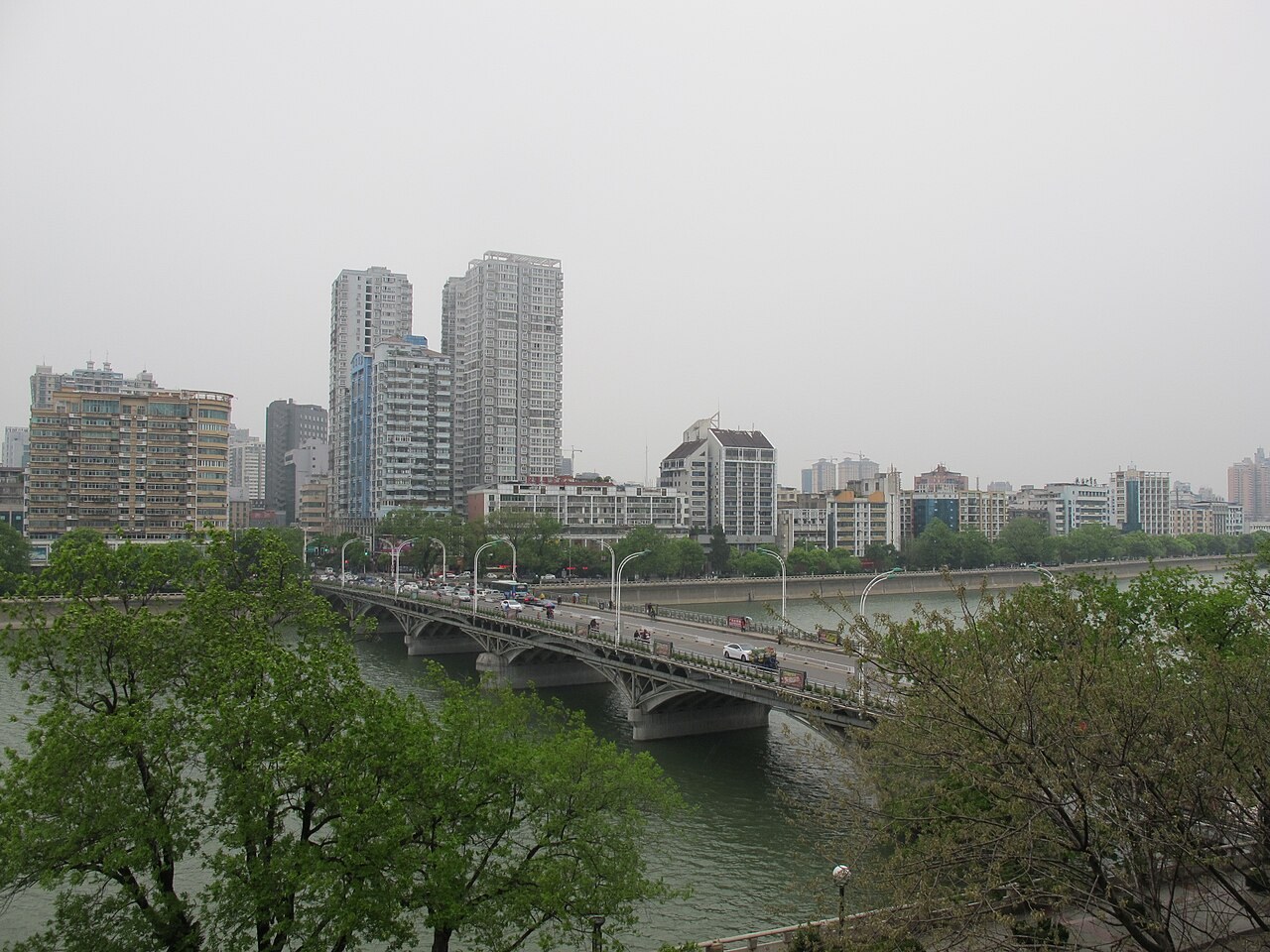
Central Shangrao and Xinjiang Bridge in April 2014; the city skyline has since changed.Photo: 江上清风1961 · CC BY 3.0 · Image credits
Granite pillars, forest and elevated mountain paths · Northeast regional mountain outing, separate from the city and Wangxian
A full mountain day; staying near the chosen entrance is useful · Scenic admission plus the chosen cableway product
A city day plus one landscape decision
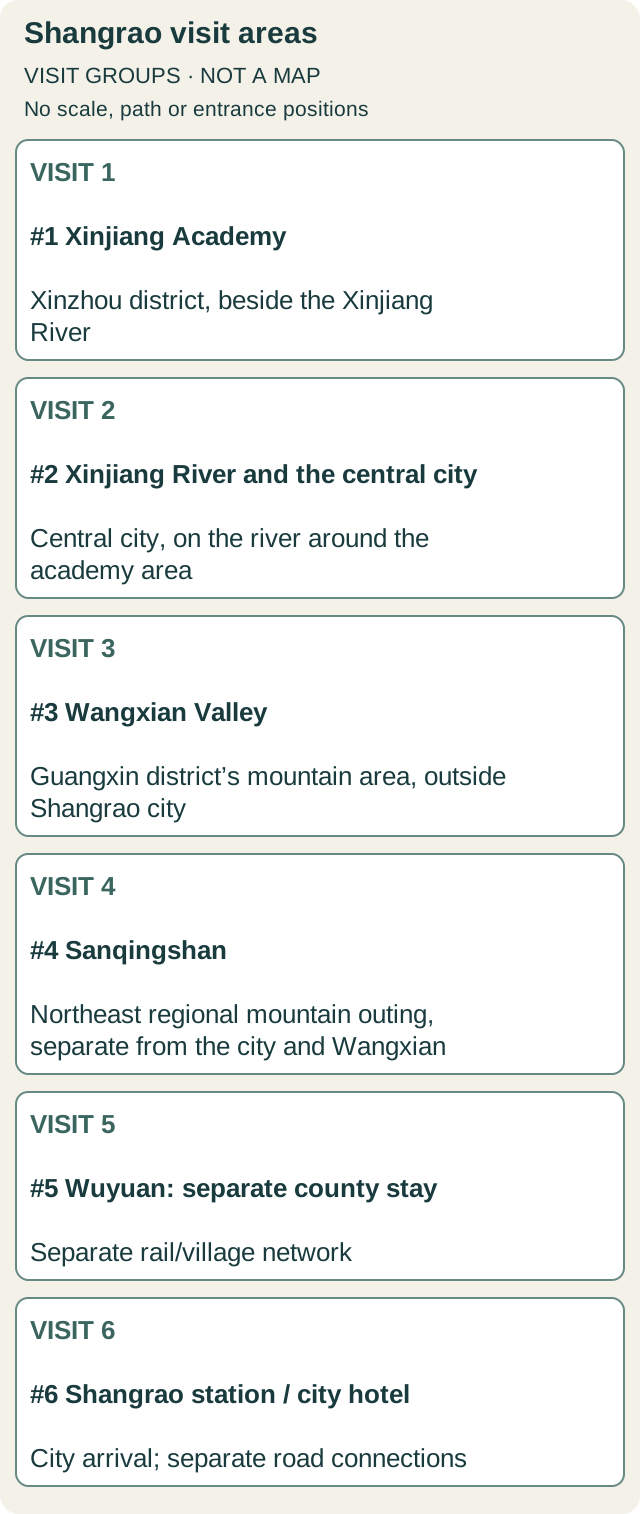
Open full-size map ↗. Xinzhou district, beside the Xinjiang River. Central city, on the river around the academy area. Guangxin district’s mountain area, outside Shangrao city. Northeast regional mountain outing, separate from the city and Wangxian. Separate rail/village network. City arrival; separate road connections. This is an editorial relationship diagram, not a navigation map; box position does not encode distance or an entrance. ChinaMile diagram; location sources. Navigation: search the Chinese name in Amap.
City only: one full day, two nights. Visit Xinjiang Academy when open, walk part of the river and enjoy local meals. This is a relaxed stop rather than a claim that the city contains every famous attraction in the region.
City plus Wangxian: two full days, three nights. Keep a central hotel and book the valley’s complete return journey before the evening visit. This is the default plan below.
City plus Sanqingshan: two full days, three nights, with a hotel change. Use night 1 in the city, visit the academy and river during the first day, then travel to your selected mountain entrance for night 2. Walk the mountain on day 2 and return to the city for night 3. Do this only with the transfers confirmed; otherwise add a night near the mountain.
Wuyuan 婺源: choose a separate county itinerary with its own village base and railway connection. Gexian Village / Gexianshan 葛仙村 / 葛仙山 offers another resort-and-mountain direction, while Lingshan 灵山 is a separate mountain choice. Treat either as a replacement or an added day, not a compulsory link between Wangxian and Sanqingshan.
Match the bed to the actual evening and morning
Central Xinzhou / Xinjiang river area: the default for meals and a city visit. Check the walking route to the academy and the hotel’s road entrance. A riverside room is a preference, not a requirement.
Shangrao railway-station area: useful for a late arrival or early departure, but less convenient for repeated city meals and walks. Choose it for the actual train, not as a substitute for checking your scenic transfer.
Near Wangxian: sensible when late scenery matters more than returning to town. Confirm whether the room is inside the paid scenic area or in a surrounding village, whether tickets are included, and the last hotel pickup. Nearby does not necessarily mean a safe walk along the road at night.
Sanqingshan entrance base: match the hotel to Jinsha, Waishuangxi or Gangshou and ask how to reach the lower station with luggage. A room high on the mountain is a different product with its own ascent and baggage constraints. Confirm passport check-in at every booked property.
Regional rice noodles before the day trip
Look for 铅山烫粉 Yanshan tangfen, rice noodles served with a hot broth and toppings, as a practical breakfast or lunch. Shangrao’s wider region also has 广丰羊肉粉, mutton rice noodles. Choose according to the menu in front of you; the regional name does not mean you must travel to that county just to eat.
Ask about stock, meat and chilli before ordering. Jiangxi dishes can be strongly seasoned, and a plain-looking broth does not prove it is vegetarian. Pair a noodle meal with vegetables or another small dish if you need a more substantial lunch.
For the mountain, carry water and a simple snack and allow time for a meal before the return. At Wangxian, compare the displayed food prices and leave time to reach the pickup even if you stop for dinner. A leisurely city meal is easier on the first evening.
Two adults: price the regional return separately
For the city plus Wangxian version, two full days and three shared-room nights, use 3R + A + D + T + ¥720–1,000. R is the nightly room quote; A the pair’s arrival and departure transfers; D the complete valley return transport including any necessary parking connection; T the pair’s actual scenic admission and selected activities.
The allowance is food ¥440–600 from arrival dinner to departure breakfast, local city journeys ¥120–180 and drinks or contingency ¥160–220. D is separate, so the regional journey is not hidden inside a city taxi allowance. Intercity rail or flights, shopping, guides and premium in-scenic accommodation are excluded.
At R = ¥320, A = ¥120, D = ¥400 and T = ¥300, the total is ¥2,500–2,780 for the pair. These are editable sample booking inputs, including T, rather than quoted Wangxian tariffs.
For the Sanqingshan alternative, replace 3R with 2R + M, where M is the one-night mountain-base room, D with the actual city-to-mountain-and-back transfer, and T with the pair’s admission and cableway basket. R = ¥320, M = ¥400, A = ¥120, D = ¥500 and T = ¥500 gives ¥2,880–3,160. Reprice if keeping a second mountain night or choosing a private car.
The city-only one-day, two-night plan uses 2R + A + E + ¥440–660, with E the actual city entry costs. At R = ¥320, A = ¥120 and E = ¥0, that is ¥1,200–1,420; the allowance covers food ¥280–400, city travel ¥60–100 and drinks or contingency ¥100–160.
Know which experience you are actually booking
1. Xinjiang Academy · 信江书院
The academy provides a more personal introduction to Shangrao than a railway-station transfer. Its halls, pavilions and trees reflect the long role of teaching and scholarship in the city. Choose a few open buildings and read the interpretation rather than treating the whole compound as a quick photo stop.
The site involves paths and changes of level. Check which areas are open and accessible before committing to the full visit. It is in the city; Ehu Academy in Yanshan and Dieshan Academy in Yiyang are separate regional destinations, not adjacent extensions of the same walk.
Hours
Confirm the museum’s current opening and any weather closure before travelling. Do not assume a park-like setting means 24-hour interior access.
Tickets
Current entry, reservation and passport processing were not field-tested; confirm with the venue or ask the hotel to assist.
Time
Allow 1–2 hours for a selected route.
Chinese address
上饶市信州区书院路;信江书院
Getting there
Navigate to 信江书院’s visitor entrance, with a local transfer from the city hotel if needed.
How to visit
Visit in daylight and follow open paths. If closed, use a short public riverfront walk and a city meal; do not enter through an unstaffed or closed gate.
2. Xinjiang River and the central city · 信江 · 信州城区
Use the river for an easy piece of city time before or after the academy. Select one accessible waterfront section rather than planning to walk the entire river. The bridges and mixed city skyline show why Shangrao works as a lived-in base as well as a gateway.
Choose a daytime walk with a known street exit and a nearby place to eat. If heat or rain makes a long walk unappealing, shorten it and spend the time over lunch. Stay away from closed flood-control paths and never use the river as a bathing area.
Hours
Daylight is easiest for unfamiliar waterfront paths. Follow closures and river-level notices.
Tickets
The route uses public streets and open paths; no cruise or paid attraction is required.
Time
1–2 hours with pauses, adjusted to weather and energy.
Chinese address
上饶市信州区信江;信江大桥周边
Getting there
Choose a specific open riverfront access point near the day’s city route, not simply “Xinjiang River” as a taxi destination.
How to visit
Use established paths and road crossings. Return from a known road pickup rather than continuing beyond the accessible section.
3. Wangxian Valley · 望仙谷
Choose Wangxian for a designed scenic experience: buildings perched against cliffs, paths through a valley and a strong change of atmosphere around dusk. It is a modern tourism development using traditional-looking architecture, not an untouched ancient village.
Arrive while it is still light to understand the paths before the evening visit. Decide your leaving time before entering. A performance end time, scenic closing time, parking shuttle and coach back to Shangrao are different things; one does not guarantee the others are still running.
Hours
Confirm the day’s admission window, lighting or performance arrangements and all return services. No fixed lighting time is guaranteed.
Tickets
Check the current official ticket product before travelling. Recent holiday rules restricted some categories to online booking; do not assume walk-up sales or extend holiday rules to every date.
Time
Allow an afternoon and early evening, with additional road-transfer time.
Chinese address
上饶市广信区望仙乡;望仙谷景区游客中心
Getting there
Use a dated scenic-bus booking or a licensed return car. Check the actual stop and whether parking controls require an additional shuttle.
How to visit
For booking or passport uncertainty, the tourism bureau’s recent notice supplies 0793-8465666. Confirm the last shuttle to your precise pickup and the separate city return. If these cannot support the evening visit, leave earlier or book nearby accommodation with a confirmed pickup.
4. Sanqingshan · 三清山
Sanqingshan is the substantial mountain choice: forested slopes, narrow granite pillars and paths suspended against rock faces. In Nanqingyuan 南清园, compare the upright column of Giant Python 巨蟒出山 with the human-like profile of Eastern Goddess 东方女神. You do not need to reach the highest summit to see the mountain’s signature landscape.
Choose the cableway before the hotel
Jinsha 金沙, east: the default for these two rock formations. Its upper station connects to the small Nanqingyuan circuit below. Book a Jinsha-area bed and return pickup together.
Waishuangxi 外双溪, south: useful for the southern Tianmen peaks and Wanshouyuan side, or a longer circuit starting near Tiyunling. Reaching the Python/Goddess area from this side means a different walking plan; do not book it assuming it is the Jinsha drop-off.
Gangshou 港首: choose it when the Sanqing Palace 三清宫 cultural area is the main interest. It is a different approach, not a shortcut for the small Jinsha loop. A cross-mountain descent only works with the correct cableway ticket and a road pickup at the new base.
A first visit with a clear shorter option
Default: the Jinsha small circuit. Ride up at Jinsha → follow Giant Python Walkway 巨蟒栈道 past Camel Peak 神驼峰 → Giant Python viewing area → Eastern Goddess → Goddess Walkway 女神栈道 → Jinsha upper station → the same cableway down. This concentrates on the two distinctive rock forms and forest-and-cliff views. The published route allows 2–3 hours on foot; allow additional time for rests, admission and both cableway queues. It still has steps and exposed heights, so it is not a step-free walk.
For a longer hike, choose the middle circuit while still at Eastern Goddess. Continue through Azalea Valley 杜鹃谷 to Jade Terrace 玉台 for a wider mountain panorama, then past Horse-head Rock 马头石 and Jade Maiden 玉女开怀, through the signed Yixiantian 一线天 stair section and Shenlong Xisong 神龙戏松, and follow the Southeast Coast Walkway 东南沿海栈道 back to Jinsha. The tourism route guidance budgets 5–6 hours of walking. It adds substantial climbing and descending; keep the short circuit if that effort or the downbound deadline does not suit you.
The shortening point is Eastern Goddess, before Azalea Valley. Take Goddess Walkway back to Jinsha rather than starting the longer loop. Once on the longer route, do not treat a different cableway as an interchangeable exit. West Coast 西海岸, Sunshine Coast 阳光海岸 and Sanqing Palace are larger-route choices, not casual additions after Jade Terrace. If either return path is closed, use the operator’s authorised diversion; do not reverse against a one-way control or try an unmarked shortcut.
Hours
Check the actual date’s cableway operating times and route closures. Mountain and lower approach routes can have different restrictions.
Tickets
Use 三清山智慧旅游 or another seller identified by the authority. Buy the correct scenic and cableway combination; do not assume a hotel booking includes either.
Time
Keep the full day for the mountain and transfers. The Jinsha small circuit is advertised at 2–3 hours of walking; the middle circuit at 5–6 hours, before cableway queues and road travel.
Chinese address
江西省三清山;金沙索道 / 外双溪索道 / 港首索道 — use the booked entrance
Getting there
Travel to the exact cableway base by a confirmed bus or car. For an early start, sleep near that same entrance rather than in central Shangrao.
How to visit
Authority service: 0793-96373. Confirm passport handling before payment, the last downbound cableway and your road return. Use the Jinsha circuit below for a first visit. Make the short-versus-middle decision at Eastern Goddess before committing to Azalea Valley; both return to Jinsha. Follow any current one-way controls.
City plus Wangxian, with a separate mountain alternative
Arrival evening · night 1
Stay in the city, eat nearby and confirm the academy’s opening. Finalise the valley admission and both legs of the road journey.
First full day · night 2
Visit Xinjiang Academy when open. Have a rice-noodle or local restaurant lunch, then walk a selected public riverfront section and keep the afternoon unhurried. This is the city day, not a transfer day through multiple counties.
Second full day · night 3
Have a relaxed morning and travel to Wangxian in time for a daylight visit. At arrival, reconfirm the last shuttle and your exact pickup. Stay into the early evening only if the booked return supports it; leave earlier when it does not. Sleep back in the city, or substitute a nearby valley night that was booked in advance.
Departure morning
Travel to the station or airport named on your ticket. If staying near Wangxian, allow for the full road transfer before boarding.
If choosing Sanqingshan instead
Use the first day’s later afternoon to reach the booked mountain base, leaving time for check-in and dinner. On the second morning, check the Jinsha cableway and the two named return walkways before ascending. Use the small circuit for a relaxed first visit, or commit early to the 5–6-hour middle circuit only with enough walking and descent time. At Eastern Goddess, the Goddess Walkway return is the planned shortening option. Descend at Jinsha and take the confirmed city return for night 3. Do not add Wangxian after the mountain descent. If weather closes the mountain, keep the city version or adjust the stay under the bookings’ change terms.
A hub is not the same thing as a scenic entrance
Shangrao 上饶 is the rail search for the city base. Wuyuan 婺源 and Yushan South 玉山南 are different stations to compare only when they suit the onward regional plan. Check the actual train on 12306 and the road transfer to the selected hotel. Shangrao Sanqingshan Airport 上饶三清山机场 is an airport serving the region, not the mountain entrance.
The locally reported scenic-bus network uses 赣悦行 Gan Yue Xing or Didi for current booking and vehicle information. Search the precise route and date, including the return. A route-launch article establishes the service channel, not today’s departure time or a guaranteed late coach.
For a valley evening or mountain day, an agreed licensed return car can fill a timetable gap. Confirm the full cost, destination in Chinese, pickup location and waiting arrangement before setting off. At Wangxian distinguish the short parking shuttle from transport all the way back to Shangrao; at Sanqingshan distinguish the cableway descent from the road return.
Give the next destination its own stay
Wuyuan is the natural next choice for village landscapes, with separate local transport and overnight decisions. Quzhou offers a compact historic-city stop to the east. Neither requires trying to collect all the region’s sights from one hotel.
Current notices guide entry; budgets remain editable
Sources reviewed on . UNESCO supports Sanqingshan’s landscape description. The tourism authority’s August notice supplies the booking channel, cableway names and service number; its temporary closures are a reminder to check the current notice, not a claim that the same closures remain today.
The Wangxian tourism-bureau response confirms why the parking shuttle and final return need separate checks. The September reservation notice supplies a current contact, while its holiday-only sales rules are not assumed year-round. Passport booking, hotel check-in and late transport were not field-tested. Visit lengths, hotel patterns and budget figures are editorial planning choices.
The entrance comparison and named walking circuits were reviewed separately on . Sanqingshan Tourism’s published small/middle route diagrams and official-account walkthrough support their spatial sequence and advertised walking allowances; the bureau’s reservation notice supports the different entrance choices. These are route plans, not a promise of today’s opening, queues or one-way direction. The other city and valley sources retain their earlier review date.
.jpg)