
Places at a glance
| Priority | Place | What you come for | Allow |
|---|---|---|---|
| Start here · 1 | Hexia Ancient Town · 河下古镇 | Stone lanes, trading-town history and small food stops | 2–3 hours |
| Start here · 2 | Huai’an Prefectural Government Office · 淮安府署 | Courts and halls that explain local imperial government | 1½–2 hours |
| Add for a second day · 3 | Qingjiangpu Canal and Qingyan Garden · 清江浦里运河 · 清晏园 | A short waterside walk, lunch and an optional garden | A relaxed half day plus the district transfers |
The main lane walks are different from admission to individual historic buildings. The canal day does not require a cruise, and an unavailable boat must not derail it.
Choose the areas
Keep Hexia and the prefectural office together in Huai’an District. Although they share a district, use a short local transfer between them; they are not two rooms in one compact heritage complex. Qingjiangpu’s canal is a separate urban outing to the northwest. Keep your original hotel for all three nights and travel there with a day bag.
The Li Canal is a useful geographic reference, but the presence of canal paths does not make the two centres one practical sightseeing walk. In each area, select a limited stretch and return to a road pickup point.
For modern Chinese history, substitute the Zhou Enlai Memorial Hall or his former residence for the prefectural-office visit. They are distinct venues, and the home-region scenic authority supplies their admission notices. Do not add both automatically to the old-city day. For canal engineering, the China Water Transport Museum near the old-city core is an alternative indoor focus; its admission is separate from the prefectural office.
Spring and autumn are the easiest editorial choices for a walking trip. In hot or wet weather, put the historic interior first, take a long lunch break and shorten the canal walk. Wet stone lanes and open waterside paths deserve more time, not a more ambitious route.
Where to stay
Default: Home Inn neo Huai’an Zhou Enlai Memorial Hall–Hexia Ancient Town · 如家·neo 淮安周恩来纪念馆河下古镇店. Save the complete driver address: 淮安市淮安区楚州大道818号H2号楼(如家酒店). This is a road-accessible Huai’an District base rather than a room inside Hexia’s lanes. Choose it when the office and old town are your main reasons for coming. It keeps the first sightseeing day local, but it does not remove the road journey to Qingjiangpu or put every sight within a short walk.
The operator’s public room list names 商务大床房, with one 1.8 m bed and an occupancy of two. This is the straightforward choice for two adults sharing. Its 家庭房 lists a 1.8 m double and a 1.35 m single, with occupancy of three. For two adults and one child, enter the child’s actual age and have the hotel confirm that the selected rate accepts the party; three listed places do not establish free child breakfast or an extra bed. Four travellers should select two eligible rooms unless the hotel offers a separately confirmed four-person product.
Two other products are labelled twin rooms but their published bed descriptions conflict. If you need two equal beds, do not resolve that conflict by guessing: ask the property to confirm the exact category, or use the Hampton alternative below. The listing has a foreign-guest service icon; check-in for your documents and party has not been tested.
Book from the exact operator property page, replace its default dates, choose the required room and read the total, breakfast count, prepayment and cancellation deadline for that rate. The phone is +86 517 8568 0666. Save the hotel code 051709 and H2 building address: similarly named affiliated properties are different hotels. A room-list observation establishes a category, not availability for your trip. Parking at this particular property has not been verified.
Alternative for breakfast, clear twin beds and a driving base: Hampton by Hilton Huai’an Jingkai · 淮安经开希尔顿欢朋酒店, 经济技术开发区厦门路21号, +86 517 8619 1999. The operator page names King Guest Room and Superior Room with Two Twin Beds, and lists breakfast and complimentary onsite self-parking. Choose the bed setup you need before considering a room upgrade. The development-zone location requires road journeys to the old town and is less useful for walking out into heritage lanes. Published check-in is 14:00 and checkout is noon; early room access is not guaranteed.
Use the Hampton’s exact page, set actual dates, one room and the full adult/child party, then compare the final rate conditions. Breakfast inclusion for the room does not establish that every additional child eats free. If you have a third adult, need a cot or require a specific accessible room, obtain a room-specific confirmation before paying. Confirm parking access and vehicle size with reception. No airport hotel shuttle is included in this plan.
For either property, prefer a cancellable rate when the inbound connection is uncertain. Read the cancellation cutoff in the booking’s stated local time and save the confirmation. After a delay, contact the property before the no-show cutoff; cancelling a room does not automatically refund it. These are researched lodging choices, not hotels we have stayed in or tested with a foreign passport.
Arrive, reach the hotel and leave
By rail. Search the exact station Huai’an East · 淮安东 on China Railway 12306 for the high-speed option. If your ticket instead says Huai’an · 淮安, keep that name; do not instruct a driver to use the East station.
From Huai’an East, collect your luggage and follow signs to the designated taxi queue or the pickup point shown by your booked car. Show 如家·neo,楚州大道818号H2号楼 for the default, or 希尔顿欢朋,厦门路21号 for the alternative. Ask for the hotel’s reception entrance, not a nearby attraction bearing the hotel’s marketing name. Allocate 45 minutes after leaving the station for the road transfer and finding reception; this is a conservative scheduling allowance, not a measured journey or fixed taxi fare. Increase it if the live road estimate is longer.
By air. The airport is Huai’an Lianshui International Airport · 淮安涟水国际机场 (HIA), outside the sightseeing centres. After arrival formalities, collect bags on the arrivals level and use the signed taxi/pickup area. A prearranged car should have the flight number and the exact hotel address; agree where its driver will meet you and how waiting is charged. For a first arrival with luggage, take the full airport-to-hotel road transfer rather than changing through an unverified city bus connection. Allocate 90 minutes after reaching landside for meeting the car and the road journey to either named hotel, then check the live estimate. Do not treat that as a promised driving time or a quoted fare.
The airline’s Huai’an airport information confirms arrival facilities and warns that airport-bus locations and times change. A current airport-to-hotel bus timetable, taxi-queue gate number and last service were not verified. If you want a bus, ask the airport transport desk for its actual destination and final departure, then add the remaining taxi leg to your hotel. The default car chain remains the complete route if that bus is unavailable.
Leaving. Start at the same hotel reception. The evening before, show reception your ticket and book the pickup to the exact rail station or airport terminal. For a train, calculate live road estimate + 20 minutes road contingency + 60 minutes at the station, and allow more at busy times. For a flight, use live road estimate + 30 minutes road contingency + the airline’s required airport-arrival allowance; as an editorial planning floor, target two hours before a domestic departure or three before an international departure, unless the carrier requires earlier. Those buffers are planning choices, not carrier check-in deadlines.
Keep all bags at the hotel until this transfer. Do not begin departure morning in Qingjiangpu and try to combine sightseeing, luggage collection and a train connection. A very early train can justify a station hotel for the final night, but moving hotels adds a transfer and is not included in the default three-night plan.
Move around Huai’an
Walk within Hexia and within a selected canal section. Use taxis or a booked car for hotel–office, office–Hexia, and Huai’an District–Qingjiangpu. Save the Chinese destination before going offline; a city name or the words “Grand Canal” are too broad.
Ask the driver to stop at the nearest legal road access to the named entrance and save that pickup location in the map app before entering a pedestrian area. On return, order the car only when you can reach the agreed road point; the driver cannot collect you from a lane or waterside path. Hotel reception can help order a car if your phone or payment setup fails.
Local buses and trams may reduce costs, but their current stopping patterns, last departures and foreign-payment usability were not tested. The day plan deliberately works with short car transfers. If driving, the Hampton supplies the verified hotel-parking base: leave the car there after checking parking access and use the named taxi legs below. No sight in this guide depends on finding an unverified free curb space.
Give Huaiyang cooking an unhurried dinner
Order 软兜长鱼 ruandou changyu for a local eel dish, 平桥豆腐 Pingqiao tofu for a delicate tofu preparation, or 钦工肉圆 Qingong meatballs for a shared bowl. Recipes vary: a tofu dish can use meat or seafood stock, so the name alone does not establish a vegetarian meal.
For two adults, begin with one shared meat or fish dish, one vegetable dish and rice or a small soup. Ask portion size and price before choosing river seafood, then add food only if needed. A full banquet is unnecessary.
Use Hexia for small snacks and the hotel area or Qingjiangpu for the longer dinner. 汤包, soup-filled buns, contain hot liquid; let them cool and ask about the filling. 茶馓 is crisp fried dough, a snack rather than another main course. Ask a restaurant directly about allergens and stock ingredients.
Calculate the stay
For two adults sharing a room, use 3R + A + T + ¥760–1,100. R is the actual nightly room quote; A is the pair’s combined arrival and departure ground transfers; T is the actual selected historic-site total for both people. A for an airport journey will differ from A for a rail journey. Unknown prices remain inputs, not zero.
The editorial allowance comprises ¥480–680 meals, ¥160–240 local journeys, and ¥120–180 drinks/contingency, from arrival dinner through departure breakfast. It is not a taxi or restaurant quotation. Intercity trains/flights, shopping, guides and cruises are extra.
For example, R = ¥300, A = ¥100 and T = ¥160 gives ¥1,920–2,260 for the pair. Those are editable sample inputs, not an offer for either hotel. The one-full-day/two-night plan is 2R + A + T + ¥460–680: with the same inputs, ¥1,320–1,540. Change T if a site is removed.
For the additional city day/night after a lost full day, add the actual extra room Rₑ + ¥240–340 meals + ¥40–80 extra local travel + ¥40–60 contingency + C. C is the extra onward-ticket/accommodation amount and fees actually incurred, less actual refunds or credits; do not count both a whole replacement price and its already-included net difference. In the sample, Rₑ = ¥300 and C = ¥0 adds ¥620–780, producing ¥2,540–3,040. A non-refundable missed room or ticket remains a cost; money requested as a refund is not a refund received.
Places in detail
1. Hexia Ancient Town · 河下古镇
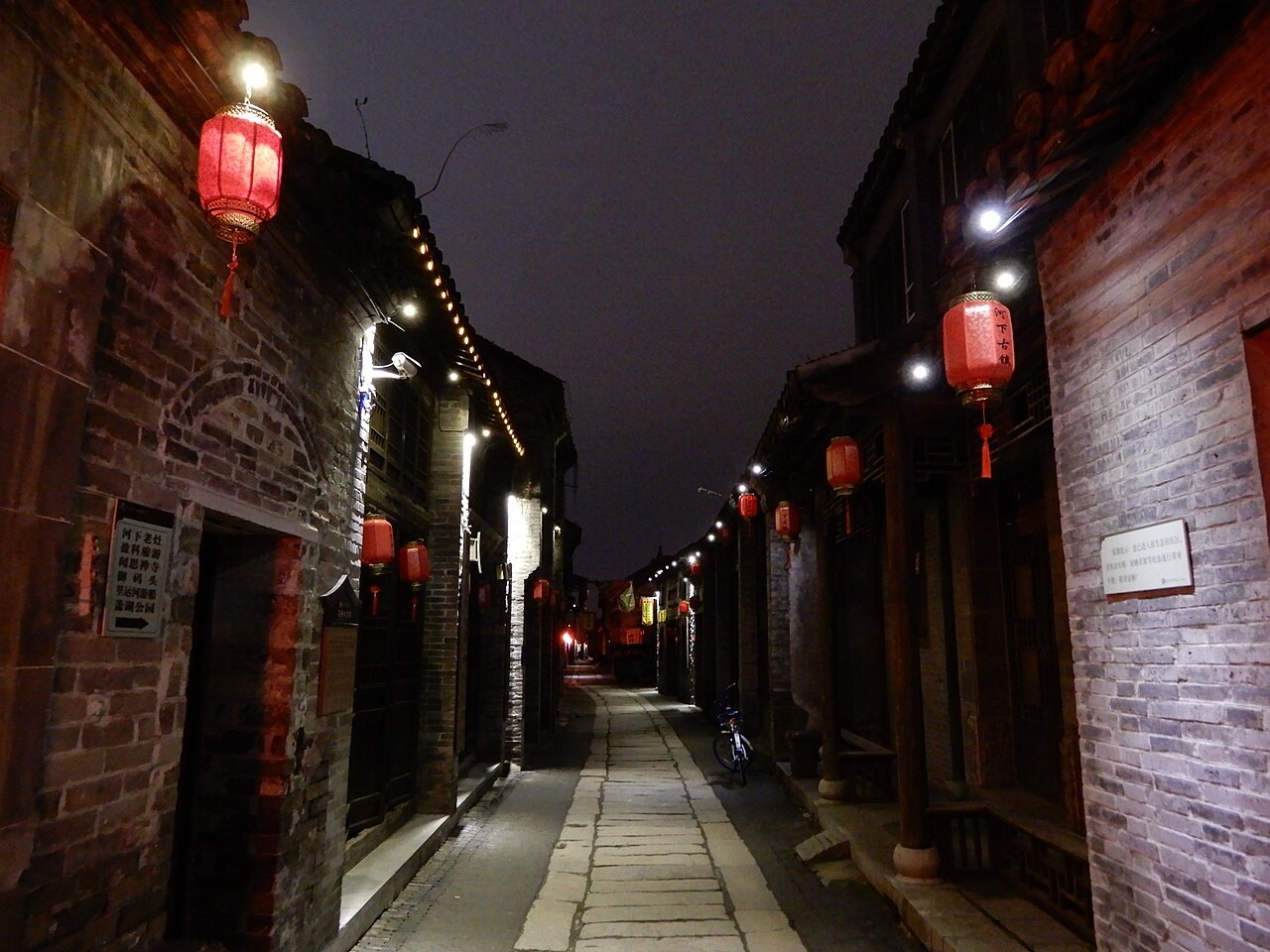
Start with the lanes themselves: stone paving, brick walls, timber fronts and the contrast between quieter side streets and busy snack shops. Hexia belonged to the trading world created by the canal. Restored visitor-facing premises are part of today’s town, so come for a lived-in heritage district rather than an untouched historical set.
Begin from the south-side access, follow the main lanes including 湖嘴大街, step into a few open side streets and return to the same side. Spend time looking at the small-scale street pattern instead of following every crowd. Wu Cheng’en’s former residence is an optional paid addition for readers interested in Journey to the West; the public-lane visit does not depend on entering it.
- Hours and admission: use daylight or early evening for the public lanes. Shops and historic houses have individual hours and admission. Festival extensions are not regular opening rules.
- Allow: 2–3 hours including a snack; reduce to one main lane and a seated stop if walking is difficult.
- Driver search: 淮安市淮安区河下古镇南入口. This identifies the desired side, not a guarantee that a car can reach the pedestrian gate.
- From the hotel / previous stop: take a taxi from Home Inn neo or from the prefectural office to the south-side road access; save the driver’s legal drop-off point.
- Return: go back to that saved road point and order to 楚州大道818号H2号楼 or 厦门路21号, matching your hotel.
- Parking: no current gate car-park terms were established. If driving, leave the car at the Hampton’s confirmed onsite parking and use the return taxi chain. Do not drive into the lanes.
- Official service: the city identifies 慧游河下 in WeChat as the attraction/product and food-map service. Select a named interior only when you want it; an area product is not automatically the ticket for every house. The scenic authority’s Hexia introduction supports its historic setting.
Keep luggage at the hotel. Wet stone can be slippery; a morning of heavy rain is a reason to shorten the lanes and keep lunch, not to replace them with an unconfirmed boat.
2. Huai’an Prefectural Government Office · 淮安府署
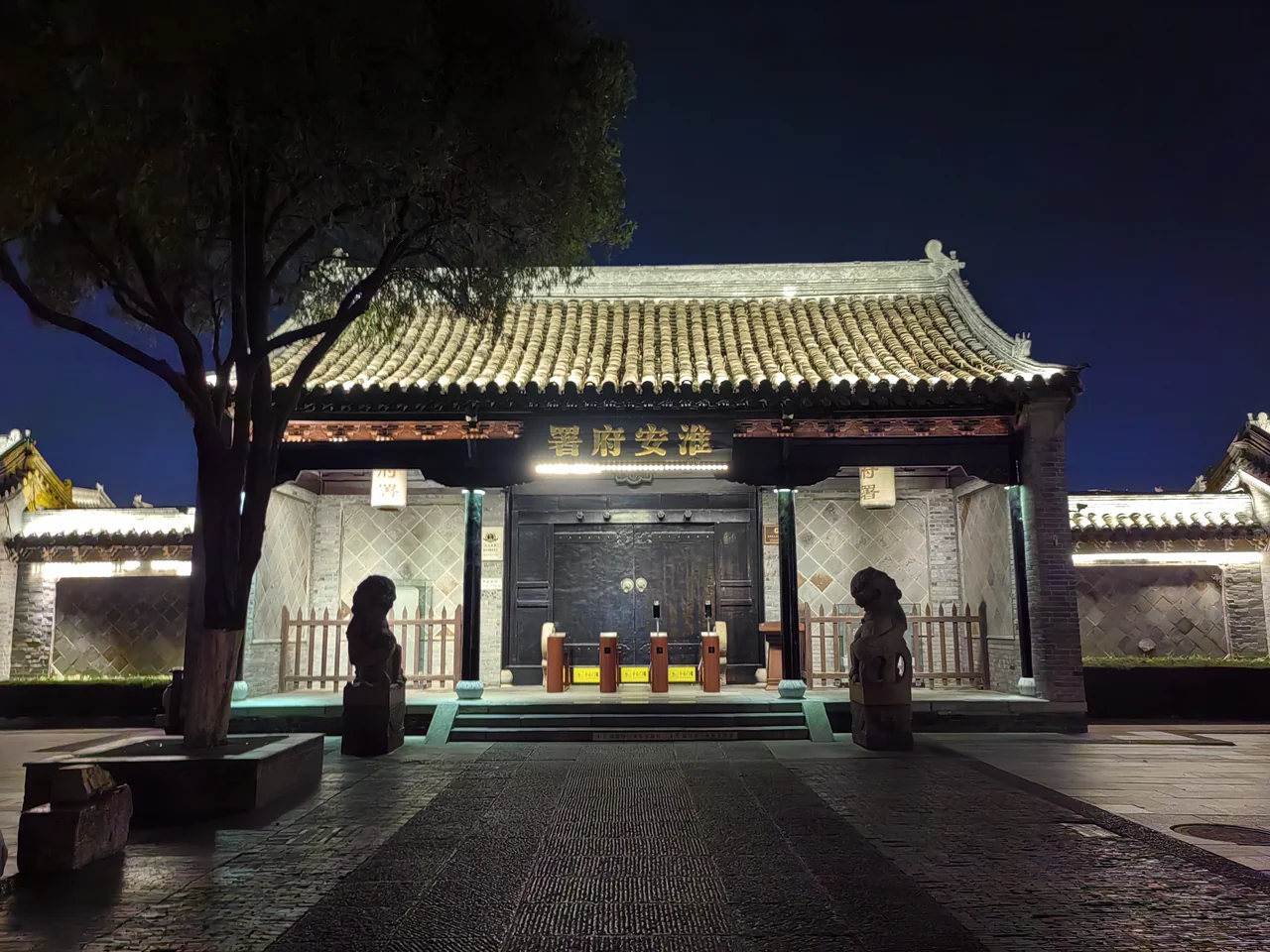

The interest is in the sequence of spaces: gates, open courts and formal halls made authority visible. Start on the central axis, compare the main public halls with the inner domestic spaces, then choose a side court that is open. This is a stronger contrast with Hexia than another shopping lane.
The complex includes restored and reconstructed fabric. The local heritage account describes how the surviving main halls were repaired and other parts reinstated. Do not read the present whole complex as an entirely untouched Ming building. Afterward, a short look around the old city and Zhenhuai Tower is enough; the separate water-transport museum is a replacement or extra-time choice.
- Hours: Trip.com/Ctrip’s attraction page, read 10 November 2026, lists 08:30–17:30 and 17:00 final ticket sale/entry. This is a platform planning reference; the selected-date official product and gate notice control admission. The itinerary arrives in the morning.
- Allow: 1½–2 hours for the main route, plus ticketing.
- Address: 淮安市淮安区东门大街38号,淮安府署.
- Book: open 慧游河下, select 淮安府署, the actual date and ordinary adult daytime admission. Read the included areas, entry time, final total and refund rules. No current official checkout price is asserted here.
- Passport boundary: choose 护照 only if the form actually offers it. If it accepts only a mainland ID, stop and call +86 517 8561 6678 before committing to this as the trip’s main attraction. The number is platform-listed; a completed call or manual passport sale has not been tested.
- At the gate: take the original passport and ask the visitor desk, 外国护照能买今天的普通门票吗?几点停止入场? Pay only after staff identify a product usable with your document.
- Transfer and return: taxi from the hotel to 东门大街38号. After the visit, use the same road-side visitor access for the taxi to 河下古镇南入口, then return from Hexia to the hotel.
- Parking: the platform lists a timed-fee 淮安府署停车场 at this address; capacity and today's charges have not been independently verified. The complete fallback is the Hampton onsite parking → taxi to 东门大街38号 → taxi to Hexia → taxi back to 厦门路21号.
- If admission fails: go to Hexia’s public lanes for the day’s main visit, keep lunch and the evening meal, and retain the separate Qingjiangpu day. Do not buy a domestic-ID product as a workaround.
3. Qingjiangpu Canal and Qingyan Garden · 清江浦里运河 · 清晏园
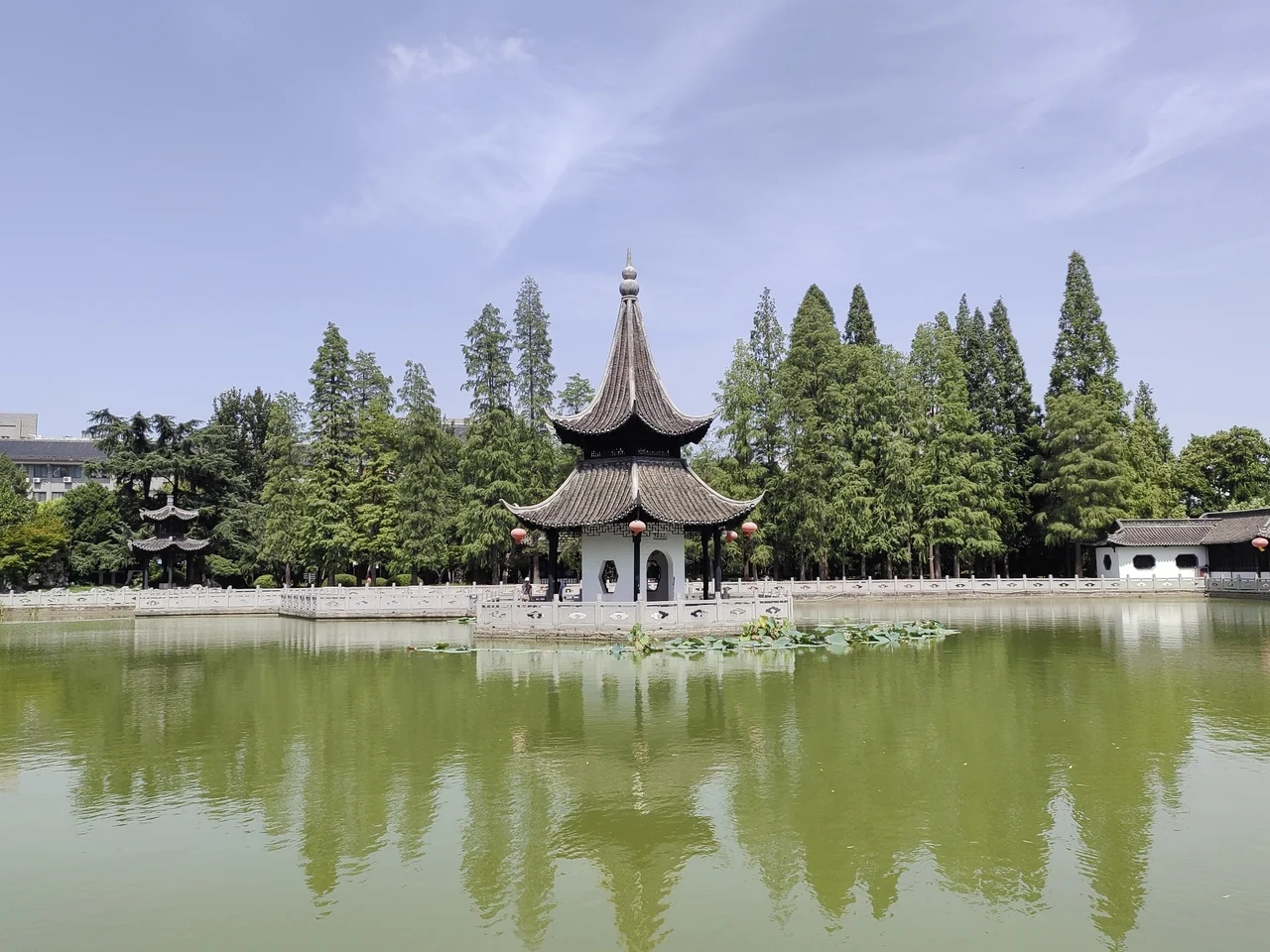

This is the slower half of Huai’an: bridges, water, old canal infrastructure and a meal beside a modern city. Use the area around 清江浦楼 and 清江大闸 as the orientation point. Pick a manageable section, pause for a drink and turn back while the return remains easy. The local account of Lunbu Road explains the former wharves along the south bank; the present promenade is a revived urban waterfront.
Qingyan Garden adds shade, courtyards and water-management history. Choose it after the canal if its gate is open, or keep a longer lunch instead. The garden and its exhibition rooms are not interchangeable: an interior can be closed while part of the grounds remains usable. A cruise is optional; buy only after its departure point, duration and return landing are clear.
- Hours and admission: the default is an accessible public canal section in daylight, with no cruise purchase. Exact current garden/interior hours were not confirmed, so the garden remains optional; follow its gate notice and any water-edge closures.
- Allow: a relaxed half day with lunch, plus a separate road transfer each way.
- Named destinations: 清江浦楼,清江浦区里运河 for the canal; 清晏园,清江浦区人民南路 for the garden. These are two distinct stops.
- Outbound: from your hotel, taxi to the legal road access serving 清江浦楼; walk the selected tower/sluice section.
- After the walk: return to the same road access, or take a short taxi to 清晏园人民南路入口附近 if visiting the garden. This avoids depending on an unverified continuous pedestrian route.
- Homeward: from the named garden-side road or the saved tower-area pickup point, taxi directly to your original hotel. Do not order merely to “Huai’an old town”.
- Parking: no current canal or garden car-park terms were verified. Driving visitors can leave the car at the Hampton and use this same outbound/return chain; public waterside paths are not parking areas.
- Official context: Huai’an government’s Qingjiangpu introduction identifies the canal, tower and garden as one broader visitor area, without promising a single admission product.
A workable four-calendar-day stay
| Calendar day | Plan | Night |
|---|---|---|
| Arrival day | Reach the named hotel, leave bags, eat nearby and resolve prefectural-office admission. An evening arrival is not a sightseeing day. | Huai’an night 1 |
| First full day | Breakfast; taxi to the prefectural office for a roughly 09:00 start; allow 1½–2 hours plus entry. Lunch in the old city. Taxi to Hexia, allow 2–3 hours for lanes/snacks, then taxi back. Have the longer Huaiyang dinner near the hotel. | Huai’an night 2 |
| Second full day | Breakfast; make the road transfer to Qingjiangpu. Walk a short canal section, take lunch, and add Qingyan Garden if open. Return to the same hotel by late afternoon, leaving the evening unhurried. | Huai’an night 3 |
| Departure day | Breakfast, collect luggage, and make the booked transfer to the exact station or airport. | None included |
Times are editorial planning blocks. Reverse the office and Hexia only when the office’s confirmed admission window allows a proper visit. With one full day and two nights, follow arrival → the old-city full day → departure and omit the Qingjiangpu day completely.
A few hours late: keep the hotel night, cut the optional arrival walk and eat near the hotel. If the sightseeing morning is shortened, retain the office booking if still valid and reduce Hexia to the main lane; do not push a paid interior beyond final entry.
One whole full day lost after arrival: to preserve both sightseeing days, add one calendar day and one hotel night, making five calendar days/four nights. Use the next available full day for the office and Hexia, the following day for Qingjiangpu, then depart the next morning. Change the onward transport and next hotel before paying for the extension. If departure is fixed, delete the whole Qingjiangpu day, keep the office and Hexia on the remaining full day, and drop the optional water-transport museum, Zhou Enlai replacement and cruise.
Arrival itself is delayed by 24 hours: keeping the original departure leaves only one full day and two occupied city nights. Use the short old-city plan and ask about refunding the missed first night. Extending departure by a day restores the original three occupied Huai’an nights, but any charged missed night and overnight spent en route remain additional costs; it is not automatically four occupied Huai’an hotel nights.
Add a culture-centre programme only after confirmation
The municipal culture bureau describes exhibition and performance rooms at 淮安市文化馆,翔宇南道13号. Call the bureau’s published number +86 517 83665272, ask for 淮安市文化馆, and give the date and programme name. Ask whether an individual visitor with a foreign passport needs a reservation, and which room and entrance to use. The bureau’s general opening policy does not establish availability for a class. If no place is confirmed, use the canal walk and Qingyan Garden day above.
Continue to Yangzhou for gardens and morning tea
Yangzhou is the recommended contrast after Huai'an's lanes, prefectural office and canal. Keep D1 arrival/night 1, D2 the prefectural office then Hexia/night 2, and D3 Qingjiangpu canal with the selected Qingyan Garden branch/night 3, following the city-day order above. The Lianyungang–Zhenjiang rail corridor links the Huai'an and Yangzhou areas. On D4, book the actual 淮安东 → 扬州东 service offered for your date in 12306; an old launch-day time is not a current timetable. Continue as follows for seven calendar days / six nights, three nights in each city.
Yangzhou's three-night base is Holiday Inn Express Yangzhou City Center / 扬州文昌阁智选假日酒店,汶河北路75号, in the Wenchang area. Use 1 Queen Bed for two sharing or 2 Single Beds for separate sleepers; the named 1 Queen Bed and 1 Single Bed configuration is a family possibility only when the selected rate accepts all adults and children's ages. Enter every guest, compare the actual total/breakfast/cancellation deadline, and confirm passport registration and late arrival with +86 514 879 79788. These are published room choices, not a dated vacancy or a tested stay. Official hotel, room types
| Day after the first three nights | Actual continuation | Overnight |
|---|---|---|
| D4 — transfer and settle | Breakfast and bags → the exact booked origin station → the booked rail itinerary → 扬州东站 or 扬州站, exactly as issued → official taxi queue → 汶河北路75号. Keep about 30–50 minutes for the station-to-hotel movement as an editorial allowance, longer in congestion. Check in, eat in the Wenchang area and rest; no reserved attraction depends on an early arrival | Yangzhou night 1, total night 4 |
| D5 — Slender West Lake | Hotel breakfast → taxi to 瘦西湖南门,大虹桥路28号 → willow bank → Xu Garden → Small Golden Hill / Fishing Terrace → Five-Pavilion Bridge and White Pagoda. Allow 3–4 hours, then retrace to the south gate → taxi to lunch/hotel rest. Continue to Twenty-Four Bridge only if energy permits and a different exit/pickup is arranged. This default omits Daming Temple, a boat ride and another paid garden that afternoon | Same hotel, total night 5 |
| D6 — morning tea, Ge Garden and Dongguan | Confirm breakfast service at 富春茶社(国庆路店),国庆路得胜桥35号; taxi to the lane's vehicle-accessible end and walk in. Order tea, a small bun portion and gansi; if the queue exceeds about 30 minutes, eat simply and protect the garden morning. Taxi to 个园北门,盐阜东路10号 → bamboo/four-season rockwork → southern residential rooms, about 1½–2 hours. Use an open signed exit for Dongguan Street → a short side lane → east gate/canal edge → seated meal → agreed legal 泰州路-side pickup → same hotel. If the garden's south exit is shut, walk around on public streets | Same hotel, total night 6 |
| D7 — depart | Breakfast, collect all bags → pre-booked car to the exact 扬州东 / 扬州 station. Add the current road estimate and pickup contingency to at least a 45–60-minute rail-station buffer. For 扬州泰州国际机场 (YTY) instead, book the separate airport car the previous evening and work backwards from airline check-in/bag-drop/boarding deadlines; allow roughly 60–90 minutes for the road/arrival movement as an editorial starting point, then the airline's airport margin | No further night included |
For these two Yangzhou full days, ordinary 2026 lake-plus-Ge-Garden admission totals ¥148 per adult in February–October, or ¥90 in January/November/December before concessions/promotions: ¥296 or ¥180 for two. Use the official 瘦西湖 / 扬州个园 daytime-ticket channels or staffed entrances, original passports and the actual date. Passport checkout was not tested. The existing Yangzhou guide's garden hours are secondary planning references, so this itinerary uses mornings and the day's entrance notice rather than promising evening admission. Published 2026 tariff table
This seven-day choice omits He Garden, the Canal Museum/Sanwan and the western Double Museum. It deliberately gives the second city a lake day and a garden/food day. A Canal Museum day would replace D6 in full or add D7 and another Yangzhou night, moving departure to D8; it is not another stop after Ge Garden. For the replacement, first secure the official 中国大运河博物馆 timed reservation (releases at 19:00 China time, up to seven days ahead; passport category supported, overseas-phone flow untested). Then use hotel → 运博路1号 → 3–4 hours of selected permanent galleries → lunch → short same-bank Sanwan walk if weather permits → original museum-side road pickup → hotel. Ordinary museum galleries and public Sanwan walking are free; a special exhibition is separate. Use an open day, normally avoiding Monday; contact +86 514 8277 3088 if the official phone/document step fails, and retain the garden day if no authorised session is obtained. Museum visitor rules, official booking instructions
If the whole D4 transfer is lost after the first city stay: keep the extra D4 night in the first city, travel on D5, use D6 for the lake and D7 for morning tea/Ge Garden/Dongguan, then depart D8. That is eight days / seven nights: four in the first city and three in Yangzhou. With the original D7 departure fixed, D5 is transfer, D6 keeps Slender West Lake, and the entire morning-tea/Ge-Garden/Dongguan day is cut; only two Yangzhou nights remain. Add the actual extra origin-city room/meals and replacement travel, retain nonrefundable originals, and subtract only refunds received. An optional arrival walk does not replace the omitted full day.
Complete seven-day budget for two adults
For seven days / six occupied nights, three in each city, use B₇ = 3R₁ + 3R₂ + A₁ + T₁ + J + T₂ + D₂ + F₁ + F₂ + U₁ + U₂ + G₁ + G₂ + K₁ + K₂. All non-room amounts below are totals for both adults. The complete example runs from the first arrival station/airport to the final departure station/airport; long-distance tickets to the first city or away from the final city, shopping, guides and optional boats/cableways are outside it. Add those only if part of your purchase.
Every room, rail fare, road fare, meal and reserve number in this example is a hypothetical editable budget input, not a live offer. The ticket references keep their dated conditions described above. Unknown actual prices are represented by explicit assumed amounts, not silently set to zero.
| Symbol | What is included once | Pair's sample amount |
|---|---|---|
| 3R₁ | Three Huai'an room nights at ¥300 | ¥900 |
| 3R₂ | Three Yangzhou room nights at ¥350 | ¥1,050 |
| A₁ | First city: arrival station/airport → first hotel | ¥50 |
| T₁ | D4: first hotel → actual departing station | ¥50 |
| J | D4: complete intercity rail itinerary for both adults | ¥160 |
| T₂ | D4: arriving station → second hotel | ¥60 |
| D₂ | D7: second hotel → final station/airport | ¥60 |
| F₁ | Meals from D1 dinner through D4 breakfast | ¥580 |
| F₂ | Meals from D4 lunch through D7 breakfast | ¥600 |
| U₁ | Huai'an sightseeing rides only | ¥200 |
| U₂ | Yangzhou sightseeing rides only | ¥220 |
| G₁ | Selected Huai’an historic-site tickets: hypothetical T160, not a verified official tariff | ¥160 |
| G₂ | Two ordinary 2026 Slender West Lake + Ge Garden admissions, using February–October reference 2 × (100 + 48) | ¥296 |
| K₁ + K₂ | Drinks not already in meals, plus contingency | ¥330 |
The worked total is 900 + 1,050 + 50 + 50 + 160 + 60 + 60 + 580 + 600 + 200 + 220 + 160 + 296 + 330 = ¥4,716 for the pair. The Yangzhou example uses the published 2026 February–October lake/garden standard. For January, November or December, substitute G₂ = ¥180; the same sample then becomes ¥4,600. Any actual promotion or concession changes only the relevant ticket input.
This formula replaces both cities' standalone A allowances. Do not add either original A again: first arrival is A₁; D4 has T₁ and T₂; the final exit is D₂. J is the intercity ticket, not either taxi leg. U₁/U₂ exclude those four boundary transfers. F₁ ends with D4 breakfast, and F₂ starts with D4 lunch, so the transfer day's meals are counted once. The meal windows contain 8 and 9 meal occasions respectively; adjust them if breakfast is already included in the room, without adding the same meal again.
If the whole D4 transfer fails
Keeping both second-city outings means 8 days / 7 occupied nights = Huai'an 4 + Yangzhou 3: D4 remains in Huai'an, D5 is the move, D6/D7 are the two full outings and D8 is departure. Keeping the original D7 departure instead means 7 days / 6 occupied nights = Huai'an 4 + Yangzhou 2: D5 move, D6 the retained outing, D7 depart; cut the entire Fuchun morning-tea, Ge Garden and Dongguan Street day; retain Slender West Lake.
Use revised budget = B₇ + new payments and added allowances − amounts actually refunded or no longer spent. An original prepaid charge already in B₇ stays there until a refund is received; do not add the same loss a second time. A replacement ticket is recorded at its full new payment minus the actual old-ticket refund, without also adding a separate fare difference.
Here is a reconciled illustration, using the same room and rail inputs as the table. Assume the three second-city nights were booked for D4/D5/D6: D4 is missed and nonrefundable, while D5/D6 remain usable. The first D4 trip to the station was made; extra local rides cover the return and retry. Assume a new intercity ticket payment J′ = ¥160, a separate ¥20 fee, and ¥80 actually refunded from the original J. Other consequential net charges, called Z, are ¥0 only for this illustration; add the real Z if onward travel, room prices or non-movable attractions cost more. No hotel, fare or attraction refund is promised.
| Changed plan | Additions / real credits against B₇ | Calculated result |
|---|---|---|
| Extend to 8d7n; retain both outings | Extra occupied first-city room ¥300; new D7 second-city room ¥350; three extra meal occasions ¥200; extra rides ¥40; extra reserve ¥20; new rail ¥160; fee ¥20; less actual rail refund ¥80; plus Z | Δ = ¥300 + ¥350 + ¥200 + ¥40 + ¥20 + ¥160 + ¥20 − ¥80 = +¥1,010; revised ¥5,726 with Z0 |
| Keep D7 departure; remove the named full day | Extra first-city room ¥300; replacement origin meals ¥160; extra rides ¥40; extra reserve ¥20; new rail ¥160; fee ¥20; less actual rail refund ¥80, second-city meals not needed ¥180, avoided rides ¥80, ticket credit/avoided purchase ¥60, released reserve ¥20; plus Z | Δ = ¥300 + ¥160 + ¥40 + ¥20 + ¥160 + ¥20 − ¥80 − ¥180 − ¥80 − ¥60 − ¥20 = +¥280; revised ¥4,996 with Z0 |
In the extension, you occupy seven nights but pay for eight room-nights: four in the first city, three used in the second city, and its missed D4 room. The missed room's ¥350 is already in B₇; the added ¥350 buys the new D7 night, not the loss again. In the fixed-date version you occupy six nights but pay for seven, since the missed second-city room is still charged and no D7 room is bought. Of the removed day's ¥96 ticket allowance, this example actually recovers/avoids only ¥60; the remaining ¥36 stays as a loss. The old rail's unrecovered ¥80 also remains in the original account. Substitute actual credits rather than subtracting an entire deleted room or attraction automatically.
For a four-day holiday, retain Huai'an alone. Hongze Lake or a countryside detour would displace a full city day or need another night; neither is included in this seven-day city combination.
Sources and conditions
The history, food and district descriptions retain their October 2026 source checks. On 10 November 2026, the hotel categories, selected official history pages, airline airport information and platform office hours were revisited; this does not refresh every older fact. The Home Inn room response was read for a sample one-night date and is used only to establish its published categories and occupancy.
No room purchase, hotel call, foreign-passport check-in, attraction purchase or actual transfer was performed. The office’s current official adult total and passport purchase path remain unresolved. Taxi time allowances, route order, walking durations and budgets are editorial planning assumptions. The official city briefing identifies 慧游河下; temporary event hours in that briefing are not used as the ordinary timetable. The city’s food introduction supplies the local dish context.