Jiuhuashan Stay among the temples, follow a pilgrimage stairway, then give Tiantai's high mountain scenery a separate day.
Jiuhuashan is compelling because its mountain setting and religious life belong together. Temple courtyards sit among inns and ordinary shops in a high basin; above them, pilgrimage stairways and rocky ridges lead toward more remote shrines. Choose it for Buddhist culture as much as for a mountain view, and allow pauses rather than trying to climb every sector.
Give it two full sightseeing days and three nights. The straightforward rail-arrival plan sleeps first in Kecun at the foot of the mountain, then twice near Jiuhua Street: one day for the temple town and nearby ascents, the other for Tiantai. That one hotel change prevents a late arrival from depending on the last uphill bus. Huatai is a separate landscape-led alternative, not a stop to squeeze into the same mountain day. If granite scenery is your sole aim and the temples hold little interest, compare Huangshan before allocating the nights.
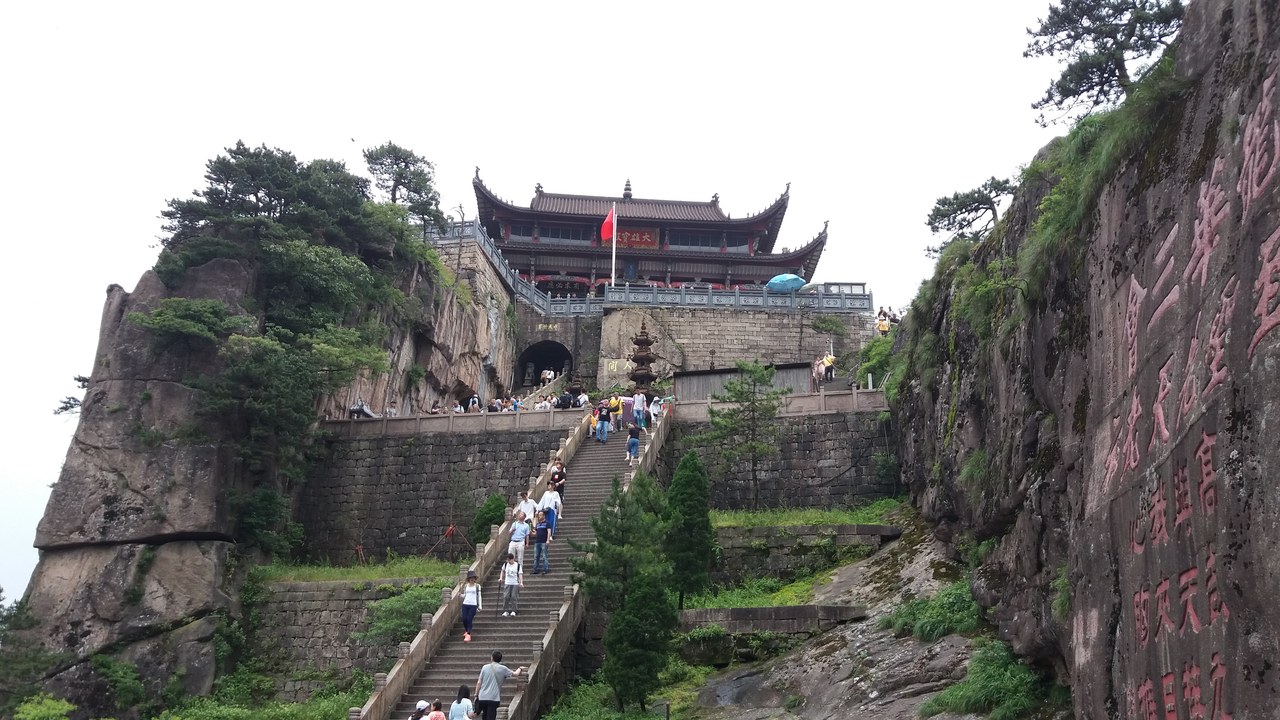
The ascent to Tiantai Temple on Jiuhuashan, photographed in June 2019. The image shows the mountain stairway setting, not current crowd or access conditions.Photo: 钉钉 · CC BY-SA 4.0 · Image credits
A stepped pilgrimage approach to a major shrine associated with Dizang · Above the street area, on Shenguang Ridge
Allow about 1½–2 hours with the climb and descent · Use the core scenic entry arrangement; religious offerings and purchases are voluntary and separate.
A hillside temple above the town, reached by a funicular or a stair climb · Above Jiuhua Street; a separate ascent from Roushen Hall
About 1½–2 hours, longer with queues or a walking ascent · The posted return-funicular fare is ¥100 per adult in the regular season, ¥80 in the low season; it is not scenic admission.
Rocky mountain scenery and the high temple's final stone-step approach · Separate mountain excursion via Fenghuangsong 凤凰松
Most of the second sightseeing day including transfers · Core admission, road transport and Tiantai cable are distinct products. Posted return cable: ¥160 regular season, ¥120 low season.
A landscape-led visit to rock formations, viewpoints and mountain paths · A separate cable-access sector reached from the lower gateway
Give it its own mountain outing · Separate Huatai cable product; check access, connecting transport and any re-entry implications before replacing Tiantai.
The lower gateway, temple basin and mountain sectors
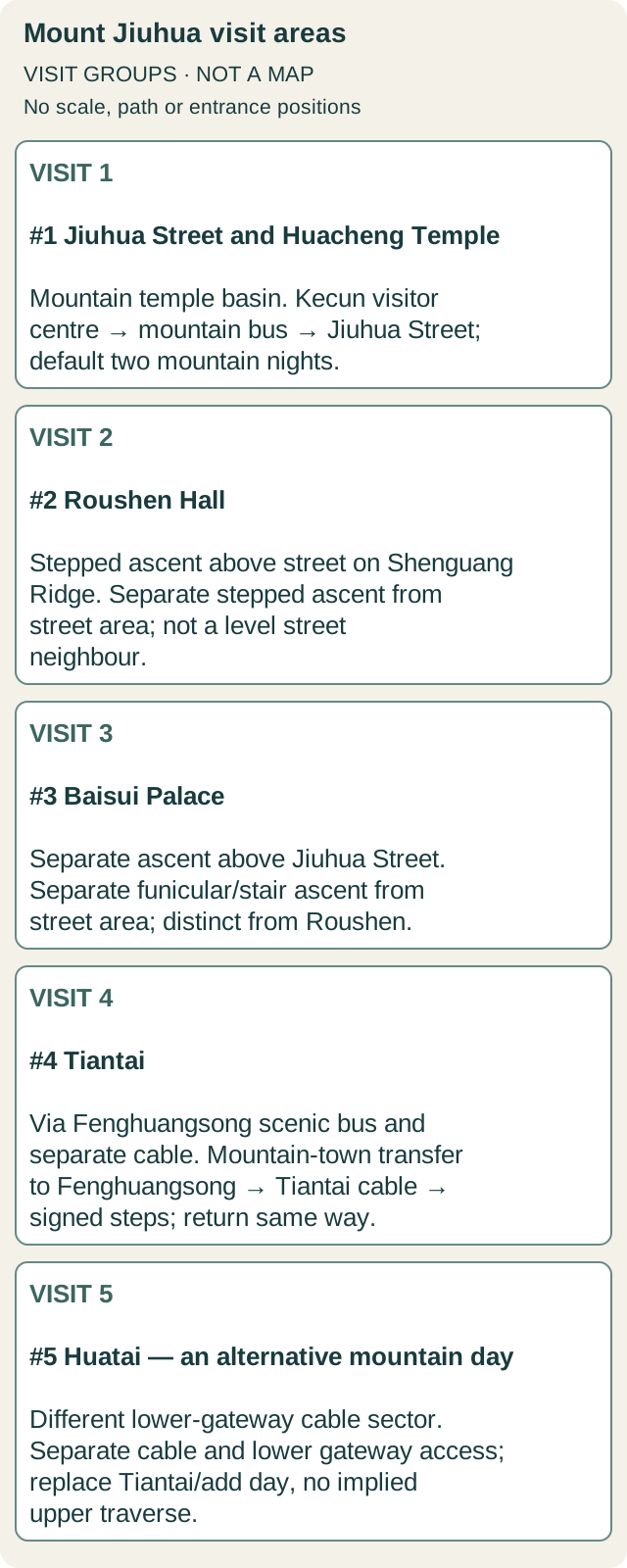
Open full-size area diagram ↗. The numbered places match this guide’s choices. This editorial area diagram groups visits; box position does not encode direction, distance, paths or an entrance. ChinaMile diagram; location sources. Navigation: search the Chinese name in Amap.
Kecun 柯村 is the lower transport and accommodation gateway near the visitor centre. Jiuhua Street 九华街 is the higher town inside the core scenic area. A hotel “at Jiuhuashan” could be in either, so the Chinese address matters more than the destination label.
Places 1–3 form the temple-town day: Huacheng and the street, the stepped Roushen Hall approach, and a separate ascent to Baisui Palace. They are not three level neighbours. Tiantai, 4, needs a road transfer toward Fenghuangsong and its own cable or hiking decision. Huatai, 5, uses a different lower access and cable product. This diagram shows relationships, not a continuous walking circuit.
Keep the first visit to one temple-focused day and one mountain-focused day. Swap their order if the weather favours Tiantai earlier. Add Huatai only by replacing Tiantai or adding time; it is a poor recovery choice when high-mountain weather is already bad. The large modern Dizang statue at the lower Dayuan Cultural Park is another separate visit, not the shrine called Roushen Hall in the town.
Choose the experience, then choose the climb
1. Jiuhua Street and Huacheng Temple · 九华街 · 化城寺
Huacheng gives the visit a centre. Its courtyard sequence and the open space outside help explain how a cluster of temples grew into a mountain town. Step back from the stalls to notice the contrast between enclosing hills, temple roofs and the narrower streets where pilgrims, residents and visitors share space.
The reward is time to observe, not the number of halls entered. Begin here, then eat nearby and decide how much climbing remains comfortable. Jiuhua Street works for a shorter cultural visit even when a high ridge disappears into cloud, although any closed hall must be respected.
Hours
Use each temple's posted admission period. A mountain town with hotels is not a promise that its halls are open at night.
Tickets
Buy the core scenic ticket in the official channel or at the visitor-centre desk. The latest admission notice publishes ¥160 for an ordinary adult ticket; see the purchase and re-entry conditions in Arrival.
Time
2–3 hours for Huacheng Temple, the nearby square and a short orientation walk; longer if the religious history is your main interest.
Chinese address
安徽省池州市九华山风景区九华街化城寺
Getting there
Enter by the official mountain bus from the lower visitor centre, then continue to the hotel and temple on foot. Ask the hotel for the exact nearest drop-off and luggage-carrying distance.
How to visit
Start around Huacheng Temple and its open square, then take a short walk through the street's mix of temples, shops and inns. Visit only the interiors currently admitted. Use this first stop to understand the town before taking a separate uphill route.
2. Roushen Hall · 肉身宝殿 · 月身宝殿
This is one of the mountain's principal pilgrimage destinations. Buddhist tradition associates the shrine with the monk Jin Qiaojue, venerated as a manifestation of Dizang, or Ksitigarbha. The approach matters: a sustained stair climb changes the pace from a commercial street to a place of worship.
Watch your footing and allow people making devotional visits room to pass. You do not need to imitate ritual actions to visit respectfully. Quiet observation, appropriate clothing and adherence to the hall's photography notices are more useful than a purchased claim of a compulsory ritual. This shrine and Baisui's shrine to Wuxia are different places.
Hours
Visit in daylight during the shrine's posted opening period; allow enough time to descend without rushing.
Tickets
Keep your scenic ticket and original identity document available. Decline unwanted incense, offerings or paid guiding before accepting them; a vendor's sales pitch is not an entry requirement.
Time
About 1½–2 hours is a planning allowance, not an accessibility guarantee.
Chinese address
九华山九华街景区神光岭月身宝殿(肉身宝殿)
Getting there
Walk from the street area using the signed approach. The local traffic route also names 月身宝殿, but a nearby stop does not remove the final steep steps.
How to visit
Climb slowly, pause before entering the shrine and follow the worshippers' circulation and posted photography rules. This is a living religious place, not a performance. If the steps are unsuitable, keep Huacheng and the street-level visit; do not substitute a steep descent as a “short cut.”
3. Baisui Palace · 百岁宫
Baisui Palace offers a second perspective on the basin and a different temple setting above the town. It is associated with the monk Wuxia, rather than being another name for Roushen Hall. The layered building and the view back toward the street give a purpose to this ascent beyond simply buying another cable ticket.
For the two-day plan, use the return funicular if available and keep energy for Tiantai. If queues or tired legs make three temple stops too much, omit Baisui and spend longer around Huacheng. Taking both cable rides is a choice, not a condition of a worthwhile Jiuhuashan visit.
Hours
The funicular's current operating period and last boarding must be checked on the day; use the operating reference in Arrival as a planning limit.
Tickets
Ask for 百岁宫缆车上下联票 if using it both ways. The published fare calendar uses 16 January–14 November as regular season, 15 November–15 January as low season. Confirm the dated payable product.
Time
1½–2 hours with a return-funicular visit, plus extra queue time when busy.
Chinese address
九华山百岁宫;save the signed 百岁宫缆车 lower station for the return.
Getting there
Reach the signed lower station from Jiuhua Street. Use the funicular for a less strenuous approach or choose the marked stair route only if the ascent and descent fit your ability and daylight.
How to visit
Visit the temple associated with the monk Wuxia, then enjoy the outlook over the street area if visible. Keep the return ticket. A cable-assisted visit still involves some walking and steps; if queues threaten the last service, shorten the visit or keep this for another morning rather than rushing down an unfamiliar path.
4. Tiantai · 天台
Tiantai shifts the experience from temple town to rocky high ground. The temple's final approach is part of the attraction: stone steps rise among the rocks, with the broader mountain landscape appearing when cloud allows. The historical photograph shows that stepped setting; it does not prove today's access or visibility.
A cable-assisted out-and-back is the default here. After arriving at the upper station, inspect the posted route and decide how far to continue before committing to further steps. Turn back by the same signed route in time for the return cable and bus. A forecast of mist does not guarantee a beautiful cloud sea, and heavy rain, lightning, ice or an operator closure can remove the mountain option altogether.
Carry water, a warm or waterproof layer suited to the forecast, and enough energy for the descent. Do not buy a one-way fare because a long walking descent sounds efficient on a map. The guide has not verified a current all-foot route, trail condition or summit-to-Huatai crossing.
Hours
Check both the mountain cable and the connecting bus before starting; their last services are different. Bad weather or safety work may override the printed reference.
Tickets
For the cable-assisted round trip, choose 天台索道上下联票, not a one-way fare or the separate 花台 cable. The fare calendar is the same regular/low-season division described for Baisui.
Time
Leave the day open for the road transfer, cable queue, signed temple route, rests and full return. The plan does not include a long descent on foot.
Chinese address
九华山天台景区;凤凰松天台索道下站
Getting there
Take the Tiantai-bound scenic transport to 凤凰松 and find the 天台索道 lower station. On descent, return to the same cable base and the confirmed bus back to 九华街.
How to visit
Use the return cable to save energy, then follow the open, signed stone-step route toward Tiantai Temple. The cable does not deliver a step-free summit visit. Turn around early if wet stone, visibility, breathing or knees make the remaining climb unsuitable. When the cable or access is closed, keep the temple-town day instead of attempting an unplanned all-foot ascent.
5. Huatai — an alternative mountain day · 花台
Huatai is the better alternative when your extra mountain time is mainly about rock formations and viewpoints rather than reaching Tiantai's temple. It still involves mountain paths, changing visibility and a separate cable-and-return arrangement; it is not an accessible substitute for every traveller who cannot manage steps.
For a first visit, select one high-mountain sector. A dedicated third sightseeing day can add the other in suitable weather, but requires another night's accommodation and a fresh check of scenic entry and transport validity. Ask the visitor centre to put the lower-station route and the return in plain terms before paying for a second sector.
Hours
Obtain Huatai's same-day opening, last cable descent and lower-station return before travelling. Mountain weather can make a scenic outing unrewarding or unavailable.
Tickets
The official Huatai price page publishes return-cable fares of ¥160 regular season and ¥120 low season. That cable product is not the Tiantai ticket; confirm any additional access charges and the complete dated total.
Time
Use it instead of Tiantai for a more landscape-led trip, or add another full day and night.
Chinese address
九华山花台索道下站;do not send a driver to 天台索道.
Getting there
Arrange the lower-gateway connection with the visitor centre. If leaving the core scenic area from a mountain hotel, resolve re-entry before exit; this guide does not assume a direct upper-mountain connection between Huatai and Tiantai.
How to visit
Choose an open out-and-back viewpoint route matching your ability and return to the same cable station. Do not treat a line on a map as an authorised hiking connection. In poor visibility, prioritise the town and temples instead of purchasing another mountain product simply to add a stop.
One gateway night, then two nights among the temples
Kecun / visitor-centre area for arrival: practical after a rail journey, with no need to force the last uphill bus. Choose a road-accessible hotel near the actual visitor-centre departure point and arrange the next morning's move. Pack an overnight bag or travel light; storage at the first hotel is not assumed unless agreed.
Jiuhua Street for the two sightseeing nights: the default once on the mountain. It keeps meals and the temple-town walk near your room and avoids a daily climb by bus. Ask for the nearest vehicle drop-off, stairs to the room, heating or air conditioning and porter help if needed. A hill-town hotel can still require carrying bags up steps.
All nights in Kecun: useful if avoiding a hotel change matters more, but adds the uphill/downhill journey each day. Obtain the admission re-entry registration and your traffic ticket's exact validity and permitted rides before paying. A cheap room below the mountain is not automatically a cheaper or easier complete visit.
Open Qingyang / Jiuhuashan hotel listings. Enter two adults and one room; book the first night near 柯村 / 九华山游客服务中心, then two nights in 九华街 using the map and the exact address. Qingyang county town and Chizhou city are different bases, despite appearing in regional searches. Confirm the room, cancellation terms, luggage route and passport check-in directly with each property; no individual hotel or live rate has been checked for your dates.
Use the temple town for a proper seated meal
Jiuhua Street is the natural lunch and dinner base. Try a 九华素斋 vegetarian-style meal: choose a tofu dish, a mushroom or bamboo-shoot vegetable and rice, and ask what the kitchen is actually serving. The local dish 石耳炒蛋 contains egg; the word “mountain” or a temple setting does not make every menu vegan.
For two adults, start with two shared dishes and rice, adding a third only if hungry. Confirm stock, egg, dairy, animal oil and sauces if they matter to you. Restaurants may also serve meat, and a familiar imitation-meat name may refer to a plant-based dish or something else on that particular menu.
Eat a substantial breakfast before Tiantai and take water and a simple snack, so a mountain queue does not turn lunch into a rushed purchase. Return to Jiuhua Street for dinner. Monastery dining, ritual meals and their hours are not promised by this itinerary; use an ordinary restaurant when access is not confirmed. Meal costs here are allowances, not verified menus or field-tested bills.
A complete three-night stay
Arrival evening · night 1 in Kecun: reach the lower gateway, check in and eat nearby. Confirm the next morning's visitor-centre departure, ticket/document process and the mountain hotel's nearest stop. If arriving after the rail shuttle, use a licensed taxi to the Kecun hotel rather than trying to negotiate an unofficial mountain ascent.
First full day · night 2 in Jiuhua Street: enter early, bring your bags to the mountain hotel or its agreed storage, then visit Huacheng and the town. Have lunch nearby, take the Roushen Hall approach, and add Baisui by return funicular only if time, opening and energy allow. Return to the same mountain hotel for dinner.
Second full day · night 3 in Jiuhua Street: use the confirmed scenic transport to Fenghuangsong, take the Tiantai return cable and follow the open route toward the temple. Keep the morning for the mountain and allow slack for queues and rests. Return by cable and bus before their final services; eat and sleep in the town. In unsuitable conditions, use a quieter temple visit and rest instead; do not replace a closed cable with an unplanned ascent on foot.
Departure morning: check out, take the downhill bus to the lower visitor centre and connect to the station actually printed on your train ticket. Keep the day free of another mountain sector. If the clear-weather day comes first, swap the temple and Tiantai days while preserving both hotel nights.
Shorter visit: with two nights and one full day, sleep at Kecun on arrival, make the next day a temple-town visit with one chosen ascent, and sleep near Jiuhua Street before descending on departure. Choose that over forcing both Tiantai and the whole town between trains. For Huatai as well, add a full day and resolve the extra exit/re-entry and transport arrangements.
Buy the right entry and keep the station connection separate
Search Jiuhuashan 九华山 and Chizhou 池州 on 12306 for your origin and date. Neither station is Jiuhua Street. The official access plan connects either station to 九华山游客服务中心 at Kecun, where passengers change to mountain transport. The published station-return tables end at 16:20 from the visitor centre, with adjustments explicitly possible: check the dated service before committing to a train. The Jiuhuashan-station shuttle enquiry is +86 566 2588600.
The published ordinary bus reference is uphill 06:00–17:00 and downhill 06:30–17:30; the Tiantai line's published return ends at 17:30, while the Tiantai cable reference ends at 17:00. These are distinct services, not guaranteed last boarding times. Confirm them at the desk and leave a margin for queues. The listed ¥50 traffic joint ticket needs its included legs, validity and permitted rides checked at purchase; it is separate from admission and cables.
For admission, the authority names 九华畅游 on WeChat and 游九华 mini program as official channels. Start from the official admission notice or use the visitor-centre ticket desk. Choose the real entry date and ordinary adult ticket for each traveller, use the original document details, and retain the QR confirmation and original document. A published Chinese real-name channel does not prove that every foreign-passport form or payment works; if it fails, resolve the document and purchase at the official desk or call +86 566 2831288 before paying for a special transfer.
Re-entry is conditional: the notice says a ticket is valid on its admission day; to leave and re-enter within three days, register at the mountain ticket-check point before leaving that day. Do not describe it as an unconditional three-day pass. The default stay enters on the first full day, remains on the mountain for two nights and exits on departure. If staying below or visiting a separate sector, show your dates and intended exits to staff and resolve the registration before crossing out.
At the hotel, book the complete departure chain: mountain hotel → downhill boarding point → visitor centre → correct rail station. If a connection is missed, ask the staffed centre or hotel for a licensed road transfer and change the rail ticket in its original channel if needed. Retain a reachable hotel number. A taxi at the lower gateway cannot be assumed to bypass mountain vehicle controls, and the posted holiday extensions are not a normal late-night service.
Budget for two, including both cable choices
For two ordinary adult ticket holders sharing one room, three nights and two full days, use R₀ + 2R + 2A + B + 2C₁ + 2C₂ + T + M + X. R₀ is the Kecun arrival-room quote, R the mountain-room nightly quote, A scenic admission per adult, B the pair's confirmed traffic products, C₁ the Baisui return funicular, C₂ the Tiantai return cable, T any station or extra road transfers not included in B, M meals and X drinks or contingency.
Worked regular-season inputs: R₀ = ¥250, R = ¥350, A = ¥160, B = ¥100, C₁ = ¥100, C₂ = ¥160, T = ¥120, M = ¥480 and X = ¥120. The result is ¥250 + ¥700 + ¥320 + ¥100 + ¥200 + ¥320 + ¥120 + ¥480 + ¥120 = ¥2,610 for the pair. Admission and cable amounts come from the published ordinary-adult references; B uses two listed ¥50 traffic tickets, subject to their actual coverage. Room, extra transport, meal and contingency amounts are illustrative inputs, not live quotations.
The published low-season cable figures reduce Baisui to ¥80 and Tiantai to ¥120 per adult, a ¥120 reduction for the pair's two return rides; replace admission with the dated applicable ticket as well. Do not assume a concession applies to your passport or age without confirmation. Walking instead of the Baisui funicular saves that purchase only if the route is suitable and open.
Exclude intercity trains or flights, shopping, offerings, guiding, Huatai and any extra day. A Kecun-only stay can change both room prices and repeated transport costs; a longer mountain stay may alter entry validity. Replace the relevant inputs with confirmed products rather than calling those unknown amounts free.
What was verified and what changes on the day
Official sources actually read on 21 October 2026. The admission notice is from January 2026; the transport article from April 2026; the separately published Tiantai/Baisui and Huatai fare tables give recurring seasonal prices. The visitor-service page also lists seasonal admission, but the worked budget uses the verified ¥160 ordinary-adult reference. The newest transport article takes precedence over older general hours where they differ; weather, maintenance and the actual ticket window can still override the printed operating reference.
The guide's visit durations, hotel-base choices, split-night plan and unquoted cost inputs are editorial judgments. No foreign-passport purchase, local bus ride, hotel check-in, restaurant meal, current trail or cable journey was field-tested. The historical photograph demonstrates the stepped mountain setting; it does not establish current access. Temporary late services and holiday programmes are not carried forward as routine operations.