Nantong Start beside the old moat, understand Zhang Jian’s city, then choose a separate hill outing.
Nantong is a good stop for travellers interested in the meeting of a waterside old city and modern Chinese history. The Hao River frames the centre; Nantong Museum connects it to Zhang Jian, the industrialist and educator whose projects shaped the city. Langshan adds a separate visit to wooded hills and a temple landscape beside the Yangtze.
Give the combined visit two full days and three nights. With less time, keep the museum and one attractive stretch of the Hao River, then leave the hills for another trip. The central route is a river-city break: the wider municipality’s coastal attractions are separate journeys, not a beach at the end of the old-city walk.
Farutang’s religious art, the summit temple-and-pagoda group and open river views · South of the old city, in the Wushan area
A half day including the city transfer · Use the current dated scenic-area ticket; optional services are separate
Two distinct areas, with one flexible day
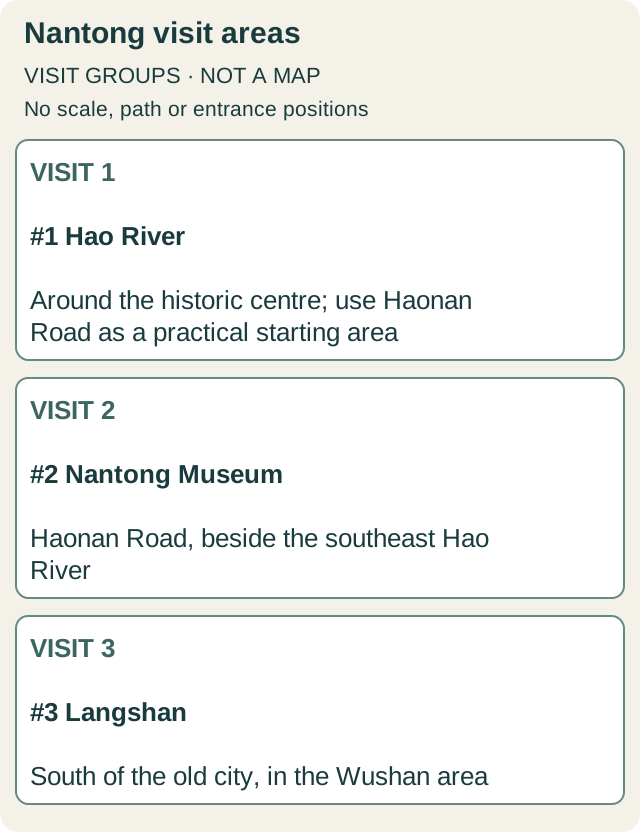
Open full-size map ↗. Around the historic centre; use Haonan Road as a practical starting area. Haonan Road, beside the southeast Hao River. South of the old city, in the Wushan area. This is an editorial relationship diagram, not a navigation map; box position does not encode distance or an entrance. ChinaMile diagram; location sources. Navigation: search the Chinese name in Amap.
The compact version: arrive in the evening, stay night 1, spend one full day at the museum and Hao River, stay night 2, and leave the next morning. This is enough for a first impression without a rushed hill outing.
The two-day version: add a separate Langshan morning and a slower afternoon, making three nights in total. Check museum opening first, then assign the clearer day to the hill. The diagram groups the old city and the southern hills; it is not a route map.
Other interests: visitors especially interested in Zhang Jian can build a longer trip around industrial and educational heritage. Coastal trips towards Lüsi or Rudong need their own transport plan. Neither is a casual addition to the Hao River loop, and you do not need to cover the entire municipality to have a worthwhile Nantong visit.
Use the Hao River as the default base
Haonan Road / southeast Hao River: convenient for the museum, a waterside walk and returning to the room between outings. Check that the advertised river view is from the room you are buying, and that the actual vehicle entrance is practical with bags.
Central Chongchuan shopping streets: useful for a wider dinner choice and straightforward taxis. Choose the location on a map rather than relying on “city centre” in the hotel name. A quiet room away from restaurant frontage may be more valuable than an elaborate lobby.
Langshan / southern scenic area: consider this only when greenery and the hill are the focus; it adds travel to the old-city evening. Station hotels work for a very early departure but are less helpful for two sightseeing days. Before prepayment, confirm every traveller’s passport can be used for check-in.
Order for the river-and-sea setting
For a sit-down meal, look for 文蛤 wenge, clams, or 黄焖狼山鸡, braised Langshan-style chicken. A small group can order one main dish, vegetables and rice instead of a large seafood spread. Confirm the portion size and whether seafood is priced per portion, by weight or individually before agreeing to it.
白蒲茶干, firm seasoned tofu, and 西亭脆饼, crisp local pastry, are regional snack or takeaway options. They do not require a special excursion to their towns of origin. If avoiding animal products, check seasonings and cooking stock rather than assuming a tofu dish is vegetarian.
Keep lunch near the museum on the city day; choose the restaurant around your return route on the Langshan day. This reduces the temptation to cross the city for every meal. Allow more money for a whole fish or premium seasonal seafood than for noodles, rice dishes or a simple dumpling meal.
Budget the complete two-day visit
For two adults sharing one room, three nights and two full days, use 3R + A + L + M + ¥760–1,040. R is your nightly hotel quote; A is the pair’s combined arrival and departure transfers; L is the pair’s current Langshan ticket total; M is the pair’s total for museum interiors or special exhibitions you choose.
The ¥760–1,040 is an editable allowance: ¥440–600 for meals from arrival dinner through departure breakfast, ¥180–260 for local journeys including the Langshan return, and ¥140–180 for drinks and contingency. These are planning inputs, not quoted restaurant prices or transport fares. Rail, flights, shopping and optional boats are excluded.
For example, R = ¥330, A = ¥140, L = ¥140 and M = ¥100 gives ¥2,130–2,410 for two people. The ticket figures are sample inputs, not current operator tariffs. Enter the real products before booking; do not set an unknown admission cost to zero.
The one-full-day, two-night city version is 2R + A + M + ¥480–680, using ¥280–400 for food, ¥80–120 for local journeys and ¥120–160 for drinks and contingency. With the same room, transfer and museum assumptions, that is ¥1,380–1,580 for the pair.
A waterway, a museum and a separate hill
1. Hao River · 濠河
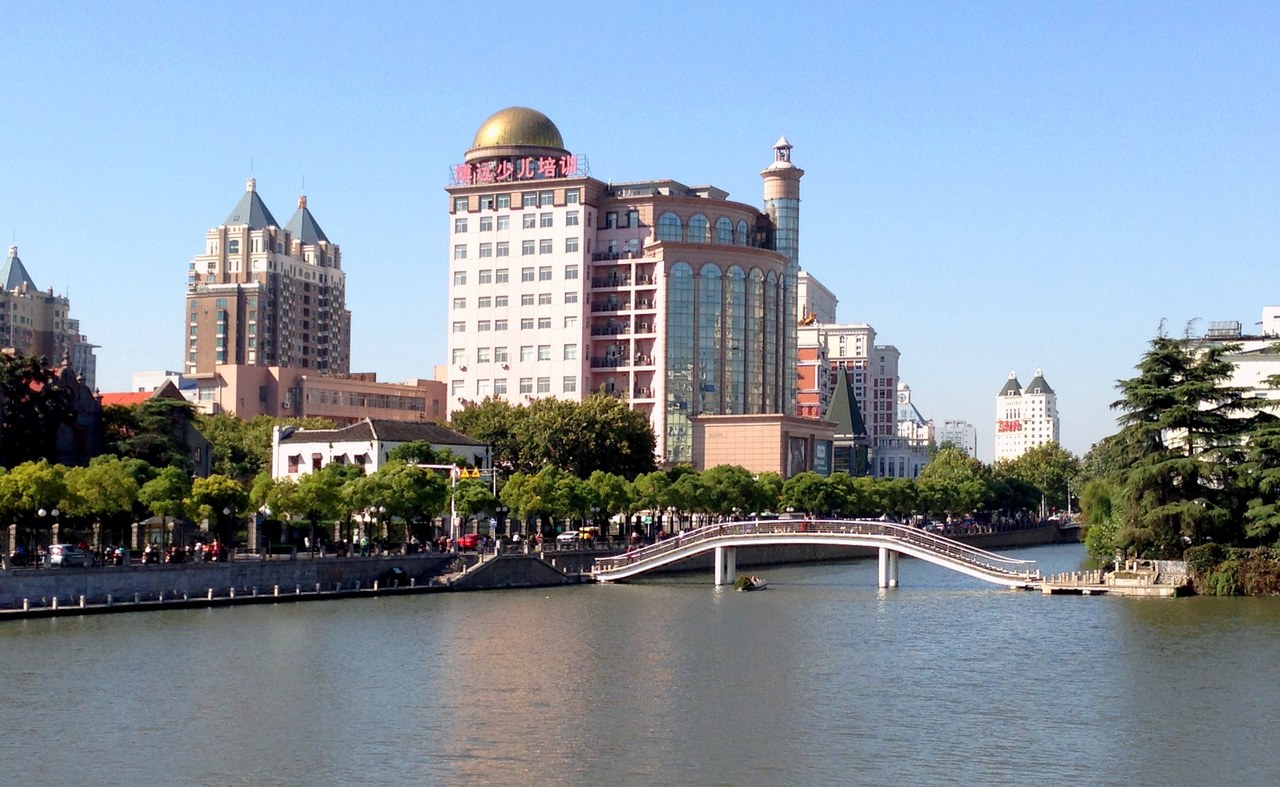
The Hao River wraps around the old city rather than forming a single little lake. Choose a continuous waterside section close to the museum or your hotel, then leave time to pause on a bridge or find a café. Completing the entire circuit is not a requirement for seeing Nantong.
Daylight helps you read the shape of the waterway and buildings; an evening stroll offers a second view without needing a sightseeing cruise. If you want a boat, buy only after checking the exact boarding pier, sailing time, route and return point.
Hours
Prefer daylight for the first walk; follow local access notices and use lit paths after dark.
Tickets
No boat ticket is needed for this itinerary. Check any paid boat product separately.
Time
Set aside 1–2 hours for a chosen stretch, then turn back or take a local transfer.
Chinese address
南通市崇川区濠河;濠南路一带
Getting there
Start near 南通博物苑 or the waterside access closest to your hotel; check a map for actual crossings.
How to visit
Pair the southeast waterside with the museum. Avoid treating the whole moat circuit as a short walk.
2. Nantong Museum · 南通博物苑
Founded by Zhang Jian in 1905, the museum is a place to understand how education, industry and public culture reshaped Nantong. Its grounds are part of the experience: the early south, middle and north halls form a historic sequence beside a later main exhibition building. Do not spend all the visit in the newest gallery and miss the small museum campus outside.
Three stops that explain the city and the museum
Main gallery: Jiang Hai Chao Yong / 江海潮涌——南通历史文化展. Start with the Qingdun archaeological material, then follow the salt, fishing, farming and cotton industries into the section on Zhang Jian’s modern city. Look for the change from a coast shaped by water and salt to a place of mills, schools and public institutions. The exhibition is listed on the main gallery’s first floor.
South Hall / 南馆, then Middle Hall / 中馆. The two-storey South Hall now recreates the early museum’s displays from documentary and photographic evidence. Its terrace inscription explains Zhang Jian’s aim of teaching through objects and the natural world. Compare that early way of arranging collections with the modern narrative you have just seen. Middle Hall’s 博物记忆 exhibition follows the museum’s own history through surviving documents and objects.
North Hall / 北馆: Bowu Liuduan / 博物六端. Finish with Zhang Jian’s museum ideas: how a building, collected objects, display and public education fit together. This makes the gardens and the small halls legible as one educational project, rather than a series of pretty buildings.
Short version: choose the main history exhibition and South Hall, then take a garden break. Allow roughly two hours as a planning target, not a measured tour duration. With children more interested in animals, replace the Middle and North Hall interiors with Jiang Hai Wan Xiang / 江海万象——南通生物资源展: its lower-level aquatic displays connect the Yellow Sea, Yangtze and inland waters; the upper-level displays turn to land animals, birds and butterflies. You do not need to add both branches to the same morning.
Architecture or biography interest: Haonan Bieye / 濠南别业, Zhang Jian’s former home, is a further choice with restored rooms and a life-and-work display. Put it in place of another interior if keeping the visit to 2–3 hours. Check its specific admission product, as well as South Hall’s, before committing; general garden access does not prove that every historic interior is included. The museum’s permanent-exhibition directory supplies these current names; a past anniversary exhibition is not assumed to remain on show.
Hours
The official visitor guide lists indoor displays 09:00–17:00, last entry 16:30, normally closed Mondays except public holidays. Gardens are listed 06:00–18:00, last entry 17:30. Temporary notices take priority; garden access does not imply that the galleries are open.
Tickets
Read the current ticket or reservation conditions for each chosen interior; temporary exhibitions may be separate.
Time
Allow 2–3 hours, longer only for a particular exhibition.
Chinese address
南通市崇川区濠南路19号
Getting there
Use 南通博物苑 as the destination; confirm the current public entrance before arranging a taxi drop-off.
How to visit
The museum directs reservations to its official WeChat account 南通博物苑 → 活动 → 参观预约, with the booked identity document for entry. Foreign-passport form handling was not tested: if it is unsupported, contact the main-gallery desk on +86 513 85062528 (Tuesday–Sunday) or social services on +86 513 85062518 (Monday). Start with Jiang Hai Chao Yong, then the historic south–middle–north hall group; use the short version below if time is limited.
3. Langshan · 狼山
Langshan is the clearest contrast to the flat waterside centre. Its appeal is the climb through a living temple landscape and the change in view above the plain. Guangjiao Temple / 广教寺 names a collection of halls on the hill, not one single building to tick off at the foot.
A temple-and-view walk with the same return
Walking approach: 入山之门 → 紫琅禅院 / Zilang temple precinct. Follow the signed walking route to the lower temple group. At Farutang / 法乳堂, look for Fan Zeng’s portraits of eighteen eminent monks and the calligraphy associated with the hall. This is the art stop to give time to before climbing.
Take the signed summit stairs. Keep to the temple route towards 支云塔院 / Zhiyun Pagoda precinct; the half-day plan omits the northern garden circuit and the other Wushan hills. Pause before continuing if the steps are already tiring: the return also descends on foot.
Yuantong Hall / 圆通宝殿 → Zhiyun Pagoda / 支云塔 → Dasheng Hall / 大圣殿. Compare the worship spaces with the pagoda’s exterior, then see the hall behind it devoted to the monk Sengqie / 僧伽. Use the signed open viewing platforms for the river-side panorama and Wangcheng Terrace / 望城台 for the city-facing view. The route does not depend on entering or climbing the pagoda.
Retrace the walking approach to your arrival side. Leave time to descend without hurrying, then return by road for lunch. Do not follow a northern garden or cableway exit expecting it to be the same pickup point.
Keep a half day including the city transfer; roughly 2–3 hours within the hill area is an editorial allowance for stops, not a promised walking time. If the summit stairs are unsuitable, make the lower temple precinct the turnaround and accept that it does not deliver the high panorama. A visitor avoiding steps altogether is better served by the Hao River city day; neither the temple precinct nor a cableway is certified as a step-free route here.
Use the scenic entrance named on the actual ticket, then the signs for 入山之门 and 法乳堂 to join this walk; save the same road pickup point for the return. Current closures override the heritage route. In heavy rain, strong wind or poor visibility, skip the climb rather than chasing a river view. Respect worshippers and the photography rules inside each hall.
Hours
Visit in daylight and confirm the scenic area’s opening, final entry and any service closures.
Tickets
Check the current admission category and total before paying. Historical tariff tables are not a booking confirmation.
Time
Keep a half day for travel, the hill and a meal break.
Chinese address
南通市崇川区狼山风景名胜区
Getting there
Navigate to the current visitor entrance at 狼山风景名胜区; return by a confirmed road transfer or a checked public-transport route.
How to visit
Choose the walking approach through 入山之门, the lower Zilang temple precinct and Farutang, then the signed summit stairs to Yuantong Hall, Zhiyun Pagoda and Dasheng Hall. Return by the same walking approach. Keep a road return to the old city; this plan uses neither a cableway nor a river crossing.
Make the museum and weather set the order
Arrival evening · night 1
Check in, eat near the hotel and take a short Hao River walk if you have energy. Save the museum for its opening day; a late arrival does not count as a sightseeing day.
City day · night 2
Visit Nantong Museum in the morning once its entry arrangements are confirmed: main history gallery → South Hall → the Middle and North Hall branch, or the natural-history alternative. Keep the architecture extension optional. Take lunch nearby, then follow a selected stretch of the southeast Hao River. Pause for coffee or return to the hotel during hot or wet weather. Use the evening for a local dinner and another short waterside section if desired.
Hill day · night 3
Travel to Langshan in the morning, use the lower temple–summit sequence above and return by the same walking approach. Take the road transfer back to the centre for lunch; do not add the northern gardens or another hill before it. Keep the afternoon loose: revisit the river, browse the central streets or spend longer in an exhibition that interested you. A full second day is room to slow down, not a demand to fill every hour.
Departure morning
Have breakfast and go directly to the booked station or airport. If the museum is closed on your first full day, swap the two days. If rain or mobility makes Langshan unattractive, retain the old-city base and use the extra day for confirmed-open indoor displays and meals.
Keep station names and river crossings straight
Compare trains to Nantong 南通 and Nantong West 南通西 on 12306. They are different stations; book the service first and then compare the actual journey to the hotel. Save the station name for your departing train as well, even if it differs from the one you arrive at.
Nantong Xingdong Airport 南通兴东机场 is the air option to check when a suitable flight operates. Confirm the actual flight, then get the current ground route or taxi quote from the airport or hotel. No fixed airport-bus timetable is assumed here.
For local travel, use current map directions for a specific destination rather than simply “Hao River,” which covers a long circuit. Taxis or checked public transport connect the centre with Langshan; agree the pickup place for the return before you need it. The core itinerary remains on the Nantong side of the Yangtze. It does not depend on a ferry.
If continuing to Shanghai, compare actual rail services and the arrival station before treating it as a simple city-centre transfer. For Yangzhou, keep a separate arrival day and check the connection rather than assuming all north-bank cities are next door.
Keep the route useful when an interior is closed
The city walk needs ordinary comfortable footwear, while Langshan adds steps and exposed weather. In heat, begin outdoors early and take the middle of the day slowly. In strong wind or heavy rain, follow scenic-area warnings and skip the climb; a view of the river is not guaranteed in poor visibility.
For the museum, check the current notice rather than a holiday promotion or old free-entry description. If a foreign passport cannot be entered online, resolve the document route with the venue before paying or travelling specifically for that exhibition. The outdoor Hao River route is the practical substitute, not a promise of admission through another gate.
Sources and planning limits
Museum exhibition names, locations and visitor-guide rules were checked against the museum’s current public website on . Langshan’s selected sequence follows the Culture and Tourism Bureau’s walking-route outline and the municipal archive’s descriptions; the choice to retrace it and the visit allowances are editorial planning. That evidence establishes the sights and their order, not day-of-visit path, temple-interior or cableway availability. No passport booking or admission purchase was tested.
Sources reviewed on . Official city descriptions support the Hao River, Langshan, museum location and local food. The December 2025 museum update takes precedence over older blanket free-entry descriptions; current paid interiors, temporary displays and booking conditions still require a dated check.
Visit durations, lodging areas and budget allowances are editorial planning judgments. This guide does not assert a tested foreign-passport booking flow, live transport fare, guaranteed museum opening or current Langshan tariff. Outdoor alternatives are included so that one optional interior or weather-dependent climb does not determine the whole stay.