LIANGSHAN · LAKEFRONT DAYS, HILLSIDE TEMPLES AND OLD STREETS
Xichang Stay beside Qionghai, walk a little of Lushan and give the old city its own visit.
Xichang rewards a slower visit than its mountain surroundings might suggest. The lakefront has reeds, open water and long views; Lushan puts temples on a wooded slope above it; Jianchang’s old streets bring the day back to courtyards, small shops and dinner. The strongest short stay is built around this contrast between lake, hill and city.
For a first visit, use three nights and two full days, staying near Qionghai’s west shore around Moonlight Town. Give one day to a modest Lushan walk and a stretch of lakeside path, and the other to Jianchang Old Town and local meals. If village lanes and photography matter more than a slow city morning, add a separately arranged Dashiban outing to the second day.
This suits travellers who want outdoor pauses, food and a sense of Liangshan without committing to a remote hike. The satellite launch centre, Luoji Mountain and Lugu Lake need different transport, access or overnight decisions; they are not automatic additions to these two days. A torch-festival programme is date-specific, not an activity promised on an ordinary evening.
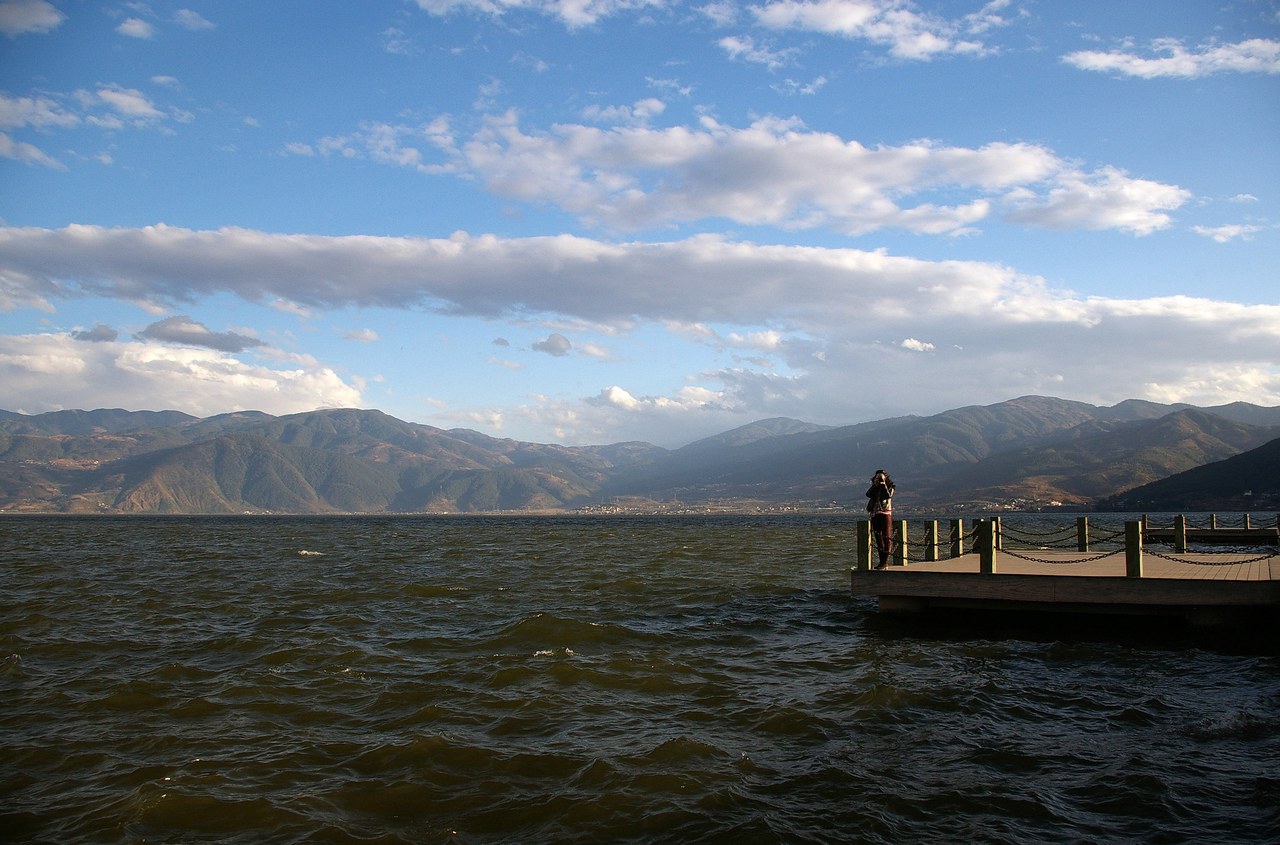
Qionghai Lake in Xichang, photographed in February 2013. This historical shoreline view does not establish current pier access or boat operation.Photo: 杨志强Zhiqiang · CC BY-SA 3.0 · Image credits
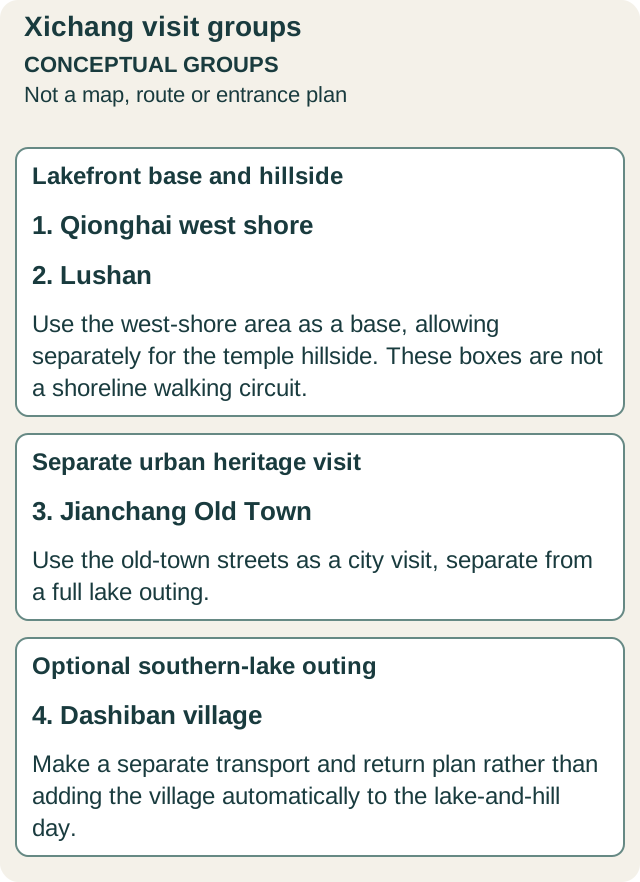
Qionghai west shore, 1, and Lushan, 2, are the lake-and-hill choice. Jianchang Old Town, 3, is a separate urban visit. Dashiban, 4, lies by the southern part of the lake and needs its own road plan. The diagram groups these decisions; it does not provide a route, distances or entrance directions.
For two full days, keep the same west-shore hotel for all three nights. This protects the easiest part of the stay: stepping out for a short lake walk before or after the main visit. A city-centre base is a sensible alternative for more dining choice and less reliance on returning after an old-town evening.
The sensible walking unit is a selected shore segment or lower temple route. A full-lake circuit, the Lushan summit and a launch-centre visit each change the task. Do not combine them merely because they share a Xichang label on a map.
Choose lake, temple hill, old streets or village lanes
1. Qionghai west shore · 邛海西岸 · 月色风情小镇
Qionghai is best experienced in pieces. Stop where reeds meet open water, watch the changes in light, then move on only as far as you want to walk back. The name contains “sea”, but this is an inland lake beside a city, not a beach-resort promise.
Moonlight Town gives a convenient western-shore reference point for a short stay. Choose a path segment, a place for a drink and one later meal rather than making a full circuit the default achievement. The lake’s quieter appeal can disappear if every pause is replaced by a vehicle or a commercial attraction.
Choose a boat only when the operating route, lifejackets, weather and return landing suit the group. For a rented bicycle, establish the return location, locking arrangements and permitted route. A hire counter does not prove an unbroken, low-traffic cycle circuit around the entire lake.
Hours
Visit the public paths in daylight and return toward evening only where the route remains open and lit. Weather and wetland management can restrict individual sections.
Tickets
This plan does not require a boat or a full-lake bicycle rental. Read the current park entry notices and any separate commercial price board before choosing an activity.
Time
Keep a half-day for a limited shore walk with breaks, not a full circumference. Shorter out-and-back walks work well from a nearby hotel.
Chinese address
四川省西昌市邛海西岸;月色风情小镇
Getting there
Use 月色风情小镇 or your verified west-shore hotel as the road destination. Qionghai is a large lake, so simply asking for 邛海 can put you at a different shore.
How to visit
Hotel or agreed drop-off → an open lakeside path → a chosen viewpoint and drink/meal → the same known return. Decide the turnaround before walking onward. A sightseeing boat is optional and does not replace a road return from a distant landing.
2. Lushan · 泸山 · 光福寺一带
Lushan provides the upward view that the flat shore lacks. The scenic authority describes a hillside shared by Buddhist, Taoist and Confucian traditions, with Guangfu Temple / 光福寺 as a major architectural group. Courts and halls follow the slope, so a modest temple walk can still involve repeated steps.
Look at the relationship between the buildings and the lake rather than making the highest point the only objective. A terrace view, a shaded pause and one open temple are a satisfying contrast to the shore. Give worshippers space and follow interior photography notices.
Keep bags closed and leave wildlife alone. Do not feed monkeys or display food to draw them closer for photographs. The route choice should remain reversible: the possibility of a cable ride or a view at a higher temple is not a reason to continue beyond a comfortable descent.
Hours
Start in the cooler part of the day after staff confirm an open visitor path. Fire-prevention rules, weather and temple activity can change what can be visited.
Tickets
Ask at the entrance for current admission and any temple or cable charge. The plan uses a reversible walk rather than relying on an unverified cableway timetable or price.
Time
Allow 2–3 hours for the lower temple area and stops. The mountain’s full summit and its roughly 800 m height difference above the lake are not the promise of this short walk.
Chinese address
四川省西昌市泸山景区;光福寺
Getting there
Arrange a short licensed-car or locally confirmed public-service leg to the open Lushan entrance. Confirm where the descent exits before leaving your driver or boarding a service.
How to visit
Open main entrance → signed steps to the accessible temple area around Guangfu Temple → permitted lake viewpoints → the same main route down. Turn back before fatigue makes the descent difficult. If closed or unsuitable, retain the shore walk and move the temple visit to another trip.
3. Jianchang Old Town · 建昌古城
Jianchang gives Xichang a historical city centre distinct from the leisure shore. The street pattern and courtyards help explain an old regional stronghold, while restored shops, cafés and accommodation show how it is used now. Read it as a living, repaired district, not a sealed museum of untouched Ming buildings.
The cultural ministry’s conservation account identifies North Street / 北街, Warehouse Street / 仓街, Fu Street / 府街, South Street / 南街 and smaller lanes with different present uses. A useful first visit is to take one principal street, turn into an accessible side lane, then pause at an open courtyard or tea shop. You do not need a prescribed circuit through every named street.
For craft shopping, compare materials and workmanship before price. Yi-style lacquerware, embroidery and silver-coloured jewellery are different products with different claims; ask who made an item and what the material actually is. An evening market or performance can add atmosphere when operating, but dinner and a street walk complete the visit without a show ticket.
Hours
Use the afternoon for building details and keep dinner for the evening atmosphere. Shops, museums, towers and organised shows keep their own hours.
Tickets
An old-town street visit does not include every tower, exhibition, performance or costume service. Ask for the dated product and total before paying.
Time
A half-day with pauses is sufficient for a first visit to the principal open streets and a meal. A specialist architectural visit may deserve longer.
Chinese address
四川省西昌市建昌古城;按酒店或景区确认的开放城门下车
Getting there
Take a city taxi or a confirmed public service from the west-shore base to 建昌古城 and agree a legal pickup point for the return. It is not an immediate lakeside walking continuation.
How to visit
A confirmed open gate → principal streets → a side lane or available courtyard → craft/tea pause → dinner → agreed return pickup. Treat private homes and closed historic buildings as boundaries; an attractive doorway is not permission to enter.
4. Dashiban village · 大石板古村
Dashiban’s appeal is the combination of an inhabited village and a developed visitor economy. Stone paths, courtyard houses and the orange wall of Lingying Temple / 灵鹰寺 make a more intimate setting than the open lake. Restaurants and portrait shops are part of the present village, so expect activity rather than an undiscovered, empty settlement.
A leisurely lane walk and lunch are enough. If a costume portrait interests you, treat it as a booked service with a finished output: ask which outfit, what makeup, how many edited photographs and how you receive them. Do not assume a displayed costume-rental number includes a photographer or editing.
The village is optional because it adds a separate southern-lake road journey. Choose it when the village texture or portrait service interests you; travellers content with a slower lakeside morning can use that time around the base before Jianchang. Neither choice needs to be apologetic about skipping a place.
Hours
Prefer daylight for the lanes and temple setting. Ask about the temple’s own visitor access; an open village street does not prove every religious interior is open.
Tickets
The visit can be a walk and meal. If you want a portrait session, agree costumes, makeup, shooting time, edited-file count, delivery and full price before changing clothes.
Time
Allow a half-day including separate road travel and lunch; do not add it after an already full lake-and-hill day.
Chinese address
四川省西昌市海南街道大石板古村;灵鹰寺为村内兴趣点
Getting there
Agree both road legs to 大石板古村. The ministry’s route page records a 106 bus connection, but the actual stop, direction and last return must be confirmed for your date.
How to visit
Public village approach → open lanes → permitted view of Lingying Temple → a simple lunch or tea → agreed pickup. Return to the city for the old-town afternoon only if the transport has been established and you still want another visit.
Stay on the west shore for the lake, in town for easier city evenings
Moonlight Town / 月色风情小镇 and the nearby west shore: the default for a lake-led first visit. You gain short walks and an easier Lushan start. Check the actual room location, road noise, stairs and taxi approach; “Qionghai view” can describe a distant or partial view, not a room on the shore.
Central Xichang or the Jianchang side: choose this when ordinary restaurants, city transport and the old-town evening matter more than an immediate lake walk. Budget the lake-day return. A hotel inside a historic lane may require carrying luggage from the nearest legal drop-off.
Dashiban: choose it for a village-centred stay and quieter morning lanes, with a property-confirmed pickup and dinner. It is less convenient for the standard city evenings. Xichang West station: useful for a late arrival or early departure, but station proximity alone does not make it a lake base.
At Xichang accommodation listings, enter two adults, one room and three nights, then use the map for 月色风情小镇 or the chosen city district. Check the complete Chinese address, bed size, total taxes, cancellation and the real transfer to the shore. The platform lists places in a broad area, so inspect location rather than relying on its “near Qionghai” wording.
Before paying, confirm foreign-passport check-in, the latest arrival your booking accepts, heating or cooling for your season, and any lift requirement. These are neighbourhood recommendations; no named room, check-in or live rate has been tested for this guide.
Make room for fire-basin barbecue and a cooked fish meal
Fire-basin barbecue / 火盆烧烤: the most useful shared dinner to plan after the lake day. It is a social meal around the heat, with meats and vegetables selected for grilling. Ask staff how the cooking works, which items are sold by portion or weight, and whether charcoal or service adds to the bill. For two, begin with a modest meat selection, two vegetables and a staple; add food after seeing the serving sizes.
Fish: a better relaxed lunch than trying to eat between short transport connections. Ask for the fish’s weight, price per unit, preparation and total before it is cooked. A village report describes one fish, three ways using soup, steamed fish and fried bones; it is an example of the local meal style, not a compulsory or price-verified set menu. A simple cooked portion suits a smaller appetite.
Jianchang pressed duck / 建昌板鸭 and Yi-style tuotuorou / 坨坨肉: two different meat choices named in the ministry’s local-food list. Ask whether the duck is ready to eat or requires further cooking before carrying it away. Tuotuorou is a substantial meat dish, so combine a small portion with vegetables rather than ordering it on top of an already large barbecue meal.
Drunken shrimp / 醉虾 appears in the scenic authority’s food directory and is described there as live shrimp in alcohol. Choose fully cooked shrimp or fish if you do not want a raw preparation; the dish name is not a statement that alcohol has cooked it. Tell the restaurant clearly 要全熟的,不要生的.
For breakfast, use a nearby noodle or rice-noodle shop and ask what meat, broth and chilli the chosen bowl contains. Vegetarian diners should check meat stock, animal fat and sauces rather than relying on the appearance of a vegetable dish. Take water for the hill, eat lunch after descending, and leave the longer shared dinner for the evening. No restaurant tasting or current menu price is claimed.
Two full days without racing around the whole lake
Arrival evening · first night: reach the west-shore hotel, establish the following morning’s Lushan entrance and return, then eat locally. Take a short open shore walk if daylight and energy allow. An arrival delay can remove this walk without breaking the visit.
First full day · second night: have breakfast, visit the lower Lushan temple area by an open, reversible route, then descend for lunch and a rest. Spend the afternoon on a limited west-shore path with a lake pause. Have fire-basin barbecue or another shared dinner near the base. The day has room for the lake itself, rather than an automatic full-circuit vehicle tour.
Second full day · third night: start slowly at the lake, then go into the city for lunch, Jianchang’s open streets and a courtyard or craft stop. Stay for dinner if you want the evening atmosphere, with the return car or public service already resolved. A current performance can be an optional purchase; the old-town visit does not depend on it.
Village variant: substitute a morning road outing to Dashiban for the slow lake morning. Walk the public lanes, see the permitted temple setting, have lunch, then take the pre-arranged ride toward Jianchang or the hotel. If you book a lengthy portrait session, give the village the whole half-day and shorten or omit the old-town visit; do not make the photographer’s finish time compete with the last ride.
Departure morning: go directly to the exact railway station or airport on your booking. Do not place a full lake loop before a fixed train. With only one full day and two nights, keep the lake-and-Lushan day; travellers who prefer history can replace the hill with Jianchang rather than trying to do all four places.
Bad weather or a closed hill: keep to safe open city streets and an available interior, meal or tea break. Lake wind can cancel boats even when walking remains possible; a forest closure can exclude Lushan while the city still works. Ask the local visitor service what is actually open rather than using another unconfirmed hillside path.
Separate Xichang West, the hotel and the lake entrance
Use 12306 to search Xichang West / 西昌西 for your actual intercity train. Confirm the Chinese station name before booking a hotel pickup; 西昌 and 西昌西 are distinct names. For a flight, use Xichang Qingshan Airport / 西昌青山机场 and your confirmed arrival time when arranging the final road leg.
From the station or airport, choose the official taxi queue or a licensed car agreed with the hotel, and show its full Chinese address. A currently operating public service can be cheaper, but confirm its route, fare and last departure at the staffed transport point. No old route number or taxi-time estimate is presented here as a present guarantee.
For each day, name the actual place: 月色风情小镇 for the west-shore base, 泸山景区 for the open hill entrance, 建昌古城 for the city visit, or 大石板古村 for the village. “Qionghai” is too broad a destination to resolve a particular pickup.
The ministry’s January 2025 route page records the 106 lake-area bus connection for Dashiban and Jianchang. Use it as evidence of the public-transport option, then ask staff or the hotel to confirm the correct stop, direction and final service. If that cannot be established, agree a licensed return car before starting. The scenic authority lists +86 834 3950720 for tourism enquiries; no call or ride was tested.
If a car fails to arrive, remain at a staffed hotel, visitor point or open business, contact the original driver or booking channel, then arrange a replacement through a licensed service. Save the hotel’s name and Chinese address offline. Do not wait for a hypothetical last bus on an isolated lakeside stretch.
A two-person budget with real road legs and optional activities
For two adults sharing one room, three nights and two full days, use 3R + T + M + A + X. R is the actual nightly room quote; T includes station/airport arrival and departure, city rides and the chosen road outings; M covers meals from arrival dinner to departure breakfast; A covers selected paid entrances, interiors or cable products; X is water and contingency.
With illustrative inputs R = ¥300, T = ¥260, M = ¥620, A = ¥160 and X = ¥120, the worked result is ¥900 + ¥260 + ¥620 + ¥160 + ¥120 = ¥2,060 for the pair. These are editable allowances, not current room rates, a taxi quote or an assertion that Lushan admission is ¥80. Unknown products have not been silently given a zero price.
Keep a written breakdown of T when choosing the Dashiban variant: include the outward village ride, its return or onward city leg, the old-town return and both gateway transfers. Replace the ¥260 input if the agreed total is higher. Do not add a “cheap village morning” without its return journey.
Exclude intercity rail/flights, alcohol, purchases, performances, portrait costumes/makeup/photographs, private guiding and any boat or bicycle hire outside your selected allowance. If you buy one of these, add its full group price and deposit terms. A paid village photo session can change both cost and the time available for Jianchang.
Sources, inherited history and current operating limits
Sources were read on 22 October 2026. The scenic authority’s Lushan and wetland descriptions support the hill-and-lake relationship; their original content is older than this guide and is not proof that a particular temple, trail or lift is open today. Its food directory supports the named local styles, not a current menu quote.
The ministry’s 2023 conservation account and January 2025 route page support Jianchang’s repaired streets, cultural uses, local dishes and a public-transport option. The February 2025 village report and August 2026 on-site reporting support Dashiban’s southern-lake setting, lived-in lanes, temple exterior and visitor businesses. Festival dates, one-off events and quoted portrait prices from those reports are not carried into the ordinary plan.
Visit lengths, the three-night stay, base choice and budget inputs are editorial judgments. No phone call, train, bus, taxi, trail condition, boat ride, meal, hotel check-in or portrait booking was field-tested. Follow the current forest and weather notices, the signed visitor route and the actual dated product you buy.