Hanzhong Read the stones in town, then follow the Three Kingdoms story west.
Hanzhong gives history a different setting from Xi’an: a green river basin south of the Qinling, steamed rice-sheet breakfasts, and a compact museum whose carved stones tell the story of routes through the mountains. Choose it for Han and Three Kingdoms history at a slower pace. The worthwhile contrast is between the city’s Guhantai museum and the memorial landscape around Zhuge Liang in Mian County.
Allow one full city day and two nights, or two full days and three nights for the city plus Mianxian. Travellers seeking major imperial monuments should give Xi’an priority; for a broad first visit combining food, museums and a different Three Kingdoms shrine, consider Chengdu. Hanzhong works best as a deliberate rail stop between larger destinations, not as a rushed excursion from either.
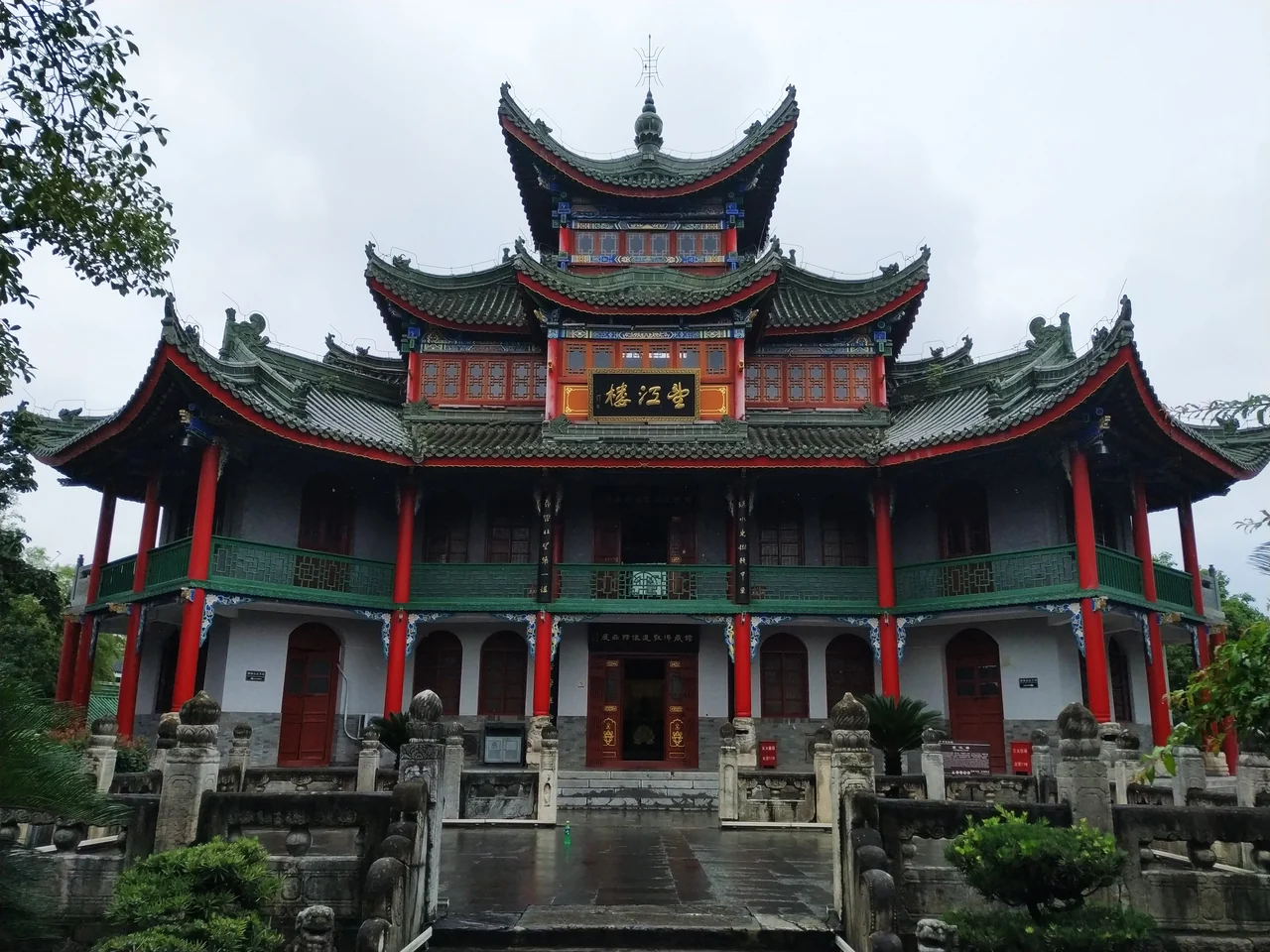
Wangjiang Pavilion at Guhantai / Hanzhong Museum, photographed on 18 July 2019. It illustrates the city-centre heritage stop, not Mianxian Wuhou Shrine or Wuhou Tomb; present access still needs checking.Photo: Tyen-Shyang Chyu · CC BY-SA 4.0 · Image credits
A memorial axis leading to Zhuge Liang’s burial mound and old trees · Dingjunshan, Mian County; south of the Han River
1.5–2 hours · Separate paid attraction; a shrine ticket does not establish tomb entry.
Separate the city from the Mianxian road day
The compact choice: Guhantai, Baijiangtan and a north-bank river walk fit one full day with lunch between the museum visits. The history-focused choice: add a separate full day for Wuhou Shrine and Wuhou Tomb in Mian County, with a hired car returning to the same Hantai hotel. The shrine is north of the Han River and the tomb south of it; neither belongs to the city walking cluster.
Shimen’s plank-road scenery, mountain parks, spring flower fields and Qingmuchuan are different outings with their own access and weather needs. They are not spare-hour additions to this route. A visitor wanting scenery more than memorial history should choose one such excursion in place of Mianxian, with its own confirmed entrance and return, rather than stack both into the day.
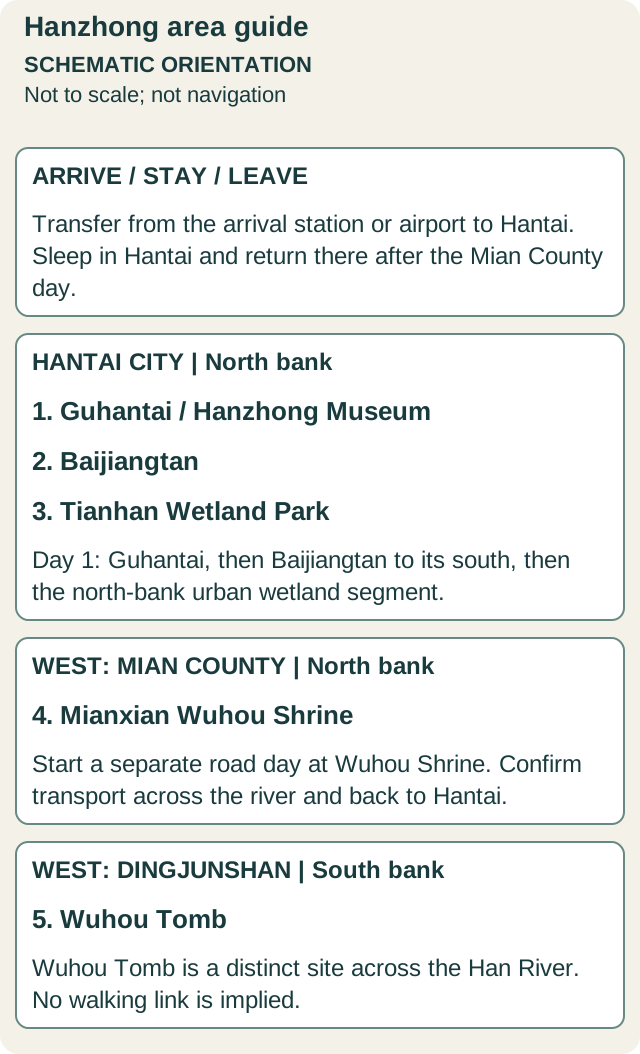
Open full-size area diagram ↗. Numbers match the guide. Named directions show broad areas; box positions do not encode geography. This schematic is not to scale or suitable for navigation, and does not prove access or current operation. ChinaMile editorial diagram; guide sources. Navigation: search the Chinese name in Amap.
Stay in Hantai for both days
Central Hantai around Dongdajie and the north side of the river is the default. It puts breakfast, the city sights and dinner within a practical walking-and-taxi radius. Choose a room on a quieter side of the property; a riverside view can be pleasant, but a hotel far along the waterfront may still require rides for every meal.
Near Hanzhong station suits an early train but gives up the old-centre setting. Mian County is reasonable only if you want a slower extra day around the memorial sites; for the two-day plan, changing hotels adds packing without removing the need for local road transport. These are area recommendations, not a ranking of named hotels. On your booking service, enter Hanzhong/Hantai, two adults and one room, then confirm the property’s actual passport-registration process, cancellation terms and vehicle entrance before payment.
Start with hot rice sheets and bean curd
Have re mianpi 热面皮 near the hotel before the museum: soft steamed sheets, usually rice-based, cut into strips and dressed with chilli oil and vegetables. Ask for less chilli before dressing. Pair a small portion with cai doufu 菜豆腐, a mild bean-curd preparation often eaten with the rice sheets. Wheat, bean and mixed variants also exist; neither a dish name nor a rice base is an allergy guarantee.
For lunch around the old centre, choose jiangshui mian 浆水面 if you enjoy a sour fermented-vegetable broth, or a simple rice-and-vegetable meal. Ask whether meat stock or animal fat is used. On the Mianxian day, eat between the shrine and tomb at a restaurant with a visible menu and a clear car pickup; a long tasting detour makes the return harder. Add a cooked vegetable dish to the evening meal rather than ordering three heavy snacks. No restaurant or menu price has been personally tested for this guide.
The numbered places, with time to look
1. Guhantai / Hanzhong Museum · 古汉台 / 汉中市博物馆
The museum is the best first stop because it connects Hanzhong’s geography to its history. Look for the Shimen stone inscriptions and the explanation of plank roads through the mountains: written stone records make more sense once you understand how difficult movement between the basin and the north once was. The courtyards and raised terraces give the visit a quieter rhythm than a large exhibition hall.
Guhantai is associated with Liu Bang’s time as King of Han, but the visible compound has later layers. Treat the buildings as a setting for interpretation rather than an intact Han palace. Prioritise the stone displays and a few good explanations over trying to photograph every plaque. Some routes involve steps; ask at the entrance about accessible circulation if that affects your visit.
Hours
The municipal science association’s museum profile lists 08:30–18:00 March–November and 08:30–17:30 December–February, normally closed Monday. Special museum notices can override that pattern; choose a morning visit rather than arriving near closing.
Tickets
Free basic admission; the published guidance directs individual visitors to the 汉中市博物馆 WeChat account to reserve.
Time
1.5–2 hours
Chinese address
汉中市汉台区东大街26号 古汉台
Getting there
From a central Hantai hotel, walk if nearby or take a taxi to the Dongdajie visitor entrance. Hanzhong railway station is a separate transfer north of this old-city cluster.
How to visit
Choose 古汉台馆区 in the museum account. If the identity field will not accept your passport, bring the original document to the public visitor desk and ask for the supported entry method before paying any intermediary. Admission after a failed online reservation is not guaranteed. The Ctrip museum listing provides visitor numbers +86 916 8152188 and +86 916 2528919; no call or passport booking was tested.
2. Baijiangtan · 拜将坛
This is the place to follow the story of Liu Bang appointing Han Xin as commander. The separate precinct, earthen platforms and commemorative displays turn a famous episode into a manageable visit after the museum. The Han Xin theme is the reason to come; it is not a second major collection on the scale of Guhantai.
Read the narrative before walking the grounds, then compare what is a remembered historical location with later memorial architecture. If the story means little to you, shorten this stop and give lunch and the river more time. Do not confuse this branch with the free Guhantai reservation.
Hours
Published seasonal window: 08:30–18:00 March–November; 08:30–17:30 December–February. The municipal profile describes this branch as open year round, unlike Guhantai’s normal Monday closure; check the branch’s own current notice.
Tickets
The municipal profile publishes ordinary adult admission at ¥20 March–November and ¥15 December–February. Optional interpretation or special activities are outside that tariff.
Time
1–1.5 hours
Chinese address
汉中市汉台区风景路 拜将坛
Getting there
Continue south from the Guhantai area by local streets, or use a short taxi to the branch entrance. These are separate museum sites, not galleries connected inside one building.
How to visit
Select 拜将坛馆区, not 古汉台, when reserving or buying. Ask the ticket desk to confirm the ordinary admission and passport handling before payment; keep the two branch bookings distinct.
3. Tianhan Wetland Park · 天汉湿地公园
The Han River is the useful pause between historical sites. On an open north-bank section, watch the river and the planted wetland edge, then turn inland for a meal. This is a place to slow down rather than cover the entire park; the full riverside system stretches far beyond a short evening stroll.
Choose a short out-and-back walk from a road access you can recognise. Avoid building the visit around a fountain, boat ride or illuminated show whose operating session has not been checked. After heavy rain, use the upper permitted route or cancel the river walk if the park is closed.
Hours
Use the open public paths in daylight. Flood-control closures override the walking plan; do not pass barriers to reach low riverside paths.
Tickets
No admission purchase is needed for the ordinary public-bank walk used here; boats, towers and events are not included.
Time
1–1.5 hours
Chinese address
汉中市汉台区滨江路 天汉湿地公园(北岸)
Getting there
Take a taxi from Baijiangtan to a legal Binjiang Road drop-off at an open park access. Stay on the north bank for a simple return to the Hantai hotel.
How to visit
Choose one short out-and-back segment, turn around after 30–40 minutes, and return to the same road access for your ride. Wetland paths spread along both banks; a pin for the whole park is not a precise pickup.
4. Mianxian Wuhou Shrine · 勉县武侯祠
At the shrine, the subject is the long life of Zhuge Liang’s reputation. Courtyards, inscriptions, plaques and old trees reward looking slowly. The memorial tradition is ancient, while the surviving buildings have been rebuilt and repaired over later periods. Read the names and calligraphy around one or two halls instead of treating the entire complex as a backdrop.
This is distinct from the neighbouring Zhuge themed-town development and from the tomb across the river. Choose the historic shrine first; add themed attractions only if that is the experience you want and your ticket explicitly covers them. Spring blossoms can be a bonus, but the courtyards and memorial history are the dependable reason for the trip.
Hours
Shaanxi Public Culture Cloud lists 09:00–17:00. A commercial listing shows a later closing time; this itinerary uses the shorter public-culture window and a morning visit. Confirm the gate’s current last entry before the road day.
Tickets
The public-culture listing does not give a current tariff. Buy ordinary shrine admission only after confirming the date and identity procedure. Do not assume a nearby themed-town combination ticket includes Wuhou Tomb.
Time
1.5–2 hours
Chinese address
汉中市勉县武侯镇 武侯祠(108国道旁)
Getting there
Use a prearranged round-trip car from your Hantai hotel for the two-site day; the shrine is west of Mian County town, not in central Hanzhong. Keep the same driver for the cross-river transfer.
How to visit
The museum’s public-culture notice gives +86 916 3296212. Ask for the current ordinary ticket, opening and last-entry time, foreign-passport entry and the exact car entrance. Book transport after this is resolved. A third-party purchase page is linked below if you prefer online buying; verify its document options and refund terms.
5. Wuhou Tomb · 武侯墓
The tomb is the more contemplative half of the Mianxian day. Follow the principal memorial axis toward the burial mound, then take time under the trees and among the commemorative stones. The landscape and the continuing act of remembrance matter more here than a large indoor museum collection.
A visit to the tomb grounds does not require climbing Dingjun Mountain. Keep the afternoon to the accessible visitor route appropriate to your mobility and save an unplanned hill walk for another trip. This makes the return to Hanzhong predictable and keeps attention on the memorial rather than an extra sightseeing tally.
Hours
Shaanxi Public Culture Cloud lists 08:30–17:00 in both its seasonal entries. Arrive early afternoon; a listed closing time is not proof that tickets remain available until that minute.
Tickets
Paid separately from the shrine. The current official ordinary tariff was not established by the public-culture listing; ask the tomb desk before buying.
Time
1.5–2 hours
Chinese address
汉中市勉县定军山镇 武侯墓
Getting there
Drive across the Han River from the shrine to the tomb’s public entrance. Keep the car waiting for the return to Hanzhong; the two places are not one walk-through complex.
How to visit
The Ctrip attraction listing gives +86 916 3316453 for visitor enquiries. Confirm foreign-passport entry and the current fare before committing to the Mianxian car day. Bring your original passport. If this site is unavailable, do the shrine alone only if it still justifies the quoted trip cost.
A complete city day, then an optional Mianxian day
Arrival evening: reach the Hantai hotel, eat locally and resolve the next morning’s Guhantai reservation. For a three-night stay, also settle both Mianxian admissions and the car quote. Put the Guhantai day on an ordinary Tuesday–Sunday; if your first full day is Monday, use the already-confirmed Mianxian day first.
City day: breakfast near the hotel, then Guhantai around 09:00 for 1.5–2 hours. Have lunch in the old centre; visit Baijiangtan early afternoon. Rest at the hotel if needed, then take a taxi to an open north-bank Binjiang Road access for a short river walk. Return from the same access and have dinner in Hantai. A two-night visitor leaves from Hanzhong station the next morning.
Mianxian day: arrange hotel pickup around 08:00, aiming for Wuhou Shrine after its 09:00 opening. The driver must confirm the road allowance when quoting; reserve the whole day rather than buying a train connection based on an assumed journey time. Spend 1.5–2 hours at the shrine, eat lunch, then drive across the river to Wuhou Tomb for an early-afternoon visit. Agree a departure around 15:30 from the tomb and a return directly to the Hantai hotel. Keep dinner and a third night in Hanzhong; depart by rail the following morning.
Recovery: in persistent rain, put the museum’s indoor displays first and shorten the exposed courtyards. Flood restrictions cancel the river segment. If Guhantai cannot admit you and it is the main reason for the stop, move the sightseeing day instead of substituting shopping. If either Mianxian admission or the full return car cannot be confirmed, do the shorter city stay; if already staying the extra night, take a slower second city day rather than depend on an unverified last bus.
Book Hanzhong station and the return separately
Search China Railway 12306 for Hanzhong 汉中 with your exact origin, date and destination. It is the practical railway gateway for this plan; Xi’an North 西安北 and the named Chengdu stations are separate choices on the other end. The fare, running time and available train belong to your dated search. Match the passenger name to the passport and save the confirmed train and station names offline.
From Hanzhong station, use the official taxi rank or a booked ride to the hotel’s Chinese address. For departure, arrange the hotel pickup with time for the actual road journey, station security and the train’s boarding cutoff. If online railway identity verification or payment fails, use 12306 support or a staffed station counter with the original passport; do not use another person’s identity. This guide has not tested a passport checkout.
For Mianxian, book a car with driver through your hotel or a licensed local transport provider. Send the complete route: 汉中酒店 → 勉县武侯祠 → 武侯墓 → 汉中原酒店. Request a written total covering both directions, cross-river transfer, waiting, tolls, parking, driver contact and the agreed end time. Ask for the price before committing and keep the driver’s number. A one-way ride does not secure a return. If you choose county buses instead, obtain the exact origin terminal, final return departure and both last-mile rides from the terminal on the day; no current bus timetable was verified, so that alternative is not the default plan.
Budget the city and the road day independently
For two adults sharing one room, two nights and one full city day, use 2R + B + ¥500–700. R is the actual room price per night. B is the pair’s Baijiangtan admission: the published seasonal tariff makes it ¥40 in March–November or ¥30 in December–February. The allowance covers ¥300–420 for meals from arrival dinner through departure breakfast, ¥100–160 for both station transfers and city rides, and ¥100–120 for drinks and contingency. These are planning allowances, not fare or menu quotations.
With a sample room input of R = ¥280 and B = ¥40, the arithmetic is 2 × ¥280 + ¥40 + ¥500–700 = ¥1,100–1,300 for two. Guhantai’s ordinary admission is free; optional experiences are not silently included.
For three nights and two full days including Mianxian, add R + C + M + ¥180–280: C is the actual full-day car quote, M the total of both attractions for two adults, and the allowance covers the extra meals and drinks. Illustrative inputs C = ¥600 and M = ¥200 make the full three-night total ¥2,360–2,660 for two. Neither input is a verified quote or official tariff; replace both before booking. Intercity rail/air tickets, guides, performances, insurance, shopping and other out-of-town excursions are excluded from both totals.
Resolve the two Mianxian tickets before paying for the car
For the city, select the correct branch in 汉中市博物馆 and carry the original passport. For the western excursion, call the shrine’s published number +86 916 3296212 and the tomb number listed by Ctrip, +86 916 3316453. Ask: 我们两位持外国护照,想买普通日场票。请问当天开放时间、最晚入园时间、票价和购票入园方式? — Two of us have foreign passports and want ordinary daytime admission; what are the opening and last-entry times, price, and purchase/entry procedure?
The shrine listing and tomb listing are separate commercial entry points. Select the attraction, date and two ordinary adult admissions; inspect the accepted documents and cancellation terms before payment. A booking confirmation must name the right attraction. If neither the seller nor the visitor desk can provide a usable passport method, do not prepay the car. A themed-town ticket or a different Wuhou Shrine in Chengdu is not a replacement.
Sources and planning limits
Sources read on . The municipal museum profile is dated 25 November 2024 and supplies the published seasonal hours, branch distinction and Baijiangtan tariff; its date has not been rewritten as a new operator notice. The public-culture venue pages supply the Mianxian opening windows but no current fares. Their news pages show inconsistent displayed dates across retrievals, so no news-page date is used to claim a new operating policy. The shrine phone is a contact entry, not evidence of a successful call.
Commercial listings supply clearly identified contact and buying options, not proof of foreign-passport eligibility. Mianxian official current tariffs, live hotel rooms, bus departures and passport transactions were not verified. The route, durations and budget inputs are editorial planning judgments. Existing restrictions, weather closures and your issued booking override a generic itinerary.