WESTERN HUBEI · LIMESTONE CLIFFS AND TUJIA FLAVOURS
Enshi Walk among immense limestone walls, then return to a city evening of hezha, potatoes and a different kind of cultural encounter.
Enshi is worth the road journey for its limestone scenery: pillars standing apart from cliffs, paths that make the depth of the landscape tangible, and views that change when clouds cross the mountain. Qixingzhai at Enshi Grand Canyon is the main outing in this plan. The city provides a gentler second day, an introduction to Tujia culture and meals that belong to western Hubei.
Use two full days and three nights rather than several distant gorges rushed between train connections. One canyon day plus Tusi City and a Daughter City meal is a coherent first visit. Yunlong Fissure is a separate sector to add only with confirmed access and enough energy. If you dislike exposed cliff paths or sustained stairs, reconsider the Qixingzhai-led trip; a cableway does not remove those features.
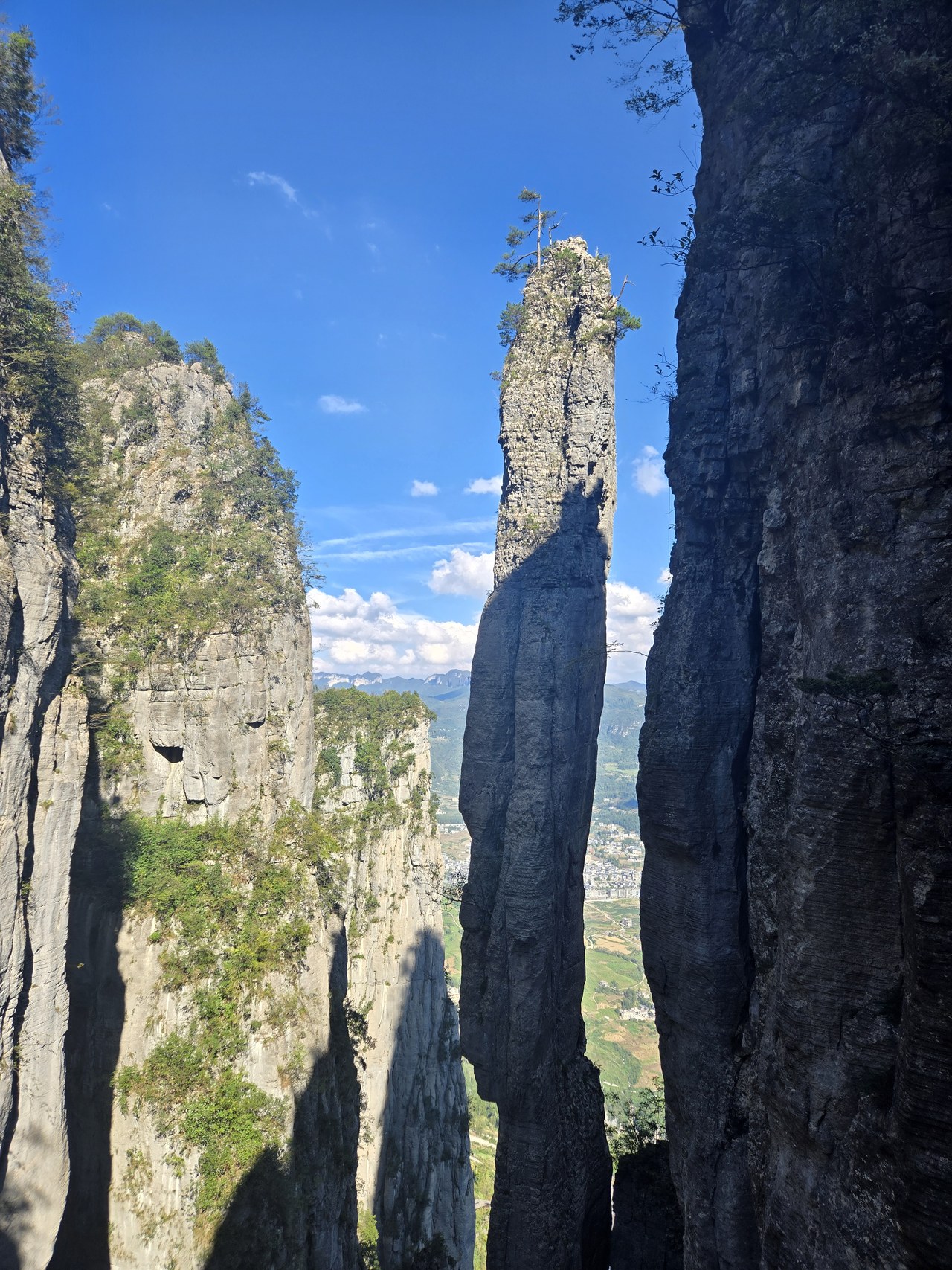
The high-cliff and rock-pillar landscape at Enshi Grand Canyon, photographed in October 2025. An archival view, not a statement of current trail access.Photo: Wimwamble · CC BY-SA 4.0 · Image credits
Look up from a narrow gorge towards waterfalls and sheer walls · Another sector within Grand Canyon, not a second city day trip
Allow an extra 1½–2 hours if the actual open route permits · Separate fissure admission and optional lift; confirm reopening and the open section before purchase.
A modern cultural quarter for an evening meal and a short browse · Qiliping side of the city
1½–2 hours around dinner · The plan is a meal-and-street visit; paid venues and shows are optional.
A city base, a country road and two different canyon routes
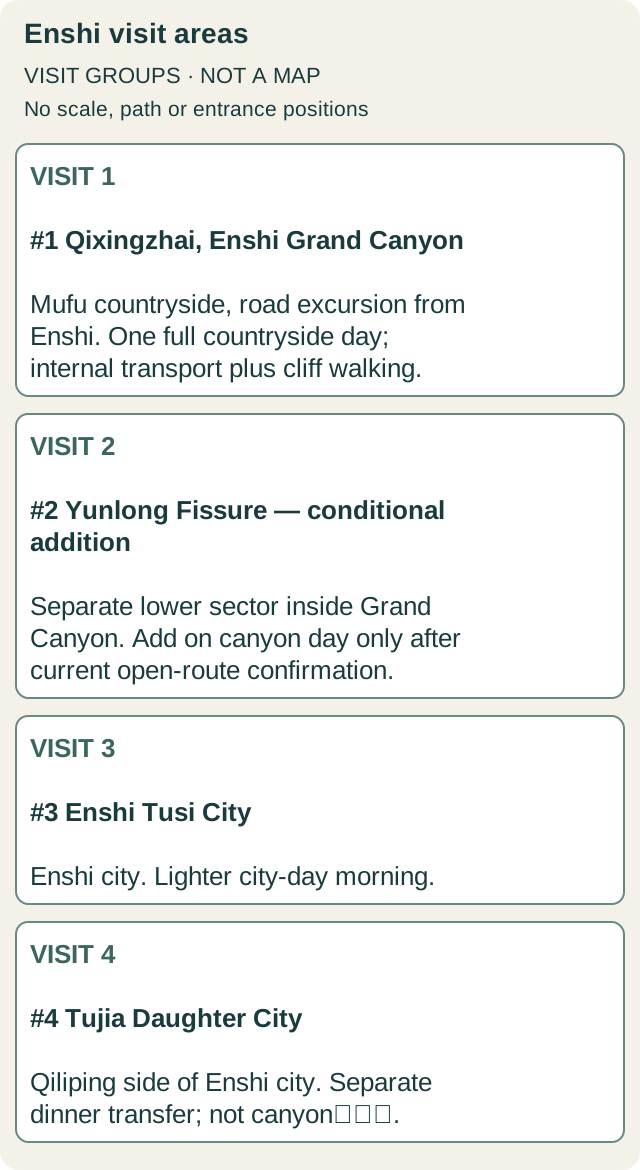
Open full-size area diagram ↗. The numbered places match this guide’s choices. This editorial area diagram groups visits; box position does not encode direction, distance, paths or an entrance. ChinaMile diagram; location sources. Navigation: search the Chinese name in Amap.
The operator places the Grand Canyon roughly 49 km from Enshi city. The city hotel, the canyon visitor centre and the cliff paths are three distinct stages of the journey. Within the scenic area, Qixingzhai supplies the elevated cliff-and-pillar circuit; Yunlong Fissure is a narrower, lower gorge reached through the same visitor system. Buying one admission does not automatically include the other.
Tusi City is a city cultural attraction; Daughter City is a separate modern dining and cultural quarter. Do not confuse the latter with 女儿寨, the hotel area at the Grand Canyon. The much wider Enshi prefecture also contains Lichuan and Hefeng: their caves and gorges are not casual additions to this two-day city-and-canyon plan.
Book the base together with the canyon return
Central Enshi around the Hangkong Avenue / Wuyangba side: suits this mixed plan, with meals and city taxis after the mountain day. Ask for a road-accessible pickup and an early breakfast or takeaway. A central hotel does not make the canyon a short urban ride.
Enshi station area: useful for a late train or a bus-led trip. Check the exact walking route to the passenger centre rather than assuming every “railway station” hotel is beside it. Mufu / Grand Canyon visitor-centre area: better for an early start or splitting the two canyon sectors over two dates, but trades away city dining and makes the departure transfer a longer arrangement. Confirm transport from the actual property to the actual scenic entrance.
Open Enshi City accommodation listings and compare your three-night dates for two adults. Use the city map rather than the broader prefecture list, which can include another county. Ask the chosen hotel for its Chinese address, passport check-in, breakfast, cancellation rules and a written canyon-return quote. This is a booking entry, not a checked room price.
Choose the experience before the ticket bundle
1. Qixingzhai, Enshi Grand Canyon · 恩施大峡谷 · 七星寨
Qixingzhai's reward is the relationship between the paths and the rock, not just reaching the well-known Incense Stick pillar. Stop where a safe viewing area lets you compare a freestanding column with the continuous wall behind it. Moving between close-up cliff faces and open views makes the scale easier to appreciate.
The one-way ascent cableway can save climbing, while the walking circuit and exit still require effort. If you are already struggling near the start, ask staff about a permitted shorter return before pressing farther along the route. Do not rely on an optional escalator as a guarantee that there will be no strenuous section.
Hours
The operator posts ticket sales 08:00–16:00 in March–October and 08:30–15:00 in November–February. Arrive near the start of sales for a full circuit; these are sales hours, not a promise that every route can start until closing.
Tickets
Posted Qixingzhai adult admission is ¥105 in March–November or ¥80 in December–February. Internal transfer plus ground funicular is ¥50; ascent cableway ¥105; the outdoor exit escalator ¥30. Choose what you will actually use rather than assuming plain admission includes the lifts.
Time
Reserve the whole day. Our plan allows roughly 5–6 hours for arrival formalities, internal transport and the main visit, with city-road travel outside that allowance.
Chinese address
湖北省恩施市沐抚办事处恩施大峡谷游客接待中心
Getting there
Start at the visitor centre, use the current signed internal route to the cableway square, then ascend by cableway if operating. Follow Qixingzhai's signed circuit to the return-transfer centre. The vehicle from Enshi city cannot drive you to the cliff path.
How to visit
Ask staff to identify the day's open circuit, ascent and exit before buying. Start early, bring lunch or substantial snacks, and take breaks before the long descent. Even using the cableway and escalator leaves considerable stairs and walking; it is not a step-free route.
2. Yunlong Fissure — conditional addition · 云龙地缝
The perspective reverses inside the fissure: instead of looking across columns from a high path, you look upward towards narrow sky, wet rock and falling water. It is a worthwhile contrast when open, but not a necessary condition of a good Qixingzhai visit.
The operator's notice archive includes a rain-triggered closure with reopening to be announced separately. A later reopening for that specific closure was not established in this review. This does not establish that the fissure is closed on your date; it means access must be confirmed directly before making it essential or paying for it.
Hours
Only visit when the operator confirms the fissure is open. Rain-related closure notices can override the general scenic introduction.
Tickets
The posted fissure admission is ¥50 per adult; its vertical sightseeing lift is ¥30 extra. Do not buy a fissure-dependent package without confirming the actual route and refund conditions.
Time
An editorial allowance of 1½–2 additional hours, adjusted to the open section and your pace.
Chinese address
恩施大峡谷云龙地缝;由大峡谷游客接待中心入园
Getting there
Use the visitor-centre transport system and current signs near the cableway square. Ask which entrance and exit are operating; do not follow a historic full-route map past a barrier.
How to visit
If open and you have the energy, see the fissure before the Qixingzhai ascent as directed by staff. If closed or time is tight, make Qixingzhai the only mountain route. A closure is not a reason to seek another way into a flood-sensitive gorge.
3. Enshi Tusi City · 恩施土司城
This is a cultural theme complex recreating the authority, belief and domestic setting of the Tujia chieftain system. The operator describes three principal elements: the gateway, the Linjun shrine and the Jiujintang palace display. Taking these in sequence gives the buildings a purpose beyond photographs.
Pay attention to the woodwork, changing courtyard levels and how the display presents political and ancestral authority. Allow a relaxed morning rather than treating the site as a quick historic “old town.” It provides a different kind of understanding from the mountain landscape, and is easier to fit around lunch and rest.
Hours
Plan a daytime visit and confirm the current admission window with the operator. A published evening performance is a separate scheduling question.
Tickets
Use the current operator quote; no present official Tusi City tariff was established in this review, so the budget retains it as a visible input.
Time
About 2–3 hours; allow more if buying a confirmed performance.
Chinese address
湖北省恩施市土司路138号;恩施土司城
Getting there
Take a city taxi or matched ride to the currently operating visitor entrance. Confirm the gate with the operator, especially when a driver or old map shows a different entrance.
How to visit
Work through the gateway interpretation, Linjun ancestral shrine and Jiujintang palace display. Read the displays as an interpretation of the chieftain system. This is not the archaeological Tangya Tusi site in Xianfeng County.
4. Tujia Daughter City · 恩施土家女儿城
Daughter City began operating as a modern cultural quarter in 2013. Go for a sociable meal, shopfronts and an introduction to presented local traditions, without mistaking the streets for an untouched ancient town or the performances for an everyday village ceremony.
If the place is too busy or the programme is not running, keep dinner simple near the hotel instead. This evening is deliberately flexible; the full mountain day should not leave you racing to a fixed show you have not booked.
Hours
Choose late afternoon through dinner for the street visit; individual restaurants, interiors and performances keep their own schedules.
Tickets
Pay the displayed menu total and any separately chosen venue admission. No recurring evening performance is promised here.
Time
1½–2 hours, shortened if tired after the canyon.
Chinese address
恩施市七里坪;恩施土家女儿城
Getting there
Use a separate city ride and save the agreed road-accessible pickup location. It is not the Grand Canyon's 女儿寨 hotel area.
How to visit
Browse a short section, choose dinner by its actual menu and return to your hotel. Treat any scheduled cultural presentation as a bonus only after checking that day's programme.
A full canyon day and a slower city day
Arrival evening · night 1: reach the city hotel and confirm the next day's weather, open route, ticket categories and return pickup. For dinner try 合渣 hezha, ground soybeans cooked with the pulp retained. It can come with vegetables, meat or other toppings; ask what the particular pot contains. For two, agree whether the menu charges per person, per pot or per dish before ordering.
Canyon day · night 2: eat early and leave with time to reach the visitor centre near the start of ticket sales. Do Qixingzhai as the day's main walk, with the ascent cableway if operating and suitable. Carry lunch or substantial snacks and water. Add the fissure only if staff confirm access, the entry sequence and adequate time. Meet the return vehicle at the agreed visitor-area point and eat near the hotel.
City day · night 3: visit Tusi City in the morning, have lunch and rest after the stairs of the previous day. Later take a separate ride to Daughter City for an early dinner. Try 炕土豆, pan-cooked potatoes, with vegetables and a modest shared meat dish, or a hezha meal if you missed it. A 豆皮 breakfast or noodle-style meal is another regional option. Ask about chilli, broth and soy rather than inferring ingredients from an English dish name.
Departure morning: retrieve luggage and take the confirmed station or airport transfer. Swap the full days to suit weather. If you have only one full day and two nights, choose the canyon and a flexible city dinner; omit Tusi City rather than forcing it into the return from the cliffs. To walk both canyon sectors at a slower pace, add a full day and consider a canyon-side night after confirming two-date ticket use.
Make the outward and return journeys explicit
Use China Railway 12306 to search Enshi 恩施 for your date, or book a flight to the actual Enshi airport serving your itinerary. Save the station or terminal on the ticket and the hotel's Chinese address. A ticket to another Enshi-prefecture county is not an arrival in Enshi city.
The canyon operator's published transport page identifies the passenger centre diagonally opposite Enshi railway station as a place to ask about its canyon service. That guidance is from 2021: its ¥25 fare and roughly 1½-hour journey are not treated here as a current fare or timetable. Contact +86 718 8542036 for the operating service, last return and boarding point. If the departure or last return does not fit, obtain a licensed return-transfer quote through the hotel; do not improvise a late roadside pickup.
For scenic tickets, enter through the Grand Canyon operator and its 恩施大峡谷 WeChat account, or use the visitor-centre counter specified in its ticket notice. Contact 400-0718-126 / +86 718 8542333 if a booking form cannot accept your passport, and carry the original document. No successful foreign-document checkout was tested. Tusi City's operator contact is +86 718 8458166; ask which gate and ticket apply.
If the fissure closes, keep the approved Qixingzhai route only if it remains open and safe. If the canyon closes entirely, switch to the city day and seek a dated ticket change/refund through the original seller; never assume the website's older general no-refund wording settles a closure refund. If your mobility cannot support the open route, choose a different outing rather than replacing it with an unverified “easy” gorge elsewhere.
Count the scenic transport, not just admission
For two adults sharing one room, three nights and two full days, use 3R + A + C + T + ¥1,280–1,580. R is the room's nightly quote, A the pair's station/airport transfers, C the quoted return road journey to the canyon, and T the pair's actual Tusi City admission.
The fixed part includes ¥580 for two regular-season Qixingzhai admissions, two ¥50 internal-transfer/funicular products, two ¥105 ascent cableways and two ¥30 exit escalators. It adds editorial allowances of ¥480–640 for meals, ¥120–200 for city rides and ¥100–160 for water and contingency. Example R = ¥300, A = ¥100, C = ¥400 and T = ¥90 gives ¥2,770–3,070 for the pair. Those four inputs are illustrations, not obtained hotel, taxi or Tusi-ticket quotes.
If Yunlong Fissure is confirmed open and added, add ¥100 for two posted admissions, plus ¥60 if both use its separate lift. In the posted December–February tariff, two Qixingzhai admissions cost ¥50 less than the regular-season example. An unused cableway or escalator changes the actual bill; use the seller's itemised order rather than adding overlapping packages. Intercity fares, performances, shopping, guiding and additional county excursions are excluded.
Sources and the difference between a tariff and an open route
Sources read on 21 October 2026. The operator's ticket page is labelled 2025 and remains its posted tariff at this review; final dated sales conditions prevail. Its scenic description provides the geography and differing canyon sectors. The actual image bodies of the rain-closure notice and a separate short maintenance notice were read: a dated maintenance interruption is not presented as a continuing closure. A reopening notice resolving the later rain closure was not verified, so the fissure is conditional.
The Tusi operator supplies the recreated display sequence, address and phone, not a current official admission tariff. The Hubei tourism department establishes Daughter City's modern development; food sources support dish identity, not today's menus. All day plans, visit allowances, base choices and spending examples are editorial. No booking, foreign-passport checkout, meal or local vehicle journey was field-tested.