ZHEJIANG · ROCK VALLEYS, A WATERFALL AND NIGHT SILHOUETTES
Yandangshan See the rocks by day and as silhouettes at night; give the other valleys their own time.
Yandangshan is a landscape of rock profiles and enclosed valleys. In daylight you see the texture of the cliffs, the stream and the gap between peaks; at Lingfeng after dark, those same outlines become figures in the sky. Lingyan adds a temple framed by immense walls, while Dalongqiu makes a tall waterfall the destination of its valley walk. Choose it for these changing perspectives rather than a single summit ascent.
Stay three nights around Xianglingtou and use two full days. Give one day to Lingfeng with a meal and rest before its separate night session. Use the other for Lingyan and Dalongqiu, linked by road transport. The three sectors are not one continuous trail, and a daytime ticket does not by itself establish night access. A short visit can keep Lingfeng plus one other valley; a broad “all scenic areas” product is unnecessary unless those extra visits are actually wanted.
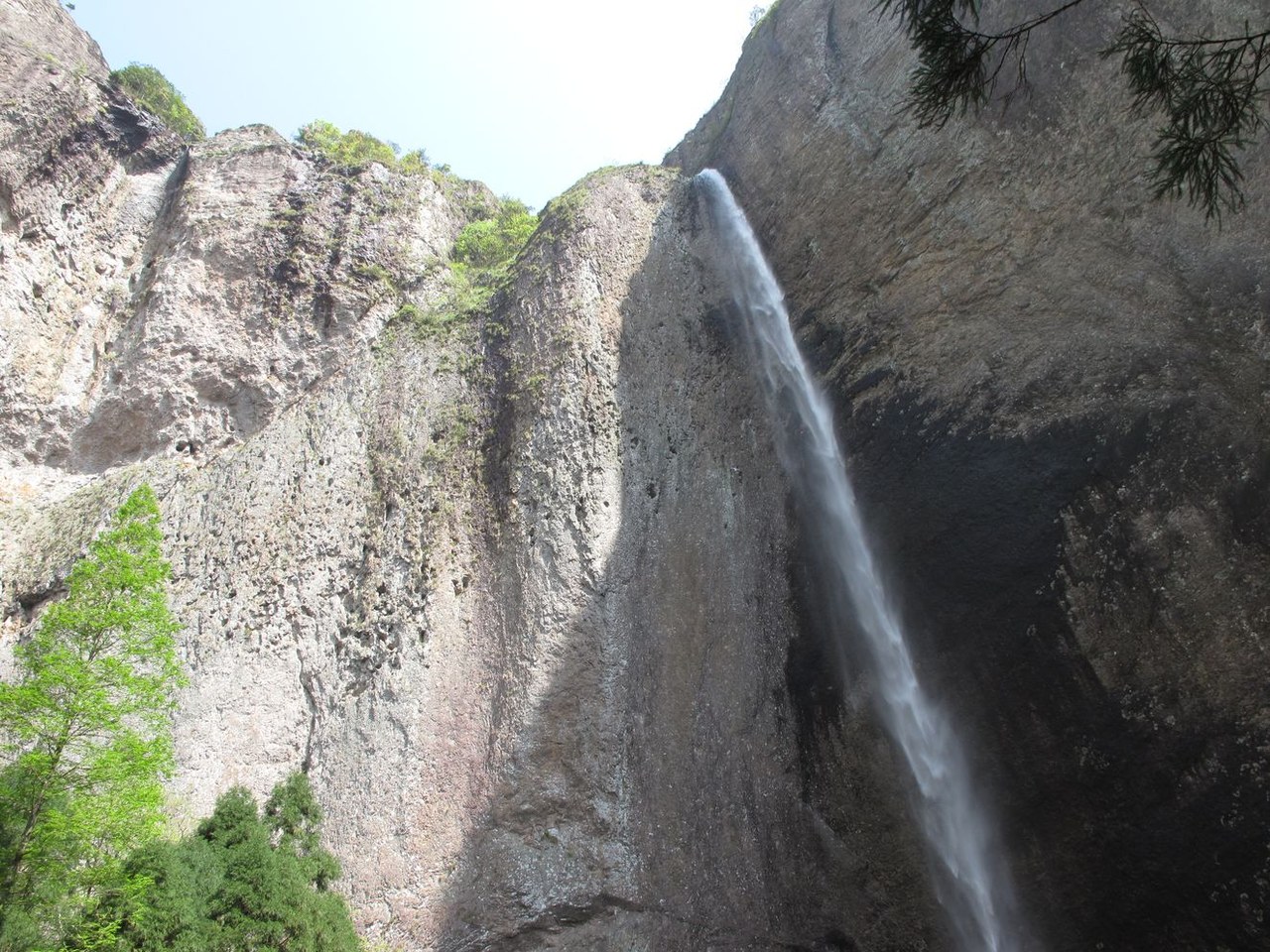
Dalongqiu Waterfall, photographed in April 2010. This historical image shows the cliff and waterfall setting; flow and access on your travel date can differ.Photo: rheins · CC BY 3.0 · Image credits
A temple beneath a great rock wall, with two sharply rising side peaks · Separate valley, reached by scenic road transport
A half-day allowance for the valley and local transfers · The operator's published single-sector reference is ¥50; extra high routes are separate decisions.
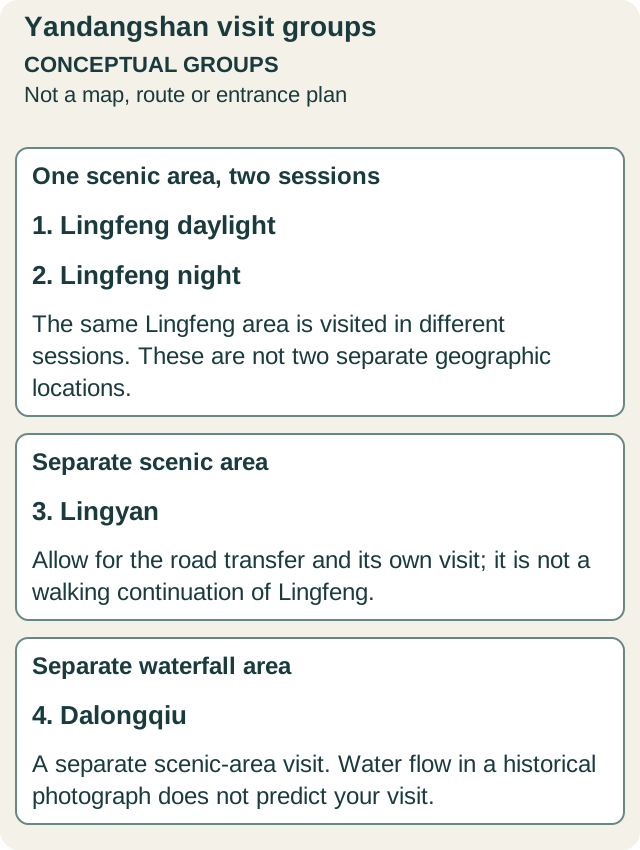
1 and 2 are the same Lingfeng sector in different sessions. Their different numbers describe the experience and ticket question, not two places. 3 Lingyan and 4 Dalongqiu have their own road entrances. Xianglingtou / 响岭头 is the hotel-and-meal base; the railway station and visitor centre are separate transport points.
Use road transport between sectors and walking inside each. The first visit does not require a cross-mountain route between Lingyan and another high area. An entrance name on a ticket should match the stop you reach; “Yandangshan” alone is too broad for a driver or a final pickup.
Fangdong / 方洞 is an alternative for visitors specifically interested in an exposed high walkway, with its own approach and any cable purchase. Sanzhepu / 三折瀑 offers another waterfall setting when the actual route is open. Add either by replacing a core visit or adding a day, not by assuming it is a free continuation. The more distant Yangjiaodong, Yanhu and Xianshengmen sectors require their own transport decisions.
This guide covers the classic northern Yandang scenic group in Yueqing. It is separate from Middle or South Yandang and from a Wenzhou city stay. Allocate the nights here before combining it with another Zhejiang base.
What changes between the four visits
1. Lingfeng in daylight · 灵峰日景
In daylight, Lingfeng is about scale and changing angle. Follow the main path along the stream and look up as the space between rock faces opens and closes. A short stop from a different position can change an apparent figure more than another kilometre of walking.
Give the lower route time before choosing a cave-temple or viewpoint ascent. Extra stairs, darkness inside a cleft and damp rock are meaningful choices, not compulsory additions. Keep energy for the night session; the daylight visit has already earned its place even if a later weather change cancels the evening.
Hours
Use a morning or afternoon daylight session after checking the day's opening and last admission. Temple interiors and steep side paths may have narrower hours than the main scenic entrance.
Tickets
The operator's service table lists Lingfeng day/night under a ¥50 reference. Ask for the actual daylight product or the named bundle; do not read the slash as proof that one single-session ticket covers both visits.
Time
Allow 2–3 hours for the main stream-and-peak visit, with extra climbs only if the signed route, conditions and energy allow.
Chinese address
浙江省乐清市雁荡山风景名胜区灵峰景区;灵峰景区入口
Getting there
Use the current scenic service or an agreed local ride from 响岭头 to 灵峰景区. Arrange the return from the entrance rather than expecting a pickup at a cave or high viewpoint.
How to visit
Entrance → open stream-side visitor path and signed peak viewpoints → one optional authorised side ascent → return to the entrance. Keep the daylight visit separate from the night session, with a rest and meal between them.
2. Lingfeng after dark · 灵峰夜景
The night visit asks the eye to do something different. With details disappearing, the outlines become the main attraction; named forms such as the paired peaks are invitations to look from a particular angle. A clear-enough sky and visibility matter more than collecting every story name.
Follow the authorised evening path and pause where staff allow people to stand. A guide can explain the traditional figures, but no paid guide is assumed or required by this itinerary. Do not climb a daytime spur in the dark simply because it was open earlier. The useful finishing point is your hotel, so settle that return before entering.
Hours
The session follows darkness and varies with the season and current operation. Obtain its actual start, last entry and finish at the ticket desk; a daytime closing time is not the night-session start.
Tickets
Buy Lingfeng night admission, or a dated bundle that explicitly names it. If your existing product is daylight-only, ask about the required night purchase before remaining in or re-entering the sector.
Time
Allow about 1–1½ hours on the permitted evening route, then the full trip back to the same hotel.
Chinese address
雁荡山灵峰景区夜景入口;返程到响岭头的酒店实际地址
Getting there
The operator's transport page lists 夜班1线 among its tourist services, with final departures adjusted to opening and closing. Before entering, confirm the actual night stop and departure for your date, or arrange a licensed pickup at the entrance.
How to visit
Eat near the hotel, reach the night entrance at the issued session, follow the open signed evening path, then return to the agreed stop or driver. If the night bus is not operating and no safe return is arranged, omit the session rather than improvising a dark roadside walk.
3. Lingyan · 灵岩
Lingyan feels broader and more enclosed than Lingfeng's changing silhouettes. The temple and the walls behind and beside it make a strong composition: give yourself time to stand in the valley and notice how the smaller buildings establish the height of the rock.
A flying display or a higher walkway may be offered, but its running time, wind conditions and route suitability are separate facts. The main valley remains the reason for this selection. Skip an upper addition if it would make the Dalongqiu transfer or final hotel ride hurried.
Hours
A daylight valley visit. Performances, upper paths and weather closures have their own arrangements; this itinerary does not depend on a fixed flying-display time.
Tickets
The operator lists ¥50 for Lingyan as a single-sector reference. Check the dated ticket's inclusions and any separate product if adding a high walkway or cable-linked route.
Time
Keep a half-day planning block including road travel, the main valley and a seated pause.
Chinese address
乐清市雁荡山灵岩景区;灵岩景区入口 / 停车场
Getting there
Take the operating tourist service from the Xianglingtou/visitor-centre area to 灵岩, or arrange a licensed road ride. Confirm the onward Dalongqiu service and the final hotel return rather than assuming every bus visits every sector.
How to visit
Entrance → permitted main path toward 灵岩寺 and the enclosing cliffs → return to the entrance by the open route. Add an upper walkway only after learning its current condition and the full descent; a valley ticket does not make every high path suitable.
4. Dalongqiu · 大龙湫
Dalongqiu's appeal is the relationship between a high drop and the enclosing cliff. The waterfall can be a narrow thread or a stronger flow; the historical photograph records one moment rather than a promise for your dates. Allow time to look at the changing rock profiles along the approach as well as the water at the end.
Water level and access are different questions. Wet weather can enliven the waterfall while also creating restrictions and slippery paths. Respect a closure instead of pursuing a more dramatic photograph. The out-and-back to the same entrance keeps the road return clear.
Hours
Use a daylight entry with enough time to walk back and catch road transport. Heavy rain and an impressive forecast are not reasons to enter a closed valley.
Tickets
The operator lists ¥50 for Dalongqiu as a single-sector reference. A ticket buys the permitted visit, not a guaranteed waterfall volume or performance.
Time
Allow 1½–2½ hours for the open valley route, as an editorial estimate; add the separate road journey.
Chinese address
雁荡山大龙湫景区;大龙湫景区入口 / 停车场
Getting there
Use the signed operating service to 大龙湫 or an agreed car. This is a different entrance from 灵岩 and 灵峰, not the end of their walking paths.
How to visit
Entrance → signed valley approach → permitted waterfall viewing area → reverse the open approach → same road entrance → hotel. Keep away from barriers, falling-water zones and flood-prone stream edges, and leave before the final transport window.
Keep all three nights at Xianglingtou
Xianglingtou / 响岭头: the practical default for food, rooms and access to the classic sectors, especially when Lingfeng night scenery is a priority. Choose a hotel with a confirmed vehicle pickup and ask which actual night-bus stop serves it. Being “near Lingfeng” on a listing does not prove there is a safe, lit walking route after dark.
Railway-station or visitor-centre area: useful for a very early train or late arrival, with extra rides to the scenic visits. Compare the complete evening return before choosing it for every night. Quieter valley accommodation: may suit a restful stay, but the location and dinner/pickup arrangements matter more than a scenic marketing photograph.
Central Wenzhou: belongs to a different city stay. Repeatedly commuting to and from the mountain makes the night session harder and can remove the flexible second day. Prefer a local bed for the two-day plan.
At Yueqing hotel listings, select the Yandang Mountain area, enter three nights, two adults and one room, then inspect the map around 响岭头. Confirm the Chinese address, bed type, stairs, heating/cooling, cancellation, passport check-in and the Lingfeng-night return with the property. These are neighbourhood choices; no individual property or live price is claimed to have been inspected.
Eat near the base between the daylight and night visits
Use Xianglingtou for a proper lunch and an early dinner, rather than depending on a long restaurant stop inside a valley. The operator lists 番薯粉丝汤, sweet-potato-vermicelli soup, 雁荡烙饼, a local flatbread, and 茴香五味豆腐干, seasoned dried tofu, among regional snacks. They can provide a useful simple meal or snack; ask about fillings, stock and the actual preparation.
For two adults, start with a shared cooked vegetable, tofu or another protein, and rice or noodles, then add only what is needed. Coastal dishes may appear beside mountain food. If choosing seafood, agree the species, weight unit and full price before it is cooked; “market price” without a total is not a usable quote.
On the Lingfeng day, finish the daylight visit, return for a meal and rest, then go back for the night session. On the two-valley day, carry water and a snack so a bus wait does not force a rushed lunch. Vegetarian-looking dishes can contain shellfish, meat stock or animal oil; state relevant restrictions directly. No menu, restaurant or personal tasting was tested for this guide.
Two full days with room for the evening return
Arrival evening · night 1 at Xianglingtou: reach the hotel, eat and obtain the current scenic-bus and Lingfeng session information. If you arrive late, leave the night visit for the following day rather than beginning before its return is arranged.
First full day · night 2 at the same hotel: use an unhurried Lingfeng daylight visit. Return to the base for lunch or an early dinner and a rest. At the confirmed evening session, visit Lingfeng again with the correct night entitlement, then use the agreed night bus or licensed pickup back to the hotel. Keep a layer or rain protection suited to the forecast.
Second full day · night 3 at the same hotel: visit Lingyan in the morning, eat or take a substantial break, then use the confirmed road service to Dalongqiu for the afternoon. Make the signed waterfall out-and-back and return to Xianglingtou before the last suitable transport. Reverse the two days when the forecast favours a different night; avoid buying inflexible dates for an evening that has not been confirmed.
Departure morning: take the booked ride or confirmed service to 雁荡山站, then the train on your ticket. Do not put a far valley ahead of an early train. A late scenic exit or a performance finish does not establish a late rail connection.
Shorter version: for one full day, choose Lingfeng daylight plus its night session and sleep locally afterward; use the next morning solely for departure. If night views do not interest you, pair Lingfeng daylight with one of Lingyan or Dalongqiu instead. For Fangdong or a fuller walking day as well, add time and quote its transport and any additional admission separately.
A railway arrival and a separate evening service
Search Yandangshan / 雁荡山 on 12306 for the actual origin and date. It is the railway starting point for this scenic stay; 温州南, 乐清 and other stations are distinct arrivals with different onward journeys. Book the exact station before arranging the hotel pickup.
The operator's current transport page lists 游1、游2、游5 and 夜班1 tourist lines and a free railway-station–visitor-centre connection. At the station follow the current signed boarding arrangement, then have the visitor desk identify the connection to Xianglingtou and each entrance. The free station link does not establish that every scenic ride is free; the dated transport product controls the rest.
For tickets, name four visits: 灵峰日景, 灵峰夜景, 灵岩 and 大龙湫. Use the online-purchase entry linked from the official scenic site, or ask the staffed visitor centre for the dated single products and any bundle explicitly covering those four visits. Compare the actual total for that selection and validity across the two days. A larger bundle is useful only if you will use its named sectors.
The official general service table gives ¥50 references for Lingfeng day/night, Lingyan and Dalongqiu, while individual dated sales may differ. Carry the original passport and have staff confirm the supported purchase and gate procedure if an online form only accepts a Chinese identity number. This guide has not verified passport checkout or facial-registration compatibility, and does not instruct you to enter invented details.
Before the night visit: obtain the actual start and finish, the last 夜班1 departure, the correct hotel-side stop and where to wait. The operator says final services adjust with scenic opening and closing; no fixed late-night departure is promised. If the bus does not serve your room, have the hotel arrange a licensed return car and agree the pickup before entering. Do not count on an unlit roadside walk or an unofficial vehicle appearing at closing.
For the daytime valleys ask the same desk about the final return from 灵岩 / 大龙湫. Save the hotel contact and the operator's service number +86 577 62178888. If a service ends early or a closure changes the route, stop the outing and arrange the permitted return with staff. If admission or the evening ride cannot be secured, keep the daytime visit and an ordinary hotel evening; do not let a paid ticket force an unsafe connection.
Budget for four admissions and the complete local travel
For two ordinary adult visitors sharing one room, three nights and two full days, use 3R + 2(D + N + L + W) + T + M + X. R is the nightly room quote; D and N are Lingfeng daylight and night admission; L is Lingyan; W is Dalongqiu. T covers both station road legs and all interior travel, M meals, and X drinks or contingency.
Using editable inputs R = ¥300; D = N = L = W = ¥50; T = ¥320; M = ¥540; X = ¥100, the result is ¥900 + ¥400 + ¥320 + ¥540 + ¥100 = ¥2,260 for the pair. The four ¥50 amounts use the operator's general published references as a conservative single-product planning basis; they are not a claim of the current checkout total. Room, transport, meals and contingency are illustrative inputs.
If a dated bundle explicitly covers all four visits, replace D + N + L + W with that actual per-person bundle price once; do not add the single admissions again. Keep scenic transport separate unless the ticket explicitly includes it. The known free station–visitor-centre link is only one leg and is not a reason to set the entire T amount to zero.
Exclude intercity trains or flights, paid guides, shopping, cableways, optional high walkways and extra sectors or nights. A cancelled night session can change the ticket and transport total; use the original seller's actual refund conditions rather than assuming the whole bundle is refundable.
Sources and what the published references do not guarantee
Sources were read on 22 October 2026. The operator's specific scenic pages support the different experiences; its service table supplies general admission references and the service number. Its transport page identifies the station connection and tourist/night lines, while explicitly leaving final services dependent on operation. Older attraction descriptions saying sightseeing buses are “temporarily free” are not used as a current all-rides promise.
The operator's general information and individual sales can show different fares or arrangements. This guide uses the published single references for an adjustable worked budget and directs the actual four-visit purchase to the operator; no cheaper third-party price is presented as an official tariff. Waterfall flow, displays, night visibility, high walkways, road controls and transport can change separately.
Visit durations, the two-day split, base advice and unquoted budget inputs are editorial judgments. No current phone call, passport purchase, ticket scan, bus ride, hotel check-in, meal or trail condition was field-tested. A historical waterfall photograph shows one capture's conditions, not the volume on your travel day.