SOUTHERN SICHUAN · BAIJIU HERITAGE AND OLD STREETS
Luzhou See a working distilling tradition, then give Yaoba its own road day.
Luzhou is a river city with a very particular reason to stop: the old fermentation pits and craft behind baijiu, China’s distilled spirit. Add the white Baoen Pagoda, an ordinary riverfront evening and an old-town day in Yaoba, and the visit has a clear shape without becoming a tour of every attraction in the municipality.
Stay three nights in central Jiangyang for two full days. Use one for the Laojiao visitor area and city streets, and one for Yaoba by road. This suits travellers curious about food production, southern Sichuan architecture and a slower working city. You can visit for the craft without drinking. If distilling history has little appeal, a one-day stop or another southern Sichuan base may suit better.
Yibin has a different focus: the Min–Jinsha confluence, ran mian and Lizhuang, with a separately planned Bamboo Sea stay. Luzhou’s plan is not that itinerary under a new name. Zhangba’s longan grove is the gentler city alternative to Yaoba, or a reason to add a fourth night.
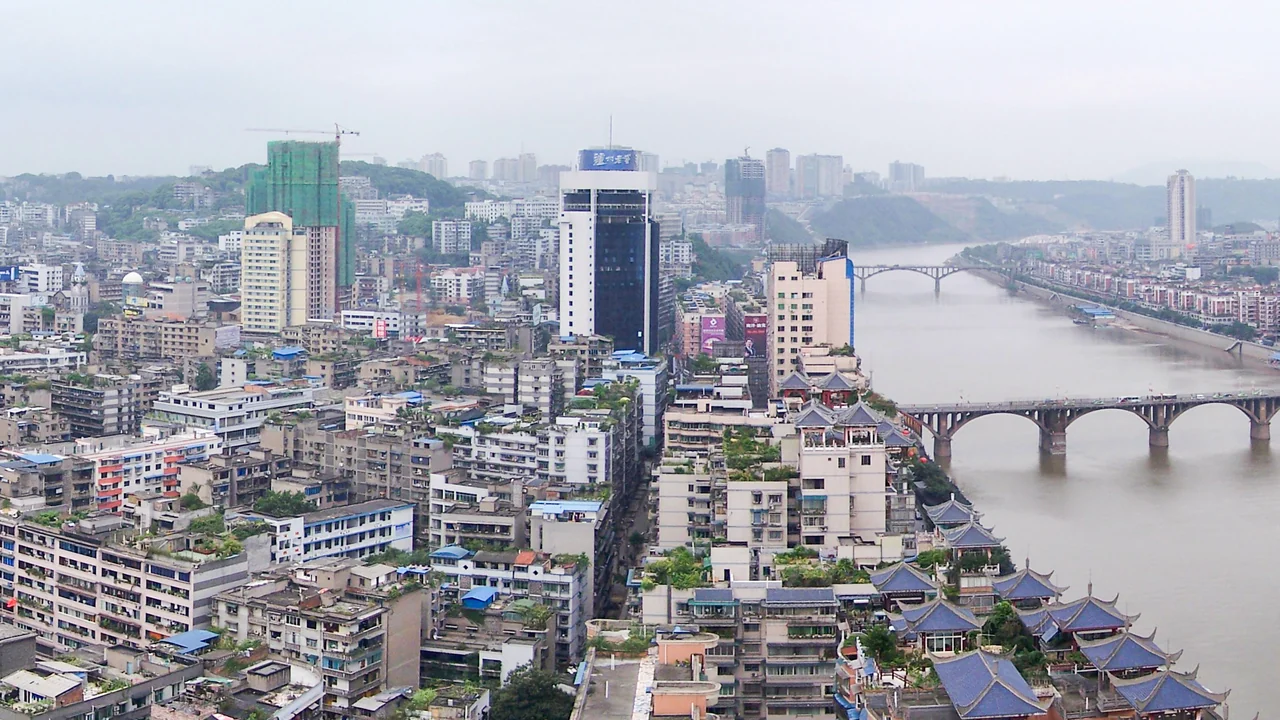
Luzhou city and riverfront, photographed on 21 August 2008. This archival city view illustrates its riverside setting; buildings and the skyline have changed, and it does not establish current visitor routes or access.Photo: PhiLiP · CC BY-SA 4.0 · Image credits
Mature longan trees and a green walk beside the wider river-city landscape · Eastern Jiangyang / Zhangba
A half-day including city travel · A simple walk differs from sightseeing vehicles and fruit-picking services.
Keep the central city together and Yaoba separate
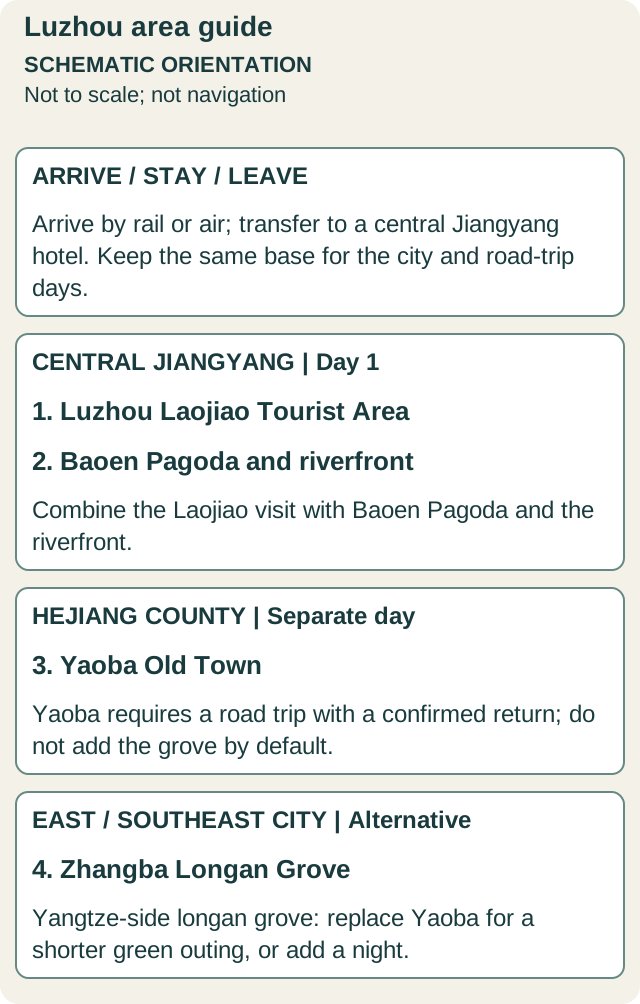
Open full-size area diagram ↗. Numbers match the guide. Named directions show broad areas; box positions do not encode geography. This schematic is not to scale or suitable for navigation, and does not prove access or current operation. ChinaMile editorial diagram; guide sources. Navigation: search the Chinese name in Amap.
1, Laojiao, and 2, Baoen and the riverfront, form the main Jiangyang city day. 3, Yaoba, is a separate road outing in Hejiang County. 4, Zhangba, is a greener city-side alternative that can replace the longer old-town day. The diagram gives relationships, not road directions or a measured walking route.
Keep the same Jiangyang hotel for the default three nights. A station hotel or a room across the river can be appropriate for a specific train or room requirement, but adds rides for central evenings. Do not change hotels merely to make a map line look shorter.
In very hot weather, use the cellar visit in the morning and rest before the evening streets. In prolonged rain, swap the Yaoba and city days if the road service allows it. Neither the grove nor a slippery old street is a reliable indoor rain substitute; keep a meal and sheltered city time as the shorter fallback.
Four places and how to visit them
1. Luzhou Laojiao Tourist Area · 泸州老窖旅游区 · 国窖1573广场
The attraction is a production tradition made visible. The operator identifies the 1573 pits and the inherited distilling craft as the core of the visitor area. Look for the relationship between fermentation pits, grain and working practice rather than treating the site only as a place to buy a bottle.
A guide or clear interpretation makes the visit more useful. Ask whether English interpretation is actually available; if not, decide whether translated signs or a translation app will be enough for your interest. Do not expect an individual worker to stop production to explain the process.
Tasting is optional. Tell the host if you prefer not to drink, and do not make an alcohol purchase necessary to complete the heritage visit. Children can look at the craft with an accompanying adult but should not be included in tasting. A showroom, a working production view and a special event are different experiences; the admission description should say which you are buying.
Hours
The Ctrip visitor listing publishes 09:00–17:30, last entry 17:00. Use a morning visit and check the actual tour/session: production activity is not guaranteed all day.
Tickets
Use the specific 泸州老窖景区 admission product for your date. Ask what interpretation and tasting it includes and whether your passport can be entered or checked at the counter. No current operator tariff was obtained.
Time
Allow 1.5–2 hours for the visitor route and interpretation; it is not a tour of every company production site.
Chinese address
四川省泸州市江阳区三星街国窖广场;泸州老窖旅游区
Getting there
Show 国窖1573广场 / 泸州老窖旅游区, not the corporate headquarters in Longmatan or a distant industrial park. Use a city taxi or a walk that fits your actual hotel location.
How to visit
Visitor entrance → available interpretation and permitted cellar-viewing route → exit. Stay behind barriers; do not assume access to the production floor. If the pits cannot be viewed on your date and that is the purpose of the trip, change the visit before paying.
2. Baoen Pagoda and the city riverfront · 报恩塔 · 滨江路
Baoen Pagoda gives the old city a vertical marker: its white body and stacked storeys contrast with the streets around it. See it as an exterior architectural stop, then continue into the ordinary city instead of searching for a tower ascent this plan does not promise.
The riverfront adds the sense of Luzhou as a working Yangtze city. Notice the bridges, banks and movement of the waterfront rather than waiting for a particular sunset or lighting effect. Choose a comfortable public section and return to your hotel for dinner or find an ordinary meal in the central streets.
This pairing is flexible enough for arrival or a rainy-day gap, but the river edge is not an all-weather substitute. In heavy rain or high water, stay behind barriers and move the walk inland. A seated tea break can replace the river portion without breaking the day.
Hours
Daylight shows the tower’s form; the riverfront can also suit an early evening walk. No specific lighting programme, tower interior or cruise is promised.
Tickets
Use the permitted exterior and public streets. Do not buy a product expecting to climb the pagoda unless its current operator explicitly offers that access.
Time
Keep a relaxed half-day including a meal; use a shorter riverfront section for the arrival evening.
Chinese address
四川省泸州市江阳区报恩塔文化广场;滨江路沿江公共步道
Getting there
Start at 报恩塔文化广场, then use ordinary streets to a currently open riverside section. The tower and river are separate stops, not a single fenced attraction.
How to visit
Pagoda exterior → central streets and lunch → accessible public riverfront → city hotel. Follow flood barriers and road crossings. A river closure means returning to city streets, not descending to a lower bank.
3. Yaoba Old Town · 尧坝古镇
Yaoba’s old street is a change in scale from Luzhou: a compact sequence of stone paving, tiled roofs and traditional house fronts. The heritage-design researchers who surveyed the town describe a trading-street settlement; that gives a better reason to look closely than an expectation of a spectacular monument at every turn.
Look for the relationship between shop fronts, domestic courtyards and the street. The town’s well-known architectural interests include the Dahong Rice Shop / 大鸿米店, Dongyue Temple / 东岳庙 and the military-graduate archway / 武进士牌坊. Ask which interiors are open; the default visit remains complete as a lane-and-exterior walk with lunch.
Do not assume that the larger Yaoba Yi / 尧坝驿 entertainment development is the same experience as the old main street. Choose additional performances only if you want them and still have a reliable return. Stone paving can be uneven and slippery: a shorter reversible street walk is a sound option for travellers with limited walking energy.
Hours
Visit during the day. Public-street access does not establish the hours of Dahong Rice Shop, a temple or a memorial interior. Confirm any specialist must-see interior before leaving Luzhou.
Tickets
At the visitor service ask which parts are open public lanes and which interiors require admission. Do not confuse a nearby themed entertainment package with entry to the old street.
Time
Allow 3–4 hours for the town, lunch and pauses; keep most of the day free for the outward and return road journey.
Chinese address
四川省泸州市合江县尧坝镇;尧坝古镇游客中心
Getting there
Arrange a licensed car to the old-town visitor centre and the reverse journey to your Jiangyang hotel. If using a coach, obtain the actual operating stop, last return and fare before departure.
How to visit
Visitor service → old main street and permitted architectural exteriors → an actually open interior if desired → lunch → the same confirmed pickup. Shorten the walk rather than missing the last agreed return.
4. Zhangba Longan Grove · 张坝桂圆林
Zhangba is a grove rather than a checklist of monuments. The mature trunks, spreading canopies and orchard landscape create the visit. It makes a useful contrast after the cellar tour, especially for someone who would rather have a green half-day than another old town.
Choose a short signed circuit from the entrance you use. The operator’s published description places the grove on the eastern river-city side and identifies long-established longan trees. It does not establish that every path, vehicle service or fruit-picking plot is open today.
Longan picking is seasonal and permission-based. An attractive fruit tree is not an invitation to harvest. Outside the fruit season the grove can still be a walk; if seeing or picking fruit is the main purpose, obtain a date-specific confirmation before substituting it for Yaoba.
Hours
Choose a cooler daylight block, subject to current public-path access. A summer fruit season does not establish a picking session on your date.
Tickets
The route is a modest grove walk. Confirm the entrance arrangement locally; sightseeing vehicles, rentals and fruit picking are separate services with their own prices.
Time
A half-day allows the city rides, a 1–2-hour walk and a rest. A full grove traverse is unnecessary.
Chinese address
四川省泸州市江阳区张坝桂圆林旅游区;使用当天开放的游客入口
Getting there
Ask the hotel or current visitor service which entrance is open, then agree a pickup at that same entrance. Do not use an old map’s footpath as a through route.
How to visit
Open entrance → selected signed grove paths → shaded pause → same entrance and ride home. Stay off private growing plots and do not pick fruit without an agreed paid arrangement.
Breakfast in town, then give Yaoba a real lunch
Luzhou white rice cake / 泸州白糕 is a small local breakfast or snack choice. Buy a modest portion to eat fresh rather than automatically buying a gift box. Dou tang mian / 豆汤面 offers a fuller noodle breakfast; ask about broth and toppings rather than assuming a bean-based name means vegetarian.
At Yaoba, hongtang yangrou / 红汤羊肉 is a local mutton dish in a red broth. Ask for the portion size, whether the quoted price is per bowl or by weight, and how spicy the kitchen can make it. For two, start with a small shared portion, vegetables and rice; a large table platter is not the minimum order to try the dish.
City restaurants may also offer Gulin mala chicken / 古蔺麻辣鸡, associated with another county in the wider Luzhou region. Choose it if you want a chilli-and-peppery cold dish, but do not travel to Gulin simply for dinner during this city stay. Ask for a small portion and expect bone-in pieces unless the restaurant says otherwise.
Keep the cellar tour before any optional tasting and use ordinary transport afterwards. At dinner, a bottle price and a tasting measure are different purchases; establish both before accepting a pour. No restaurant, current menu price, personal tasting or alcohol-related health benefit is claimed here.
Central Jiangyang makes the evenings easier
Jiangyang near Baoen Pagoda, Sanxing Street and central commercial streets is the default. It keeps the principal visitor area, food and evening walks in one part of the city. Check the actual pedestrian approach, traffic noise, lift and legal car stop rather than treating every riverside listing as equally convenient.
Longmatan across the Tuo River can suit a specific hotel or an earlier station transfer; allow city rides and bridge traffic for the Jiangyang visits. Luzhou station surroundings suit a short overnight before a very early train, with fewer reasons to choose them for all three nights.
Yaoba overnight is worth considering if the quiet old-town evening is the purpose, but it changes the luggage journey and departure. The default here returns to Luzhou, so you do not have to move bags or depend on a remote early pickup for the train.
At Luzhou accommodation search, enter two adults, one room and three nights, then use the map for central Jiangyang. Compare the complete price, bed configuration, cancellation and arrival window; ask the property to confirm foreign-passport check-in. This is a neighbourhood choice, not an evaluation of named rooms.
Two complete days, with one hotel and an agreed return
Arrival evening · night one: reach the Jiangyang hotel, eat nearby and take a short riverfront walk only if time, weather and open access permit. Keep the cellar admission for a full morning rather than betting it on an arrival connection.
First full day · night two: breakfast → Laojiao Tourist Area, 1, with the selected interpretation → lunch → Baoen Pagoda exterior and central streets, 2 → rest → a short public riverfront walk and dinner. No bottle purchase, cruise or pagoda climb is needed to complete the day.
Second full day · night three: agreed road pickup → Yaoba visitor service, 3 → old main street and open architectural interests → mutton or another local lunch → a final short lane walk → confirmed return to the Jiangyang hotel. Do not reserve a tight onward train for this evening.
Departure morning: travel to the exact station or airport printed on the ticket. If a delay develops, use the original rail/air booking channel for the options rather than driving to a different station in the hope that it is interchangeable.
Gentler variation: replace Yaoba with Zhangba, 4, and an extra city meal. To do all four: add a fourth night and a third full day for the grove, leaving the second day intact for Yaoba. With only one full day and two nights, keep Laojiao, Baoen and the city riverfront.
Luzhou and Luzhou East are not interchangeable stations
For this city stay, begin with Luzhou / 泸州站 on 12306 English booking. Luzhou East / 泸州东站 is in Yunjin Town, Lu County / 泸县云锦镇, and Luxian / 泸县站 is another separate station. Compare the actual hotel transfer before accepting an East or county-station result just because it carries the Luzhou name.
The air gateway is Luzhou Yunlong Airport / 泸州云龙机场. Use the airport site and operating airline for your dated flight. At either gateway, use the official taxi queue or a licensed hotel pickup and show the full Jiangyang address. No current airport-bus last departure or taxi tariff is assumed.
For Laojiao, the operator’s visitor page identifies Guojiao 1573 Square and the heritage pits. The specific visitor listing provides a booking entry and the visitor number +86 830 2393388. Confirm the dated product, language and passport process; that phone number was read, not called. The corporate headquarters is not the tourist entrance.
For Yaoba, agree the entire Jiangyang hotel → 尧坝古镇游客中心 → Jiangyang hotel journey with a licensed provider, including waiting, pickup time and the total. If using a public coach, obtain the operating station, onward local leg and last return first. If that cannot be established, use the Zhangba variation or a pre-arranged licensed round trip, not an unplanned one-way ride.
If a ticket form cannot accept your passport or card, contact the attraction for the supported staffed-counter process before paying for a non-refundable transfer. Carry the original document; do not substitute a different identity number to force the form through.
If passport verification fails, use the supported document-photo review or take the original passport to a staffed railway ticket window. Match the ticket name and document number to that passport. Leave time for assistance at station entry if an automatic reader cannot process it. Neither a passport upload nor a ticket purchase was tested for this guide. 12306 identity-verification rules explain the official alternatives.
A complete three-night example for two
For two adults sharing one room, three nights and two full days, calculate 3R + T + M + A + X. R is one nightly room; T covers both gateway transfers, city rides and the Yaoba round trip; M includes arrival dinner through departure breakfast; A is the chosen cellar admission and paid Yaoba interiors; X covers water and contingency.
Using illustrative inputs R = ¥300, T = ¥480, M = ¥560, A = ¥160 and X = ¥160, the total is ¥900 + ¥480 + ¥560 + ¥160 + ¥160 = ¥2,260 for the pair. All five inputs are planning allowances. No live hotel rate, car quotation or current operator admission tariff is represented by those numbers.
The booking platform advertises starting prices for the cellar product; a starting price is not the price for your date, document or selected inclusion. Replace A with the actual two-adult product and any selected old-town interiors. Replace T with the complete car quote including return and waiting; do not hide a long East-station transfer inside an unchanged city allowance.
For four nights and three full days including Zhangba, an illustrative additional room ¥300 + meals ¥160 + city rides ¥100 + contingency ¥40 adds ¥600, giving ¥2,860 for the pair before any paid grove services. These are planning inputs too. Intercity trains/flights, alcohol, shopping, private guides, cruises, performances and fruit-picking or rentals are excluded. An unknown optional cost is not zero.
Sources and the limits of the visit plan
Sources were read on 22 October 2026. Laojiao’s own visitor page supports the historic pits and craft. Its page is not a dated price quote; the separately labelled platform listing supplies published visitor hours and a booking contact. The airport’s Yaoba description and the heritage institute’s surveyed-town account support the architecture and separate county location.
The official Zhangba page returned only a lightweight page shell in direct retrieval; its indexed operator description supports the broad grove setting, not current opening or service availability. No new operational check date is claimed for that shell. The Sichuan government station reference supports the Yunjin location of Luzhou East.
Visit lengths, the three-night sequence, base preferences and every sample budget input are editorial judgments. No factory-floor access, English tour, call, meal, hotel stay, train purchase or overseas-passport admission was tested. Production schedules, entry products, private interiors and road returns must match the traveller’s date; the old-street route remains useful without a show or tasting.