Wutaishan Stay for the temple town and its religious landscape; treat the five high summits as a different journey.
Wutaishan is a living Buddhist landscape, rather than a single temple or a mountain to tick off from a summit. The White Pagoda rises over Taihuai's roofs, large courtyards lead into halls of images, and raised temples reveal how the town sits among the hills. Choose it when Buddhist art, pilgrimage and the time to observe matter more than fast scenic variety.
Give the first visit two full days and three nights. A practical road-arrival plan spends the first night by the lower visitor centre, then two nights in Taihuai inside the scenic gate: a day for Xiantong, Tayuan and an optional Pusading ascent; another for Shuxiang and, if suitable, Dailuoding. This is a temple-basin stay. The five exposed plateau tops, Foguang Temple and Nanchan Temple need separate access decisions and are not spare stops in the same walking circuit.
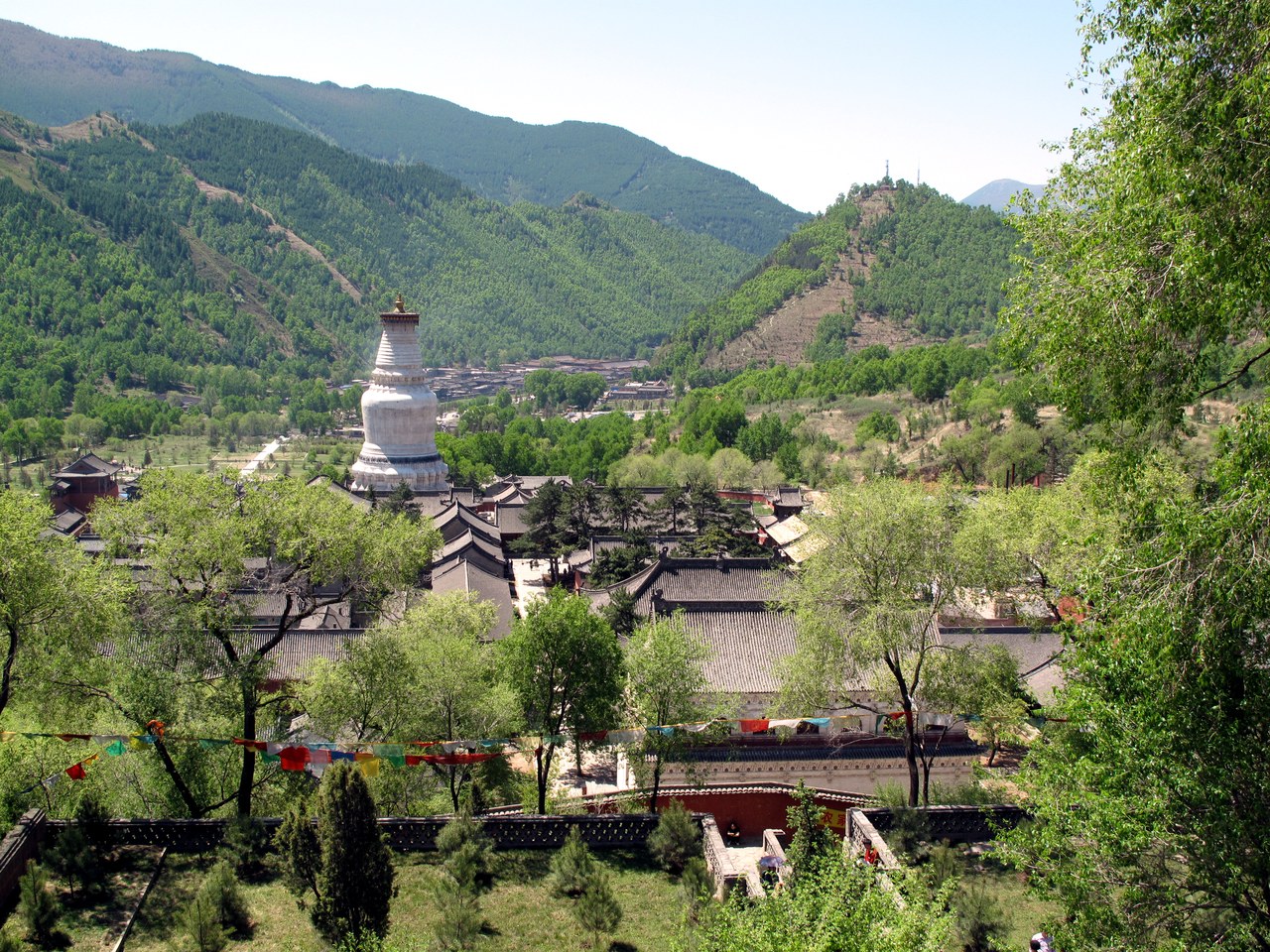
Tayuan Temple and its white pagoda in the Taihuai temple basin, photographed in 2009. This is a historical view, not a terrace-summit hiking scene.Photo: G41rn8 · CC BY-SA 4.0 · Image credits
Jingangku / 金岗库 and the visitor-centre gateway sit outside the core temple stay. Taihuai / 台怀镇 is the interior base. A hotel advertised as “Wutaishan” may be on either side of the entry control, or much farther away in the county. Resolve that before arranging the vehicle.
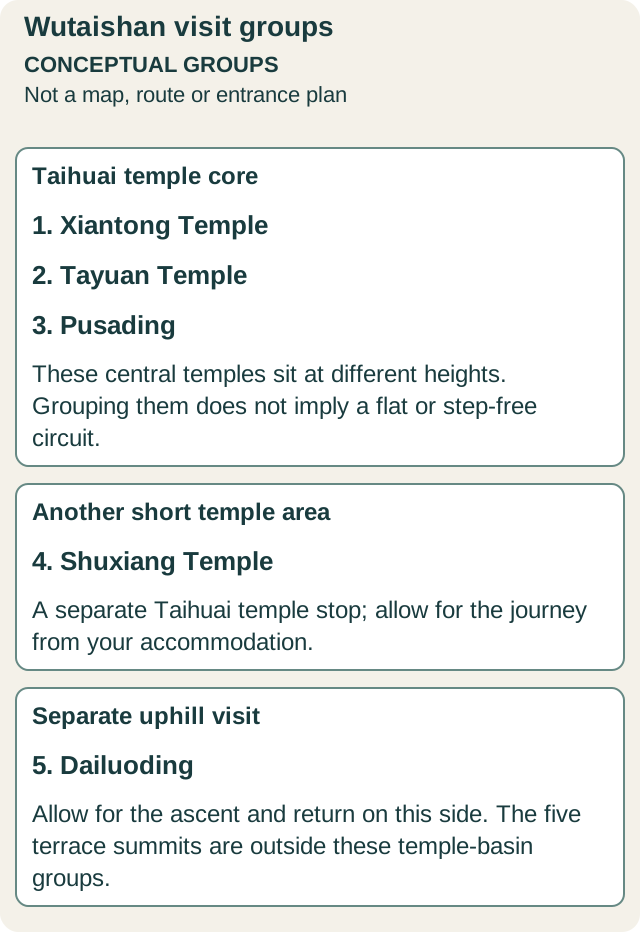
Xiantong, 1, Tayuan, 2, and Pusading, 3, belong to the central group but involve different entries and height. Shuxiang, 4, makes a separate temple visit; Dailuoding, 5, is a sustained stair ascent on the valley side. The diagram groups visits and transfers; it does not turn them into one level pedestrian route.
The five flat-topped mountains around the basin explain the destination's name. The scenic authority has issued weather-related restrictions on plateau-top hiking. Those are dated controls, not evidence of a permanent closure or current permission to walk. Do not add a social-media five-peak traverse to this temple stay. Before considering a separate summit journey, ask the authority for the current permitted routes and transport. A plateau notice is not evidence that Taihuai temples or the separate Dailuoding stairway are closed. For this first stay, seeing the landscape around the town and one manageable viewpoint is enough.
Foguang's Tang timber hall and Nanchan's early timber architecture are compelling for specialists, but lie outside this central temple plan. Reserve a separate car route and visiting permissions if they are the main purpose. Choosing Datong instead may suit a short trip focused on monumental sculpture and a city base; Taiyuan offers another history-led base with different transfer demands.
Courtyards, stupa, sculpture and one optional climb
1. Xiantong Temple · 显通寺
Xiantong gives the first morning a substantial anchor. Move through the main open courts at a measured pace, noticing changes between larger halls, smaller structures and framed rooflines. The experience is less about locating every named relic than understanding how several buildings make one sacred setting.
Leave time to look back along the sequence and to observe from a respectful distance. Inner rooms may be closed for worship or conservation. Keep the temple entrance and Tayuan's entrance distinct; the most useful route is the one the site is actually admitting visitors to that day.
Hours
Go in the morning after asking the hotel or visitor desk which halls are open. A scenic-area arrival time does not establish the opening hours of an individual religious site.
Tickets
The visitor centre's published ¥135 admission reference is for the first scenic gate, with separate charges at some temples. Pay the temple's posted charge only when visiting; keep small payments and any receipt separate from the main ticket.
Time
Allow 1–1½ hours at the temple, as an editorial visiting estimate. Add a break before the higher Pusading approach.
Chinese address
山西省五台山风景名胜区台怀镇显通寺
Getting there
From a Taihuai hotel use the current local service or a short road connection to the central temple area, then the signed visitor approach. From a hotel outside the scenic gate, first complete admission and the designated transfer.
How to visit
Start with the main open courtyards, compare the changing hall forms and return to the central pedestrian area. Keep Tayuan as a separate entrance and Pusading as a separate climb, even though all three belong to the same central group.
2. Tayuan Temple and the White Pagoda · 塔院寺 · 大白塔
The White Pagoda gives Taihuai its visual centre. At close range its broad base, curved body and high finial create a different sense of scale from the surrounding halls. Compare a view from the open town approach with the permitted view inside the temple rather than expecting a climb up the stupa.
Tayuan also provides a reason to slow the first day down. Let pilgrims pass, observe any marked circulation direction and keep cameras outside areas where photographs are prohibited. Nearby Wuye Temple is a different religious site; neither the White Pagoda visit nor a hotel booking establishes that its interior is available.
Hours
Visit in ordinary daylight hours. Access during ceremonies, maintenance or crowd control can differ from the surrounding street.
Tickets
Obtain the current temple price at its own entrance. No current individual tariff or free interior entry was established in this guide.
Time
Around an hour, more if you choose a quiet pause rather than adding another temple.
Chinese address
五台山台怀镇塔院寺;大白塔
Getting there
Follow the signed route from the central temple area. Tayuan and Xiantong are near one another, but have their own entries and opening arrangements.
How to visit
See the stupa and its relationship to the surrounding roofs from permitted visitor areas, then continue through the open courts. Follow the direction used by worshippers where indicated and leave space around active rituals. Do not confuse Tayuan with nearby Wuye Temple / 万佛阁.
3. Pusading · 菩萨顶
Pusading changes the perspective by raising the visitor above the central group. The approach and the formal temple courts make this a worthwhile architectural choice for people comfortable with steps. It also helps show that Wutai's Buddhist landscape includes different traditions, rather than a row of interchangeable halls.
Add it after a break, with the return in mind. Visitors who prefer to avoid a further climb can keep the morning to Xiantong and Tayuan, have a longer lunch and explore only open town streets in the afternoon. That remains a complete cultural day.
Hours
Choose a daylight window with enough energy for the steps and a descent before temple closing. In ice or heavy rain, omit this ascent.
Tickets
Confirm the current temple charge and any route restrictions at the entry. The scenic ticket does not promise entry to every inner hall.
Time
About 1–1½ hours including the approach is a planning allowance; queues and rest needs can increase it.
Chinese address
五台山台怀镇菩萨顶
Getting there
Use the signed uphill approach from the central temple group. A map pin for the temple is not a promise of a level road drop-off at its principal doorway.
How to visit
Make the climb only if comfortable, visit the permitted courtyards, then descend by the open approach to the central group. Skip it while keeping Xiantong and Tayuan if steps are the limiting factor.
4. Shuxiang Temple · 殊像寺
Shuxiang is the choice for a more concentrated encounter with Manjusri, the bodhisattva associated with wisdom and with this mountain. UNESCO identifies its sculptural storytelling as part of the landscape's significance. Look at how figures and their setting work together from the position visitors are permitted to stand.
It makes a good second morning because it does not require repeating the whole central cluster. Allow time for a seated lunch afterward. Visitors are not required to buy a ritual, a costly incense package or a guide's claimed privileged access to appreciate the site.
Hours
A daytime temple visit. Check the individual hall's visitor rules and photograph restrictions before entering.
Tickets
Use the posted admission conditions on the day; no specific charge or guaranteed open interior is assumed.
Time
Allow 45–75 minutes, plus the local connection from your hotel or other temple.
Chinese address
五台山风景名胜区台怀镇殊像寺
Getting there
Show 殊像寺 to a licensed local driver or the staffed bus desk. Keep this and the Dailuoding ascent as two separate stops, with a meal and a road connection when needed.
How to visit
Focus on the Manjusri imagery and the sculptural landscape described by UNESCO, where the authorised visitor view permits. Do not buy a promise of special inner-hall access from an unofficial guide. Return to the agreed local pickup or hotel.
5. Dailuoding · 黛螺顶
Dailuoding makes the physical side of pilgrimage visible: the stairway steadily lifts the visitor above the valley. The official description links the temple's five Manjusri images to a “small pilgrimage,” distinct from travelling to the five actual summits. The upward effort and return steps are part of the decision.
Use it as the second day's main physical activity in dry, suitable conditions. If steps, ice, visibility or fatigue make it unattractive, omit it and spend longer at Shuxiang and in the open temple town. A quiet afternoon is better than an improvised attempt to reach a high plateau top.
Hours
Start in the morning in suitable conditions, after confirming the signed stairway is open. Summit-area closures and this local temple approach are not interchangeable; ask staff about the actual route.
Tickets
Pay any posted temple charge at the authorised entrance. This plan uses the open stairway on foot; a claimed cableway on an old travel page is not a verified alternative for the visit.
Time
Keep a half-day allowance for the sustained up-and-down walk and rests. Turn back early when the descent, weather or the group's pace warrants it.
Chinese address
五台山台怀镇黛螺顶;先到黛螺顶登山步道入口
Getting there
Reach the signed lower stairway by the operating local transport or a licensed car, then climb on foot. Set the return pickup at the lower approach, not the hilltop temple.
How to visit
Lower stairway → open marked ascent → permitted temple courts → same marked stairway down → agreed local pickup. The operator describes a long stepped pilgrimage to five Manjusri images; this is not a substitute road tour to all five plateau summits.
One gateway night and two interior nights
Arrival night near the Jingangku visitor centre: useful after the road journey, before the next morning's admission and transfer. Confirm that the room is actually outside the gate and how to reach the ticket hall with luggage. A hotel's “visitor centre” label can be imprecise; send the Chinese address to the property.
Two nights in Taihuai inside the gate: the default for both full sightseeing days. Choose an address with a manageable connection to the central temples and a known road pickup. Ask about stairs, vehicle restrictions, heating, hot water and the actual twin/double bed configuration. An inside room reduces repeated gate crossings, but still may need local rides.
All nights outside: can suit a lower room quote or a late arrival, but each sightseeing day adds the gate/transfer chain and depends on the ticket's current re-entry validity. Do not buy three outside nights on the assumption that a room booking includes entry or a vehicle permit. Wutai county town and Shahe / the railway-station area are separate bases, not substitutes for a walkable Taihuai stay.
Use Wutai County hotel listings or your preferred provider, search Wutaishan, enter two adults and one room, then use the map: first night at 金岗库 / 五台山游客服务中心, following two nights in 台怀镇 inside the gate. Confirm foreign-passport check-in, address, cancellation and pickup with both properties. No named hotel or live rate is endorsed here.
Use Taihuai for lunch and dinner
Plan breakfast at the hotel and ordinary seated meals in Taihuai between temple visits. A 台蘑 mushroom dish, tofu and Shanxi noodles give a useful starting order. Local reporting describes mushroom dishes cooked with chicken as well as vegetarian preparations, so the regional ingredient does not imply a vegetarian meal.
For two people, choose one clearly priced mushroom or tofu dish, another vegetable and noodles or rice. Ask whether soup, stock and oil contain meat if that matters. A premium mushroom label can carry a substantial price; confirm the dish and total before ordering. Never collect or eat an unidentified mushroom yourself.
Keep the longer lunch after the morning temples and eat before committing to the Dailuoding ascent. Monastery dining has its own admission, religious and meal-time arrangements; the itinerary does not rely on a free meal or a walk-in place in a communal dining hall. No menu bill or restaurant visit was tested.
Two temple days without turning transfers into sightseeing time
Arrival · night 1 near Jingangku: complete the agreed road transfer, check in outside the gate and eat. Resolve the next morning's original-passport admission, whether the car can enter, and the designated transfer to the Taihuai hotel. Keep luggage manageable for a possible vehicle change.
First full day · night 2 in Taihuai: enter in the morning and leave bags at the hotel by prior agreement. Visit Xiantong and Tayuan with a break between them; have lunch in town, then add Pusading only if its steps and current opening suit the group. Return to the same interior hotel for dinner.
Second full day · night 3 in Taihuai: make Shuxiang the morning cultural visit. After a meal, choose Dailuoding's signed stairway in good conditions, with enough time for the descent, or keep a quieter town afternoon. Reverse the two days if weather makes the stairway more suitable earlier. Stay inside rather than assuming a third gate crossing is included.
Departure morning: check out, reach the agreed interior pickup or bus stop, take the designated transfer to the gateway if required, then continue to the reserved onward station or Taiyuan hotel. Confirm the entire chain before leaving the room. Do not add a plateau-top visit ahead of a fixed train or flight.
With only one full day: use the gateway arrival night, visit Xiantong and Tayuan and choose either Pusading or Shuxiang, then sleep in Taihuai before departing. Leave Dailuoding and the remote temples out. Two well-chosen sites with time to observe are preferable to five hurried doorways.
Arrange people, the car and the inside transfer separately
The simple road-based approach is via Taiyuan. Reserve your train to the actual 12306 station or arrive at the named Taiyuan hotel, then agree a licensed car transfer to the Jingangku gateway hotel. Have the quote name both the inward and outward endpoints, luggage, road charges and any change of vehicle at scenic controls. This guide does not invent a journey time or fare for your date.
Wutaishan station / 五台山站 is not Taihuai. It still needs a substantial onward road connection, with the northern approach subject to its own weather and controls. Likewise, 忻州西 is a separate railway gateway, not a scenic-area station. Choose either only when its dated onward service and return have been secured. A train with the mountain's name is not automatically the easier overall trip.
Start ticket purchase at the official QR ticket entry or the 五台山游客服务中心 WeChat account. Select the actual admission day for every traveller. The site's older reservation reply establishes that channel, not today's booking window or document-field compatibility. Have the original passports available; if the form cannot accept them, ask the official visitor service to specify the supported booking and gate procedure before paying non-refundable transport or accommodation. Do not substitute another person's Chinese identity number.
A passenger ticket and a vehicle reservation are different permissions. If a private car is to enter, have its licensed provider identify the actual vehicle, plate, entry date, gate and confirmed permission. The scenic government site directs visitors to vehicle-reservation assistance. If the car is not admitted, use the designated gateway parking/transfer arrangement and settle the onward interior stop with staff; a hotel reservation is not a vehicle exemption.
Before admission, show the intended two temple days and two interior hotel nights to the desk and have the ticket's validity and exit/re-entry terms explained. Use both days consecutively and avoid an unnecessary gate exit. A main scenic ticket does not include all temple payments, summit transport or special ceremonies. The published ¥135 reference is useful for planning but the actual dated product controls.
Keep the official road and weather notices open before departure. Rain, snow, ice and wind can close roads or high areas. Earlier plateau-top hiking prohibitions included temporary weather controls; an old headline does not establish today's closure or permission. Check the actual temple route separately with staff. Do not carry a short-lived old closure date forward or infer reopening because a date has passed. If the agreed approach closes, contact the licensed provider and hotel to delay or cancel; do not buy an unofficial bypass or let a navigation app choose an unapproved mountain road.
Budget for the gateway night, interior stay and complete road transfer
For two ordinary adult visitors sharing one room, three nights and two temple days, use R₀ + 2R + 2A + L + T + M + X. R₀ is the gateway room, R the Taihuai nightly room, A scenic admission per adult, L the pair's individual temple payments, T both gateway road transfers plus interior rides, M meals, and X drinks or contingency.
Editable example: R₀ = ¥250, R = ¥350, A = ¥135, L = ¥120, T = ¥1,200, M = ¥540 and X = ¥120. The result is ¥250 + ¥700 + ¥270 + ¥120 + ¥1,200 + ¥540 + ¥120 = ¥3,200 for the pair. The ¥135 is the visitor centre's published first-gate reference, whose reply is from 2024; replace it with the actual dated admission. The remaining amounts, including the temple-payment reserve and licensed road transfers, are illustrative planning inputs, not checked tariffs or quotes.
This example deliberately reserves for the complete road journey from a Taiyuan base. If a confirmed coach is used, substitute its actual tickets and all final taxi/transfer legs; do not remove T as though station names complete the journey. If all rooms are outside, add repeated transfers and any additional admission the dated product requires. A solo traveller carries the room and many vehicle costs alone.
Exclude travel to Taiyuan, shopping, offerings, guides, summit vehicles, cable rides and Foguang/Nanchan excursions. No unknown temple or local transport charge is represented as a guaranteed zero. The default Dailuoding option is on foot; a different transport choice changes both price and route.
Sources, older references and the operating boundary
Sources were read on 22 October 2026. UNESCO and the scenic authority support the cultural landscape and temple identities. The visitor centre's ¥135/extra-temple-charge answer is dated April 2024 and remains a published reference, not a new live checkout. Its ticket page currently supplies a QR purchase entry. The 2005 Antiquities Advisory Board field report supports temple locations and architecture, never present-day prices, bus schedules or access.
The scenic government's current homepage links to vehicle-reservation assistance; the directly readable government-information-office report supports that help, not a guarantee of a plate allocation. Weather and road notices are date-specific. China Tourism News's original report explains the temporary rain-control window behind the older plateau-hiking notice; that past window is not carried into this guide as a current ban. No current foreign-passport transaction, permit, telephone call, hotel stay, restaurant bill, stairway condition or summit trip was personally tested.
The default route omits Wuye Temple as a guaranteed interior stop because its present access was not established by a readable current primary notice. Travelling specifically for that temple requires a direct opening confirmation before booking. This does not establish that it is permanently closed. The guide also makes no promise of open plateau-top hiking or operation of a Dailuoding cableway.