Wuhan River views, bronze bells and the life between them
Wuhan is best understood from both riverbanks: ancient bronze bells and Yellow Crane Tower in Wuchang, then Hankou’s trading streets, breakfast stalls and broad waterfront. Choose three nights for two full days, keeping one hotel and grouped visits on each bank with the hotel return allowed for. Two nights work for a shorter selection; an extra night buys a calmer lake or temple visit rather than a longer checklist.
The essential elevated view, with poetry and rebuilding history behind the landmark. · Wuchang · Yellow Crane Tower
2–3 hours including the park; an editorial allowance · CNY 70 daytime; ordinary onsite purchase without advance reservation, subject to capacity. Night products separate; overseas checkout untested.
The strongest indoor choice: bronze music, the Goujian sword and the cultures of ancient Hubei. · Wuchang · museum south gate
3–4 hours; add a separately booked performance only if wanted · General admission free with a timed real-name reservation. Original booked passport and reservation QR required; bell performances extra.
Choose a lakeside walk after the museum, rather than trying to cover the entire East Lake system. · Wuchang · Tingtao shore
1–2 hours for a short shore walk; longer circuits are separate plans · Tingtao free; boats, cycle hire and other attractions have separate charges and conditions.
See Wuhan as a working river city, at water level rather than from a tower. · Hankou · Yanjiang Avenue
45–90 minutes; turn back before the walk becomes a transport problem · Public riverside paths; event reservations, cruises and paid attractions are separate. Follow access restrictions.
An interest-led Hanyang visit for Buddhist sculpture and a living place of worship. · Hanyang · Guiyuan Temple
1–1½ hours, excluding a religious-holiday queue · Current ordinary tariff and passport procedure unconfirmed. Check official 武汉归元禅寺 WeChat before travelling.
A compact Hanyang choice for river architecture and the story of controlling water. · Hanyang · near the riverside hotel
1–1½ hours · Daytime entry free; reservation versus gate-registration instructions conflict. Confirm the current passport procedure; night admission separate.
A Wuchang add-on for historic school, hospital and residential buildings among cafés and shops. · Wuchang · Tanhualin
1–1½ hours, longer with a café stop · No bundled attraction ticket needed for the public-street walk; exhibitions, cafés and hill rides separate.
Three towns, one base
Wuchang holds the tower, provincial museum, East Lake and Tanhualin. Hankou gives you Jianghan Road, food streets and the broad riverfront. Hanyang is the smaller cultural cluster around Qingchuan Pavilion and Guiyuan Temple, and the hotel base used below. Bridge journeys take time: avoid a museum in Wuchang, lunch in Hankou and a return to Wuchang in one half-day.
Choose one part of Wuhan at a time
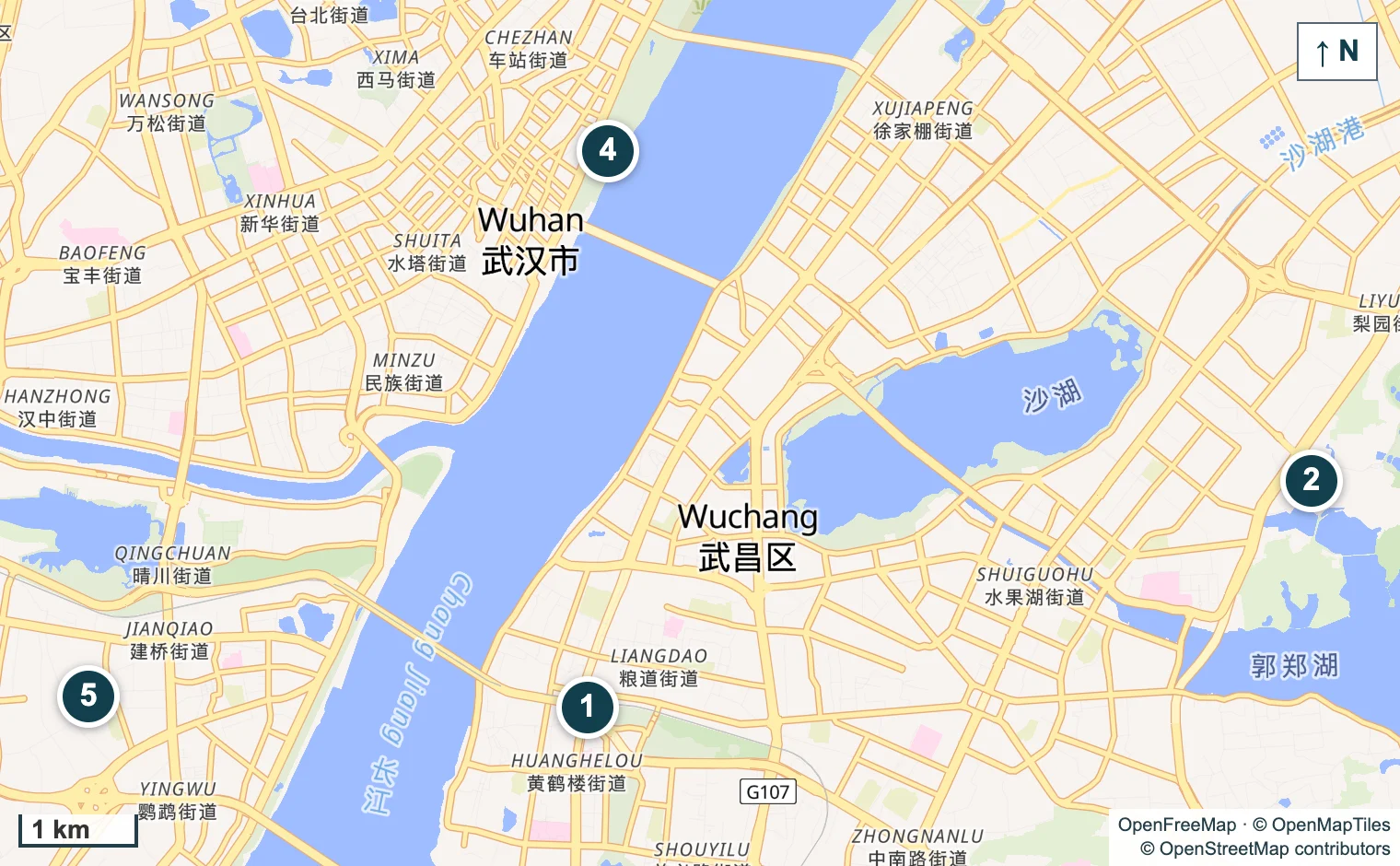
Selected locations only. The numbered choices occupy different parts of Wuhan: Yellow Crane Tower and Hubei Provincial Museum in Wuchang, Hankou Riverfront north of the river junction, and Guiyuan Temple in Hanyang. River crossings require a transport plan; no walking route is drawn.
1. Yellow Crane Tower · 黄鹤楼 — Place reference, not a verified entrance. Map source
2. Hubei Provincial Museum · 湖北省博物馆 — Place reference, not a verified entrance. Map source
4. Hankou Riverfront · 汉口江滩 — Phase I reference within the riverfront. Map source
5. Guiyuan Temple · 归元禅寺 — Place reference, not a verified entrance. Map source
Open full-size map ↗ · Numbers match the guide; letters mark travel references. Locations are approximate place references, not verified gates, walking routes or journey times.
Choose spring or autumn for more comfortable walking; summer calls for early outdoor visits, an indoor midday block and less ambitious distances. A cherry-blossom visit is a separate seasonal choice, not a guaranteed feature of this city plan. Keep the provincial museum reservation as the fixed point and arrange the other outings around it.
How long to stay and what to combine
Choice and time
Plan and conditions
Default: three nights, two full days, one hotel.
Arrive, leave bags and make the first evening a nearby meal. Put the confirmed Hubei Museum session on the first full day when available; use the other day for the tower and Hankou. Do not make the arrival flight and a hard-to-replace museum slot depend on one another.
Museum and lake:
use a morning museum reservation, eat on that side, then take a short Tingtao lakeside walk in daylight if weather and energy allow. Return to the hotel before dinner. If you book an evening museum session instead, put the daylight lake walk and meal first, then return to the hotel after the museum. This day is about the collections and water, not completing the whole East Lake area.
Tower and Hankou:
visit Yellow Crane Tower in a substantial morning block. After lunch and a break, cross to Jianghan Road and the Hankou riverfront; fit Jiqing Street food into that same bank. Return to your original hotel after dinner.
A shorter stay:
keep the museum if booked and choose either the tower or a long Hankou evening. A longer stay can add Guiyuan or Tanhualin with its current entry conditions checked.
Two nights:
two separate Wuchang blocks require an early arrival that leaves a usable half-day after reaching the hotel and leaving your bags. Use that arrival half-day for the tower and keep the confirmed museum session plus a short Tingtao walk on the full day. Keep departure sightseeing on the hotel side of the river, with the bag-collection and onward-travel allowance protected. If the arrival day does not leave that half-day, choose either the museum-and-lake block or the tower. Use the arrival or remaining evening for Hankou food and the riverfront. Qingchuan fits only if its opening and your hotel timing align. Stay in the same room.
With a fourth night, or instead of a main visit:
choose Guiyuan for Buddhist sculpture or Tanhualin for buildings and cafés, then leave a slower half-day for weather or museum queues. Do not turn both optional choices into obligations.
Rain / Monday:
the museum is the main indoor option only when open and booked. Monday is not a safe automatic museum day. Use a short shopping-street outing and seated meal, or change the order of the stay; do not substitute a closed cultural building with another unconfirmed one.
All visit and transfer allowances here are editorial planning estimates, not measured journey guarantees or operator cutoffs. Start with the four core choices below, then add according to interest.
A named base and the right beds
Holiday Inn Wuhan Riverside · 武汉晴川假日酒店
The operator's Chinese property page gives 湖北省武汉市汉阳区晴川大道3号. Choose it for the Hanyang river setting and proximity to Qingchuan Pavilion. The tradeoff is taxi journeys to the provincial museum and Hankou food streets; this is not a hotel directly outside every major sight or a promise of a metro entrance at its door.
The actual room catalogue lists 2 Twin Beds and 1 King Bed among its room options. Two friends should select the exact two-twin category; a couple can select a king. “Hollywood Twin” is a different label, so do not use it as proof of separated beds. A catalogue is not availability for your dates, and neither a river view nor breakfast is included in every rate.
Before paying, send an enquiry within your original reservation if messaging is offered; otherwise use the property's published front desk, +86 27 8471 6688. Confirm the exact bed setup, all guests' passport details, arrival time and bag storage before check-in and after checkout. We have not made a booking or tested passport check-in. Keep the written reply with the reservation.
We are two guests with foreign passports. Please confirm two separate single beds / one large bed, luggage storage before check-in and after checkout, the vehicle entrance and the latest bag-collection time.
Eat locally without making food another expedition
Give the Hankou evening a definite dinner stop: Shang Palace at Shangri-La Wuhan, 汉口建设大道700号2层, lists Wuhan dishes alongside other Chinese regional cooking. Its named 楚灶小火炆牛肉 is slow-braised beef; two diners can start with this, a vegetable dish and rice, checking the portion and total on the current menu. Take a taxi from the Jianghan Road area rather than assuming it is part of the riverfront walk. The hotel’s restaurant page supplies the reservation contact.
For a shorter Hanyang return: the selected Holiday Inn’s Riverview Terrace lists Wuhan specialties and outdoor dining at the hotel. Use it when weather is suitable and the kitchen confirms service; request an indoor hotel dining option in rain. No specific Wuhan soup is promised on that restaurant’s current menu.
Breakfast: try 热干面 (hot dry noodles), then choose 豆皮 or 汤包 if you want something more substantial. Hot dry noodles commonly use sesame sauce; fillings, broth and allergens vary by stall. Ask explicitly rather than treating a meatless-looking bowl as vegetarian. A seated breakfast at the hotel is the fallback before an early museum reservation; you do not need to cross the river to earn an “authentic” breakfast.
Hankou: the city's Jiqing Street account names hot dry noodles, soup dumplings, doupi and thick fish-noodle soup among the local foods. Use 吉庆街 as a food stop with #7, check the menu and price before ordering, and choose a busy operating kitchen that can explain your ingredients. It is a district recommendation, not a claim that every stall is open or equally good.
A local dish to recognise:莲藕排骨汤 (lotus-root and pork-rib soup) is a useful dish to ask about; it is not vegetarian. Order modestly for two and confirm portion sizes. If a queue will consume your remaining evening, use another open restaurant or the hotel's available dining option after checking its kitchen hours.
If something fails: no museum slot → Tingtao and a shorter Wuchang walk; no temple confirmation → Qingchuan after confirming its admission; riverfront closure → Jianghan Road and dinner; heavy rain/heat → shorten the outdoor block and return to the hotel. Preserve the reserved attraction and departure margin, not the number of stops.
Core choices: choose from these first
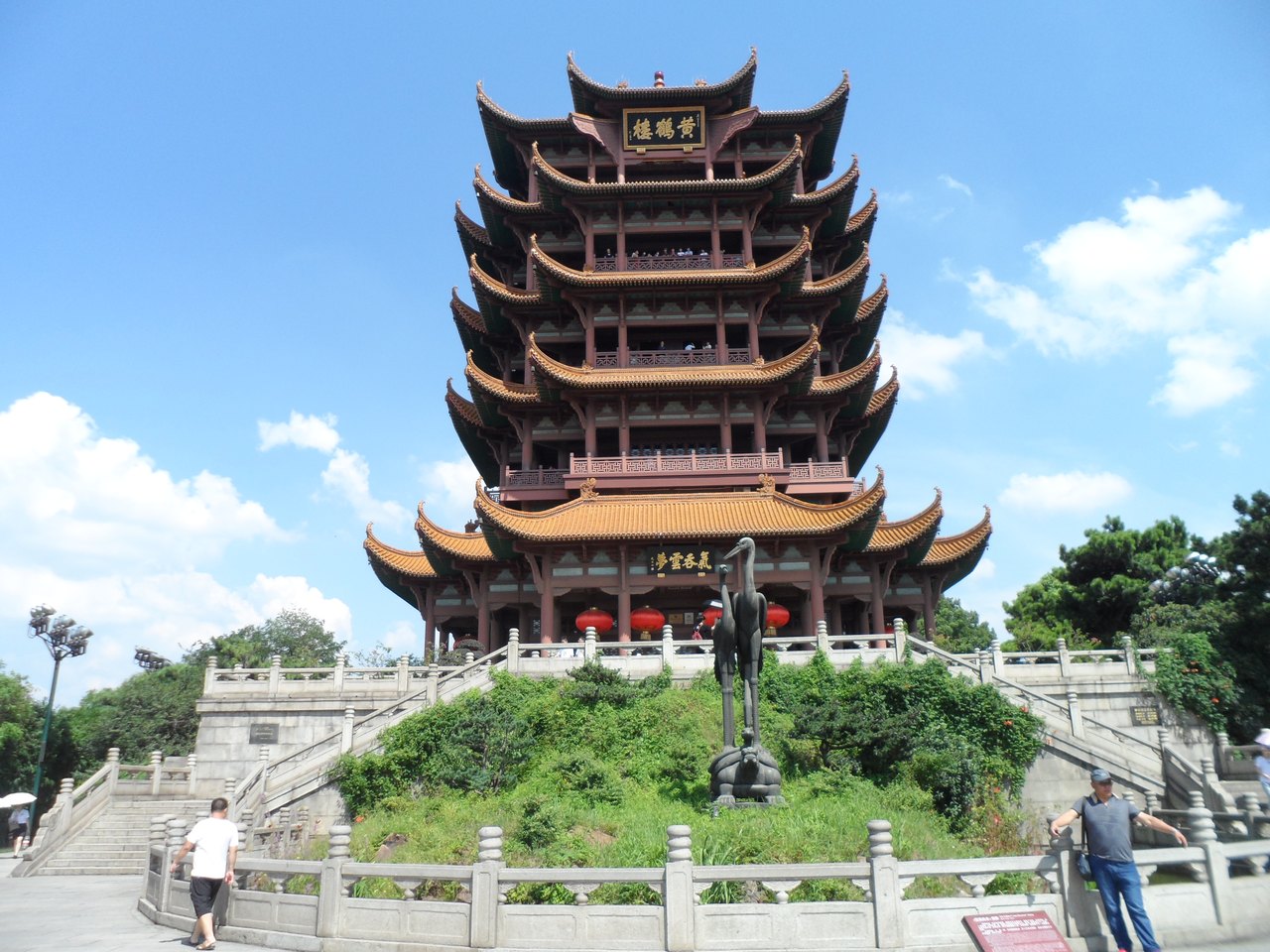
1. Yellow Crane Tower · 黄鹤楼
The essential elevated view, with poetry and rebuilding history behind the landmark.
From the tower, the Yangtze, its bridges and the dense city become a single landscape. The building you climb is a modern reconstruction, opened in 1985; the long literary tradition belongs to successive towers. The cultural exhibition at the east-gate visitor centre explains those changes through old photographs, objects and poetry. Visit it before the ascent if you want more than a skyline photograph. Allow time to stop in the park and look back at the building; climbing every level is optional.
The city visitor page lists 08:00–18:40 April–October and 08:00–17:40 November–March. These are opening hours, not a verified last-entry time. Choose a morning visit and check the park's dated admission notice before a late arrival.
Tickets
Standard daytime admission is CNY 70 in the 2026 municipal tariff. Night visits are separate products. A park announcement carried by the city allows ordinary onsite purchase without advance real-name reservation, subject to capacity; carry your passport for any concession/document check. Overseas online checkout was not tested.
Time
2–3 hours including the park; an editorial allowance
Chinese address
湖北省武汉市武昌区武珞路1号,黄鹤楼公园;文化展示馆在东门游客服务中心。
Getting there
Taxi from the Holiday Inn Wuhan Riverside base to 黄鹤楼东门游客服务中心. Confirm the legal drop-off and final pedestrian approach with the driver; a tower-centre map pin is not a road entrance.
How to visit
Hotel → east visitor approach → cultural display if open → park and tower → signed visitor exit → lunch in Wuchang → #8 if energy permits → taxi to the same hotel. Do not add a river crossing on foot merely to connect the photograph spots.
2. Hubei Provincial Museum · 湖北省博物馆
The strongest indoor choice: bronze music, the Goujian sword and the cultures of ancient Hubei.
Give the museum a substantial half-day. The museum's account of its permanent galleries identifies the Marquis Yi of Zeng, the Sword of Goujian and Eight Hundred Years of Chu among its central displays. Start with the bronze bells and their ritual setting, then choose the sword or a broader Chu gallery. A famous object can mean a queue; seeing fewer galleries carefully is more rewarding than rushing through every room. A bell performance is an optional separate experience, not included automatically with admission.
Hours
The museum's extended-hours notice sets the regular schedule from October 2026: Tuesday–Friday 09:00–17:30, last entry 16:30; Saturday–Sunday 09:00–20:30, last entry 19:30; national public holidays 08:30–21:00, last entry 20:00. Mondays normally close outside public-holiday arrangements. Your booked session and any later museum notice take priority; extended hours do not allow entry without the required reservation.
Tickets
General admission is free with a timed real-name reservation. Use the official 湖北省博物馆 account or museum visitor service. It explicitly supports passports: take the original booked passport and reservation QR to staff. A failed form is not a walk-in entitlement; call +86 27 8671 6789 before travelling. Bell performances cost extra; confirm availability after securing museum entry.
Time
3–4 hours; add a separately booked performance only if wanted
Chinese address
湖北省武汉市武昌区东湖路160号,湖北省博物馆南门;按省博路游客入口指引。
Getting there
Taxi to 湖北省博物馆南门, not the north luggage-storage gate. The museum also directs Metro Line 8 users to 省博湖北日报站 Exit A, then via 黄鹂路 and 省博路. Leave large bags at the hotel by prior agreement.
How to visit
For a daytime reservation: same hotel → south visitor gate → booked galleries → signed exit → a short #3 lake walk while it is still daylight, if weather and energy suit → taxi back to the same room. With an evening museum reservation, walk by the lake beforehand or leave it out, then return directly to the hotel after the museum. If reservation fails, use the lake and another open-air choice; do not pay an unofficial seller for a supposedly guaranteed museum slot.
3. East Lake: Tingtao shore · 东湖听涛景区
Choose a lakeside walk after the museum, rather than trying to cover the entire East Lake system.
Tingtao offers water, trees, low pavilions and views across the lake: a different rhythm from the tower and busy river port. The city's East Lake introduction describes a much larger network of scenic areas and greenways. For this first visit, stay on one shore and turn back when ready. Moshan, the botanical garden and distant greenway sections are separate outings; a general East Lake pin can send you far from the museum-side walk you intended.
Hours
Plan daylight access and follow notices at the open visitor entrance. A current all-gates timetable was not established; this route does not depend on late-night park access, boat departures or a full greenway circuit.
Tickets
The municipal tariff lists Tingtao as free. Boats, cycle hire and other attractions have separate charges and operating conditions; none is necessary for this walk.
Time
1–2 hours for a short shore walk; longer circuits are separate plans
Chinese address
湖北省武汉市武昌区沿湖大道,东湖听涛景区;向司机说明听涛,不是磨山。
Getting there
From the museum, use a live pedestrian route to an open Tingtao entrance or take a short taxi if tired. Save the entrance/pickup pin before walking; do not assume every lakeside gate admits cars.
How to visit
Museum exit or hotel → confirmed open Tingtao entrance → short lakeside out-and-back → same entrance → licensed taxi → same hotel. In heat, heavy rain or thunder, shorten or skip the walk instead of relying on a boat to return.
4. Hankou Riverfront · 汉口江滩
See Wuhan as a working river city, at water level rather than from a tower.
The broad Yangtze, passing vessels and opposite-bank skyline are the reason to come. The city's riverfront description places this public landscape beside Yanjiang Avenue and the Jianghan Road area. Walk a modest section, sit when a view appeals, then return to a known exit. The riverfront is extensive; reaching its far end brings little benefit on a short stay. This is also a flood-management landscape, so barriers and closure signs take precedence over a scenic route.
Hours
Use an open signed pedestrian gate in daylight or early evening. Event controls, high water and weather can close sections; this guide does not promise round-the-clock access or a particular light show.
Tickets
The plan uses public riverside paths, without a cruise or paid attraction. If access is restricted, stay on the permitted city-side streets; an event reservation or boat ticket is a separate product.
Time
45–90 minutes; turn back before the walk becomes a transport problem
Chinese address
湖北省武汉市汉口沿江大道,汉口江滩开放游客入口;江汉路附近开始短程散步。
Getting there
Combine with #7 on foot using crossings and the nearest open riverfront gate. From the hotel, take a taxi to the agreed Yanjiang Avenue drop-off, then walk; cars cannot take you along the promenade.
How to visit
Hotel → #7 street and meal → open riverfront gate → short bank-side walk → return to Yanjiang Avenue → permitted pickup → same hotel. If the riverfront closes, retain the street walk and meal; do not cross a flood barrier.
Interest-led choices
5. Guiyuan Temple · 归元禅寺
An interest-led Hanyang visit for Buddhist sculpture and a living place of worship.
The city's temple introduction highlights the hall of five hundred arhats. Look at the figures' differing poses and expressions rather than treating the hall as a quick counting game. Open courtyards and halls make a quieter contrast to the big river views, though religious holidays can be extremely busy. Give worshippers space, follow the temple's photography rules and keep donations separate from admission. Choose this for an interest in religion or sculpture; it is not essential merely because you are sleeping in Hanyang.
Hours
Current ordinary opening and last-entry hours were not confirmed from an accessible temple-issued schedule. Plan a morning only after checking the verified 武汉归元禅寺 WeChat account; festival timetables are not the normal calendar.
Tickets
Check the same official account for the dated admission product and passport procedure. A city-published festival notice establishes that channel, but its CNY 20 festival price and online-only arrangement do not establish today's ordinary tariff. If you cannot confirm entry/payment, choose #6 instead; do not travel expecting a guaranteed cash counter.
Time
1–1½ hours, excluding a religious-holiday queue
Chinese address
湖北省武汉市汉阳区归元寺路20号,归元禅寺。
Getting there
Taxi from the Hanyang hotel to the currently permitted drop-off near 归元寺路; finish on foot following the temple signs. Allow extra approach time if streets around the temple are controlled.
How to visit
Hotel → admitted temple entrance → open halls and arhat display → signed exit → seated Hanyang lunch → hotel. If services restrict the relevant hall, respect the closure and shorten the visit.
6. Qingchuan Pavilion · 晴川阁·武汉大禹文化博物馆
A compact Hanyang choice for river architecture and the story of controlling water.
The pavilion and neighbouring structures frame the river at close range. The reopening account describes a copy of the historic Jianghan panorama in the main hall and an exhibition on water management in Tiemen Gate. Look from the painted city to the river outside: the relationship between hills, bridges and water is the point. The painting here is a copy, not the original. This is an easy cultural addition near the hotel, or a shorter alternative to a second large attraction.
Hours
The March 2026 reopening notice lists Tuesday–Sunday 09:00–17:00, last entry 16:30. The standing operator page also mentions Thursday closure at 15:00; use a morning visit and confirm current access if Thursday is your only option.
Tickets
Daytime entry is free. The reopening notice says reservation, while the standing page says registration at the gate. Ask the operator for the current passport procedure at +86 27 8471 0887. Night admission is separately charged and unnecessary for this plan.
Time
1–1½ hours
Chinese address
湖北省武汉市汉阳区洗马长街86号,晴川阁(武汉大禹文化博物馆)。
Getting there
Ask the Holiday Inn desk for the open pedestrian approach to neighbouring 晴川阁. Use public pavements and the museum gate, not an assumed hotel-to-museum shortcut.
How to visit
Hotel → museum visitor gate → pavilion and open water-history display → same signed exit → hotel or Hanyang meal. If entry is unavailable, keep a short permitted riverside walk and return to the hotel; no cross-city replacement is needed.
Along the way: match the riverbank
7. Jianghan Road and a Hankou meal · 江汉路步行街
An easy addition for commercial architecture, busy street life and local food.
Look above the shop signs: the façades give this shopping street its character. The city commerce bureau describes Jianghan Road as a historic commercial district, with Jiqing Street nearby as a food-focused counterpart. Choose this if you enjoy a lively urban walk; it is a functioning retail area rather than a preserved, silent old town. It pairs well with #4, not with an extra taxi across the river between every stop.
Hours
Public-street walking has no single museum timetable; individual shops and restaurants set their own hours. Choose late afternoon into dinner for this combination, and check the kitchen before sitting down late.
Tickets
No attraction admission is needed for the public street walk. Meals, shops and building interiors are separate; seeing a historic façade does not grant access upstairs.
Time
1–2 hours plus a meal
Chinese address
湖北省武汉市江汉区江汉路步行街(中山大道至沿江大道一带);吉庆街在相邻汉口街区。
Getting there
Taxi to a vehicle-accessible end of 江汉路步行街, or use the 江汉路 metro station and follow signs to the street. Agree the pickup outside the pedestrian section, not at a shop doorway.
How to visit
Hotel → Jianghan Road architecture walk → meal, with Jiqing Street as a deliberate short extension → #4 if its gates are open → street-side pickup → same hotel.
8. Tanhualin · 昙华林
A Wuchang add-on for historic school, hospital and residential buildings among cafés and shops.
The city's neighbourhood account describes a compact concentration of former churches, schools, hospitals and houses. Read the building plaques and compare the different façades; the interest lies in how this quarter connected education, medicine and cultural exchange. Modern cafés and souvenir shops are part of today's street. Choose it after the tower if you still want to walk, but skip it if shopping streets feel repetitive after Hankou.
Hours
Visit by daylight to read plaques and see the buildings. Streets, private businesses and small exhibitions do not share one opening schedule; interior access is optional and must be checked at each door.
Tickets
The proposed public-street walk needs no bundled attraction ticket. An exhibition, café purchase or hill ride is a separate choice; do not buy a package merely to see the neighbourhood.
Time
1–1½ hours, longer with a café stop
Chinese address
湖北省武汉市武昌区昙华林历史文化街区(昙华林街)。
Getting there
From Yellow Crane Tower, take a short taxi to the legal drop-off for 昙华林, then walk into the quarter. With a live map and enough energy, a longer Wuchang street walk is possible, but it is not included in the sight time above.
How to visit
#1 or hotel → public neighbourhood entrance → short plaque-and-façade walk → drink or meal → return to a vehicle-accessible street → taxi to the same hotel. Leave residential courtyards and closed buildings alone.
Budget for two riverbank days
Add two CNY 70 Yellow Crane Tower entries to the CNY 2,770 example below: the default stay totals CNY 2,910 for two adults. The museum reservation remains necessary; a separate performance or other paid outing is extra.
Worked planning allowance for two adults sharing one room: 3 nights × CNY 450 for the room + 4 calendar days × 2 people × CNY 140 for food + CNY 300 for city transport = CNY 2,770 before attraction tickets and travel into or out of the city. These are editable spending assumptions, not researched room rates, restaurant quotations or a minimum budget. Breakfast is included in the food allowance even when a room package may cover it. Replace the room and transfer inputs with the offers you actually book.
Keep a taxi allowance for river crossings and the dinner return. Hubei Museum’s entry and any separate performance are different decisions; the tower and other paid choices need their own tickets. Each total above already includes the tickets named for that example. Replace those ticket amounts with the current prices for your actual visitors; add only visits or extras not already included. Do not add the same ticket twice. A shared restaurant meal can use a large part of one day’s food allowance; keep a noodle lunch or raise the allowance rather than treating every meal as a hotel dinner.
Reserve the visit that fixes the day
Settle the Hubei Museum session before assigning the museum day, using its booking and passport instructions in the sight entry. Prefer a morning slot for the museum-then-lake sequence; an evening slot needs the lake walk beforehand or omitted. Then book three nights in the same room and your exact train station or airport. Check any separate bell-performance ticket rather than assuming entry includes it. The tower can stay on the other full day; a missing museum slot changes the programme to the lake and city, not an unofficial ticket purchase.
Arrive, leave the bags, return and depart
For a mountain-led Hubei stay, open the Wudangshan guide. Choose its actual arrival station, scenic transport, admission products and overnight base before adding the mountain beyond these Wuhan city days.
For another Hubei stop, compare Yichang with Xiangyang. Yichang needs its own river and land-trip decision, while Xiangyang offers a separate historic-city stay. Match the booked station and next hotel and allow a new stay, rather than fitting either into a Wuhan departure morning.
Arrival: check whether your ticket says 武汉天河国际机场 (WUH), 汉口站, 武昌站 or 武汉站. These are different arrival points. At the airport, use the signed official taxi rank for the hotel with luggage; the city transport introduction also identifies the airport's rail/metro connections, but its old timetable is not a current last-service promise. Show the full Chinese hotel address, confirm the entrance and ask for the meter/receipt. At a station, follow the official taxi signs rather than accepting an unsolicited car in the concourse.
The complete stay: arrival point → named hotel → document/room confirmation → leave bags only after staff accept them → reserved museum or selected same-bank outing → meal → return to the same hotel and room. On departure morning, check out and agree the bag-collection deadline; finish with #6 near this hotel if it is open, or a seated meal. Return for the bags before the onward transfer.
Flight departure budget: from collecting bags at this Hanyang hotel, reserve roughly 3½ hours before a domestic flight or 4½ hours before an international flight: an editorial 90-minute road/queue allowance plus two or three hours at the airport. Add time for collecting bags before that. These are planning buffers, not airline rules; use a larger allowance if the airline requires it, the driver reports congestion or a holiday affects bridges.
Rail departure budget: plan to collect bags about two hours before a train from 武汉站, or at least 90 minutes before 汉口站 / 武昌站, then go directly. These are editorial starting budgets including a station-arrival margin, not guaranteed taxi durations. Ask the hotel to check the live road route the previous evening and again before leaving; earlier is sensible with mobility needs or severe traffic. The ticket's station name and railway gate cutoff control the journey.
Do not finish at East Lake on the assumption you can collect bags in Hanyang and reach a far station quickly. Keep the departure outing on the hotel side of the river, with an easy cancellation option. For document and station procedure, use our train booking and issued-ticket guide.
Keep the weather on your side
Hot, humid afternoons favour a museum or hotel break between outdoor blocks. Rain and strong river wind make a shorter waterfront visit more useful than an extended crossing for a view. On the museum’s closed day, swap the full days and retain the same base. The fallback choices in the food section preserve a worthwhile visit without depending on an unconfirmed gate.
Sources and what still needs checking
For a separate nature-led Hubei stay, open the Enshi guide to plan a canyon day and city visits. Allow its own nights, transport and return rather than adding it to a full Wuhan day.
For a separate stop, use the Jingzhou guide to choose visits, a hotel base and arrival and departure arrangements. Give the selected destination its own travel time and nights rather than adding it to an already full sightseeing day.
Shang Palace’s address, Wuhan cuisine and named beef dish, and Holiday Inn’s dining venues, were checked on using the linked hotel pages. Restaurant service, table availability and prices were not transaction-tested. Other factual check dates remain those below.
Hubei Museum's regular weekday, weekend and national-holiday hours were checked on against its 29 September extended-hours notice, effective from October. This newer notice replaces the hours in the older English visitor guide; it does not replace the reservation requirement. No booking or evening visit was tested.
Other factual checks date to 5 October 2026 against the linked museum, park, city and hotel pages. The strongest dated references are the 2026 municipal tariff, museum visitor guide, city tower guide and Qingchuan reopening notice. Older pages are used for geography, cultural context or an identified contact channel, not as proof of current transport timetables or festival prices.
Guiyuan's ordinary tariff/hours, Qingchuan's conflicting reservation instructions, same-day gate access, live road times, room availability and hotel bag arrangements still require the specific checks above. No passport purchase, hotel stay or walking route was tested onsite. Prices exclude transport, food and optional activities. There are no affiliate booking links.