HUANGSHAN · 黄山 · GRANITE PEAKS AND HUIZHOU VILLAGES
Huangshan: choose your mountain walk before your hotel
Choose the mountain experience before the hotel: a day walk needs two lowland nights; a summit night needs three nights and two usable mountain days. Start from Tangkou, compare a shorter upper route with a full crossing, and decide how much stair walking you want. A cableway helps with the initial ascent but does not turn the summit into a level viewpoint. Add Huizhou villages on a separate day.
Two full mountain days / three nights for an unhurried overnight crossing. Add one full day and a night for villages.
Sleep
Tangkou before ascent; a true summit hotel for sunrise; Tunxi for city food and departure.
Arrange
Mountain date, entrance and session; separate cableway directions; the exact hotel room and return transport.
Which places fit your visit?
For a first mountain visit, start with the granite peaks and pine-framed upper paths. Choose the shorter out-and-back if steps or time are limiting; choose a crossing with a summit night if lingering on the mountain matters more than seeing more towns. Treat the canyon as a demanding branch to select deliberately. Tunxi and the villages offer a different, lower-altitude part of the trip.
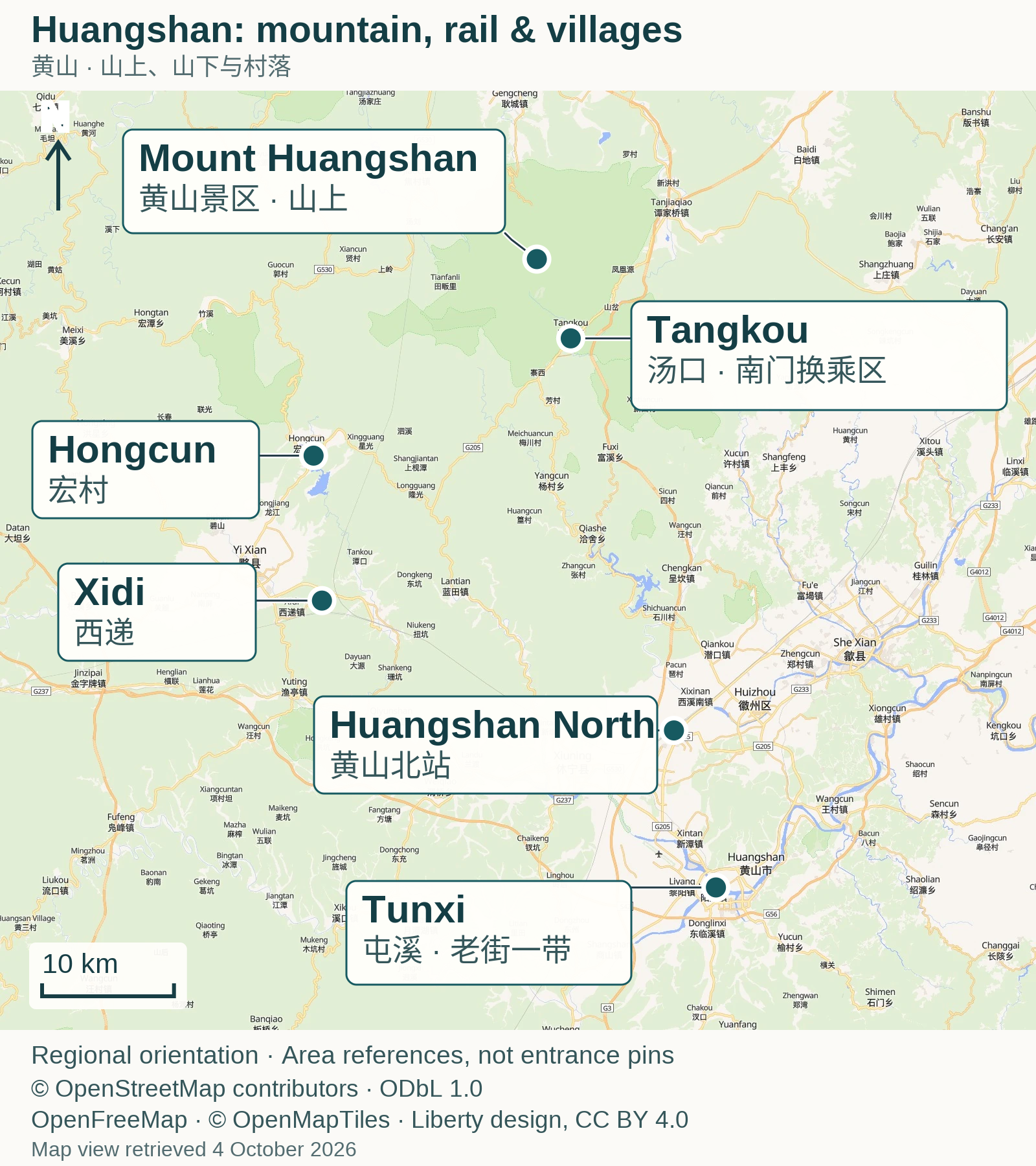
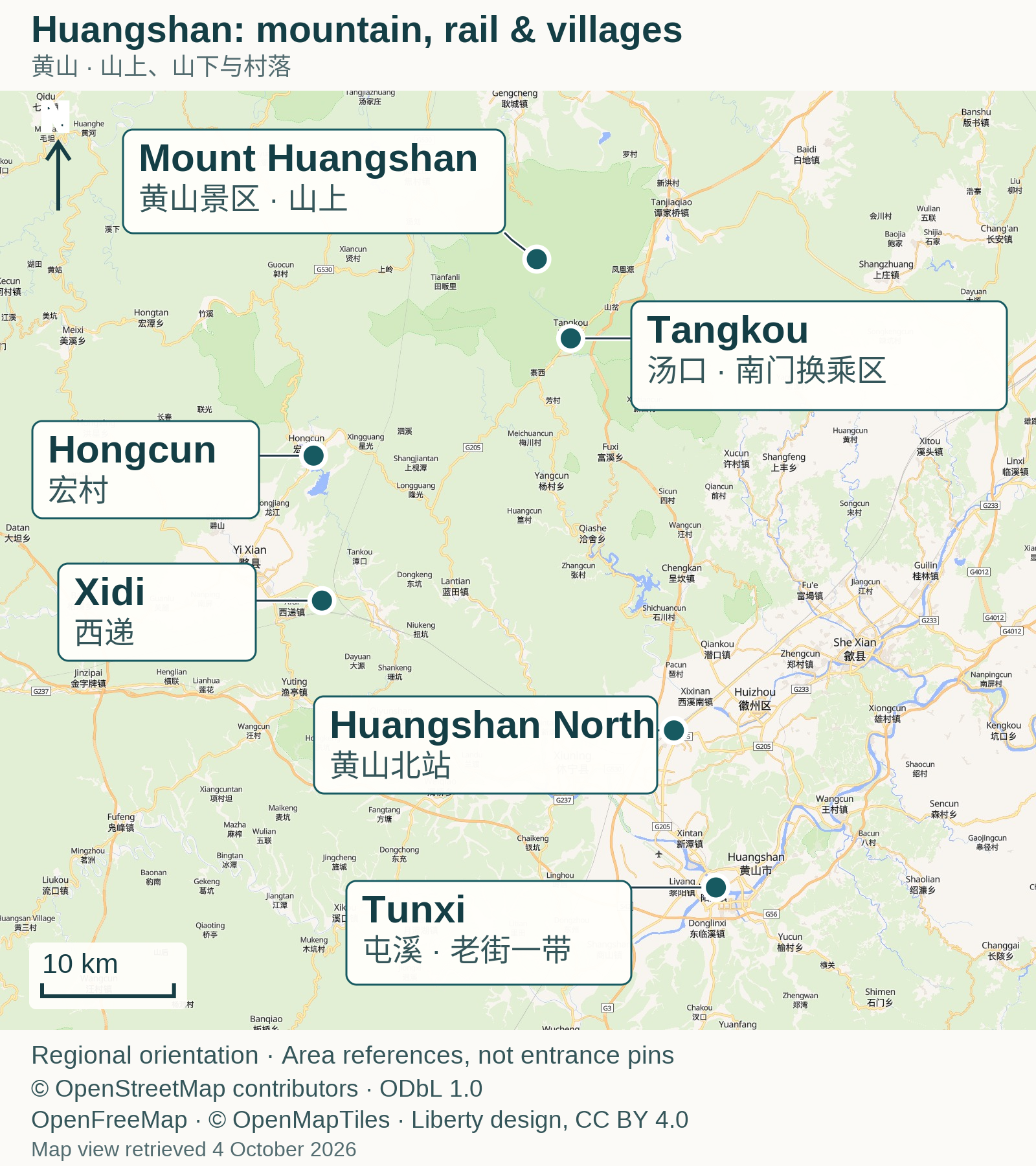
The first five are within Huangshan Scenic Area. Tunxi is the lowland city; Hongcun and Xidi are separately ticketed villages in Yi County. Choose a coherent route rather than trying to fit all eight into two days. Walking and road times below are editorial allowances, not measured journeys or guaranteed schedules.
Start here: The core mountain areas
Add by interest: Add one demanding mountain experience
For a specific interest: Stay lower or extend into Huizhou
Two mountain days and a Baiyun night spread the walking and allow a sunrise attempt. Add the canyon only when its exit is operating.
Count full days, then place the nights
One mountain day / two nights: arrive and sleep in Tangkou, use the full following day for a shorter out-and-back or a fit walker’s crossing, then sleep in Tangkou again. This avoids making the last cableway and a fixed evening train part of the same deadline.
Two mountain days / three nights: Tangkou before ascent → one summit night → Tangkou or Tunxi after descent. The hotel divides the walk and creates a sunrise opportunity. It does not guarantee clear skies. A late arrival and an early departure belong outside those two usable days.
Add a village day / one more night: fit Hongcun or Xidi after descent, when you can start the next morning with rested legs. Two villages work in one full road day; one village allows longer inside houses and around the lanes. Keep Tunxi Old Street as a city evening, not another full excursion.
A complete three-night plan
This is the default for two adults comfortable with sustained stair walking, sharing a private room. It uses the central route, keeps the canyon optional and leaves departure until after the mountain. Meal and walking blocks are editorial planning allowances; your entry session, weather and confirmed hotel service control the final timing.
Arrival day · sleep in Tangkou. Arrive at 黄山北站 or TXN, transfer to the Tangkou hotel and check in. Eat dinner near the bed, buy water and a packed lunch, and arrange the morning transfer plus suitcase storage until the afternoon after the summit night. Verify both mountain entry and Baiyun room confirmations before sleeping. If a late flight makes this transfer unreliable, sleep in Tunxi and add a lowland night before starting the two mountain days.
First full day · sleep at Baiyun on the mountain. Have breakfast before the early reserved entry, or use a takeaway arranged the night before. Take the South Gate shuttle for Yungu, ascend, then visit Shixin and selected Beihai viewpoints. Eat the carried lunch at a permitted resting place. Continue by the central Guangmingding–Tianhai path and check in at Baiyun; do not combine this default with Tiandu. Have dinner at the hotel and ask reception for a short, currently open sunset or sunrise option. Choose the canyon approach instead only if its funicular, your entry time and the hotel arrival margin all fit.
Second full day · sleep in Tunxi. Attempt a nearby sunrise walk only if the hotel advises that conditions and paths are suitable, then return for breakfast and checkout. Follow Tianhai → Haixin → Aoyu → the open Lotus bypass → Guest-Greeting Pine → Yuping cableway. Carry lunch or eat before the longer descent, without extending the walk to find a restaurant. Shuttle to Tangkou, collect the suitcase, then take the agreed car to Tunxi. After check-in and rest, choose a short Old Street walk with dinner, or eat at the hotel if tired; skip the extra walk after a delayed descent.
Departure day. Breakfast, checkout, then the booked transfer to the exact rail station or TXN with the margin below. For a four-night trip, turn this into a full Hongcun or Hongcun-and-Xidi road day, return to Tunxi for the additional night, and depart the following morning. A village morning belongs before a train only when its fixed return leaves a substantial buffer; it is not part of the three-night default.
For the two-night version: keep the arrival night in Tangkou, use the shorter Yungu return on the full day, eat dinner and sleep in Tangkou again, then leave after breakfast. This removes the summit room and its overnight bag, without placing a last-cableway deadline against an evening train.
If the mountain forecast is uncertain, an extra lowland night gives room to move the ascent. Keep the mountain ticket, hotel cancellation terms and return journey aligned before swapping dates. A village is an alternative in ordinary low cloud, not a safe substitute during a severe-weather warning.
Three bases with very different journeys to bed
Tangkou / South Gate · 汤口、南大门
The practical first-night base for Yungu or Yuping. Stay near the Zhaixi transfer centre or confirm the hotel’s morning transfer. A room elsewhere in Tangkou can still require a car ride. Leave the large bag here by arrangement and carry a small overnight pack uphill.
On the mountain · 山顶
Choose the hotel on the walking route. Baiyun at Tianhai works for a crossing and a canyon ascent by funicular. It is reached on foot, even after taking a cableway. Do not arrive late expecting a car to deliver you to reception.
Tunxi city · 屯溪
Choose for food, Old Street, an arrival too late for Tangkou, or the night before an early departure. Budget a substantial road journey to the mountain in the morning; a hotel labelled Huangshan city is not necessarily near South Gate.
Named hotels and rooms to compare
Mercure Mount Huangshan South Gate Transfer Center · 黄山南大门换乘中心美居酒店, 黄山区汤川路111号2号楼. A convenient Tangkou starting point with breakfast and self-service laundry. Accor lists a 27 m² Deluxe King and 30 m² Deluxe Twin, both with maximum occupancy two. For two adults and a child, get an approved room arrangement or book suitable separate rooms; do not assume the twin permits three. Accor lists check-in from noon and checkout by noon; confirm breakfast timing and the precise walk or pickup to the scenic shuttle. The hotel’s published contact is +86 559 2209888. Even its “Classic Family Room” displays a maximum of two people on the brand page; obtain a written occupancy confirmation for your party before paying.
Huangshan Bai Yun Hotel · 黄山白云宾馆, 黄山风景区天海景区. A central mountain base after #2 or the canyon. For two people wanting a private room, Trip.com lists the Area A Superior Standard Room with two single beds and its own bathroom. For three, compare the Area A Superior Triple with three singles or the specifically named Area B family room with a double plus a single. The same listing also sells gender-separated, per-person bunk beds: two bed orders do not reserve a private room. Its policies say guests from all countries/regions are accepted, check-in is after 14:00 and checkout before noon, and no cots or extra beds can be added. These are platform-listed conditions; confirm every occupant and the exact room in the order. Allow several hours on foot from an upper gate cableway to Tianhai with stops; an early mountain entry is essential. Use the official platform’s hotel service at +86 559 2590999 if the room or passport process is unclear.
Crowne Plaza Huangshan Yucheng · 黄山昱城皇冠假日酒店, 屯溪区徽州大道1号. A riverside city base after the mountain, with a separate taxi ride to Old Street. IHG lists Standard rooms with a king and a single as one option, alongside king-only and twin rooms; choose the exact bed configuration. Connecting rooms and cots are by request, and rollaways have a fee. IHG lists check-in from 14:00, checkout by noon and a minimum check-in age of 18. Confirm availability, total occupants and meals for children with +86 559 2591888 before relying on them. The brand’s transport page says an airport shuttle is not available; budget a separate taxi or confirmed paid transfer.
Book with a foreign passport and keep the bags below
Bring every guest’s original passport, including children’s, and use the booking channel’s passport-name fields. Baiyun’s seller explicitly lists international guests; the Accor and IHG pages establish rooms and direct contacts but do not prove your party’s registration or payment will succeed. Before a non-refundable payment, have the property or booking support confirm foreign-passport check-in, all occupants, arrival after a delayed flight, and the payment/deposit method. An English brand website is not evidence that a particular overseas card will work at reception.
For the summit night, agree suitcase storage with the Tangkou hotel even if you will not sleep there again; ask about any fee and the latest collection time. Keep the claim ticket and the hotel’s Chinese name, carry only the overnight pack, and collect the case after the Yuping shuttle returns to Tangkou. Do not leave the passport in the stored bag. If the summit room or registration cannot be confirmed, keep a refundable Tangkou room and the shorter out-and-back route; do not ascend expecting to solve an unconfirmed bed after dark.
Message to the property: “We are [number] adults and [number/ages] children travelling on foreign passports. Please confirm this exact room for all guests, check-in documents, arrival at [time], deposit/payment options and luggage storage until [time].” For a summit hotel also ask for the currently open approach from your chosen cableway and meal service on your dates.
Hotel names here identify useful locations and verifiable room types, not a quoted rate or tested stay. Compare the selected-date total, cancellation deadline, breakfast, extra guests and luggage arrangements. For a summit booking, secure mountain entry first and tell the hotel your intended entrance and arrival time.
Eat in the lowlands; carry enough for the mountain
Plan three different meals around the ascent. Eat a proper dinner in Tangkou before the mountain day; carry the lunch and water you need until a confirmed open stop; have the next seated dinner at the hotel where you will actually sleep. If that is a summit hotel, check its meal inclusions and last service with the room booking. If you descend to Tangkou, leave the village-food detour for another day. An early light breakfast and an accessible snack are more useful than a long restaurant hunt before your entry session.
Try Huizhou food at a seated meal in Tangkou or Tunxi: fermented mandarin fish / 臭鳜鱼 has a strong aroma; hairy tofu / 毛豆腐 is another distinctive choice. Mushroom or bamboo-shoot dishes, eggs, greens and rice make an easier order for a mixed group. Ask for the fish’s total price and size before ordering, and explain dietary restrictions explicitly; a vegetable dish may still use meat stock or animal fat.
A first Huizhou dinner for two: choose one shared fermented mandarin fish if both diners want its strong aroma, one green vegetable and rice; ask for the whole fish’s price, weight and bones before ordering. If fish is unsuitable, start with a fully cooked tofu dish, greens and rice and check the broth and sauces. Hairy tofu is fermented tofu, commonly pan-fried locally; Huangshan shaobing commonly contains preserved vegetables and pork, so ask about meat and cooking fat rather than assuming it is vegetarian. Buy tea for its flavour, not a promised health effect. These are ordering suggestions, not a set menu or an allergy guarantee.
In Tangkou, eat near your hotel before the early start. Check when breakfast opens and arrange a takeaway or buy breakfast the evening before. Purchase water and familiar snacks in town. For a Baiyun night, have the hotel confirm dinner service and last order, breakfast opening, and how many meals your selected room rate actually includes. The seller confirms a Chinese buffet breakfast and a restaurant, but we could not verify a dependable dinner timetable or that any undated room includes meals. Carry a shelf-stable backup meal and breakfast as well as the day’s lunch; do not depend on a shop opening or hot water being available. If the hotel cannot confirm adequate meals and you cannot carry suitable food, use the two-night Tangkou plan. Do not cross the mountain after dark looking for another restaurant.
In Tunxi, Old Street suits a snack stop for Huangshan baked pastries / 黄山烧饼 and tea shops. For a planned sit-down meal, the Crowne Plaza’s dining page lists Yuping Chinese Restaurant and Yuhai private dining with local Chinese/Anhui dishes. The listed Yuping lunch window is 11:00–13:30 and dinner 17:00–21:00; it is on the hotel’s first floor at No. 1 Huizhou Road, with +86 559 2599000 for enquiries. Use it after a Tunxi check-in, not as a detour before collecting the Tangkou suitcase. Confirm the current outlet, last order and table; the brand page uses more than one English restaurant name. Riverside Café is the hotel’s more familiar breakfast/dinner alternative. A late descent may miss restaurant service: ask the lowland hotel to arrange the available meal before leaving Tangkou.
Carry drinking water, an extra snack, a windproof warm layer, a light raincoat, grippy walking shoes and a charged phone/power bank. A small torch is useful for a hotel-approved sunrise walk. Buy only what you can comfortably carry on stairs and take litter out; pack essential medicines yourself rather than relying on a mountain shop.
The eight places in detail
1. Shixin Peak and Beihai · 始信峰、北海
Start here for pines growing from granite and several changing views without committing to the full mountain crossing. Shixin is the compact pine-and-peak experience; the Beihai side opens toward Qingliang Terrace and Lion Peak. These are neighbouring parts of one mountain walk, not separate gate admissions.
Hours
Visit in daylight within the mountain and Yungu operating window. Choose an early entry; lookout access can change with conditions. Allow time to walk back to the cableway before its last boarding.
Tickets
The mountain ticket covers this area. Buy Yungu up and down for an out-and-back, plus the two South Gate shuttle journeys. A crossing instead needs Yungu up and Yuping down; see the separate charges.
Time
2–3 h above the cableway; most of a day with both transport chains
Chinese address
黄山风景区始信峰、北海景区;山下集合点:黄山风景区南大门寨西换乘中心(汤口镇). Shixin is on the mountain; a taxi cannot drive to it.
Getting there
Tangkou hotel → South Gate transfer centre → Yungu Temple-bound scenic shuttle → Yungu cableway → signed Shixin path. Save 云谷索道上站 as the return target; 白鹅岭 is also used around the wider eastern approach.
How to visit
Walk toward Shixin via the signed scenic path, then the Black Tiger Pine / 黑虎松 junction and Beihai. Add Qingliang Terrace / 清凉台 only if the return margin remains comfortable. Retrace toward Yungu for the shorter option; skip the Lion Peak steps when legs are tiring. For a crossing, continue inland toward #2 instead of returning to the lift.
2. Guangmingding and Tianhai · 光明顶、天海
Guangmingding gives an open, high view across several ranges rather than the close pine compositions of Shixin. Tianhai below it is where the central trails, Baiyun hotel and canyon funicular side meet. This is a useful overnight hinge, but reaching a hotel here still involves substantial walking.
Hours
Daylight for through-walking. Sunrise is practical from a confirmed mountain hotel, with the hotel’s current advice on open paths and the morning’s conditions; ground-level cableways do not provide a pre-dawn arrival.
Tickets
Covered by mountain admission. Arriving from the canyon adds the funicular fare. Staying at Baiyun is a separate hotel booking, and does not itself reserve scenic-area admission.
Time
1–2 h around the summit and Tianhai, plus long approach walks
Chinese address
黄山风景区光明顶、天海;住宿定位:黄山白云宾馆(山顶天海景区). Distinguish this mountain hotel from similarly named accommodation down in town.
Getting there
From #1 follow the signed Beihai–Guangmingding connection, then descend toward Tianhai / Baiyun. From the canyon, the funicular arrives on the Tianhai side; Guangmingding is an additional uphill walk.
How to visit
Take the panorama at Guangmingding, then descend to Tianhai for a meal or your hotel. For the southern exit continue via Haixin Pavilion / 海心亭 and Aoyu Peak / 鳌鱼峰 toward #3. Make the decision here: if the remaining walk and Yuping boarding window no longer fit, speak to staff about an available operating exit or accommodation before continuing.
3. Yuping and the Guest-Greeting Pine · 玉屏、迎客松
Choose Yuping for the spreading Guest-Greeting Pine and its mountain backdrop. It makes a focused lift-assisted outing or the southern finish of a crossing. The viewpoint is often busy: allow time to look beyond the main photo queue.
Hours
Use the Yuping cableway window. The summit path between the lift and pine takes time in both directions. Lotus Peak / 莲花峰 remains closed for ecological rotation in the operating notice; the route uses the open bypass.
Tickets
Included in mountain admission. For a focused visit buy Yuping in both directions; for the northern-to-southern crossing buy only the descent. Tiandu is a separate reservation within the mountain, not an automatic extra on a Yuping cableway ticket.
Time
1–2 h for the pine area and lift approach; longer for the central crossing
Chinese address
黄山风景区玉屏景区迎客松;山下乘车方向:玉屏索道/慈光阁方向. Use the South Gate transfer centre rather than trying to drive to the pine.
Getting there
From Tangkou take the scenic shuttle for the Yuping cableway approach and ascend. Allow roughly 30–60 minutes on steps from the upper station to the pine at a leisurely pace. From Tianhai, follow the open Aoyu–Hundred-Step Ladder–Lotus bypass route.
How to visit
Upper lift → Guest-Greeting Pine / 玉屏楼 area → same lift for the short visit. After a crossing, finish the pine visit and follow signs to 玉屏索道上站, descend, then take the shuttle back to Tangkou. Do not add Tiandu late in the afternoon or rely on a closed hiking trail as a substitute for a missed lift.
4. Xihai Grand Canyon · 西海大峡谷
Choose the canyon when you want to descend among the rock towers and see their scale from below. Its stairways give a different experience from the upper viewpoints. The commitment is the descent and the way out: the funicular carries you toward Tianhai, not back to Paiyun.
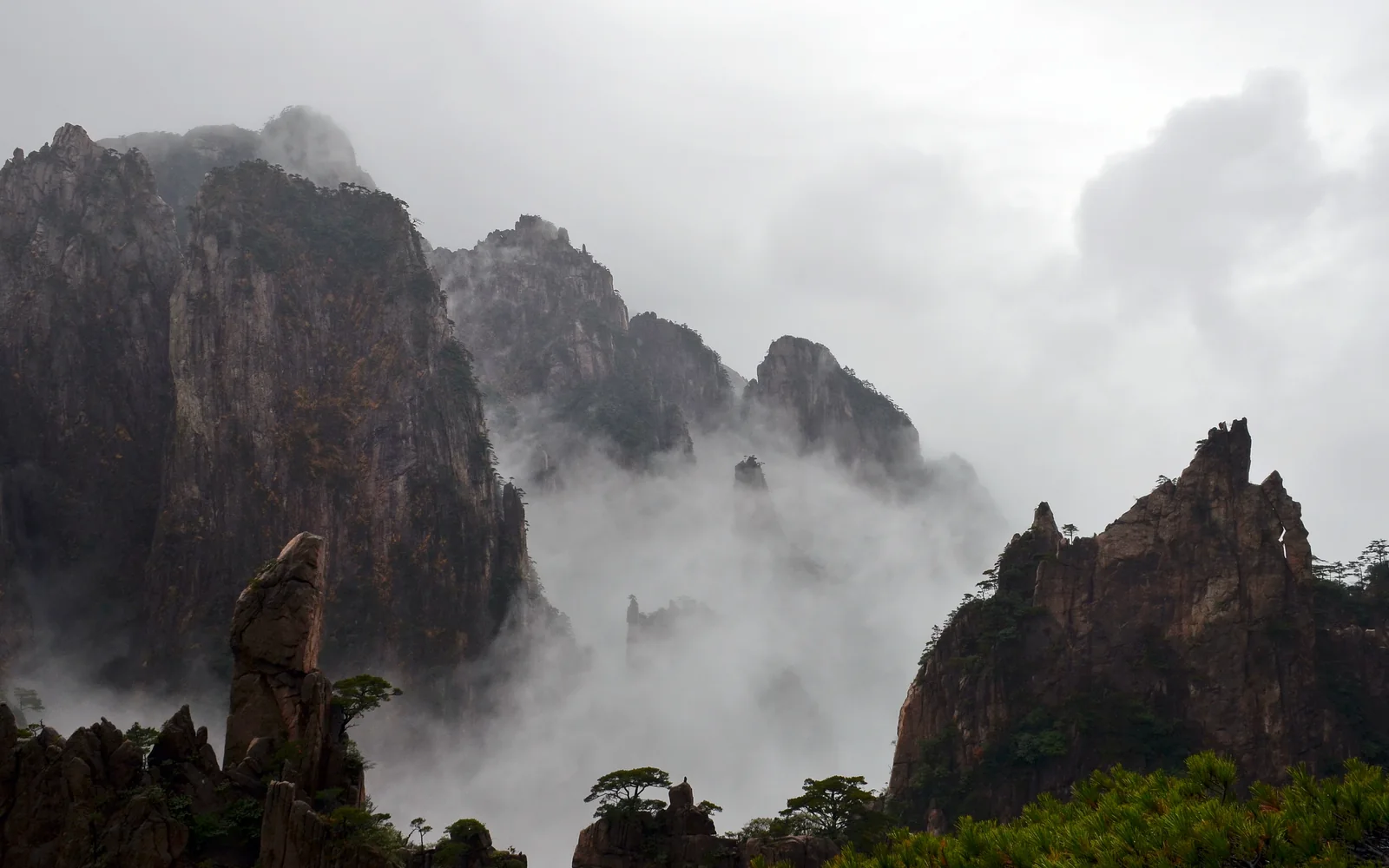
Granite peaks and pines in Huangshan’s West Sea Grand Canyon.Photo: 颐园新居 · Wikimedia Commons · CC BY-SA 4.0. Resized and recompressed.
Hours
Seasonal opening and weather control apply; winter maintenance can close the canyon. Obtain the day’s canyon-entry and final funicular boarding times before descending. The cableways at the mountain gates have a different operating window.
Tickets
The canyon footpaths are within mountain admission. The published standard-season funicular fare is CNY 100 one way. The recommended descent route uses the funicular uphill from the valley; it does not include transport from Tianhai back to a hotel.
Time
3–4 h from Paiyun to the funicular and Tianhai, plus approaches and queues
Chinese address
黄山风景区西海大峡谷北入口(排云亭附近);谷底出路:西海大峡谷观光缆车下站. These are walking locations inside the mountain, not roadside taxi destinations.
Getting there
Reach Paiyun Pavilion / 排云亭 from Beihai on foot, or from the Taiping upper-station side if using North Gate. From Tangkou this is already an ascent plus an upper-mountain approach; do not treat a canyon ticket as a direct valley bus excursion.
How to visit
Paiyun → north canyon entrance → first and second loops / 一环、二环 → valley funicular → Tianhai → Baiyun hotel, or the separately timed southern exit. This follows the official canyon route. If the funicular, weather or remaining time is unsuitable, keep the upper Paiyun view and leave before the deep descent. An out-and-back partway down requires climbing every step back up.
5. Tiandu Peak · 天都峰
Tiandu is for confident hikers who specifically want steep stone stairs and the narrow Carp’s Backbone ridge. It is a substantial objective, not a quick photo detour. The official introduction describes two steep approaches and sustained exposure; choose the ordinary Yuping visit if that experience does not appeal.
Hours
Only the date and session offered by the official Tiandu reservation apply. It can close for weather or seasonal maintenance, independently of general mountain opening. Start early enough for the whole peak circuit and the walk back to your operating descent.
Tickets
Secure the main mountain entry, then a confirmed Tiandu slot through 黄山旅游官方平台. A general admission or summit-hotel order does not establish a Tiandu reservation. If the peak is unavailable, keep #3; do not pay an intermediary for a promised unofficial entry.
Time
Allow about 4 h for the peak visit, plus access and your complete descent
Chinese address
黄山风景区天都峰;常用山上接近点:玉屏楼/迎客松,天都老道口. The 新道口 and 老道口 are different approach points; follow the entrance named in your reservation and staff instructions.
Getting there
For the southern approach, use Yuping cableway, walk to the pine area, then follow signs toward the Tiandu old-trail checkpoint. Confirm the open ascent and descent arrangement there before climbing, especially the return connection toward Yuping.
How to visit
Make Tiandu the main walking objective. At the checkpoint confirm your exit back toward the Yuping area, then follow staff-controlled directions through the open peak route. Return to the Yuping upper station with a boarding margin and take the scenic shuttle to Tangkou after descending. If the directed exit will not fit that return, decline the climb; do not improvise an off-route shortcut or combine it with the full canyon crossing.
6. Tunxi Old Street · 屯溪老街
Tunxi brings the trip back to human scale: shops, traditional façades and a riverside city evening after the mountain. It is useful for a final-night base and a relaxed meal. Expect an active visitor shopping street rather than an untouched village.
Hours
Public street access has no common shop closing time. Late afternoon into early evening suits a walk and dinner; museums, cafés and shops keep individual hours. Do not plan an indoor visit around the street’s general access.
Tickets
The visitor listing describes an open public street; no general street-admission purchase. Meals, tea, souvenirs and any separately ticketed interiors cost extra. Agree a tea’s weight and price before buying; tasting does not establish a special medical benefit.
Time
2–3 h including food
Chinese address
屯溪老街 · 黄山市屯溪区;西端定位:镇海桥(老大桥)东侧老街入口. Arrange the car pickup on a road outside the pedestrian street.
Getting there
Take a taxi from your Tunxi hotel to the old-street entrance; a Crowne Plaza stay needs a separate city ride. From Tangkou, allow 75–100 minutes by direct car before the street visit. This is a city outing down the mountain, not an evening walk from a summit hotel.
How to visit
West end near Zhenhai Bridge → shopfronts and side lanes → a tea or food stop → retrace or leave at the eastern road end. Save the pickup point before dinner. In heavy rain, use a nearby indoor meal and return to the hotel rather than extending along the river.
7. Hongcun · 宏村
Choose Hongcun for the reflection of white houses in South Lake and Moon Pond, and for the water channels threaded through the village. It is the more obvious choice when water-and-architecture compositions interest you. The UNESCO listing explains the importance of its village layout and water system.
Hours
The ticket platform lists village access all day, but house interiors and staffed entry services have their own hours. Arrive in daylight and aim to visit the interiors before late afternoon; an overnight booking needs an agreed late-arrival entrance.
Tickets
A separate Hongcun ticket is required. The platform displays CNY 104 with offers from CNY 94; check the selected date, passport acceptance and whether your product allows re-entry. Accommodation inside the village is not automatically admission.
Time
3–4 h in the village; half to full day including roads
Chinese address
宏村景区南门/游客中心 · 黄山市黟县宏村镇宏村. Use the visitor-centre meeting point for a road transfer, then walk into the village.
Getting there
From Tangkou allow 60–90 minutes by booked car. From Tunxi or Huangshan North allow 90–120 minutes including arrival at the entrance. The published coach plan includes Huangshan North–Hongcun via Yi County; confirm a service for your date and its return at the counter before relying on it.
How to visit
Visitor centre → South Lake / 南湖 → village lanes and water channels → Moon Pond / 月沼 → an open historic house → return to the agreed gate. Keep children close beside open water. For a slower visit, choose one village; add #8 only with a full day and a car or verified connecting service.
8. Xidi · 西递
Choose Xidi for looking closely at buildings: carved doorways, interior timberwork, courtyards and the ceremonial arch at the entrance. It complements Hongcun’s water views, but visitors with only a half-day gain more by choosing one and spending time inside a few houses.
Hours
The seller lists all-day village access; this does not mean every historic interior or night programme runs throughout the day. Use a daytime block, roughly 09:00–16:00, for this walking plan and check the included interiors at entry.
Tickets
Separate from both Hongcun and the mountain. The platform reference is CNY 104, with discounted products. Buy the dated product you intend to use; any advertised night show, combined ticket or repeated entry needs its own stated terms.
Time
2–3 h in the village, plus road travel
Chinese address
西递景区游客中心 · 黄山市黟县西递镇西递村. Agree pickup at the visitor-centre car area, not inside a narrow residential lane.
Getting there
Allow 30–45 minutes by car from Hongcun, or roughly 75–105 minutes from Tangkou. A Huangshan North–Hongcun coach may serve Xidi, but confirm that departure’s stop before boarding. For both villages, a car with waiting time removes dependence on a rural connection.
How to visit
Main entrance and Hu Wenguang Arch / 胡文光牌坊 → main lanes → Jing’ai Hall / 敬爱堂 and whichever homes are open → smaller side lane → main entrance. Ask before entering occupied homes or photographing residents; avoid touching carvings. Finish with time to meet the return driver and retrieve stored luggage.
Three complete mountain walks
Start each route with the day’s operating notices and a return cutoff. The sequences use the tourism authority’s signed upper-mountain connections; the shorter combinations and time margins are editorial choices. The official platform’s historical route FAQ supplies the central Beihai–Guangmingding–Tianhai connection, and the official canyon route account places the funicular exit at Tianhai. Only those stable connections are used here; their old operating times and admission rules are not carried forward.
Three routes from Yungu · 云谷上山的三种走法
Schematic, not to scale or a navigation map. Arrows show visit order, not distance, slope, walking time or current access.
The canyon funicular joins Tianhai; it does not return you to Paiyun. An overnight room does not reserve mountain entry, cableways or a clear sunrise. The written routes below give the turnaround and return conditions.
Open the guide while connected: search 智游黄山 in WeChat for the scenic area’s free guide, recommended in the scenic committee’s April 2026 notice published by the municipal government account. Check the current interface before departure; English and offline operation have not been tested. While online, screenshot this page’s diagram and your chosen written route, or use your browser’s Print → Save as PDF. Open the saved screenshots or PDF before losing the connection and check that every branch, label and return step is readable. Take a current visitor-centre paper map if available. Saved copies cannot update closures, queues or the last cableway. Follow current notices, signs and staff directions.
Topology and the published guide-entry recommendation reviewed 16 October 2026. The linked municipal-government publication was readable; it supports searching for the guide, not a tested current menu or offline mode. Use the WeChat search route above; if it fails, retain the saved route and ask at the visitor centre before starting.
A shorter Yungu out-and-back
Tangkou → Yungu shuttle and cableway → #1 Shixin / selected Beihai viewpoint → Yungu cableway → shuttle → Tangkou. Reserve most of a day: around 2–3 hours on the upper paths can become 5–7 hours with transfers, queues and rests.
At the Beihai junction, turn back toward Yungu unless there is ample time and everyone is comfortable on stairs. Skip Lion Peak or stop before Beihai for an even shorter visit. This is the lower-walking mountain choice, but it is not step-free. If you principally want the Guest-Greeting Pine, use the equivalent Yuping up-and-down visit to #3 instead.
A long Yungu-to-Yuping crossing
Tangkou → Yungu ascent → #1 → Beihai’s central connection → #2 Guangmingding and Tianhai → Haixin Pavilion → Aoyu → Hundred-Step Ladder and the open Lotus bypass → #3 → Yuping descent → Tangkou. Allow roughly 6–8 hours of walking and stops above the cableways, and an 8–10-hour mountain day overall. Crowds or a slow pace can exceed that.
At Beihai, return by Yungu if the start was late or the walking already feels demanding. At Tianhai, ask staff for the remaining time to Yuping, allowing at least a further 2–3 hours for walking and short stops in ordinary conditions, plus the boarding buffer. Do not add the western Paiyun/Feilai detour, canyon or Tiandu. If timing no longer works, get help with the nearest feasible exit before pressing south.
Two mountain days with a Baiyun night
Walk in to Tianhai, sleep on the mountain, then leave through Yuping. From Yungu and #1, either take the central path over Guangmingding to Baiyun, or choose the longer Paiyun → #4 canyon → funicular → Tianhai approach. The canyon route needs an early start, operating funicular and sufficient legs; the central option keeps more flexibility.
After checking in, ask the hotel which nearby sunset or sunrise viewpoint is appropriate for current weather and the open paths. Next morning, walk toward Haixin and Aoyu, follow the open route to #3 and descend by Yuping. Keep the final lowland night for bags, recovery and the onward journey. A summit night spreads exertion; it does not remove it.
Budget for the stay you choose
Three nights / four calendar days for two adults sharing one private room: 2 lowland nights × an assumed CNY 500 + 1 summit night × CNY 1,500 + 4 days × CNY 300 for the pair’s meals + CNY 500 for external road transport = CNY 4,200 before mountain products. This covers food on the arrival and departure days as well as both mountain days. The room, meal and road figures are editable planning assumptions, not hotel offers or researched transport quotes.
Add 2 × the CNY 360 standard-season admission / Yungu-up / Yuping-down reference subtotal = CNY 4,920. Add an editable CNY 200 reserve for both travellers’ scenic-shuttle journeys to make CNY 5,120 for this working plan; the reserve is not a shuttle tariff and must be replaced with the products in your order. If both take the optional canyon funicular, add 2 × CNY 100 = CNY 200. Check the tariff period and recalculate winter travel separately.
Two lowland nights / three calendar days, using the shorter Yungu out-and-back: 2 × CNY 500 room + 3 × CNY 200 meals for the pair + CNY 500 road transport = CNY 2,100 before mountain products. Two adult admissions and four Yungu journeys add CNY 700 at the stated standard-season reference prices; the same CNY 200 shuttle reserve brings this illustration to CNY 3,000. A different cableway route changes the ticket subtotal.
Both examples exclude intercity trains/flights, village admission and village-day transport, guides and personal shopping. They assume one private room each night, not two per-person dormitory beds. Room packages may include breakfast; remove it from your meal allowance only once confirmed. A selected-date summit quote can change the comparison substantially: if it breaks the budget, keep the shorter mountain route and the lower bed.
Match the gate, the cableway and the return
South Gate / Tangkou: the same lowland base serves two different mountain approaches. The scenic shuttle to 云谷寺/云谷索道 leads toward Shixin and Beihai; the shuttle for 玉屏索道/慈光阁方向 leads toward Yuping and the pine. A private car finishes at the authorised transfer point. Choose the shuttle direction before boarding.
North Gate / Taiping:黄山风景区北大门、松谷庵、太平索道 is a different road approach to the western upper mountain and Paiyun side. Huangshan North railway station / 黄山北站 is down in the wider city region, not this gate. Use North Gate only with the road arrival and return already arranged; descending there with luggage stored in Tangkou creates an extra road transfer.
East Gate / Donghai:黄山风景区东大门游客中心、东海索道 at Tanjiaqiao is now an operating alternative. The committee’s opening notice states that no hiking path connects the east gate with the upper cableway station: the lift is the only way through that entrance. Choose its dated product and an east-side return explicitly; the Yungu and Yuping directions described here do not cover it.
West Gate: the western hiking approach is not a lift-assisted substitute for a missed cableway. This guide’s first-visit routes begin and finish through operating cableways. If one closes, agree a feasible alternative with scenic-area staff before entering.
Book the mountain, then add the right transport
Open 黄山旅游官方平台 in WeChat or Alipay, choose 黄山风景区, then the date, entrance direction and admission session. Use an early session for an overnight walk or a crossing.
Enter each traveller’s real document details and obtain a successful reservation. A waitlist or unpaid order is not entry. Secure this before making a non-refundable summit-hotel commitment.
Add the actual shuttle and cableway directions. The crossing uses Yungu up and Yuping down; the short northern route uses Yungu both ways. Xihai’s internal funicular is another ticket.
If climbing Tiandu, complete its separate reservation and keep that confirmation. For a later mountain re-entry, reserve again in the official platform after the first visit has been validated; capacity still applies.
Adult reference budget: the published standard-season tariff is CNY 190 admission, CNY 80 one-way Yungu or Taiping, CNY 90 one-way Yuping and CNY 100 one-way Xihai funicular. Thus the Yungu-up/Yuping-down subtotal is CNY 360 before scenic shuttles, road transfers, food and lodging; a canyon funicular makes that CNY 460. Winter pricing uses a separately announced period, which does not simply match the winter operating hours. Confirm your date’s total in the order; concessions for admission and lifts have different conditions.
Foreign passports: check the selected product’s document choices before paying. Where passport/other-document booking is offered, enter the original passport details exactly and keep that passport for staffed verification. We have not completed the current passport checkout; an older promotional instruction does not establish today’s standard-ticket or Tiandu process. If a mainland identity number, local phone or payment requirement blocks you, contact official platform support at +86 559 2590999 before travelling. Ask for a confirmed dated passport reservation, the collection/verification location and required documents, rather than an assurance that you can queue on arrival. Save the confirmation and Chinese entrance name offline.
If support cannot confirm admission, keep the lowland bed and use Tunxi Old Street while choosing another mountain date. Hongcun or Xidi is an alternative only after that village product accepts your document and the road return is arranged. Do not use a dummy identity number or pay an intermediary promising guaranteed access; Tiandu and each village require their own confirmation.
Admission, cableways, the scenic shuttles, the internal funicular, lowland road journeys and the summit hotel are different purchases. Read every bundle’s included directions. The admission’s repeated-entry facility does not make those transport journeys free.
Use the hours to protect the whole return
The regular operating notice gives mountain opening and Yungu/Yuping/Taiping cableways as 07:00–17:10 on weekdays and 06:30–17:40 on weekends and smaller holidays from 5 March through 30 November. The winter window is 08:00–16:40 from 1 December through 4 March. Major holiday schedules and weather notices can override these reference hours.
In the regular warmer-season schedule, South Gate shuttles run uphill 06:40–16:30 and downhill 07:10–17:40 on weekdays; weekend/smaller-holiday windows are 06:10–17:00 uphill and 06:40–18:10 downhill. Winter windows are 07:40–16:00 uphill and 08:10–17:10 downhill. These are operating windows, not a promise that reaching the queue at closing is sufficient.
The 15:00 hiking-entry cutoff is a separate rule. The committee’s notice closes hiking admission checkpoints to new entries at 15:00; it does not grant permission to walk in later because a cableway operates until evening. For the routes here, finish all ascent arrangements in the early reserved session.
Before leaving an upper junction, ask for the latest boarding time at your intended descent and the final shuttle back to Tangkou. Work backward from that, leaving at least an hour of contingency beyond the expected walking time; lengthen it in peak crowds. The canyon funicular and Tiandu have separate controls. Follow a staff-directed early closure even if the general timetable is later.
Get from the station or airport to the right bed
Huangshan North railway station / 黄山北站 → Tangkou: leave the rail station and follow signs for 黄山旅游客运中心. At the staffed counter ask for 黄山风景区南大门换乘中心(汤口), the next departure and final drop-off. The coach operator’s published South Gate reference fare is CNY 30 one way; confirm the selected service. From its Tangkou stop, walk or use the agreed hotel pickup. Allow about 1–1½ hours after boarding, plus waiting and the last hotel leg.
A booked car from Huangshan North to a Tangkou hotel is the simpler choice with luggage or a late arrival; allow roughly 45–75 minutes on the road, longer in congestion. Ask for the total including tolls and any waiting. A Tunxi hotel instead normally needs a 30–50-minute city-side car journey from North station.
Huangshan Tunxi International Airport / 黄山屯溪国际机场 (TXN): use the official taxi queue or a hotel-arranged pickup with your flight details. Plan roughly 20–35 minutes to a Tunxi hotel or 75–100 minutes to Tangkou after baggage collection. A late landing is a reason to sleep in Tunxi unless the Tangkou transfer and reception are confirmed. Do not book a mountain hotel for an evening flight arrival.
If TXN has no flight that fits: compare available trains from your preceding city to Huangshan North / 黄山北站 on China Railway 12306. Shanghai Hongqiao and Hangzhou East are useful search origins when already staying in those cities, but do not treat an international flight arrival and a separately booked train as a protected connection. Select the station actually printed on the ticket. No airport-to-Tangkou bus timetable or last departure was verified in this update; the usable default is the taxi queue or a confirmed pickup, with a Tunxi bed if the late transfer cannot be secured.
For a pickup, send the flight/train number, arrival time, number of people and suitcases, hotel’s Chinese address and your contact method. Agree the meeting point, total including tolls/waiting, and what happens after a delay. If the driver does not appear, remain at the staffed arrival area and contact the hotel or use the signed taxi rank; do not board an unidentified vehicle on a verbal promise.
A summit hotel adds another journey: rail or flight → road transfer → South Gate shuttle → cableway → several hours on foot. It is practical only with early enough arrival and the correct entry session. Store the suitcase by agreement at the lowland hotel; take passport, overnight clothes, food, water and rain protection in a daypack.
Connect the villages and leave room to depart
For a separate temple-mountain stay, compare Mount Jiuhua. Its Jiuhua Street base and mountain choices need their own arrival and return arrangements; they are not part of the Huangshan descent day.
For a village extension, arrange Tangkou → Hongcun → Xidi → Tunxi or Huangshan North as a full road day, with enough time at the chosen places and luggage secured with the hotel or agreed provider. Rough road allowances are 60–90 minutes Tangkou–Hongcun, 30–45 minutes Hongcun–Xidi and 60–90 minutes Xidi–Tunxi/North station; holiday traffic can lengthen all three. One village is the more relaxed choice before a train.
The city’s bus guide identifies the Tangkou–Hongcun corridor, and the coach-centre notice includes Huangshan North–Hongcun via Xidi. Use those corridors to find a dated service at the counter or official booking platform; older published departure lists are not a guarantee of the last return. Book a car with waiting and pickup when the available buses do not fit.
Keep the descent separate from the departure deadline
The default is the Tunxi night before departure. If you must connect on the descent day, choose a later, changeable service and work back from its required terminal arrival. For planning, allow at least 60 minutes at the rail station, around 2 hours at TXN for a domestic flight or 3 hours for an international flight, unless the carrier requires more; these are our margins, not carrier check-in rules. Then add the road journey, suitcase collection in Tangkou, scenic-shuttle queues, cableway queues and all walking before boarding.
Even after reaching Tangkou, a rail connection needs the complete hotel-bag pickup and a roughly 45–75-minute car journey to Huangshan North, plus contingency and the station margin. An airport connection adds roughly 75–100 minutes of road travel before its terminal margin. Do not subtract only the cableway ride from the train or flight time. If a closure or queue removes the spare time, stop sightseeing and contact the carrier about changing the onward booking; never use an unmarked descent to rescue it.
Save the exact station on your issued ticket: 黄山北站, 黄山西站 and 黟县东站 are different places. For Shanghai or Hangzhou onward, choose the available train for your actual departure station, then reserve the road transfer and the carrier’s required arrival margin. Finish the mountain on the previous day when an early train or flight would otherwise depend on its first descent.
Change the plan for weather and walking ability
Clear weather and comfortable legs: use the chosen crossing or overnight route. Cloud sea and sunrise are possibilities, not scheduled attractions. A summit hotel gives more chances to look; it cannot create visibility.
Some walking, but no long descent: choose Yungu out-and-back to Shixin with a firm turnaround, or Yuping up-and-down for the pine. Keep the canyon and Tiandu out. Families should decide by the child’s actual stair endurance, not by the presence of cableways; avoid carrying a stroller into a mountain crossing.
Wheelchair or very limited stair tolerance: do not assume the upper paths connect without steps. Ask the scenic-area service for a specific supported route before buying. A Tunxi base, a short Old Street outing and a seated meal are easier to shorten. Hongcun and Xidi have uneven paving, thresholds and open water; they are not automatically accessible.
Low visibility without dangerous weather: keep a short open upper route if the pine-and-rock scenery still interests you, or move the mountain booking to another available day and choose one village. Thunderstorms, strong wind, ice or heavy-rain warnings: follow closures and postpone exposed walks. Use indoor time at the hotel and a nearby meal; do not replace a closed mountain with a gorge, riverside or long village walk in the same severe weather.
A cableway or trail branch is unavailable: if Yungu is closed but Yuping is operating, change to Yuping up-and-down for the pine, with a lowland bed. If Yuping is closed but Yungu is operating, keep the Shixin/Beihai out-and-back and return by Yungu; do not start the full crossing expecting another easy exit. If the canyon or its funicular is closed, retain the central Beihai–Guangmingding–Tianhai connection only when staff confirm it is open and it fits your confirmed room or descent. An unavailable Tiandu slot means omit Tiandu. If neither planned lift or the main connecting path is usable, postpone the mountain and align the hotel/ticket changes before leaving the lowlands. A short-lived repair report is not a permanent closure rule; ask the official platform for your travel day.
If weather interrupts you on the mountain, stop extending the route and ask staff for the nearest shelter and feasible exit. Tell your hotel or transfer provider about the delay. If you miss the safe return margin, seek staffed assistance while it is still daylight; do not follow an unmarked track or assume an unopened trail goes down to your car.
Sources and dates
On , we re-read the committee’s regular operating notice and the linked annual tariff, passenger-centre notice, Accor room/contact page, IHG property/room/dining/transport pages, and Trip.com’s Baiyun room and guest policies. They support the stated reference rules and named-room comparison; they do not establish a completed passport transaction, current inventory, overseas-card acceptance or a live bus timetable. The three-night schedule, meal combinations, cost inputs and departure margins are editorial planning choices. No hotel stay, phone call, booking or mountain walk was tested.
The rest of the source review below dates to 4 October 2026. Published rules and source types are distinguished below; booking availability, weather, temporary closures and transport departures must be checked for the selected date. Travel times are editorial planning allowances. We have not field-tested these walks, hotels or passport transactions.
Huangshan Scenic Area Management Committee operating notice, 4 March 2026, official government account on The Paper: regular hours, reservations, repeated entry and Lotus rotation. Golden Week and other temporary notices override the reference timetable.
Anhui government account’s 2026 tariff notice, 19 December 2025, carried on Sina and attributed to Huangshan government/platform: standard-season prices apply 21 January–19 December 2026. This is a dated tariff, not a future-year price promise.
East Gate and Donghai notice, committee notice dated 8 June 2026, republished by Phoenix Anhui on 9 June: opening from 11 June and no east-gate hiking alternative. The original municipal pages could not be fetched during this review; this linked copy identifies the issuer and complete notice.
Earlier government-account promotion, 3 March 2026, retained as background only. Its promotional eligibility has expired; it does not verify the current standard-ticket, passport or Tiandu checkout. The support route above is the alternative until a dated booking is confirmed.
Farmers’ Daily reporting carried by CNR, 31 January 2026, for the local pan-fried fermented-tofu description; CNR’s Huizhou food report, 28 April 2017, for the preserved-vegetable and pork filling. Re-read 18 October 2026 for ingredients only, not current vendors or prices.
The regional map uses OpenStreetMap data and the OpenFreeMap Liberty design, retrieved 4 October 2026; it shows relative locations, not travel times or a mountain hiking route.
The canyon photograph was taken on 8 November 2014; the linked author and licence accompany it. It illustrates scenery, not present trail access.