Shaoguan Settle into the river city, then choose the temple and mountain days separately.
Shaoguan works best when you give the city time between its famous outings. Fengcai Tower and the old riverfront introduce the compact centre; Shaoguan Museum gives the regional history behind it. A separate journey south reaches Nanhua Temple, a major centre of Chan Buddhism associated with Huineng. Meals and evenings in one urban base make the combination easier.
Choose three nights for two full days: a complete city day, then a relaxed Nanhua outing with an afternoon back in town. Add a fourth night and a third full day for Danxia Mountain, or substitute Danxia for Nanhua if landscape matters more than temple history. The red cliffs are a substantial excursion northeast of the city, with their own hiking and return-transport decisions.
This stay suits travellers who want an ordinary Guangdong city as well as a major religious site, with the option of one active mountain day. If your only purpose is a Danxia sunrise or several days on its trails, a property near the scenic-area entrance may suit better. A city hotel is valuable for rail access, meals and combining different interests; it does not put you at the mountain gate.
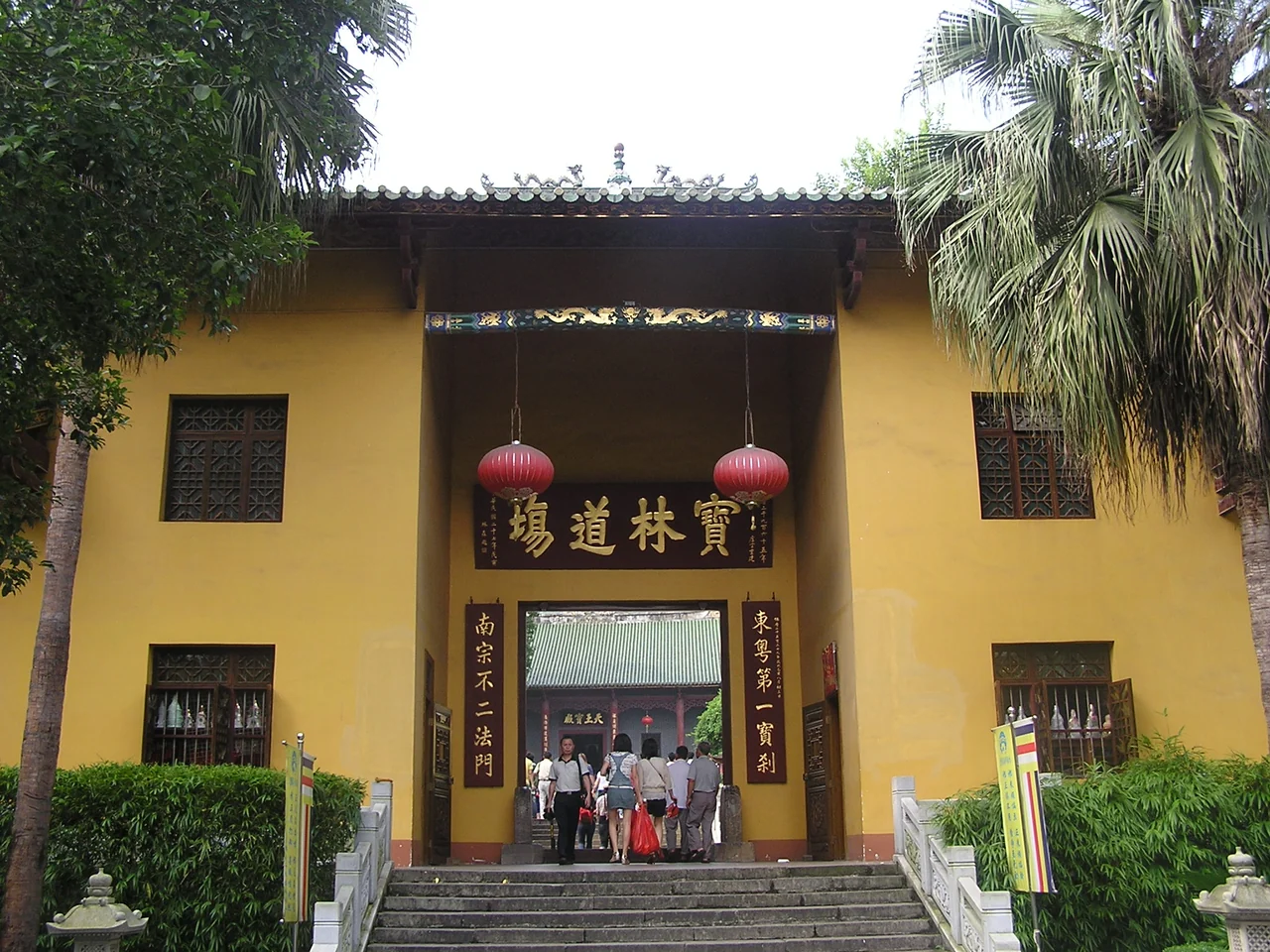
Nanhua Temple’s gate in Shaoguan, photographed on 27 June 2010. This illustrates the separate temple outing in Qujiang, not the city-centre riverfront or Danxia Mountain; present access needs checking.Photo: CenkX · Public domain · Image credits
Chan Buddhist history and a sequence of active temple courtyards · Qujiang, south of the central city
2–3 hours inside; allow a relaxed outing with road travel · Buy the current ordinary admission through the temple’s stated channel; tariff and foreign-passport handling need confirmation.
Red sandstone cliffs and an active trail day outside the city · Renhua, northeast of Shaoguan
A separate full day; add a night if keeping both city and Nanhua days · Published 2026 standard adult admission ¥100, valid 48 hours; transport and other services need separate pricing.
A real city base with two separate outward journeys
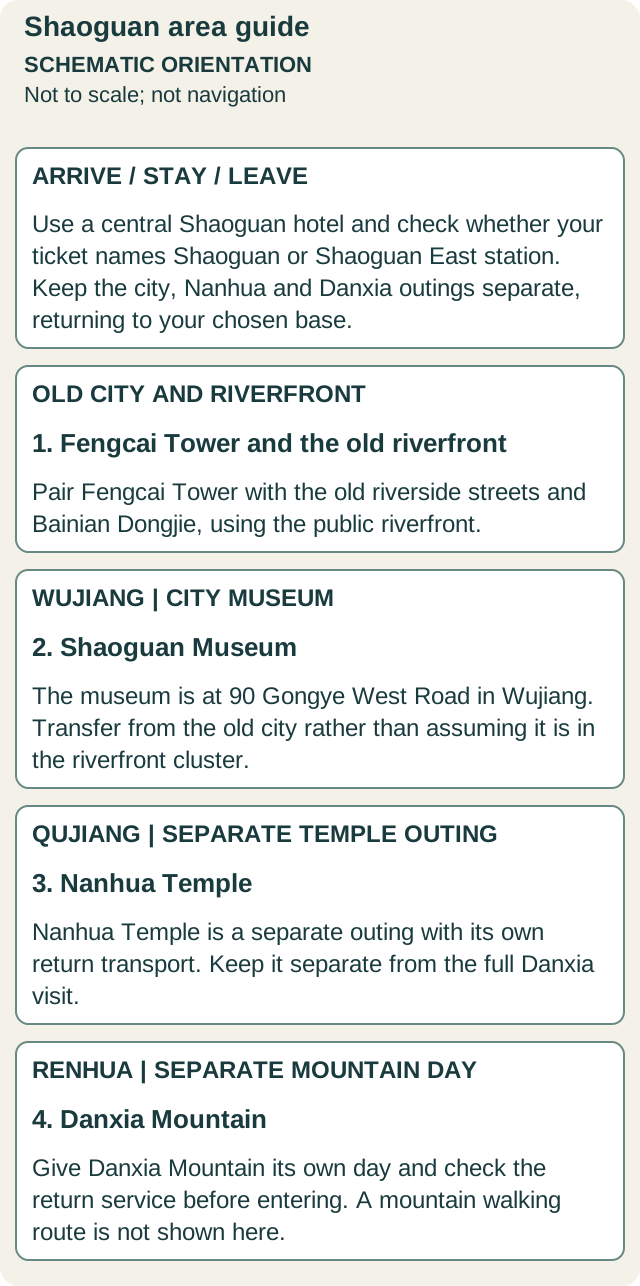
Open full-size area diagram ↗. Numbers match the guide. Named directions show broad areas; box positions do not encode geography. This schematic is not to scale or suitable for navigation, and does not prove access or current operation. ChinaMile editorial diagram; guide sources. Navigation: search the Chinese name in Amap.
1, Fengcai and the riverfront, is the central-city reference; 2, Shaoguan Museum, is to the west. A taxi joins those city blocks. 3, Nanhua, is a separate journey south; 4, Danxia, is northeast in Renhua. They are not opposite ends of one convenient city walk.
Use the city hotel for a museum-and-streets day and for meals before and after Nanhua. This gives Shaoguan its own place in the trip. If you have only one full day, keep the museum, Fengcai and riverfront; if Nanhua is your main reason for stopping, substitute the temple and retain a small city evening instead.
Autumn is a useful season for combining city walking and mountain views, subject to the actual weather. Summer can be hot, humid and stormy; start early, break indoors and abandon exposed trails when the operator restricts access. Winter can feel damp and cool, so carry layers. Spring rain can make outdoor stone paths slippery; a clear forecast matters more than a calendar label.
Four places and how to visit them
1. Fengcai Tower and the old riverfront · 风采楼 · 百年东街
Fengcai Tower is the best starting landmark for understanding the older centre. It commemorates the official Yu Jing, and the surviving structure has a history of rebuilding. Read it as part of a living city rather than as an untouched medieval street set. The outside view and the surrounding street pattern are enough for the route here.
Continue to the old riverfront at Bainian Dongjie. The worthwhile experience is modest: changing views of the water, central-city shops and a meal at a normal pace. A modern café or renewed frontage is not evidence that the whole street is ancient. This is the low-pressure counterweight to temple crowds and a strenuous mountain outing.
In hot weather, keep the exposed river stretch short and move lunch indoors. After rain, use the upper public street wherever lower waterside access is closed. A dramatic waterfront photograph does not justify passing barriers.
Hours
The selected street and exterior route fits daylight and early evening. Tower-interior hours and holiday evening openings are not part of the default visit.
Tickets
No paid tower climb, performance or cruise is included. Meals and cafés are separate purchases.
Time
Split 2–3 hours around lunch, a rest and an evening river walk.
Chinese address
广东省韶关市浈江区风采路;风采楼、百年东街
Getting there
Use 风采楼 as the taxi destination, then continue through central streets to the permitted 百年东街 riverfront. Cross roads at signed crossings.
How to visit
Tower exterior → central food streets → a short riverfront section → return to the hotel. The diagram is not a bridge or footpath guide; use the inland street if river access is closed.
2. Shaoguan Museum · 韶关市博物馆
The museum turns a city stop into something more than waiting for the next scenic-area bus. Its regional-history presentation introduces the places, people and routes that shaped northern Guangdong. Start here before the street walk if understanding the region matters more than seeing the landmark first.
Recent municipal reporting confirms the city-history displays and cultural programming, but a temporary exhibition mentioned in a holiday report may have ended by your visit. Choose from what is open that day. The museum’s registered address on Gongye West Road is important: a search for another similarly named city-history venue can send a driver to a different building.
Monday is the main scheduling trap. Put the museum on a normal opening day and move the temple outing to Monday if its own arrangements permit. If the museum is unexpectedly closed, keep the city streets, meals and river route; do not substitute an unverified indoor attraction merely to fill the afternoon.
Hours
The municipal list gives Tuesday–Sunday 09:00–16:30, last entry 16:25; Monday closed except national public holidays.
Tickets
The regular visit is listed as free. Bring the original passport and ask the reception desk about the current registration process; online overseas-document registration was not tested.
Time
Allow 1.5–2 hours. Choose the city-history galleries rather than trying to see every temporary display.
Chinese address
广东省韶关市武江区工业西路90号;韶关市博物馆
Getting there
Take a city taxi to the exact museum address. This is not the Shaozhou museum at Fengdu Pavilion; the two names should not be interchanged.
How to visit
Reception and current entry check → permanent regional-history displays → available temporary gallery if time allows → return to the central hotel or lunch area.
3. Nanhua Temple · 南华禅寺
Nanhua deserves a separate outing because its value is the religious setting, not a quick gate photograph. Huineng’s association with the temple gives it a central place in the history of Chan Buddhism. Follow the main courtyard sequence slowly and leave space for people who are there to worship.
The provincial and municipal descriptions identify halls and the Lingzhao Pagoda as parts of the complex. That historical inventory is not a guarantee that every room, relic or pagoda interior is accessible. Select the open courtyards and halls, follow signs and avoid photographing worshippers at close range.
In June 2026 the temple identified its certified WeChat account 南华禅寺 and its own noticeboards as its authoritative channels, and rejected unauthorised prayer packages. An ordinary sightseeing visit does not require buying an outside vendor’s bundle. Its statement also describes free incense and public-benefit meals, but meal times and availability were not verified; keep a normal lunch budget instead of depending on a free lunch.
Hours
Plan a morning arrival and a daylight visit. A current ordinary-day opening/last-admission schedule was not established from the primary material reviewed.
Tickets
Use the certified WeChat account 南华禅寺 or the temple’s own visitor desk for its current admission arrangement. Bring a passport and ask staff if a booking form only accepts Chinese ID; no passport workflow is claimed as tested.
Time
About 2–3 hours inside, plus both road legs and lunch. Leave the afternoon flexible.
Chinese address
广东省韶关市曲江区;南华禅寺游客入口(曹溪门一侧)
Getting there
From Shaoguan East south square use 南华寺专线; from the high-speed Shaoguan station use route 23 at the bus area. Establish the dated return stop/service before leaving town, or book a licensed round-trip car.
How to visit
Visitor entrance → permitted main-axis courtyards and halls → Lingzhao Pagoda area where open → the same visitor exit. Follow worship and photography rules; relic viewing, ceremonies and a temple meal are not guaranteed.
4. Danxia Mountain · 丹霞山
Danxia provides the landscape contrast to Shaoguan’s streets and Nanhua’s courtyards. The red sandstone walls and separated peaks are the reason to spend a full day here. This city guide gives one feasible outing, not a promise to cover the entire scenic area or to see sunrise from a city hotel.
For walkers comfortable with steep steps, the operator’s cable-assisted Changlaofeng route links the upper viewpoints around Shaoyin and Guanri with a descent through the signed trail system to the lower exit. Follow the current route board and allow about 3–4 hours for the selected mountain section. A cable car removes some ascent; it does not make the remaining route flat or step-free.
Keep the Yangyuan viewing platform as an optional short second section, not a compulsory extra hike. If rain, storms, poor visibility or trail restrictions undermine the mountain route, use only the lower areas that the operator confirms are open, or postpone Danxia and retain the city day. Do not replace a closed cable service with an unfamiliar steep ascent under time pressure.
A sunrise, night boat ride and multiple summit circuits need a different overnight plan. They are excluded from the city-based day and budget here. When an outer attraction becomes the main purpose of the trip, choose its accommodation and return journey directly rather than forcing the city itinerary to absorb it.
Hours
Start the outing in the morning. Entry areas, trails, cable car and internal buses have different operating arrangements; the 48-hour ticket validity is not a promise of continuous access to all services.
Tickets
The management committee’s 2026 standard adult ticket is ¥100, valid 48 hours. Ask the official counter to confirm passport registration, any eligible concession and the price/inclusion of internal transport and cable-car travel.
Time
A full day from Shaoguan. The operator describes the cable-assisted Changlaofeng route as roughly 3–4 hours of sightseeing, before town transfers and breaks.
Chinese address
广东省韶关市仁化县;丹霞山景区游客中心/外山门
Getting there
Take the Danxia bus from Shaoguan East south square or Shaoguan high-speed station bus bay 5. Buy a usable return or book a complete licensed city-hotel round trip; do not confuse an outbound last bus with the last return.
How to visit
Visitor centre → current internal transfer to the Changlaofeng cable-car side → cable-assisted upper trail if operating and suitable → the signed downhill exit → return transport. A short Yangyuan viewing loop is optional only if time, weather and the booked return permit.
Order a northern Guangdong meal, then a small street snack
Sour-bamboo-shoot duck / 酸笋鸭 is a regional dish associated with Nanxiong, within the wider Shaoguan area. Its fermented bamboo flavour is distinctive. Try it in a city restaurant when offered, with rice and vegetables, and request less chilli if needed. A dish from the wider region is not a reason to add a long Nanxiong detour to this short stay.
Tongshaobing / 铜勺饼 is another Nanxiong speciality you may find sold as a regional snack: a crisp fried rice-batter cake that can contain preserved vegetables, radish or dried shrimp. Ask about the filling, especially for shellfish allergy or a meat-free diet. Buy a small portion rather than replacing a whole meal before a long outing.
For a simple shared dinner, choose one main dish, a tofu or egg dish, seasonal greens and rice. A vegetable or tofu name does not guarantee the absence of meat stock. The guide does not endorse a named restaurant or claim to have checked a current menu.
Have lunch in the city between the museum and the afternoon rest. On the Nanhua day, use a restaurant outside the worship areas or return to town for a later lunch. For Danxia, carry water and a snack, then eat before the afternoon return; a mountain departure is easier to manage without relying on a last-minute meal.
The central peninsula is the default; the rail stations serve different needs
The Fengdu Road / central peninsula area is the default for three nights. It keeps food and the old-city evening close, with a short city ride to the museum. Check which street the property entrance is on, lift access and whether rooms face a busy road or nightlife.
Near Shaoguan East / 韶关东站 is practical if the Danxia or Nanhua bus is the priority, because the official services leave its south-square side. Check the route between the hotel entrance and the actual boarding area. Near Shaoguan high-speed station / 韶关站 suits a very early high-speed train but places you farther from the old-city evening.
Maba / Qujiang can suit a stay focused on Nanhua. The Danxia entrance area suits sunrise or repeated mountain visits. Either choice changes the base and luggage plan; it is not the same urban stay described here.
At Shaoguan accommodation search, enter two adults, one room, three nights, or four if adding the mountain day. Compare the complete price and map pin, then confirm foreign-passport check-in, arrival time and cancellation. No hotel or live room rate was tested.
Two full days for city and temple; a third for Danxia
Arrival evening · night one: transfer from the station printed on your ticket to the city hotel → dinner nearby → a short walk if time and weather allow. Do not attach a late temple visit to an uncertain arrival.
First full day · night two: breakfast → Shaoguan Museum, 2, around 09:00 for 1.5–2 hours → city lunch → hotel rest → Fengcai Tower exterior and central streets, 1 → a permitted riverfront section near dusk → dinner. This is a complete city day, with time to absorb the museum and ordinary streets.
Second full day · night three: use the morning Nanhua bus or your booked car → ordinary admission through the temple’s current channel → 2–3 hours in the open courtyard/hall sequence, 3 → lunch outside the worship areas or after returning to town → the confirmed return → rest and a different central dinner. Keep the afternoon flexible rather than adding a second distant attraction.
Optional third full day · night four: an early confirmed Danxia bus or licensed car → visitor centre and current ticket/service check → the selected Changlaofeng route, 4 → lunch or packed snack → only if time permits, the short Yangyuan viewpoint section → the booked return to Shaoguan → dinner and final night. Retaining a city night avoids a rushed mountain-to-intercity-train connection.
Departure: leave from 韶关 or 韶关东 exactly as booked. If you have only three nights and want Danxia, replace the Nanhua day instead of compressing both. Guangzhou is a natural separate onward city stay; use the actual dated train search, not a generic city-to-city duration.
Choose the correct station and settle the outing’s return first
Search Shaoguan / 韶关 for the high-speed station and Shaoguan East / 韶关东 for the conventional station near the older city on 12306 English booking. The English suffix matters. Show the Chinese station name and full hotel address to the licensed taxi queue or booked driver. Neither station is the Danxia scenic-area entrance.
The September 2026 municipal transport notice places the Danxia bus at Shaoguan East’s south square, or bay 5 at the high-speed Shaoguan station, left of the exit. It distinguishes regular service from holiday extras. Use the dated sale through 韶关粤运 or Didi’s station-bus service, and secure the return boarding point and time before leaving. No holiday late bus is assumed here.
For Nanhua, the same notice identifies 南华寺专线 from Shaoguan East and route 23 from Shaoguan high-speed station. Ask for the day’s return stop and last usable departure at the service point. If the app rejects your document or payment, use staff assistance; if both directions cannot be established, book a licensed hotel → attraction visitor entrance → hotel car with waiting time and total included.
The museum’s published desk number is +86 751 8172239. Danxia ticket enquiries are +86 751 6291630; ask 外国护照如何购票和入园? — how does a foreign passport buy a ticket and enter? These are published contacts, not calls we made. Do not enter a fictitious Chinese identity number to bypass a form.
Rail tickets must use the same original passport carried for travel. If online verification fails, use 12306’s supported verification process or a staffed railway counter; allow time for staff assistance at entry. 12306’s rules accept foreign passports.
Two adults sharing a room: keep the mountain addition visible
For three nights and two full days, city plus Nanhua, use 3R + T + M + A + X. R is the shared room per night; T includes both rail-station transfers, city rides and the Nanhua return; M covers arrival dinner through departure breakfast; A is the temple-admission allowance; X is water and contingency.
Planning inputs of R = ¥280, T = ¥360, M = ¥520, A = ¥60 for the pair and X = ¥140 give ¥840 + ¥360 + ¥520 + ¥60 + ¥140 = ¥1,920 for two. These are estimates, including A: the current ordinary Nanhua tariff was not established from the primary sources reviewed. The museum is officially listed as free and the street/exterior route has no paid tower visit. Replace A with the actual temple charge and T with the complete booked travel cost.
To keep that stay and add one Danxia day plus a fourth night, a sample addition is ¥280 room + ¥240 transport + ¥180 meals + 2 × ¥100 admission + ¥220 cable/internal-service allowance + ¥100 contingency = ¥1,220. The resulting pair total is ¥3,140. Only Danxia’s standard ¥100 adult admission and 48-hour validity are verified tariffs in this addition; the ¥220 is an allowance, not a quoted cable or shuttle fare.
The sample transport assumes a mixture of public transport and city rides. A private car for the whole mountain day can change the total substantially: replace the transport line with the full quote, including waiting and the return. Intercity trains/flights, guides, cruises, sunrise transport, shopping and alcohol are excluded. Ask about concessions separately; a foreign passport does not automatically establish eligibility under every discount category.
What was verified and what still depends on the operator
Sources were read on 23 October 2026. Municipal material supplies the correct museum, its regular free-entry schedule and the separate station boarding points. Danxia’s management committee supplies the 2026 tariff and route descriptions. A short museum closure in March and a short Danxia trail-work notice in June–July are expired notices, not evidence of current total closure.
The temple’s June statement was read in a news report reproducing the temple’s own announcement. It identifies the authoritative account and warns against unauthorised packages; it does not establish an ordinary-day tariff, current last entry or a foreign-passport booking process. The visit therefore uses its own visitor channel, a morning block, a separate admission allowance and a city fallback.
We did not test a phone call, passport gate, app checkout, bus departure, room, restaurant or mountain path. Visit lengths, stay choices, meal timing, weather alternatives and non-tariff budgets are editorial planning judgments. The old official English arrival page contains outdated travel material, so the newer Chinese transport notice is used for the station distinction.