SOUTHERN SICHUAN · RIVER CITY, NOODLES AND LIZHUANG
Yibin Come for the river city and its food; give the Bamboo Sea a stay of its own.
Yibin makes the most sense from the water. At Hejiangmen, the Min and Jinsha rivers meet and continue as the Yangtze; old commercial streets sit close to the riverfront, while the wooded rise of Cuiping Mountain gives the city a different scale. A breakfast bowl of dry, aromatic ran mian, an unhurried riverside walk and the old architecture of Lizhuang are enough reason for a stop.
For a first visit, stay three nights in the Cuiping old city and use two full days: one for the hill and central riverfront, one for Lizhuang. This suits travellers who enjoy ordinary streets, local food and architectural history more than a dense checklist of major monuments. With only one full day and two nights, keep the city day and leave Lizhuang for another visit.
The Shunan Bamboo Sea is a different visit within the wider Yibin region. Choose it for forest paths and bamboo-covered hills, then add two nights near the scenic area, a transfer day and a full forest day. It is not an extra stop after lunch in Lizhuang, and this guide does not hide its road travel or internal transport costs inside the city budget.
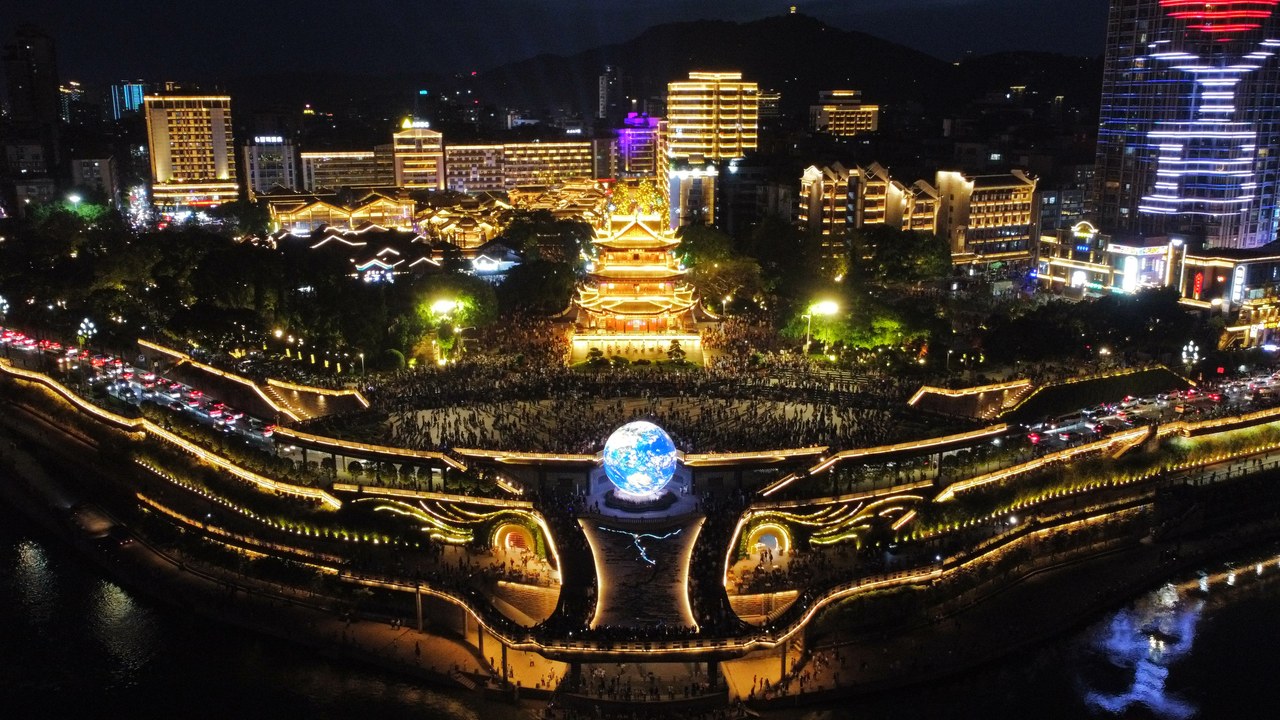
Hejiangmen waterfront square in Yibin, photographed in May 2025. A historical city-riverfront view; lighting and access on your visit can differ.Photo: RieezH · CC BY-SA 4.0 · Image credits
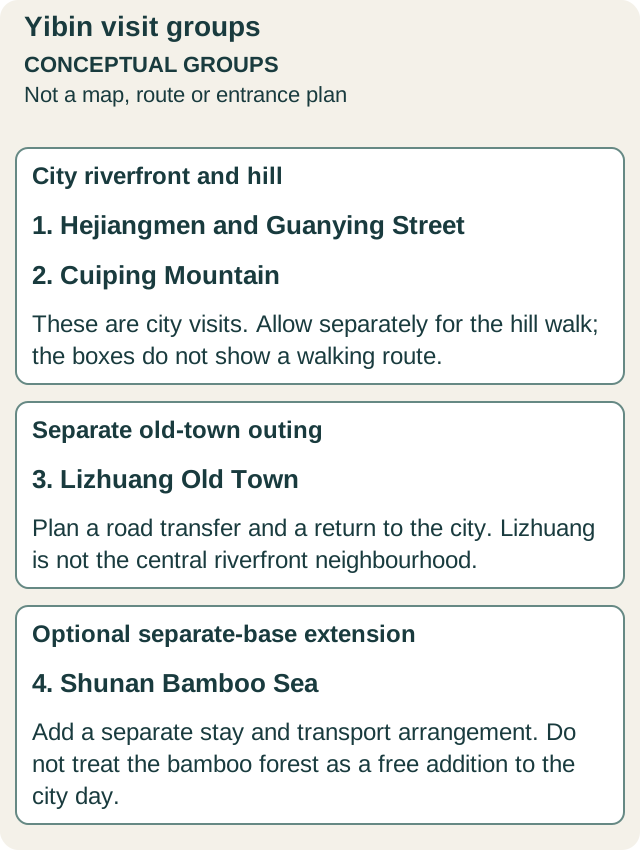
Hejiangmen/Guanying, 1, and Cuiping Mountain, 2, form the city stay, with a separate local ride or walk appropriate to your hotel and mobility. Lizhuang, 3, is a road outing outside the central riverfront. Shunan Bamboo Sea, 4, is an additional scenic-area stay in the wider region. The diagram groups decisions; it gives no directions, distances or entrances.
Keep one hotel for the default three nights. Crossing a river or changing to a station hotel every evening adds luggage work without improving the visits. For the Bamboo Sea, do change base: the early forest start and quieter evening are the reason for the extra stay.
In persistent rain, choose the flatter city streets and an actually open interior instead of wet hill steps. A river flood barrier is a stop line, not a request to find another waterside access. Move dinner or tea indoors and return to the city route when the public paths are safe.
Four visits with different reasons to choose them
1. Hejiangmen and Guanying Street · 合江门 · 冠英古街
At Hejiangmen the broad water is the principal sight. Look for how the two rivers meet and for the bridges and settled banks that reveal Yibin as a working river city. A distinct colour boundary depends on water and light; the geographical confluence remains worth seeing without a dramatic two-colour photograph.
Guanying is the smaller-scale counterpoint. Look into permitted courtyards, notice the rooflines and timber or brick details, and leave time to sit rather than treating the street as a photo corridor. Parts of the wider district have been restored or newly built in a traditional style. Enjoy the living commercial place without assuming every façade is an untouched old house.
This is the best flexible arrival activity: a short walk, dinner and a chance to understand the city before the next morning’s hill. Do not make a fixed boat departure the only way to complete it; river services are optional purchases.
Hours
Choose daylight for understanding the meeting rivers; return toward dusk if you want the change in atmosphere. No particular lighting sequence, cruise departure or performance is promised.
Tickets
The plan is a public-street and riverfront visit. An indoor exhibition, tasting, boat trip or ticketed show must be checked and paid for separately where applicable.
Time
Allow a slow half-day including Guanying lanes, the riverside and a meal. The riverfront alone can be a shorter arrival-evening walk.
Chinese address
四川省宜宾市翠屏区合江门广场;冠英古街
Getting there
Use 合江门广场 as the car drop-off request and follow the permitted public approach. A river cruise is not needed to connect the street visit.
How to visit
Riverfront viewpoint → nearby Guanying lanes and open courtyards → tea or a meal → the same central-city base. Follow barriers beside the water; do not descend to exposed riverbed or landing steps to reproduce a photograph.
2. Cuiping Mountain · 翠屏山
Cuiping gives the city visit shade, steps and a change of perspective. The point is a modest urban hill walk with temple settings, not a strenuous summit achievement. Choose one open main route and turn back while the descent still feels comfortable.
The Nezha shrine / 哪吒行宫 belongs to a living tradition around the mythic young deity. It is interesting for the relationship between local worship, stories and present-day popular culture. The shrine is not archaeological proof that a legendary character was a historical resident. Follow worship and photography rules if its visitor areas are open.
Do not rely on a cableway to make a one-way hill crossing possible. If a lift is closed or its return uncertain, use a walk you can reverse, or replace the hill with a longer old-city morning. A low-energy city visit remains worthwhile.
Hours
Use daylight and ask at the entrance which paths and buildings are open. The city day does not depend on a specific shrine interior or cableway operating.
Tickets
Read the entrance and cable boards before buying. The budget contains a paid-attraction allowance rather than an unverified promise that every part is free.
Time
About 2–3 hours is an editorial allowance for a comfortable stepped walk with pauses, not a full traverse of all adjoining hills.
Chinese address
四川省宜宾市翠屏区翠屏山景区;翠屏路一带的景区入口
Getting there
Show 翠屏山景区 to a licensed taxi or city transport service and confirm the currently open entrance. It is a separate city leg from Hejiangmen, not a continuation along the water.
How to visit
Start at the staffed or signed city-side entrance, follow an open main path toward the temple/shrine area, pause where a public viewpoint is available, then descend by the same known route. If steps are unsuitable, omit the hill and give the old city more time.
3. Lizhuang Old Town · 李庄古镇
Lizhuang offers more than a decorative old street. Its courtyards, lanes and building details tell one story; the institutions and scholars who moved here during the war tell another. Choose the architectural and academic-history thread together, rather than spending the whole visit in the newer retail area.
The Ministry’s description identifies the Xuanluo Hall / 旋螺殿, the carved Hundred-Crane windows / 百鹤窗 and Kuixing Pavilion / 奎星阁 among the town’s characteristic architectural interests. Ask the visitor centre which can actually be visited and whether transport or separate admission is needed. Seeing three named places is not required for a satisfying walk.
For a first visit, focus on the accessible old lanes, one open history interior and a white-pork lunch. If the Chinese Society of Architecture or Tongji-related historic site is closed, keep the town walk and meal; do not claim that buying a different street ticket will unlock it. Academic-history specialists should verify their exact interior before making Lizhuang the reason for the trip.
Hours
Go during the day for architectural details and ask about individual museums before leaving the city. A public old-town lane does not establish the opening hours of a memorial or historic residence.
Tickets
Choose the actual dated old-town or exhibition product through the local visitor service. Confirm passport booking/collection if an entry reservation is required; no foreign-passport transaction was tested.
Time
Use most of a day including road travel, three to four hours of walking and a proper lunch. This allows a return before relying on an evening connection.
Chinese address
四川省宜宾市翠屏区李庄镇李庄古镇;李庄古镇游客中心
Getting there
The Ministry of Culture and Tourism places Lizhuang about 24 km from central Yibin and records city-bus access. Obtain the current bus stop, last return and fare locally, or agree both road legs with a licensed car before leaving.
How to visit
Visitor centre → open old lanes and courtyards → an available academic-history interior if that is your priority → lunch → riverfront → confirmed return pickup. Ask specifically about 中国营造学社旧址 and 同济大学旧址; they are interests to check, not guaranteed interiors in one blanket ticket.
4. Shunan Bamboo Sea · 蜀南竹海
The Bamboo Sea changes the texture of the journey. Here the interest is in the close forest: bamboo stems narrowing a path, filtered light, the sound and movement of leaves, then a wider view of rolling green hills. A compact walk and a quiet evening can be more rewarding than collecting scattered cable and boat rides.
Choose a short confirmed forest sequence around the Emerald Corridor / 翡翠长廊 or another operator-recommended open path, then one contrasting valley or viewpoint. Tell the hotel your walking limit and ask it to match the route to the available internal service. A map full of attraction names does not create a walkable loop.
Forest-area rooms trade city convenience for the setting. Confirm the actual gate, bus stop, dinner, luggage transfer and departure vehicle before paying. The separate two-night extension below leaves room for arrival and one full visit; travellers without that time should enjoy Yibin and Lizhuang rather than forcing a rushed forest detour.
Hours
Dedicate daylight to the forest and use the current operator notice for buses, cableways and final returns. Admission hours alone do not establish that each internal activity is running.
Tickets
Start at the operator’s official ticket entry. Identify the admission, internal transport and optional cable/boat products separately, then ask about luggage arrival and any second-entry condition before selecting an inside-area hotel.
Time
Add two nights: reach the chosen forest-area base on a separate day, keep the next whole day for bamboo paths, and leave after the second night.
Chinese address
四川省宜宾市长宁县蜀南竹海景区;酒店须确认具体山门和接送点
Getting there
Arrange an interurban road transfer from Yibin to the precise entrance or hotel, with an onward return to the exact rail station or city base. An old timetable or a hotel’s district name is not a confirmed last-mile connection.
How to visit
Base/visitor service → an operator-confirmed internal vehicle connection → a short bamboo walk such as the Emerald Corridor → a second open viewpoint or valley only if transport permits → the agreed hotel return. The overnight extension is offered as one full forest day, not as a promise to cover every dispersed attraction.
Eat ran mian in town and give Lizhuang a proper lunch
Yibin ran mian / 宜宾燃面: start with a bowl at breakfast near the old-city base. These are dressed, relatively dry noodles rather than a bowl of noodle soup; the combination of aromatic oil, yacai preserved vegetable and crunchy toppings is the attraction. Ask for 少辣 if you want less chilli, and mix the bowl before eating. A separate drink or soup can make the dry texture easier to enjoy.
A government craft report lists peanuts, sesame and lard among a master’s recipe ingredients. Do not infer vegetarian or allergen-safe preparation from the absence of visible meat. Ask about 花生、芝麻、猪油 and meat toppings where relevant; a severe allergy needs a clear answer from the kitchen rather than a topping simply removed at the table.
Lizhuang white pork / 李庄白肉: make this the longer lunch on the old-town day. The appeal is thinly cut cooked pork with a separate or accompanying garlic-led dipping sauce. For two, begin with a small shared portion, a cooked vegetable and rice, then add food if needed. Ask for the portion size and price before a large platter is prepared.
White rice cake / 白糕 and lianggao / 凉糕: useful small tastes rather than an obligation to buy gift boxes. Compare the displayed serving and takeaway size; a sweet snack can follow the Lizhuang walk or a riverfront tea break. Around the Bamboo Sea, choose bamboo shoots or a bamboo-fungus dish from the current menu. An elaborate whole bamboo banquet is a separate meal choice and price, not the default dinner for two.
For the city hill morning, eat before starting and carry water. Have the slower meal after descending; for Lizhuang, leave the return pickup late enough for lunch but early enough for a staffed departure. No restaurant meal, queue or current menu price was personally tested.
Choose a Cuiping base, then move only for the Bamboo Sea
Cuiping old city around Guanying Street and Daguanlou: the default for three nights. It gives the city stay an easy connection to breakfast and evening streets. Verify the actual pedestrian approach and a legal taxi drop-off; an address inside a busy lane can mean carrying bags from the road.
Southern-bank city hotels: choose these when a specific room, accessibility feature or quieter large hotel matters more than an immediate old-city walk. Budget the bridge-crossing rides and traffic. Being beside a river does not necessarily put the property beside Hejiangmen.
Yibin or Yibin West rail-station area: useful for an unusually late arrival or early departure. It is a transport choice with separate city rides, not the best automatic location for the full stay. Lizhuang: a reasonable alternative overnight if the old town itself is your priority, but it changes the city-to-hotel and next-morning transfer.
At Yibin accommodation listings, enter two adults, one room and three nights. Use the map for the exact Cuiping neighbourhood you chose. Compare total taxes, bed configuration, lift/stairs, cancellation and the hotel’s confirmed Chinese address. Confirm foreign-passport check-in with the property. This is a base comparison, not a review of named rooms or a live price quote.
For the Bamboo Sea, ask the operator or the selected property to identify the entrance, whether it is inside the admission boundary, the luggage pickup and the return vehicle. Book two separate forest nights only after those details are workable. Do not enter “Yibin” and assume the nearest-looking forest photograph establishes a useful location.
Two full days and three city nights
Arrival evening · first city night: reach the Cuiping hotel, eat nearby and take a short riverfront walk only if the arrival leaves time. Keep the first evening flexible; a delayed train does not break the full-day plan.
First full day · second city night: eat ran mian, take the Cuiping hill walk by a reversible open route, then descend for lunch and a rest. Use the afternoon and early evening for Guanying lanes and Hejiangmen. Tea or an ordinary meal provides a better pause than adding a distant attraction simply to fill the afternoon.
Second full day · third city night: take the pre-confirmed road service to Lizhuang, choose the old-lane and academic-history visits that are actually open, eat white pork or another local lunch, then return to the same city hotel. Leave a generous margin before the last confirmed service. A late transfer is a reason to shorten the walk, not abandon the return plan.
Departure morning: go to the exact station printed on the booked ticket. Do not combine a final Lizhuang excursion with a fixed intercity train. If a road delay threatens the train, contact the original rail booking channel while the hotel helps arrange the next licensed vehicle.
Bamboo extension · two additional nights: after the three-night city stay, use the next day for checkout and the road transfer to the confirmed scenic-area base. Spend that night near the forest, keep the following full day for a modest internal-transport-and-walking sequence, sleep there again, then depart the following morning with a separately arranged station or city transfer. This adds a transfer day and a full forest day, rather than turning the ordinary departure morning into an unpaid extra visit.
Only one full day: use two city nights and the first full-day plan. If Lizhuang is your chief interest, substitute it for the hill-and-street day. Choose one coherent visit; both towns and the forest will still exist on a later trip.
Use the exact rail station and agree both road legs
Compare trains to Yibin / 宜宾 and Yibin West / 宜宾西 on 12306. They are distinct station names; let the actual train, hotel address and arrival time determine the choice. Yibin Wuliangye Airport / 宜宾五粮液机场 is another gateway. Use a current flight search for your date rather than a historic route list.
At the station or airport, use the official taxi queue or a licensed hotel-arranged car and show the full Chinese hotel address. Ask the hotel about a currently operating city service if you want public transport. This guide does not assign a precise taxi duration or copy an old last-bus time as today’s guarantee.
For Lizhuang: before leaving, establish the outbound stop or pickup, the return place, the last usable return and the fare or round-trip car quote. The cultural ministry’s road-distance reference establishes that this is a separate outing; it does not establish a current timetable. If the last bus is uncertain, agree a licensed return car, or keep that day in the city rather than being stranded after the town visit.
For the Bamboo Sea: arrange city-to-forest travel, the admission/check-in order and forest-to-station travel together. Ask which internal service reaches the chosen walk and hotel, and what happens after the last bus. The operator’s contact on its English site is +86 831 8885199; use it or the official booking entry to resolve date-specific visitor services. No call or passport ticket purchase was tested.
If a required reservation cannot accept your document or payment, ask the official visitor service for the supported process before committing to a non-refundable transfer. Save the original order and hotel contact. A reseller’s promise of an internal ticket is not an adequate replacement for a valid admission confirmation.
A budget for two, with the forest extension separate
For two adults sharing one room, three city nights and two full days, use 3R + T + M + A + X. R is the nightly room quote; T covers arrival/departure road legs, the Lizhuang return and city rides; M covers food from arrival dinner to departure breakfast; A is an allowance for the paid interiors, admission or cable products you actually select; X is water and contingency.
With illustrative inputs R = ¥300, T = ¥260, M = ¥560, A = ¥160 and X = ¥120, the result is ¥900 + ¥260 + ¥560 + ¥160 + ¥120 = ¥2,000 for the pair. These are editable planning allowances, not sampled hotel rates, a taxi quotation or verified current tariffs. A is not a claim that a particular ticket costs ¥80; an unpriced optional product has not been assigned zero.
For the five-night city-and-Bamboo-Sea version, calculate the whole stay again as 3R + 2Rb + 2P + Tf + V + Mf + Xf. Rb is the nightly forest room; P the actual per-person forest admission; Tf all road travel for the combined trip; V forest internal transport; Mf all five nights’ meals; Xf water and contingency. An illustration with R = ¥300, Rb = ¥300, P = ¥100, Tf = ¥780, V = ¥160, Mf = ¥920 and Xf = ¥220 gives ¥900 + ¥600 + ¥200 + ¥780 + ¥160 + ¥920 + ¥220 = ¥3,780 for the pair. This is ¥1,780 above the three-night illustration, using these particular inputs.
Tf includes gateway arrival, city rides, the Lizhuang return, city-to-forest travel and forest-to-station departure. It replaces T: do not add the original ¥260 again or retain a city-to-station ride you no longer take. P and V are placeholders to replace with the operator’s dated products, not current guaranteed fares. Exclude intercity trains/flights, shopping, alcohol, guiding, optional cruises, photo sessions, performances and cable/boat activities outside the selected allowances. An extra city or forest night needs its own room and meals.
Sources and the limits of the planning examples
Sources were read on 22 October 2026. The cultural ministry’s July 2024 route page supports Lizhuang’s architectural and academic heritage, local food and the separate road geography. The March 2025 riverfront report supports the confluence and restored Guanying district. The older Taiwan Affairs Office report supports the Nezha shrine tradition; it is not a current opening-hours notice. The 2022 government craft report supports ran mian’s ingredients, not a restaurant price.
Visit lengths, the three-night shape, base preferences and all sample budget inputs are editorial judgments. The Bamboo Sea operator’s visitor entry is supplied for current products; a dynamic ticket page is not a checkout completed by this guide. No rail journey, phone call, passport admission, hotel check-in, meal, cableway or river cruise was field-tested. Read the current entry notices and your own dated order, and follow closed paths and river barriers.