PEARL RIVER DELTA · CUIHENG HISTORY & SHIQI STREET LIFE
Zhongshan Put the old city and Sun Yat-sen’s home on different days
Zhongshan works best as two related visits: Shiqi’s commercial streets and Sun Yat-sen’s home in Cuiheng. The old centre gives you arcades, tea and a riverfront; the village-and-museum visit explains the local upbringing of a figure central to China’s modern history. Between them, make time for a pigeon dinner or a bowl of Cantonese rice noodles.
Choose two full days if both sides interest you. With only a day trip, choose either the city or Cuiheng and do it properly. Zhongshan is a spread-out municipality, so a hotel labelled “Zhongshan” may be nowhere near your chosen walks. This guide uses a central Shiqi base and treats the journey to Cuiheng as a separate road or rail-and-road outing.
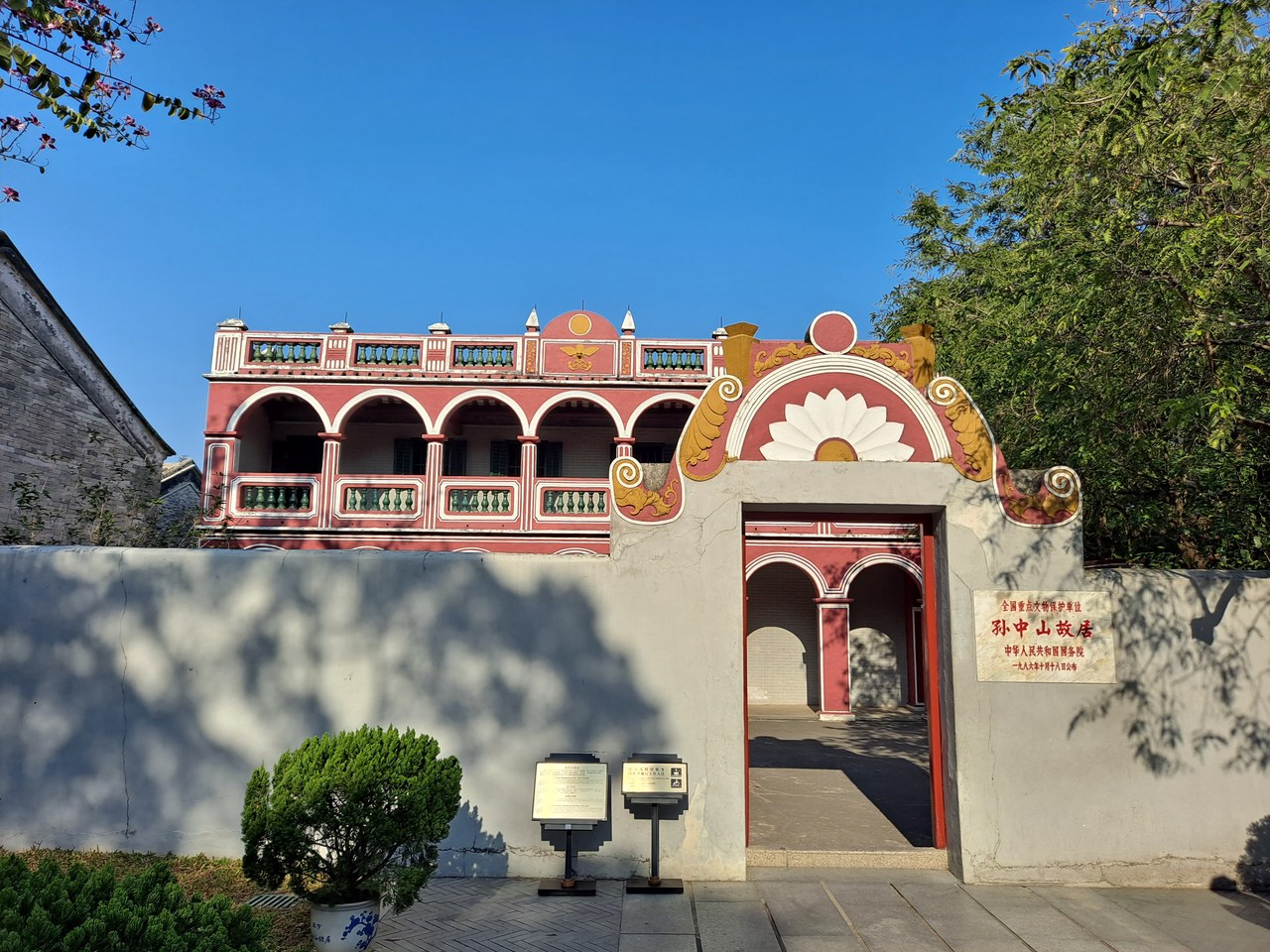
Sun Yat-sen’s former residence in Cuiheng, photographed in February 2023; the image illustrates the building, not current opening conditions.Photo: EditQ · CC BY-SA 4.0 · Image credits
A former shipyard reworked into a riverside landscape. · West side of the Qijiang · a separate park stop from the old streets
1–2 hours; shorten it in heat or rain · Ordinary outdoor park walk; indoor exhibitions have separate hours.
An old-city day and a Cuiheng day
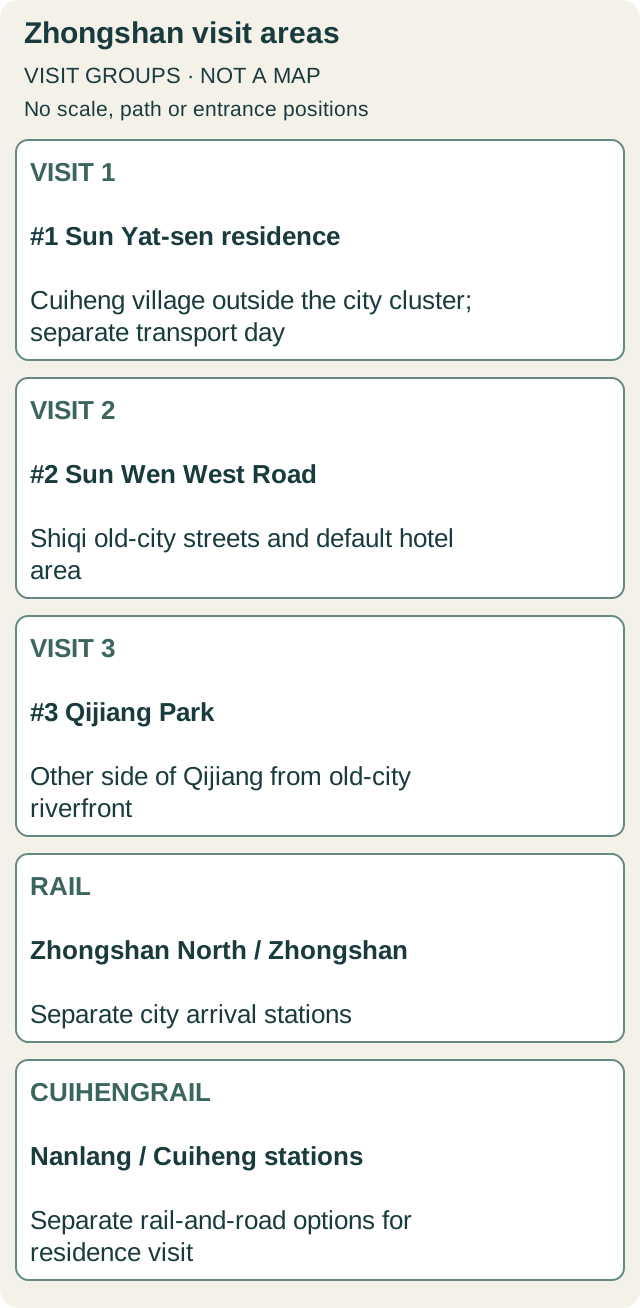
Open full-size map ↗. Cuiheng village outside the city cluster; separate transport day. Shiqi old-city streets and default hotel area. Other side of Qijiang from old-city riverfront. Separate city arrival stations. Separate rail-and-road options for residence visit. This is an editorial relationship diagram, not a navigation map; box position does not encode distance or an entrance. ChinaMile diagram; location sources. Navigation: search the Chinese name in Amap.
For the first full day, start with tea or breakfast in Shiqi, walk Sun Wen West Road and its neighbouring lanes, and have lunch nearby. Rest, then visit Qijiang Park in the late afternoon before a pigeon dinner. Do not stack every central museum into the same morning.
For the second full day, leave after breakfast for Cuiheng, visit the residence and main museum, then use the village-life displays or a short village walk to complete the outing. Return to Shiqi for an unhurried final dinner. Evening arrival plus these two days plus morning departure means three nights; one hotel is enough.
With only one full day, choose Cuiheng if modern Chinese history is your main interest, or the old-city and park combination for a gentler food-and-streets visit. With a third day, add a separate rural or coastal outing only after its transport is arranged. A place elsewhere in the municipality is not automatically an easy continuation on foot.
Dry, milder weather is easier for both village and city walks. In hot humid weather move outdoor sections to morning and late afternoon. During storms, keep to open indoor venues and drop riverside detours; a closed museum gallery is not a reason to enter a closed park.
Keep the first stay in central Shiqi
Default: the Sun Wen West Road–Xingzhong Square area. You can return to the hotel between street walks and dinner, while keeping a clear taxi route to Cuiheng. A room just outside the pedestrian core is often more convenient for luggage than one deep in a lane. Ask about street noise and the exact vehicle entrance.
The East District commercial centre offers another useful hotel base if you prefer larger modern properties and easy road pickup; budget transfers to the old city. Nanlang or Cuiheng suits a history-led overnight or a wider village plan, but makes central evenings less spontaneous. Zhongshan North station is useful for an early departure, not a substitute for checking your actual train’s station.
At Trip.com hotels, search Zhongshan with every night and all guests, then use the map around Sun Wen West Road, Xingzhong Square or the selected East District address. Compare the actual entrance, room type, cancellation terms and full total. Confirm foreign-passport check-in and a late arrival with the property before paying a non-refundable rate. These are area choices, not inspected hotel endorsements.
Pigeon in Shiqi, with room for breakfast tea
Shiqi roast pigeon / 石岐乳鸽 is a useful first dinner choice. It is served on the bone; ask whether the listed price is per bird, then add vegetables and rice rather than ordering several large mains for two people. Choose a restaurant near your base so the meal does not create a new cross-city journey.
Crisp grass carp / 脆肉鲩 is valued for its firm texture and may be served in a hotpot or another cooked preparation. Confirm whether the price is for a portion, weight or whole fish and how cooking is charged. A small party should settle portion size before agreeing to a whole-fish order.
A Cantonese tea-and-dim-sum breakfast fits the city morning: steamed buns, rice-noodle rolls and dumplings can be ordered gradually. Tea and table charges may be separate. Almond-style biscuits / 杏仁饼 make a practical small souvenir; ingredients vary, so read the package for nuts, dairy, egg or lard instead of interpreting the name as an allergy guarantee.
On the Cuiheng day, eat breakfast before leaving and carry water. Have a straightforward lunch by the visitor area or after returning to town; a specific village restaurant is not essential to the plan. Tell staff about dietary restrictions before ordering broth, sauces or stuffed snacks.
Keep the Cuiheng transfer visible in the budget
For two adults sharing one room, three nights and two full days, use 3R + F + T + X. R is the actual nightly room total, F all meals from arrival dinner through departure breakfast, and T city transport plus the outward and return Cuiheng journey and two city-station transfers. X covers optional paid attractions. The ordinary street/park route and the residence museum have no general admission charge.
Example editable inputs: R = CNY 350, F = CNY 500–720, T = CNY 220–420 and X = CNY 0–100. Total: CNY 1,770–2,290 for two, or CNY 885–1,145 each. These are allowances, not live quotes. The high transport input allows more road travel; it does not quote a guaranteed taxi fare. X = 0 means skipping separately ticketed extras.
Exclude intercity trains, airport transfers, private guides, shopping, alcohol and any extra overnight away from Shiqi. Replace T with your actual return-transfer quote if hiring a driver; do not silently add a private car on top of an assumed low public-transport budget.
Three places, arranged around two different districts
1. Sun Yat-sen’s former residence and memorial museum · 孙中山故居纪念馆
The red-and-white family house makes the visit tangible: Western-influenced arches and local domestic forms sit within a village rather than a monumental city square. Pair the exterior and permitted house-viewing areas with the biographical exhibition so the building becomes part of a life story, not just a photograph.
The wider memorial site includes displays of Cuiheng village life and local traditions. Choose the core residence, main museum and a short village walk. The neighbouring Zhongshan film-city attraction is a separate product of recreated settings; it is not required to understand the actual former residence. Do not expect every special exhibition to be open.
Hours
Current operator notice: daily 09:00–17:30, last admission 17:00. Public holidays and Golden Weeks throughout the year, plus May–September weekends, extend to 18:00 with last admission 17:30; a weekend designated as a working day follows the normal schedule. Use the operator’s current announcement for exceptions.
Tickets
The current Chinese operator notice permits ordinary visitors to enter after security without booking; older online reservation instructions are superseded. Capacity controls still apply. Carry your original passport; the security/document handling was not field-tested. For a document or access question, call +86 760 28158366 before the journey.
Time
3–4 hours, plus outward and return transport
Chinese address
广东省中山市南朗街道翠亨村,孙中山故居纪念馆。
Getting there
Use a taxi or agreed return transfer from Shiqi, showing the full Chinese museum name. The operator lists buses 082, 218, K26 and K28 at 孙中山故居(杨殷故居); check the live boarding stop and return departure before relying on a specific bus. Nanlang / 南朗 or Cuiheng / 翠亨 rail stations still need a local connection.
How to visit
Morning arrival → security → residence → main historical exhibition → village-life section → lunch and return to Shiqi. Save the road pickup before entering. If a gallery closes, the other open core sections can still justify the visit; do not substitute the film city without deciding you want reconstructed scenery.
2. Sun Wen West Road and the Shiqi old centre · 孙文西路 · 石岐老城
Look at the continuous street front rather than one building: covered pavements, balconies and mixed Chinese and overseas-influenced details express the city’s trading connections. The street is restored and commercial, with present-day shops alongside heritage façades. A short walk with time to look up is better than racing between shop signs.
Use the river end near Xingzhong Square as one anchor and the lanes toward Sun Wen Middle Road as the other. The Xiangshan Commercial Culture Museum can add depth when open, but do not confuse it with the Sun Yat-sen residence in Cuiheng. The public route remains complete if you only see the streets and choose a seated local meal.
Hours
Visit the outdoor streets in daylight into early evening. Individual museums, temples, cafés and shops operate separately; no combined street opening time guarantees access to interiors.
Tickets
No general pedestrian-street ticket. If choosing an interior or the commercial observation wheel, check that operator’s actual ticket and opening notice; these are excluded from the core route.
Time
2–3 hours including a meal or tea stop
Chinese address
中山市石岐街道孙文西路文化旅游步行街,近兴中广场。
Getting there
Taxi to 孙文西路步行街 or 兴中广场, then walk. Choose a return pickup outside the pedestrian lanes. From a central hotel, walk only if the actual entrance is nearby rather than relying on a broad district label.
How to visit
Arcade walk → pause for tea → nearby lanes or an open museum → dinner. Cross busy streets at marked crossings; take a short road transfer if heat or mobility makes a longer link unsuitable.
3. Qijiang Park · 岐江公园
Qijiang Park changes the subject from merchant houses to industrial work. Retained shipyard elements, steel structures and waterside spaces are part of the landscape design. It rewards a slow look at how a working waterfront was reused, rather than a long list of monuments.
Combine it with the Sun Wen West Road day after a break, but keep the bridge and street transfer visible in the plan. The art museum is an optional indoor addition if its current exhibition and opening arrangements suit you. The park itself is the reason for this stop; no scheduled show is required.
Hours
Use open public paths in daylight. Follow posted access restrictions after heavy rain or maintenance. Indoor museum hours are not the park’s hours.
Tickets
No general charge for the ordinary public park route. Optional exhibitions, refreshments and nearby commercial venues are separate.
Time
1–2 hours; shorten it in heat or rain
Chinese address
中山市西区岐江公园,岐江河畔。
Getting there
From the Xingzhong Square side, follow a pedestrian route across the river to the park; use a taxi if the particular bridge approach is inconvenient or closed. Save 岐江公园 as the destination, not just 岐江河, which names a much longer river corridor.
How to visit
Enter the open park → look at retained industrial structures → short riverside circuit → return to the named entrance. In bad weather, use an indoor meal or café in the city instead of extending the exposed river walk.
Choose the station for the part of Zhongshan you are visiting
Zhongshan North / 中山北 is a useful station to compare for a Shiqi stay; Zhongshan / 中山 is another distinct city gateway. Search both on China Railway 12306 for your actual date and origin, then compare the road transfer to the hotel. “Zhongshan” in a journey search can conceal a change of station or district, so read the booked ticket.
Use a licensed taxi or a current city-bus route from the station. Save the hotel’s Chinese name and exact entrance. For the return train, allow for the road journey, station security and any passport check; do not arrive at the building at the printed train departure time.
For Cuiheng only, compare suitable trains to Nanlang / 南朗 or Cuiheng / 翠亨, then the local bus or taxi to the residence. A station named Cuiheng is not the museum gate. The museum’s service page lists the current access options and consultation number. Confirm a return train and local connection before treating this as a same-day stop with luggage.
Zhongshan has no city airport serving this plan. If arriving through Guangzhou, Shenzhen or Zhuhai, choose the actual airport-to-Zhongshan transfer for your arrival time: rail with its required city interchange, an operating coach, or a licensed prearranged car. A cross-estuary bridge does not make all airport journeys equally short, and no 24-hour coach or direct airport train is promised here. Late arrivals should go to the hotel, with Cuiheng left for the following morning.
Connect city stays without repeating the same day
Guangzhou adds large-city museums, food and river districts; Zhuhai adds a different coastal setting. Use actual train availability and station locations to choose the order. Give the transfer part of a day rather than counting it as a full sightseeing day at both ends.
Current entry rules take priority over older booking guides
Sources checked on . The residence museum’s current Chinese visitor notice says ordinary visitors enter free after security without a reservation; older reservation instructions were not carried forward. Passport handling, hotels and paid extras were not field-tested. The city sources establish the separate Cuiheng and Shiqi areas, local dishes and walking connections; no exact taxi fare, bus interval or airport connection is promised. Times allowed, route choices and budget inputs are editorial judgments.