Chaozhou Leave space between the bridge and the next meal
Choose Chaozhou for an old town you can explore between meals: stone archways over busy lanes, temple courtyards, small cups of tea and Guangji Bridge stretching into the Han River. Stay two nights on the old-town side of the river, with one full sightseeing day and useful arrival and departure half-days.
The best first visit stays mostly in the historic centre. Visit the bridge from the old-town side, and give the east bank a separate outing if you want Han Yu’s shrine; do not make the historic bridge your only way back. This plan suits travellers who enjoy architecture, food and short walks with pauses. It does not require a hired car for the whole stay or a race through every Chaoshan city.
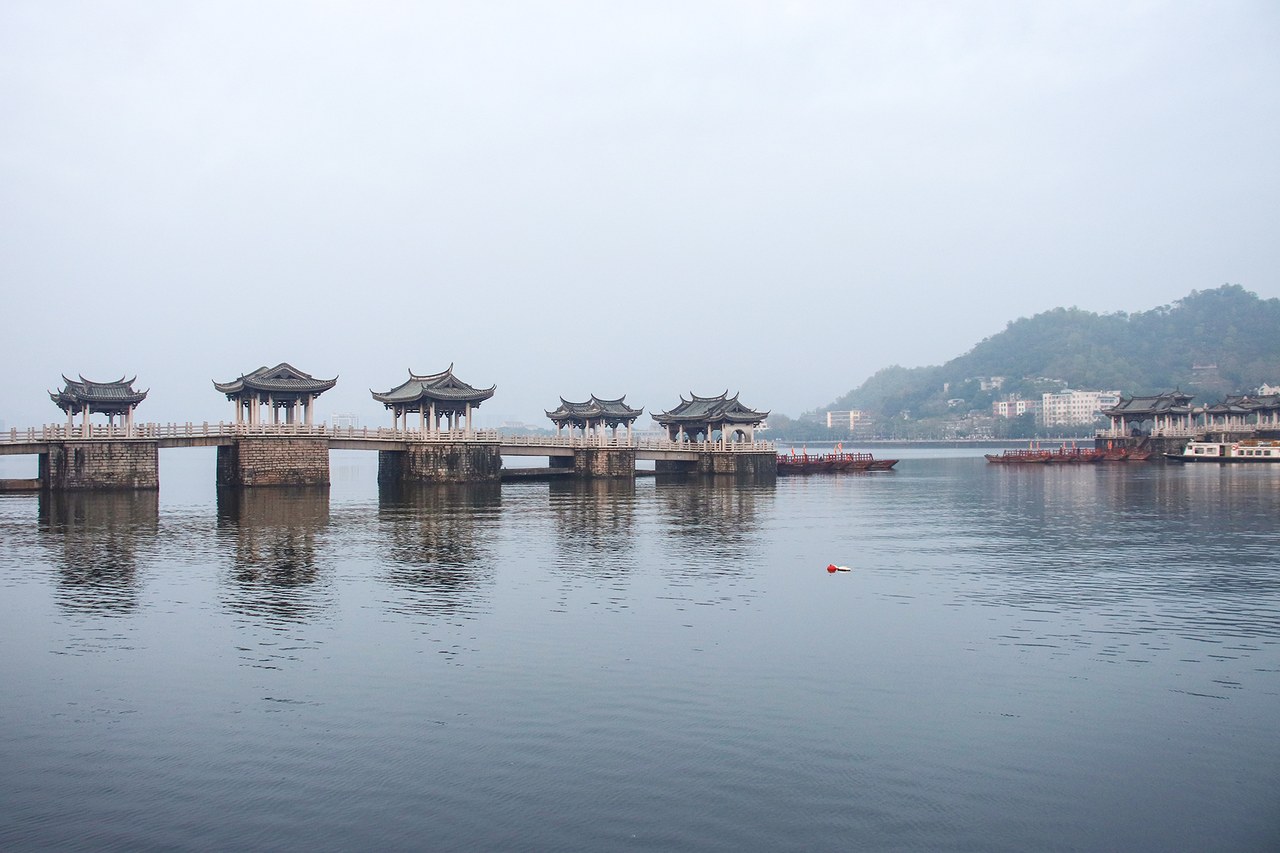
Guangji Bridge with its centre open, photographed in February 2023; not evidence of today’s access.Photo: Windmemories · CC BY-SA 4.0 · Image credits
A hillside setting, inscriptions and Chaozhou’s connection with the writer Han Yu. · East bank · opposite the old town
1–1.5 hours, longer with rests · Generally free; secure the required visitor arrangement before the east-bank outing.
Two nights for the old town, bridge and an optional east-bank outing
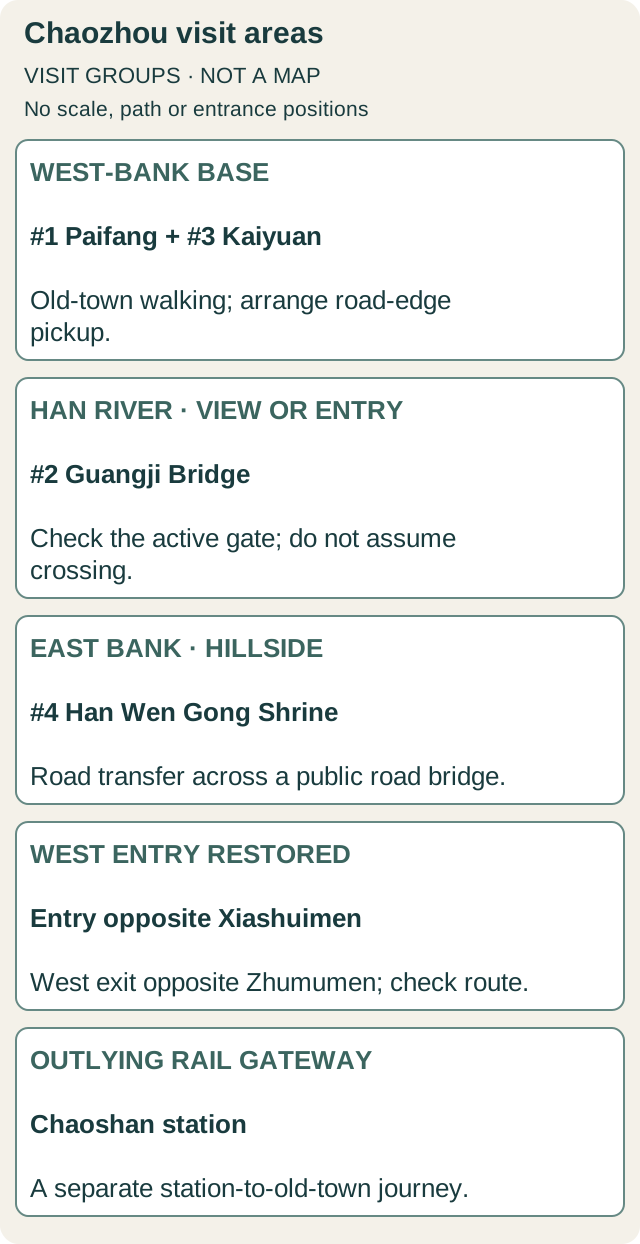
Open full-size map ↗. Paifang Street and Kaiyuan Temple form the west-bank old-town block. Use the restored west gate for the bridge; Han Wen Gong Shrine remains a separate east-bank outing. A through-crossing must not be assumed. This is an editorial relationship diagram, not a navigation map; box position does not encode distance or an entrance. ChinaMile diagram; location sources. Navigation: search the Chinese name in Amap.
Arrival half-day: settle into the west-bank old town
Arrive around lunch, complete the station-to-hotel transfer and drop bags. Walk a manageable Paifang Street section, pause for tea and have a proper dinner. Finish with a short riverbank view only if weather and public access allow. There is no need to chase the bridge’s last admission on arrival day.
Full day: old-town morning, bridge afternoon
Visit Kaiyuan Temple in the morning if open, then continue the nearby lanes and eat lunch. Use the west entrance for a bridge visit after checking that day’s route. If Han Wen Gong Shrine is a priority and admission is confirmed, replace part of the lane time with a separate east-bank outing and arrange the road return. Do not add two river crossings merely to reach the bridge. Eat dinner back in the old-town district.
Departure half-day: breakfast, one small walk, collect bags
Use a nearby breakfast place, revisit a favourite lane and buy only what you can comfortably carry. Collect bags before the transfer to Chaoshan station or the airport. With an early departure, this is a travel morning; add a third night if you also arrive late and want the full two-day experience.
Only one day
Choose the old-town lanes, Kaiyuan Temple if open, lunch and a west-bank bridge view. A paid bridge visit fits from the west entrance; shorten another block if queues are long. Shantou and Nan’ao are different excursions, not automatic add-ons to this first day.
Use the old-town edge with a clear luggage pickup
Old-town edge on the west bank / 湘桥区古城西岸片区 is the default for walking and meals. Choose a property with a usable road-access point rather than assuming a taxi can reach a room deep inside a lane. Ask how far bags must be carried, whether there are stairs or a lift, and which room faces away from evening street noise.
The east bank / 桥东 suits a river-facing stay or a quieter property you specifically want, but creates extra transfers for repeated old-town meals. Chaoshan station / 潮汕站 is an arrival hub outside the old-town core; staying there is useful for a particular train, not the default for this itinerary.
Use your usual accommodation service with Chaozhou, your dates, the old-town map area and the real guest count. Choose the room and cancellation terms, then have the property confirm passport check-in and your arrival time. See foreign-passport hotel check-in. This guide recommends areas, not a list of inspected hotels.
Give snacks a role in the day, and keep one seated dinner
Start near your hotel with beef-ball noodle soup / 牛肉丸粿条 or another clearly priced noodle breakfast. Tell the shop if you do not want offal, and ask about the broth rather than assuming a vegetable-looking bowl is vegetarian. A light breakfast leaves room for lunch after the old-town walk.
For dinner, choose a braised goose / 卤鹅 plate with rice and vegetables, or a beef hotpot / 牛肉火锅 meal if that is your priority. For hotpot, check the unit and weight of each meat order and the separate pot or sauce charges. Two adults do not need to order every cut. For seafood, agree the total before cooking; a fixed-price dish is simpler than an unclear live-weight order.
In the Paifang Street area, try yamunian / 鸭母捻: filled glutinous-rice dumplings in a sweet soup. Recipes can include peanuts, sesame or animal fat, and the soup may contain egg or other additions. Ask for ingredients rather than relying on the sweet appearance. Old published snack prices are not used as current menu quotes here.
A gongfu-tea / 工夫茶 stop fits between two walking blocks. Agree whether the charge is per person, per pot or for a tasting service before sitting down. A pot of tea and time to rest are enough; you need not buy packaged tea or ceramics. If a famous shop has a long queue, another clearly priced place in the same district preserves more of the day.
Calculate for two adults, then add the actual arrival transfer
For two adults sharing one room, two nights, one full day and two useful half-days, plan 2R + CNY 620–920. R is your actual all-in nightly room quote. The remainder is an editorial target: CNY 400–560 for the party’s meals and tea, CNY 180–320 for local transport and CNY 40 for two bridge admissions using the published CNY 20 reference. Replace that reference with the actual dated ticket if it differs.
Entering R = CNY 350 gives CNY 1,320–1,620 for the party. This is arithmetic using an assumed room price, not a live offer. The transport allowance covers the city outing, not a guaranteed taxi fare; fewer taxi journeys can lower spending, while a long wait or expensive quote can raise it. If you skip paid bridge access and stay with public views, remove the actual ticket cost.
Exclude travel to/from Chaozhou, both station or airport transfers, shopping, a guide, premium tea purchases, a large seafood meal and any extra paid historic-house interiors. Add the real arrival and departure transfer quotes before deciding the total. Free shrine or temple admission does not mean reservations, access or a private tour are guaranteed.
Old-town lanes first; river sites with a return plan
1. Paifang Street and the old-town lanes · 牌坊街 · 太平路
Paifang Street is the easy starting point: archways interrupt the long view along Taiping Road, while the shopfronts bring the streets back into everyday use. Look up at the differences between the archways, then turn into one or two public side lanes instead of trying to cover the whole old town in a straight line.
This is a living commercial and residential area, not a single museum enclosure. Expect a mixture of older buildings, restoration, food shops and contemporary businesses. A tea break is useful in its own right; you do not need to buy a tea set or book an elaborate cultural package to enjoy a small part of the city.
Hours
Visit in daylight for the architecture, then return for dinner or a short evening walk. Shops, temples and historic-house interiors set their own opening times.
Tickets
The proposed public streets need no combined ancient-city ticket. Check the exact admission if you add a historic-house interior or exhibition; a sales package is not mandatory for this lane walk.
Time
Half a day is a comfortable allowance including Kaiyuan Temple if open, a meal and tea. Shorten the walking section in heat or crowds.
Chinese address
潮州市湘桥区太平路牌坊街、开元路及周边公共街巷。
Getting there
From an old-town-edge hotel, enter at the nearest signed public street. Taxis may need to stop outside pedestrian or controlled lanes; save the hotel’s agreed pickup and bag-drop point.
How to visit
A chosen Paifang Street section → Kaiyuan Temple if open → lunch → one or two side lanes → tea break. Save the riverside for a later, cooler block.
2. Guangji Bridge and the Han River · 广济桥 · 韩江
The interest is the bridge’s changing structure as much as its skyline: pavilion-covered stone sections face a central stretch connected by boats when operations allow. From the bank, you can understand the overall shape; from the permitted bridge sections, the view becomes a sequence of roofs and river openings.
The bridge is an attraction with operating controls, not a dependable all-day pedestrian crossing. A management notice dated 30 September restored the west entrance from 1 October. Start on the old-town side; ask staff which sections and exit are available that day. A riverside evening is optional; no light-show time is promised.
Hours
Check the current gate notice for your date; the reopening notice’s 09:00–17:30 hours and 17:00 last entry applied to the National Day holiday, not an established year-round timetable. Visit in the middle of the day and leave room for weather or access changes.
Tickets
The operator’s published historical standard tariff is CNY 20 per adult; confirm today’s ticket and open sections before payment. Temporary access arrangements may change the product. If a mini-program cannot accept your passport, take the original to official ticket staff and request the correct process; no passport checkout was tested.
Time
1–1.5 hours on the permitted bridge route, with a nearby west-bank start for the old-town plan.
Chinese address
潮州市湘桥区广济桥西桥段入口及售票处:下水门对面;西桥段出口:竹木门对面。
Getting there
Walk from the old town to the west ticket entrance opposite Xiashuimen / 下水门; the notice places the west exit opposite Zhumumen / 竹木门. Follow the current signs. A separate east-bank shrine visit needs its own confirmed transport plan.
How to visit
Confirm the permitted sections and exit at the west gate → buy the correct ticket → visit the allowed route → leave through the designated exit. Do not assume the floating section gives an unrestricted through-crossing.
3. Kaiyuan Temple · 开元寺
Kaiyuan Temple changes the pace from the shopping streets without requiring a trip to another district. Walk slowly through the areas open to visitors, notice the carved details and leave space for worshippers. It is useful as an old-town morning stop, not as a promise that every hall or ceremony is available to tourists.
Chaozhou’s Kaiyuan Temple is a different place from the temple of the same name in Quanzhou. Save the full Chinese destination with Chaozhou before navigating. Dress and behave for a functioning religious site, and follow photography instructions inside halls.
Hours
The platform listing describes a daytime visit with a midday break. Aim for 09:00–11:00 or early afternoon after 13:00, then follow posted gates and worship arrangements; a current temple-issued full timetable was not established here.
Tickets
The reviewed visitor listing describes free admission. Donations and purchases are optional; use the actual gate instructions for any special access arrangement.
Time
45–75 minutes as part of the same old-town walk.
Chinese address
广东省潮州市湘桥区开元路32号,潮州开元寺。
Getting there
Walk from the Paifang Street/Kaiyuan Road area; choose the marked visitor entrance. Do not use a Quanzhou search result for this temple.
How to visit
Old-town lanes → open temple courtyards and halls → nearby lunch. If closed for worship or a break, continue the public lanes and return later if convenient.
4. Han Wen Gong Shrine · 韩文公祠
This is the strongest optional addition for someone interested in literature and Chaozhou’s historical identity. The buildings and inscriptions commemorate Han Yu; the hillside approach gives the visit a different feel from the flat commercial streets. Expect steps, and decide whether that effort matches your party.
Give the shrine its own east-bank outing, with a road return arranged. You may combine it with an east-side bridge visit if staff confirm the gate and route, but the bridge can also be visited separately from the old-town side. If shrine admission cannot be arranged, the slower old-town and west-entry bridge day remains complete.
Hours
Ctrip lists Tuesday–Sunday 08:30–17:30, last entry 17:00, normally closed Monday except statutory holidays. Check the visitor arrangement for your date on +86 768 2523581, particularly when holiday or weather notices override the ordinary pattern.
Tickets
Admission is generally listed as free, but reservation/identity handling must be confirmed. The current online foreign-passport route was not established. Contact the shrine with your date and document type before crossing the river; carry the original passport and do not enter a fabricated Chinese ID.
Time
1–1.5 hours for the shrine and inscriptions, with extra pauses for the hillside steps.
Chinese address
潮州市湘桥区东兴北路,韩文公祠。
Getting there
Use a taxi to 韩文公祠 for the outward trip from an old-town hotel. The shrine and the eastern bridge entrance can be one district block, but ask staff for the open pedestrian approach and your return pickup.
How to visit
Confirmed shrine visit → break → return by road to the old-town base. An east-side bridge visit is optional only after gate and exit confirmation. On an ordinary closed Monday, omit the shrine rather than treating a free listing as guaranteed entry.
Chaoshan station is the rail gateway, not the old town
Arrive by rail
For high-speed trains serving this visit, start with Chaoshan / 潮汕站 on 12306. Select the exact departure city, date and passenger document. Do not assume a ticket to Shantou / 汕头 or another similarly named station delivers you to Chaozhou’s old town.
From Chaoshan station, use the signed licensed-taxi rank to the hotel’s road-access point for the simplest luggage transfer. A bus can cost less if its current stop works for your lodging: the Transport Bureau names 潮州粤运, 车来了 and 掌上公交 as local query channels. Show 潮州古城 / 牌坊街 and your hotel address to staff, confirm the actual departure and final walk, and use a taxi if the service or last leg is unsuitable. No fixed fare, frequency or late-night bus guarantee is implied.
Arrive by air
Jieyang Chaoshan International Airport / 揭阳潮汕国际机场 serves the region. China Eastern’s airport guide gives airport-express enquiries as +86 663 3828788 and notes that stops and timetables can change. At the arrivals counter ask for the current Chaozhou service and its actual drop-off before buying; a signed airport taxi to the hotel is the direct alternative. A bus labelled Shantou is not automatically the Chaozhou route.
Move within Chaozhou and leave on time
Walk within the old town, use road transport between riverbanks, and keep the same hotel base. Confirm the return pickup outside any controlled lane. For departure, collect bags first and use the booked station or airport name, your carrier’s check-in cutoff and a live road allowance. Do not rely on a floating bridge section or an unconfirmed last bus to make a train.
Protect the useful part of the visit
Choose daylight for architectural detail and take seated breaks in hot or wet weather. A covered shopfront can shelter a short shower but is not a safe plan during a severe-weather closure. River levels, wind and maintenance can change bridge access; if staff cannot confirm the route, enjoy an open public-bank view and keep the old-town meal-and-lane day.
The newer reopening notice supersedes the earlier west-approach closure. Confirm the actual gate, permitted bridge sections and exit before payment; a restored entrance does not guarantee an unrestricted river crossing. The foreign-passport booking paths for bridge and shrine were not tested: ask official staff before payment or the east-bank transfer. If shrine admission cannot be arranged, skip it; no other essential stop depends on entering it.
For reduced mobility, use a short street section with a nearby seated meal and direct pickups. The shrine has a hillside approach, old buildings have thresholds and the bridge includes uneven transitions; no continuous step-free circuit is claimed. Ask the specific venue about the route your party needs.
Continue along the rail corridor, with a new base
Xiamen and Quanzhou offer a natural contrast for a longer southeastern trip; compare dated services from Chaoshan station and give the next city its own nights. Guangzhou is another separate rail move. Shantou and Nan’ao can extend a Chaoshan stay, but their transfers and island conditions belong in an additional day, not in the default Chaozhou plan.
Shantou has its own city guide and hotel-base decision. Choose it as a separate Chaoshan stop, using the actual booked station and allowing for the hotel transfer; it is not one more Chaozhou old-town attraction.
What was checked and what remains conditional
Sources read on . The west-entry plan follows the newer 30 September notice signed by the city’s Ancient City Cultural Relics Protection Centre, republished on Sohu; its holiday hours are not treated as a permanent schedule. The CNY 20 bridge tariff is an older operator-attributed notice, used as a budget reference rather than a newly quoted sale. Shrine and temple operating details come from current platform listings where a direct operator page was not available. No foreign-passport purchase, admission, hotel or transport transaction was tested. Visit sequences, time allowances and spending targets are editorial choices. Follow current gate notices, actual orders and weather controls if they differ.