Zhaoqing Two landscapes, two days, one practical city base
Zhaoqing gives you two distinct outdoor experiences: the limestone outcrops and open water of Seven Star Crags, then the shaded paths, waterfall and temple setting of Dinghu Mountain. Stay in the older Duanzhou city area for dinners and a short look at its walls and arcaded streets. That combination is more rewarding than squeezing both scenic areas into one rushed day.
Choose two full days for both landscapes. With one day, prioritise Seven Star Crags for the characteristic lake-and-rock views, or Dinghu Mountain if forest walking is the main reason you came. You can still enjoy the public city lakefront without buying every optional boat or sightseeing-car package.
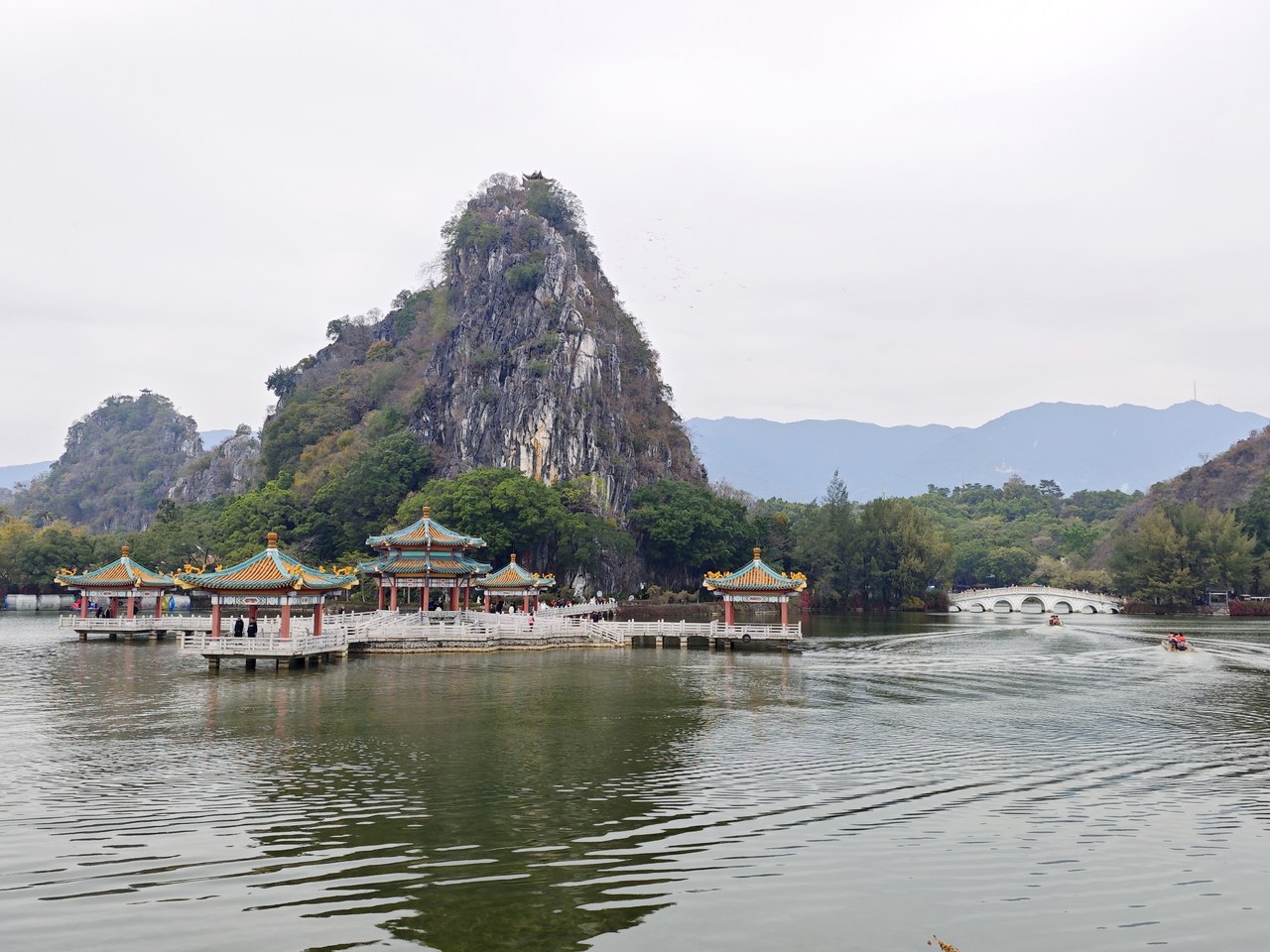
Wulong Pavilion and Qixing Bridge in the Seven Star Crags scenic area, photographed in February 2026. Boats in the image do not establish current service times.Photo: Jasonjiang.1998 · CC BY-SA 4.0 · Image credits
A short urban-history walk between the two nature days. · Old Duanzhou · Songcheng streets, south of the lakefront
2–3 hours, or a shorter evening street walk · Public street route; wall-top sections and cultural interiors follow their own notices.
Keep Seven Star Crags and Dinghu Mountain on separate days
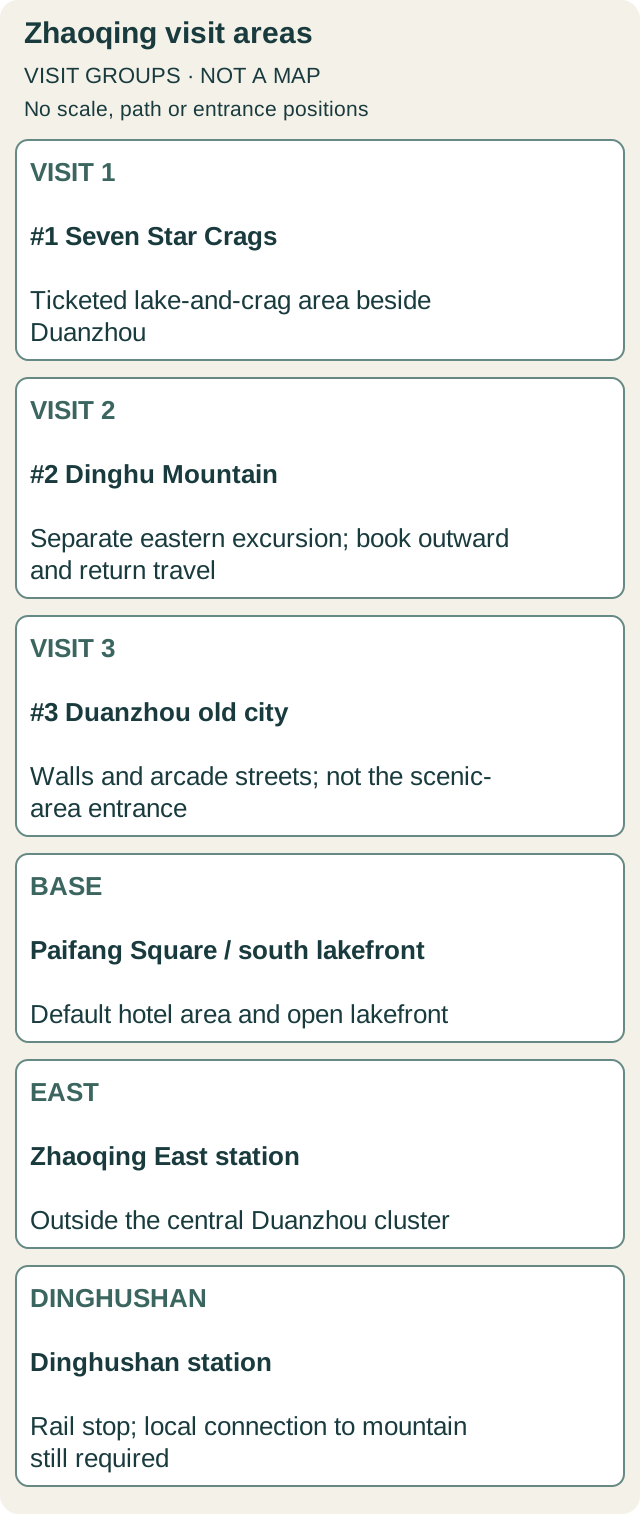
Open full-size map ↗. Ticketed lake-and-crag area beside Duanzhou. Separate eastern excursion; book outward and return travel. Walls and arcade streets; not the scenic-area entrance. Default hotel area and open lakefront. Outside the central Duanzhou cluster. Rail stop; local connection to mountain still required. This is an editorial relationship diagram, not a navigation map; box position does not encode distance or an entrance. ChinaMile diagram; location sources. Navigation: search the Chinese name in Amap.
Arrival evening: check into Duanzhou, have dinner and make a short open-lakefront walk if conditions suit. First full day: visit Seven Star Crags in the morning through early afternoon, return for a rest, then choose a small old-city section and dinner. A full scenic-area circuit plus every wall and museum is unnecessary.
Second full day: leave after breakfast for Dinghu Mountain, choose the waterfall-and-temple route, have a simple lunch, and return to Duanzhou with daylight and transport margin. Evening arrival, these two full days and next-morning departure means three nights. You can keep one hotel throughout.
With only one full day and two nights, choose Seven Star Crags + a short city walk, or Dinghu Mountain alone. With a third day, use an unhurried old-city and local-history day or more open lakeside walking. Duan inkstone craftsmanship is a useful theme for shoppers or calligraphy enthusiasts; view an actual workshop or exhibition on its current opening terms, and do not confuse a sales claim with an independent quality appraisal.
For limited mobility, the open city lakefront and selected flatter scenic paths are the easier starting point. Ask specifically about steps on the chosen route and vehicle stops; neither a mountain ticket nor a sightseeing-car ticket guarantees a step-free visit. In storms or heavy rain, switch to open indoor city venues and meals rather than forcing the forest itinerary.
Duanzhou for a first visit; Dinghu for a mountain-led stay
Default: southern Xinghu near Paifang Square, in Duanzhou. This keeps city dinners and an evening lakefront within reach and leaves a clear road excursion to Dinghu Mountain. Check the actual gate and road pickup: a “Seven Star Crags” hotel can be on a different shore from the route you want.
The north or east side of Seven Star Crags suits a quieter lake-focused stay if the exact property and dining options work for you. Dinghu near the mountain entrance makes sense for an early forest start or an extra mountain night, but changes the old-city evening. Zhaoqing East station is useful for an early train; its location is not the same as central Duanzhou.
At Trip.com hotels, search Zhaoqing with every night and all guests, then use the map around Duanzhou, Paifang Square or the exact selected Xinghu shore. Compare the actual entrance, room type, cancellation terms and full total. Confirm foreign-passport check-in and a late arrival with the property before paying a non-refundable rate. These are area choices, not inspected hotel endorsements.
Start with guozheng, then order a simple Cantonese meal
Zhaoqing guozheng / 肇庆裹蒸 is the distinctive local rice parcel: glutinous rice, mung beans and usually pork, wrapped in leaves. A large one can be substantial, so buy one to share as a snack or breakfast before adding more food. Ask whether it is ready to eat, freshly cooked or packaged for reheating.
For dinner, choose a cooked fish dish, chicken or another Cantonese main with vegetables and rice. If ordering fish by weight or a whole fish, settle the weight, preparation charge and total before cooking. Local menus also feature regional ingredients such as zhaoshi / 肇实; they are not compulsory dishes, and dietary claims are not part of this guide.
On the mountain day, eat breakfast first and carry water plus a small snack. Confirm any temple or scenic-area meal’s actual serving time before relying on it for lunch. A vegetarian-looking dish may still use meat broth; describe restrictions before ordering. Return to Duanzhou for the more flexible dinner choice.
Count two scenic-area entries and a mountain return
For two adults sharing a room, three nights and two full days, use 3R + F + T + A + X. R is the nightly room total, F meals from arrival dinner to departure breakfast, T city-station transfers and local travel including the Dinghu return, A standard attraction admission, and X optional vehicles or other paid extras.
Example inputs: R = CNY 350, F = CNY 480–700, T = CNY 200–360, A = CNY 240–280, X = CNY 0–120. Total: CNY 1,970–2,510 for two, or CNY 985–1,255 each. The A range compares two CNY 120 combination tickets with four CNY 70 single-area entries, using the operator’s published reference tariffs. Confirm the current product, validity and availability before purchase; use the actual checkout amount if different.
All other figures are editable planning allowances, not live quotes. X = 0 assumes walking without separately paid extras. Intercity fares, airport transfers, guides, shopping and additional nights are excluded. A hired car with waiting should replace T with the actual quote, rather than being hidden inside a public-transport estimate.
Lake crags, forest mountain and an old-city counterpoint
1. Seven Star Crags · 七星岩
The strongest first visit is a selected lakeside route with changing angles on the crags. Walk toward the central rocks, pause near the bridges and pavilions, and look for permitted rock-inscription areas. You do not have to climb every peak, take a boat or visit every cave to understand the setting.
Choose one staffed gate that works with your hotel and ask for the current pedestrian route before entering. Wulong Pavilion and Qixing Bridge are recognisable viewpoints, but maintenance can affect individual links. Plan to finish at a known gate; the ticketed scenic area is not the same thing as the whole public Xinghu lakefront.
Hours
Start in the morning and use daylight for the main visit. Check the current gate opening and final admission with the operator before travelling: +86 758 2302838. The published tariff alone does not establish today’s gate hours.
Tickets
The operator lists CNY 70 for one area and CNY 120 for the Seven Star Crags + Dinghu Mountain combination. Its ticket guide states single entry for a single-area ticket and two-day validity for the combination. These are published reference terms, not a tested checkout. Confirm the current product and document handling at the official sales channel or staffed gate; boats, caves or sightseeing cars may be separate.
Time
4–5 hours at a relaxed pace
Chinese address
广东省肇庆市端州区七星岩景区;选择东门、北门或当日开放的合适入口。
Getting there
From a Duanzhou hotel, take a city bus or licensed taxi to the specific staffed gate you intend to use. Do not set the drop-off only as 七星岩牌坊: the city square and a scenic-area entry gate are different locations. Save a gate pickup for the return.
How to visit
Selected entrance → central lake-and-crag walking route → pavilions and inscriptions where open → return to the chosen gate. Add a boat only after checking destination, price and final return. Skip steep steps in heat or wet conditions and keep the lakeside portion.
2. Dinghu Mountain · 鼎湖山
Dinghu Mountain is the forest counterpart to the open lake scenery. A first visit can focus on the Feishuitan waterfall route and Qingyun Temple, using the currently open signed paths. Decide your walking distance at the entrance rather than committing to a route that climbs beyond your energy or the weather.
Baoding Garden and the Butterfly Valley area are possible extensions, with additional transport or activity arrangements. They are not necessary for a satisfying waterfall-and-temple visit. A sightseeing vehicle reduces some road walking but does not make every attraction step-free; check where it actually stops and which remaining paths use stairs.
Hours
The operator’s published ticket guide lists ticket sales 08:00–18:00 and Qingyun Temple 08:00–17:00. Plan a morning arrival and daylight return, and confirm current access or weather closures on the day. Do not treat ticket-sale hours as a promise that every trail or vehicle operates equally late.
Tickets
The published standard entry is CNY 70, or the operator-listed two-area combination at CNY 120 under its current sale conditions. Confirm optional sightseeing-car stops and the final downhill service before boarding. Carry the original passport; online passport purchase was not tested. For ticket or entry help: +86 758 2623877.
Time
Most of a day including return transport
Chinese address
广东省肇庆市鼎湖区坑口,鼎湖山景区入口。
Getting there
Use a current bus route or a licensed taxi from Duanzhou to 鼎湖山景区游客入口. Agree the return meeting point before entering. Dinghushan railway station / 鼎湖山站 is a transport stop, not the mountain gate; it still needs a local connection.
How to visit
Entrance and current route board → waterfall/forest walk → Qingyun Temple if open → return while transport is operating. On heavy-rain or closure days, use the Duanzhou old-city alternative. Stay on marked paths and do not walk into closed forest sections to avoid a ticket or save time.
3. Duanzhou’s old streets and city walls · 端州古城 · 宋城墙
The old-city walk adds the urban setting behind the scenery: stretches of defensive wall, lanes and the restored Songcheng arcade district. Use the area around Songcheng Road and the public approaches to Chaotian Gate or Piyun Tower as orientation points. The walls are not a licence to climb any staircase you find; enter only where the site is open.
Choose a compact section rather than attempting the entire historic circuit after a long mountain walk. A guozheng snack and a look at the façades can be enough. Paifang Square and the open southern lakefront form another gentle city stop, but they are a separate walk from the wall area and do not include admission to Seven Star Crags.
Hours
Daylight helps with the wall and architecture. Public streets continue into the evening, while wall access, towers and museums keep separate hours. Do not plan around a light or fountain show without an actual same-day schedule.
Tickets
No combined attraction package is needed to walk ordinary public streets and the open city lakefront. Read posted conditions for wall-top access, towers or museum interiors; the core city alternative does not depend on entering them.
Time
2–3 hours, or a shorter evening street walk
Chinese address
广东省肇庆市端州区宋城路、朝天门、披云楼一带;湖边另一处为七星岩牌坊广场。
Getting there
Walk between nearby old-city stops using mapped crossings, or take a short taxi from the lakefront hotel area. Use the specific street or entrance as the destination; the entire historic district is too broad for a pickup pin.
How to visit
Choose one wall approach and the adjoining arcade streets → snack or meal → return to the hotel. If adding Paifang Square, allow for the city link rather than assuming it is the same entrance or a continuous scenic-area ticket route.
Check Zhaoqing East against your actual hotel district
Zhaoqing East / 肇庆东 is a high-speed gateway in the eastern part of the urban area, outside the central Duanzhou walking cluster. Zhaoqing / 肇庆 is a distinct city station. Compare dated services and local transfer needs on China Railway 12306; do not pick a hotel based only on the shared city name.
Dinghushan / 鼎湖山 is a separate intercity station option where a suitable service exists, followed by local road transport to the mountain gate. Train schedules, booking products and accepted ticket methods vary by service, so search the precise origin and destination for your date. This guide does not treat every intercity train as a turn-up metro.
Use current city buses or a licensed taxi for the booked station-to-hotel connection. Save the exact Chinese station name for departure, with enough time for the road journey, security and document checks. Avoid leaving Dinghu Mountain late for a tightly timed onward train; either keep the final city night or plan the mountain visit around a confirmed return transfer.
If flying via Guangzhou, allow a separate airport-to-railway or road transfer before the Zhaoqing leg. No direct airport train, all-night coach or fixed taxi time is assumed. A late airport arrival can be better treated as a transfer night than as the first sightseeing day.
Connect the scenery with a different city experience
Guangzhou adds large-city food, museums and river districts. Foshan adds craft, temple and neighbourhood interests. Choose the order from actual trains and hotel locations, allowing a transfer period rather than counting a travel day as a full day in both places.
Reference tariffs are not a live ticket purchase
Sources checked on . The scenic operator’s tariff and ticket-guide text was readable through the search index, while direct page requests failed during this check. It supports the published reference figures and conditions quoted here, not a confirmed sale for a future visit. Check the current operator notice or staffed sales point for opening, weather closures and the ticket you need. Passport purchase, hotel check-in and transport transactions were not field-tested. Visit durations and budget allowances are editorial planning judgments.