NORTHERN SICHUAN · CLIFF ART AND THE JIALING RIVER
Guangyuan Give the city’s cliff art a full day, then take a slower road to Zhaohua.
Guangyuan is worth stopping in for the city itself. At Huangze Temple, Buddhist carvings sit within a temple landscape associated with Empress Wu Zetian; at Qianfoya, the cliff becomes a layered wall of niches and figures. The Jialing River and ordinary old-city streets provide the space between those concentrated visits.
Choose three nights for two full days: one city day for the two carving sites, food and the river; one separate outing to Zhaohua Ancient Town. This works for travellers who enjoy looking closely at sculpture and architecture, with a single urban hotel and time to sit down for meals. Two nights and one full day are enough if you keep only Guangyuan itself.
The two stone-art sites are the reason to choose this city over a generic transit stop. If mountain paths are your main interest, plan a separate Jianmenguan / 剑门关 day or stay nearer its entrance. Zhaohua, Jianmenguan and the Guangyuan city sights are different journeys; a tourism map showing all three does not make them one relaxed day.
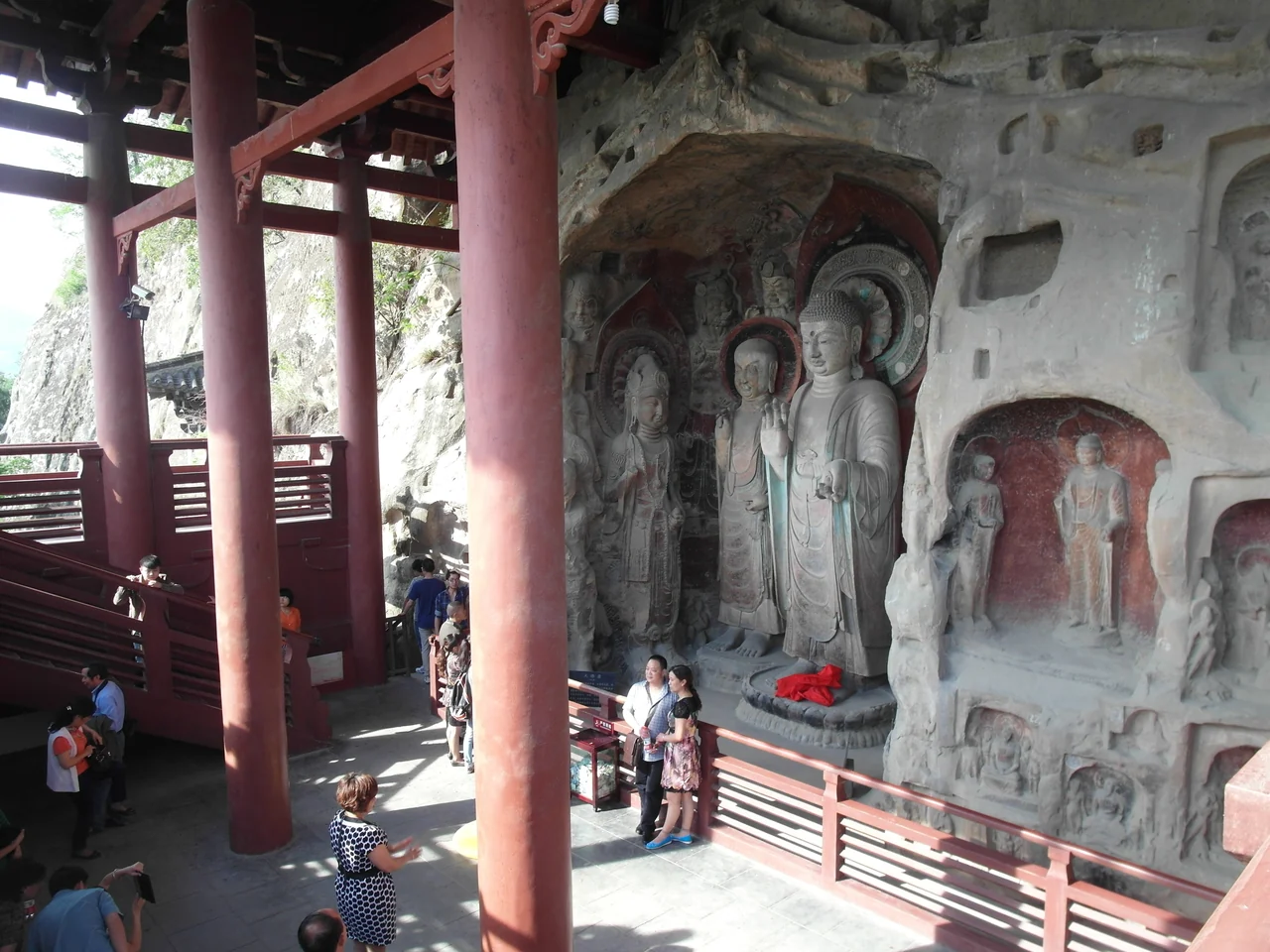
Cliff carvings at Huangze Temple in Guangyuan, photographed on 7 June 2010. This shows Huangze Temple, not Qianfoya; the archival view does not establish which caves or walkways are open today.Photo: 申威隆 · CC BY-SA 3.0 · Image credits
A compact old-town street pattern and selected historic interiors · Southwest of Guangyuan; a separate road outing
Most of a day with travel; 3–4 hours in town · The municipal list gives ¥52 for the paid visitor product; ask which interiors it covers.
One city day, then one old-town day
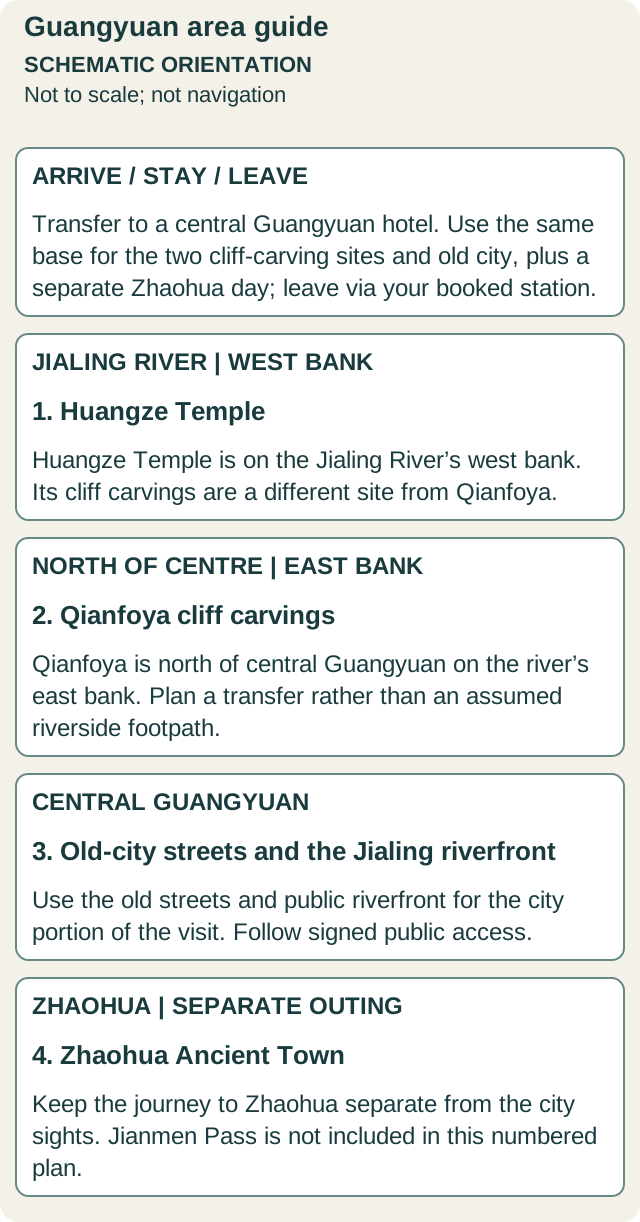
Open full-size area diagram ↗. Numbers match the guide. Named directions show broad areas; box positions do not encode geography. This schematic is not to scale or suitable for navigation, and does not prove access or current operation. ChinaMile editorial diagram; guide sources. Navigation: search the Chinese name in Amap.
1, Huangze, is on the west bank; 2, Qianfoya, is farther north on the east bank; 3, the old city, is the east-bank urban base. Use road transport between the carving sites and a city meal between them. 4, Zhaohua is the separate southwest outing. The diagram shows relationships, not safe walking shortcuts or bus routing.
For one full day, keep both carving sites and a small old-city section. If detailed sculpture is not a major interest, choose Qianfoya alone and use more time for the city meal and streets. For two full days, add Zhaohua without changing hotels.
Spring and autumn are comfortable choices for a mixture of outdoor stone art and streets. In summer heat use the earlier carving block and a long indoor lunch break; in heavy rain or icy conditions follow site closures and reduce the outdoor portion. Neither cliff steps nor old stone paving is a reliable all-weather route.
Four places and how to visit them
1. Huangze Temple · 皇泽寺
Huangze combines two kinds of looking. The temple and memorial setting introduces Guangyuan’s association with Wu Zetian; the carvings reward close attention to the arrangement of Buddhas, attendants and architectural frames. Do not let the famous imperial name obscure the stone art itself.
The Sichuan archaeology institute identifies groups around Dafolou, Wufoting and the Heart Sutra Cave area. Choose the sections that are actually open and look at changes in scale, pose and carving detail. You do not need access to every niche for the visit to make sense. If English interpretation is important, ask for its actual availability; the existence of a Chinese guide service is not an English-tour promise.
Conservation work can change what is visible. The reviewed public procurement material concerns rock and water-hazard treatment, not proof that the entire temple is closed. Use current barriers and the visitor desk to decide whether the open route meets your interests.
Hours
The research institute’s published notice gives March–October 08:00–19:00, ticket sales ending 18:00; November–February 08:30–18:30, sales ending 17:30. Check any special access notice.
Tickets
Standard adult ¥50. The two-site ¥80 ticket is bought at either site’s staffed counter; confirm both visits and the passport process before paying.
Time
About 1.5–2 hours, including the open carving areas and a pause for interpretation.
Chinese address
四川省广元市利州区皇泽路97号;皇泽寺景区游客入口
Getting there
Take a city taxi to 皇泽寺, or use the transport authority’s route 15 listing and alight at 皇泽寺. The hotel-to-site road journey crosses the Jialing if you stay in the old city.
How to visit
Entrance → available temple/memorial rooms → open carved-cliff sections → return to the visitor exit. Ask which carving areas are accessible before purchasing if a particular cave is your priority.
2. Qianfoya cliff carvings · 千佛崖
Qianfoya is the stronger choice if you can visit only one place and want a concentrated cliff-carving experience. The dense layers show how different groups were added to the same rock face. Step back to understand the whole cliff, then slow down at a few accessible figures instead of trying to count everything.
The archaeology institute’s work places the Lotus Cave beside the old road, with the Dayun Cave group higher nearby. These relationships help explain the site’s scale; they do not promise that a particular chamber or upper walkway is open. Signs and protected viewing positions should determine the route.
Huangze adds temple and imperial-history context, while Qianfoya gives the more continuous sculptural cliff. For a first visit to both, keep Huangze in the morning, lunch in town and Qianfoya in the afternoon. This allows a real break between two sessions of close looking.
Hours
The same published seasonal schedule as Huangze: March–October 08:00–19:00, sales to 18:00; November–February 08:30–18:30, sales to 17:30. A conservation closure can restrict individual sections.
Tickets
Standard adult ¥50, or the ¥80 Huangze–Qianfoya combined ticket. Keep the original document and ticket for the second site. A foreign-passport gate scan was not tested.
Time
Allow 1.5–2 hours to look at a selection of niches, not just photograph the whole cliff.
Chinese address
四川省广元市利州区千佛路43号;千佛崖景区
Getting there
Use a city taxi to the signed 千佛崖景区 entrance and arrange the city return. It is north of the urban core, not a pedestrian continuation of Huangze Temple.
How to visit
Visitor entrance → permitted lower viewing paths → signed access to open cave groups → the same visitor entrance. Respect barriers and do not touch carvings or climb for a closer image.
3. Old-city streets and the Jialing riverfront · 广元老城 · 嘉陵江滨江步道
The old city occupies the east-bank side between the river and Phoenix Mountain. Mother’s Lane / Mujia Xiang and Shanghui Xiang are among the streets the municipal housing authority describes as renewed. Their interest is the continuing street pattern and daily city life, not a claim that every shopfront is untouched ancient architecture.
Use the city walk to connect the visits with breakfast, lunch and an evening meal. Notice how the hills and river frame the centre. This guide keeps the walk at street level; a Phoenix Mountain ascent, tower interior or river cruise is optional work with its own conditions, not an unnoticed addition to an already full carving day.
Hours
Use the streets in daylight or early evening. River access depends on current barriers and water conditions; no lighting timetable or interior opening is promised.
Tickets
The selected route is on ordinary public streets and permitted river paths. Food and drinks are separate purchases.
Time
A meal plus 1–2 short walking sections, rather than an additional strenuous climb.
Chinese address
四川省广元市利州区老城;市场街、母家巷、商会巷及开放的嘉陵江滨江步道
Getting there
Use the old-city side of Lizhou as the reference. Choose road crossings and signed river access; the river is not crossed by a footpath inferred from the diagram.
How to visit
Old-city lanes → lunch or dinner → an open riverside section → hotel. If the waterfront is closed, stay inland around the streets and cafés.
4. Zhaohua Ancient Town · 昭化古城
Zhaohua has a smaller scale than Guangyuan. Gates, traditional street frontages and courtyard interiors make it a place to wander slowly, with the history of administration and the Shu routes behind it. Choose two or three interiors that genuinely interest you rather than treating a multi-site ticket as an instruction to hurry through every door.
The county-office and Confucian-temple visits give different ways to understand a small historical town: governing and education. Then sit down for lunch and return through the lanes. Ask the visitor centre what the current ticket includes; a public street, a heritage room and a performance are different products.
Keep Zhaohua as its own outing. The wider Shu Road contains mountain paths and other sites, but the existence of a cross-region bus is not a reason to add Jianmenguan after lunch. An agreed return to the same Guangyuan hotel is the simplest end to this day.
Hours
Keep the visit in daylight, with morning arrival. Public streets and ticketed interiors have different hours; ask at the visitor centre for the current interior closing time.
Tickets
The municipal attraction list publishes ¥52. Buy the product for the actual open interiors at 昭化古城游客中心; concessions and foreign-document handling require the operator’s confirmation.
Time
Allow 3–4 hours in town and most of the day overall, including transport and lunch.
Chinese address
四川省广元市昭化区昭化镇;昭化古城游客中心
Getting there
The official tourist bus runs from 广元高铁站(市长途客运站) via 皇泽寺 and 南河汽车站 to the visitor centre. Obtain the day’s outbound and return tickets; frequency can change.
How to visit
Visitor centre → old streets and gates → selected open interiors such as the county office and Confucian temple → lunch → return to the confirmed boarding point. Do not leave the return booking until the end of the walk.
Start with rice noodles; order a small tofu meal
Guangyuan mi liangmian / 广元米凉面, also called zheng liangmian / 蒸凉面, is made from rice batter and cut into strips. The preparation is different from ordinary wheat noodles. Try a small breakfast or lunch portion and request chilli separately if you are unsure about the sauce.
Jianmen tofu / 剑门豆腐 is a regional speciality that can appear on Guangyuan menus as well as nearer Jianmenguan. Two people can order one tofu dish, vegetables, rice and one other dish instead of a large tofu banquet. Tofu dishes may include meat stock or pork; ask about the whole recipe for a vegetarian meal.
Chaotian walnut cakes / 朝天核桃饼 are useful as a snack or train food. Buy a small amount before a long outing, check freshness and ask about nuts or other allergens. The city’s 2026 food map gives named local businesses and addresses if you want a specific nearby stop; it is an official directory, not our restaurant test.
Take the main city lunch between Huangze and Qianfoya, and leave time for a proper Zhaohua lunch on the outer day. No tasting, restaurant service, queue or current menu price was tested.
Central Lizhou keeps the city evening useful
The old-city side of central Lizhou, around Market Street / 市场街 and the established central streets, is the default. It makes meals and the riverside part of the visit straightforward while keeping both carving sites within a city ride. Check the actual building, lift and street noise, especially for rooms over restaurants.
The railway / Shangxi side is useful for an early Guangyuan departure or a hotel you specifically prefer, but it is across the river from the main old-city streets. Dongba and Wanyuan offer newer city hotels; choose them for the room or facilities and include extra rides for the heritage day.
Zhaohua overnight suits someone who wants the town after day visitors leave, but it changes the luggage and rail-return plan. The default three-night stay keeps bags in Guangyuan and uses a round trip. A Jianmenguan station hotel is a different base, not a nearby substitute for a Guangyuan city booking.
At Guangyuan accommodation search, enter two adults, one room and three nights. Compare the full price and cancellation, check the map against central Lizhou, and confirm foreign-passport check-in and the legal pickup point. No named hotel or live rate is endorsed.
Two full days with meals and the return already included
Arrival evening · night one: settle into the Lizhou hotel, eat nearby and use a short old-city walk if time permits. Keep the paid carving visits for a full day.
First full day · night two: breakfast → Huangze Temple, 1, for 1.5–2 hours → city lunch → Qianfoya, 2, for 1.5–2 hours → return to the hotel and rest → old-city streets and an open riverside section, 3 → dinner. Buy the combined ticket at the first site if both visits and document handling are confirmed.
Second full day · night three: confirmed morning tourist bus or licensed car → Zhaohua visitor centre, 4 → old streets plus selected paid interiors → lunch → a final short lane walk → the confirmed return bus or pickup → Guangyuan hotel. Set a personal finish time before the ticketed return rather than waiting for the last available service.
Departure: travel to 广元站 for the train you booked. Do not place a non-refundable early-evening train immediately after Zhaohua unless the actual return and a generous station buffer support it.
For Jianmenguan: add a third full day and fourth night, or replace Zhaohua if the mountain pass is the main interest. Select the actual Jianmenguan entrance, dated ticket and complete return first; the city-day budget below does not buy that extra excursion. Chengdu and Hanzhong are separate onward city stays, with trains selected on 12306.
Guangyuan station for the city, a separate bus for Zhaohua
Search Guangyuan / 广元 on 12306 English booking for the city stay. A result for Jianmenguan / 剑门关 serves a different location and is not the same arrival. Keep the Chinese station name on the booking and send that to the hotel or driver. Train times and prices depend on the selected date and train.
Use the official taxi queue or a licensed booked transfer to your Lizhou hotel. For Huangze, the municipal bus route list includes route 15 via the railway side and 皇泽寺; use the live stop board for the correct direction. Qianfoya is simplest by a city taxi, with the return to your hotel arranged before you finish.
The transport authority’s Zhaohua service announcement names the route: Guangyuan high-speed rail station / city long-distance coach station → Huangze → Nanhe Coach Station / 南河汽车站 → Zhaohua Ancient Town visitor centre. Its published journey was about 50 minutes each way, but departure frequency is explicitly adjustable. Buy both directions through the operating station window or its current service channel; do not use the launch-day frequency as a promise.
If a usable return bus cannot be confirmed, agree a licensed hotel → 昭化古城游客中心 → hotel car with waiting, pickup and total included. If neither arrangement is available, keep the city day and omit Zhaohua. For a ticket form that rejects a passport, use the staffed attraction counter to establish the supported process before paying for a non-refundable ride.
Rail tickets must use the same original passport carried for travel. If online verification fails, use 12306’s supported verification process or a staffed railway counter; leave time for staff assistance at entry. 12306’s rules accept foreign passports.
A three-night budget with published admission separated from estimates
For two adults sharing one room, three nights and two full days, use 3R + T + M + A + X. R is one room per night; T covers both Guangyuan station legs, city rides and the Zhaohua return; M covers arrival dinner through departure breakfast; A is the three selected paid sites; X is water and contingency.
The municipal published figures are ¥50 for Huangze, ¥50 for Qianfoya, ¥80 for the two-site ticket, and ¥52 for Zhaohua. With the combined product, A = 2 × (¥80 + ¥52) = ¥264. If the combined ticket is unavailable or unsuitable, two individual stone-art tickets raise A to 2 × (¥50 + ¥50 + ¥52) = ¥304. The foreign-passport purchase and concession eligibility have not been tested.
Using planning inputs R = ¥280, T = ¥400, M = ¥520 and X = ¥160, the default total is ¥840 + ¥400 + ¥520 + ¥264 + ¥160 = ¥2,184 for the pair. Only the stated admission figures come from published tariffs; accommodation, meals, transport and contingency are estimates. Replace the transport input with your bus total or complete car quote.
The research institute’s October notice says the ¥80 ticket is sold at the counters and valid for 30 days. Buy it only when both visits fit; do not confuse validity with a right to enter a closed conservation area. Intercity trains/flights, Jianmenguan, cable cars, cruises, guides, shopping and alcohol are excluded. An added mountain day needs its own room, meals, transport and admission calculation.
Sources and the limits of the current visit plan
Sources were read on 23 October 2026. The municipal attraction directory supports the adult prices and locations; the Sichuan archaeology institute supports the carved-cliff content. Some Guangyuan government pages returned 405 on direct retrieval, so their clearly identified indexed official text was used and that access limit is retained here.
For seasonal hours and combined-ticket handling, we read the research institute’s notice dated 13 October, reproduced on Sohu with the institute attribution and municipal tourism-site footer. Its newer counter-only information takes precedence over older holiday restrictions quoted elsewhere. We did not complete a ticket purchase or obtain a direct telephone confirmation.
The transport authority confirms the Zhaohua route but expressly allows timetable changes. Visit order, duration, base preferences and non-ticket spending are editorial planning judgments. No taxi fare, bus departure, meal, hotel stay, call, English guide or overseas-passport admission was field-tested. Use current entrance boards for conservation access and the actual booked return for the outer day.