Wuhu Make a relaxed city stop around the lake, old lanes and working river.
Choose Wuhu for an easygoing Yangtze city break: a lake in the centre, streets made for small meals, a renewed old-city district and a riverfront where the scale of passing ships changes the mood. Its appeal is the combination of everyday urban life, trading-city history and local food, rather than one monument that fills a whole day.
One full day and two nights is a comfortable first stay. Add a half day for Wuhu Museum, or use the museum instead of a long outdoor block in poor weather. Nanjing is the stronger choice for a larger historical-city itinerary; Huangshan is a separate mountain trip. Wuhu suits a gentle pause in an Anhui or lower-Yangtze rail route, with dinner and an evening walk worth staying for.
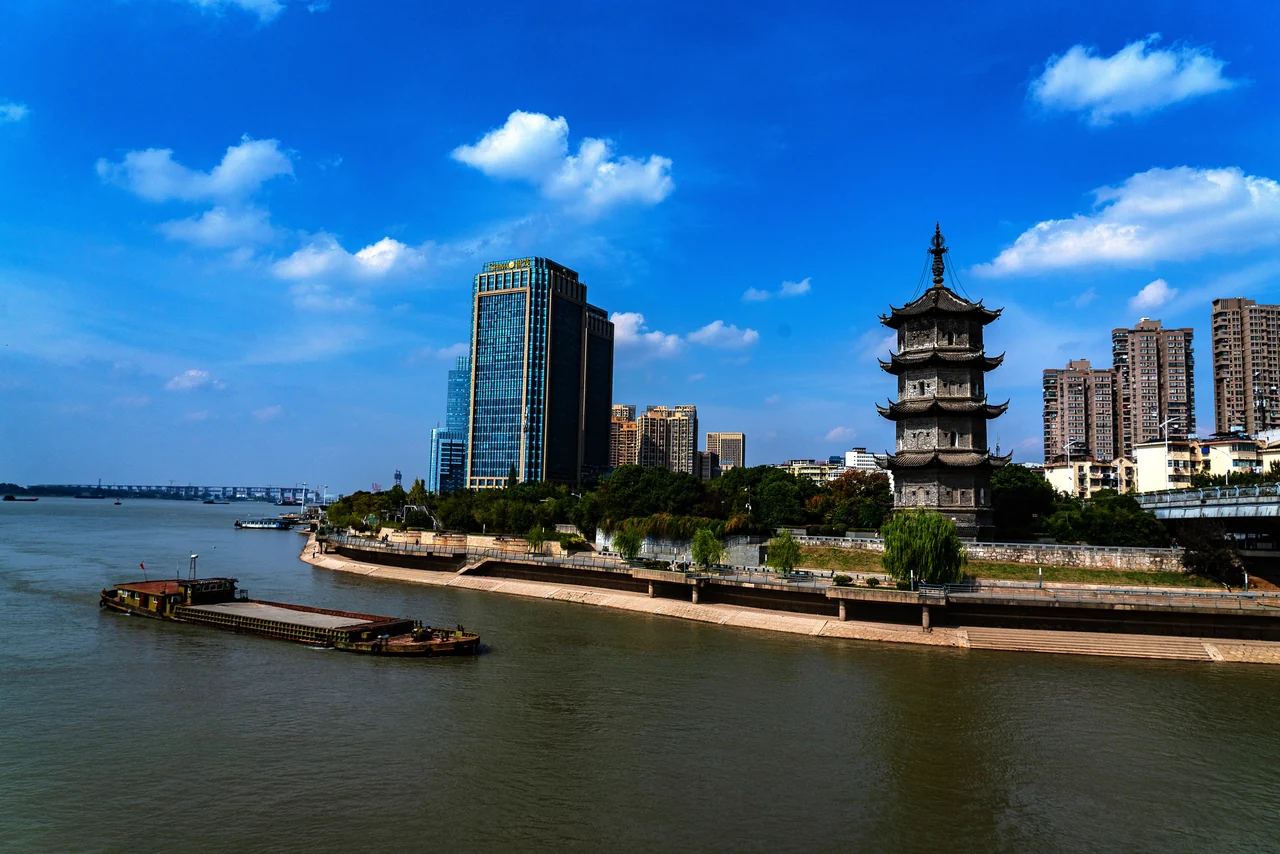
Zhongjiang Pagoda and the riverfront in Wuhu, photographed on 13 October 2018. This historical waterfront view is not Jiuzi Ancient Town and does not establish today’s weather, water level or tower access.Photo: Admornish · CC BY-SA 4.0 · Image credits
Regional archaeology, ceramics and the city’s historical context · Renhe Road in the eastern administrative district
2–3 hours · Free; the museum’s current guide removes individual online reservation.
Three central stops and one separate museum visit
The default day runs from Jinghu and Jiuzi Square to the Ancient City, then the Yangtze waterfront. These form a central-city sequence, with taxis between clusters when the walking stops being pleasant. The museum sits farther east in the administrative district and deserves its own half day or a deliberate substitution.
Keep three names straight: 鸠兹风景区 is the central square–lake–pedestrian-street area; 芜湖古城 is the renewed old-city district by the Qingyi River; 鸠兹古镇 is a separate northeastern resort. The last is not included in the core route. Likewise, a Fangte theme-park day needs its own chosen park, ticket and transport; it cannot be squeezed between the lake and dinner.
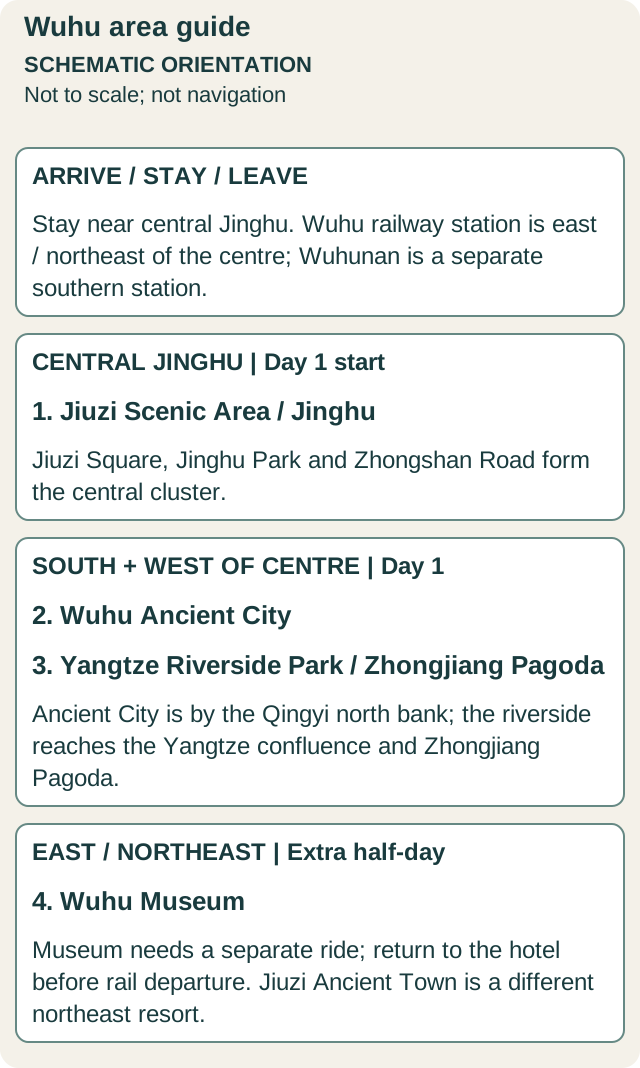
Open full-size area diagram ↗. Numbers match the guide. Named directions show broad areas; box positions do not encode geography. This schematic is not to scale or suitable for navigation, and does not prove access or current operation. ChinaMile editorial diagram; guide sources. Navigation: search the Chinese name in Amap.
Choose a Jinghu base unless the station decides the trip
Jinghu / Jiuzi Square is the easiest base for the first visit. You have food, the lake and the Line 1/Line 2 interchange nearby; choose a hotel with a clear car entrance and a quiet room if close to the shopping street. Search your hotel platform for Wuhu, two adults, one room and your actual nights, then locate the property relative to 镜湖 and 鸠兹广场 rather than trusting a broad “city centre” tag.
Near Wuhu station works for an early departure and retains the Line 2 connection, but is less pleasant for an unplanned evening walk. The eastern administrative district can suit business or a museum-focused stay, yet adds rides to the old city. A theme-park-area hotel belongs to a different trip. This guide recommends neighbourhoods, not specific hotels; confirm foreign-passport registration, bed arrangement, cancellation terms and the Chinese entrance address before payment.
Use small meals to connect the walking blocks
Start near Jinghu with xiazi mian 虾籽面, noodles seasoned with shrimp roe. Traditional versions can use pork-bone broth, so it is unsuitable for shellfish avoidance and not a vegetarian dish. A small bowl leaves room for another local snack later. Xiaolong tangbao 小笼汤包 are soup-filled buns; check the filling and let the hot broth cool before biting.
At the Ancient City, make lunch a real sit-down break: order a small portion of red-skinned duck 红皮鸭 with rice and vegetables, or choose a straightforward cooked dish from a posted menu. Chidou jiuniang 赤豆酒酿, red beans with fermented sweet rice, is a different sweet finish; ask about fermentation if avoiding alcohol. The city’s food listings establish the dishes, not the current quality or price of every shop. Choose a visible menu and clarify portion sizes; no named restaurant or food purchase was tested.
The numbered places, with time to look
1. Jiuzi Scenic Area and Jinghu · 鸠兹风景区 / 镜湖
Begin at Jiuzi Square, then use the lake to find your bearings before entering Zhongshan Road’s pedestrian shopping area. The pleasure is a changing sequence of water, open civic space and busy shops, with short food stops whenever you want them. It is a useful introduction precisely because it does not require a timed attraction ticket.
The city’s official Jiuzi Scenic Area comprises the square, Jinghu Park and Zhongshan Road pedestrian street. Jiuzi Ancient Town 鸠兹古镇 is elsewhere; the similar name is a common navigation trap. Around Jinghu, take the walk at your own pace and choose a bench or café when tired, rather than treating the whole lake edge as a compulsory circuit.
Hours
The outdoor square, lake and street can be visited flexibly; businesses and any enclosed attractions set their own hours. Daylight is best for lake orientation.
Tickets
No general admission purchase for this public-space circuit; optional activities and food are separate.
Time
1.5–2 hours, with extra time for food
Chinese address
芜湖市镜湖区 鸠兹广场 / 镜湖公园 / 中山路步行街
Getting there
Use Jiuzi Square 鸠兹广场 station, the Line 1/Line 2 interchange, then walk to the lake and pedestrian street. From a Jinghu hotel, walking may be simpler.
How to visit
These three central places form 鸠兹风景区. Do not select 鸠兹古镇 in a taxi app: that is a separate resort in Jiujiang District, northeast of the centre.
2. Wuhu Ancient City · 芜湖古城
Walk the lanes to see how the historic street pattern and surviving buildings sit among conservation work, rebuilt facades and current cafés. This is a living commercial heritage district, not an untouched ancient city. Pause at a courtyard or architectural detail that interests you and leave time for a meal.
The strongest visit combines daylight architecture with a relaxed evening atmosphere. Not every building is open and some interiors have separate charges, so the reliable core is the street walk. Keep optional performances out of the schedule until their actual time and ticket are confirmed. This is also separate from Jiuzi Ancient Town; a driver should see 芜湖古城 on your saved address.
Hours
Plan daylight for the lanes and architecture, then stay for dinner if you wish. The public district’s access does not establish the hours of its museums or courtyard interiors.
Tickets
The public street walk is free; ask at each separately ticketed interior what its admission includes. No performance is assumed in this itinerary.
Time
2 hours plus a meal
Chinese address
芜湖市镜湖区 芜湖古城(九华中路、环城北路一带)
Getting there
From the Jinghu area take a short taxi to the Ancient City’s street edge, or Line 1 toward 白马山 to Huancheng Beilu 环城北路; the operator lists Exit 1 for 芜湖古城·同丰里. Leave pickup on a road accessible to cars.
How to visit
Use the full name 芜湖古城. Walk the open lanes first; buy an interior ticket only if that specific exhibition interests you. Ask permission before entering residential or business courtyards.
3. Yangtze Riverside Park and Zhongjiang Pagoda · 滨江公园 / 中江塔
Here the city opens onto the Yangtze. Watch working boats and compare the broad river with the smaller Qingyi River near the Zhongjiang Pagoda end. The pagoda and the waterfront’s historic fabric give the walk a sense of Wuhu’s long role in river trade; the outdoor view is enough to make the stop worthwhile.
Start near the pagoda and walk only as far as you comfortably want to return. A bench and a short stretch can be more rewarding than trying to cover the full waterfront after a day on foot. Visibility, river levels and wind change the experience, so use the walk as the flexible final block rather than the only reason for the trip.
Hours
Choose daylight through early evening, subject to weather and flood controls. Follow closed flood gates and barriers; a riverside pin does not guarantee access to the lower promenade.
Tickets
The itinerary uses the public waterfront only. Zhongjiang Pagoda is viewed from outside; no interior opening or ascent was verified.
Time
1–1.5 hours
Chinese address
芜湖市镜湖区 滨江公园 中江塔
Getting there
Take a taxi from the Ancient City to the open public approach near Zhongjiang Pagoda, then walk a manageable northward stretch and return to the same pickup area.
How to visit
Keep the walk on permitted paths and use a recognisable street-side pickup. Skip the lower bank in high water, thunderstorms or strong wind. Do not plan a boat trip without a separate operator and return booking.
4. Wuhu Museum · 芜湖市博物馆
The permanent displays supply the context missing from a casual street walk: early settlement, metalwork, ceramics and the growth of a river city. Give particular attention to the regional objects that differ from the major museums elsewhere on your route. Two focused hours are better than rushing every label.
It is a useful wet-weather choice on an open day, but reaching it takes a separate ride. The current visitor guide allows ordinary individuals in without an online reservation, subject to security and capacity. Leave luggage at the hotel and return there before heading to the railway station.
Hours
Tuesday–Sunday 09:00–17:00, last entry 16:30; normally closed Monday. Special notices may change the holiday pattern.
Tickets
The museum’s April 2026 guide states free entry and no individual online reservation; enter after security, subject to capacity controls.
Time
2–3 hours
Chinese address
芜湖市鸠江区仁和路60号 芜湖市博物馆
Getting there
Take a taxi from Jinghu to the visitor entrance at Renhe Road 60 and return by the same mode. This is a separate trip to the administrative district, not part of the central walking loop.
How to visit
Carry the original passport. If staff need help processing it, use the visitor desk or the museum’s published enquiry line +86 553 3862050. No passport visit was tested. Do not buy a reservation service for ordinary entry.
Leave the river until the light softens
Arrival: reach the Jinghu hotel, eat nearby and take a short lake-edge walk if there is time. Full day morning: breakfast, Jiuzi Square, Jinghu and Zhongshan Road at an unhurried pace. Around midday take a taxi or Line 1 to the Ancient City, have lunch, then explore its lanes for roughly two hours. Return to the hotel for a rest if needed. Late afternoon: take a taxi to the Zhongjiang Pagoda end of the riverside park, walk a short out-and-back section, then ride back to the Jinghu area for dinner. Sleep a second night and leave the following morning.
Add the museum: choose a departure afternoon that leaves a genuine 2–3 hours in the museum plus the hotel luggage return and station transfer. Visit at 09:00, eat lunch, collect bags and take the confirmed train. If the train leaves too early, add a third night or replace the long central morning with the museum; do not treat the museum as a luggage stop on the way to a tight train.
Rain or heat: on an open day, take a morning taxi to the museum, return for lunch and do only a short Ancient City walk when conditions improve. Monday: keep the central outdoor route and do not rely on the museum as a rain fallback unless its holiday notice explicitly opens it. In severe weather, shorten the stay’s walking ambitions and use an indoor meal or café; a closed riverfront is not a reason to cross a barrier.
Read Wuhu and Wuhunan as different destinations
Book the dated journey through China Railway 12306. Wuhu 芜湖 is the natural station for this central itinerary. Wuhunan 芜湖南 is a different station to the south; do not choose it solely because a search result has a convenient train time. Compare the whole door-to-door trip, including the hotel transfer. Save the exact station name, passenger name and original passport details with the issued booking.
If your ticket is for Wuhunan, follow the station connection to Line 1 toward 保顺路 for Jiuzi Square, or take a taxi to the hotel. At Wuhu station, follow signs for the monorail’s 芜湖火车站 station. Take Line 2 toward 鸠兹广场 for the central hotel area; reverse the journey for departure. The operator lists both stations on that line. Use its station information and linked first/last-train pages for your travel day. At ticket machines or the service desk, select the destination station; if a mobile payment method fails, ask staff for the supported single-ticket payment option.
With heavy luggage, late arrival or a hotel away from the station, use the official taxi rank to the saved Chinese hotel entrance. Keep a road alternative for the return if the monorail is closed or disrupted, and leave time for rail security and boarding beyond the local journey. If 12306 identity verification or payment fails, use its support or a staffed railway counter with the original passport. No foreign-passport train transaction was tested for this guide.
Two nights for two, with optional extras kept visible
For two adults sharing one room, two nights and one full sightseeing day, use 2R + ¥560–800 + E. R is the real nightly room price. The allowance is ¥360–480 for meals from arrival dinner through departure breakfast, ¥100–180 for station transfers and city transport, and ¥100–140 for drinks and contingency. E is any separately chosen interior, show or other paid activity. The ordinary public-space route has no paid attraction built into it; the museum’s published basic admission is also free.
With a sample room input R = ¥300 and no optional paid interiors, 2 × ¥300 + ¥560–800 = ¥1,160–1,400 for two. These room, food and transport figures are planning inputs, not current hotel offers or fare quotations. For an extra museum half day before an afternoon train, add ¥160–260 for the pair’s extra lunch, drinks and museum rides, making ¥1,320–1,660 under the same room assumption. Add the actual third room night and its meals if your train times require it.
Intercity tickets, guides, shopping, cruises, Fangte parks and Jiuzi Ancient Town products are excluded. For any of those, use the exact attraction and date, not a generic “Wuhu ticket”, and add its real total plus the additional local transport.
Use the free museum rule and buy only the extras you want
The museum’s own visitor guide removes individual online reservation. Check its latest notice, arrive on an open day and enter through security. If the passport or an access need requires help, use the visitor desk or +86 553 3862050. A commercial “reservation” product is unnecessary for ordinary admission under that guide.
For the core street-and-river day, reserve the room and exact trains rather than an all-city ticket package. Keep the correct Chinese names on the phone and ask each optional interior to identify its price, opening session and refund conditions before paying. Continue to Nanjing or Hefei only after checking the actual departure station and leaving time to collect luggage; the cities are separate stays, not extra stops in this day.
Sources and planning limits
Sources read on . The museum’s own visitor guide is dated 9 April 2026 and establishes its normal hours, free admission and removal of individual online reservation. The rail operator establishes the Line 2 station connection. City sources distinguish the central Jiuzi area from Jiuzi Ancient Town and describe the riverfront and food traditions.
The Ancient City’s older development report supports the public-street layout, while recent tourism reporting confirms continued activity; neither proves that every interior or event is currently open. Flood reporting is used only to explain why waterfront access can close, not to claim a flood today. No live hotel price, foreign-passport admission, payment transaction, boat service or train availability was tested. Visit durations and budget allowances are editorial estimates.