GUANGDONG · TOWER HOUSES AND OVERSEAS-CHINESE GARDENS
Kaiping Diaolou Look from a fortified village house to the fields, then compare it with a family's garden estate built with ideas brought home from overseas.
Kaiping's towers make sense in their surroundings. Tall, ornamented houses rise above low village homes, ponds and farmland: their owners needed security while displaying prosperity and architectural ideas carried home through migration. The pleasure is the contrast between a defensive building, the domestic rooms inside it and the quieter landscape outside.
Give Zili Village and Li Garden one full day and two nights nearby. They provide two distinct experiences without collecting every tower cluster. Add a second full day and a third night for Majianglong when bamboo-framed village scenery and more architecture are worth the additional transport. Stay in Kaiping city for easy evening services, or in Tangkou for a countryside setting with planned pickups. “Kaiping Diaolou” names a dispersed heritage landscape, not one entrance beside the railway station.
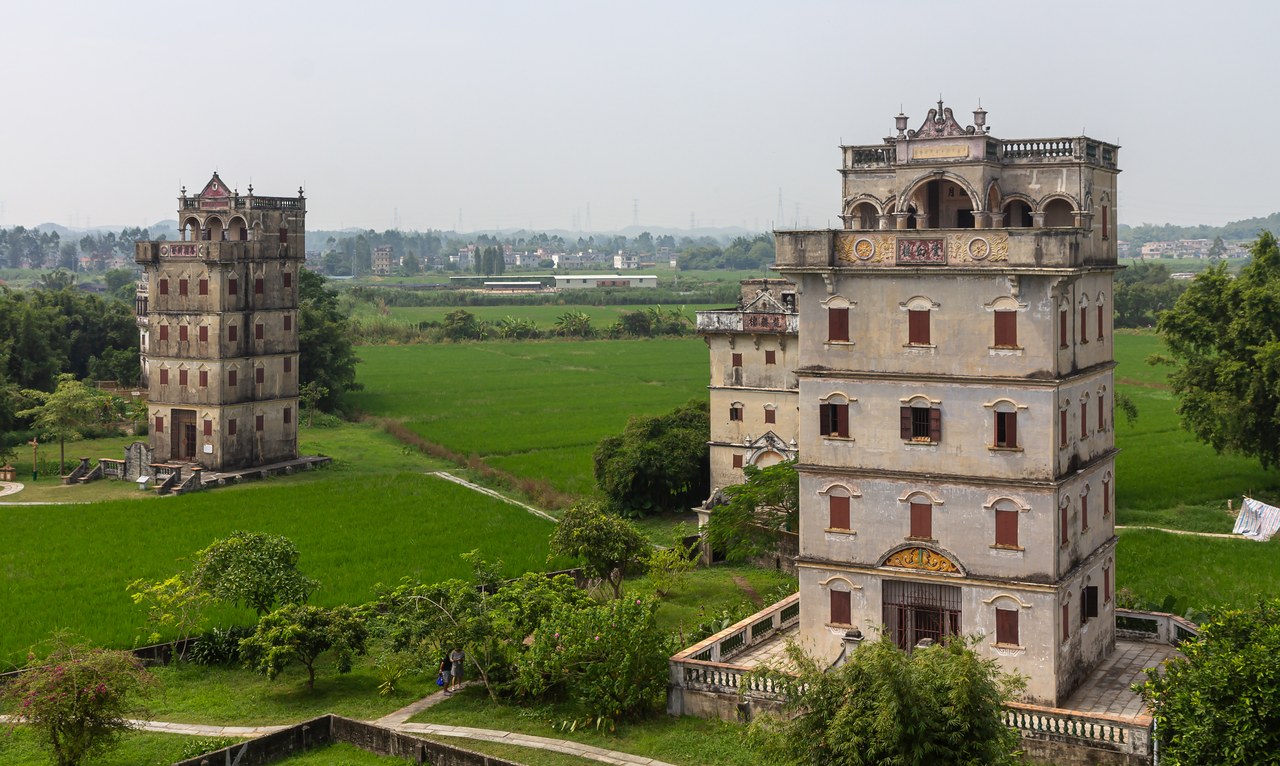
Yunhuan Lou and Yangxian Villa in Zili Village, photographed in October 2016. The tower-and-village landscape is part of the diaolou visit, distinct from Chikan.Photo: Stefan Fussan · CC BY-SA 3.0 · Image credits
An overseas-Chinese family's garden estate, with villas, waterways and pavilions · Tangkou; a separate road transfer from Zili
2–3 hours · The tourism authority publishes ¥100 for Li Garden alone and a ¥180 two-day pass including the tower-village sites; compare the actual dated products.
Towers and villas appearing between bamboo, trees and village lanes · Baihe 百合; a separate southern countryside outing
2–3 hours, with transport and lunch additional · The published ¥180 pass includes Majianglong; verify its use dates and the current open buildings before purchase.
Two Tangkou visits, then decide whether to go farther
Zili Village and Li Garden make the core day in Tangkou. Zili shows towers among village houses and fields; Li Garden concentrates wealth and imported design into an estate of villas, channels and pavilions. Allow a road transfer and lunch between them. Walking around each place is part of the visit; walking the roads between separate entrances is not the proposed route.
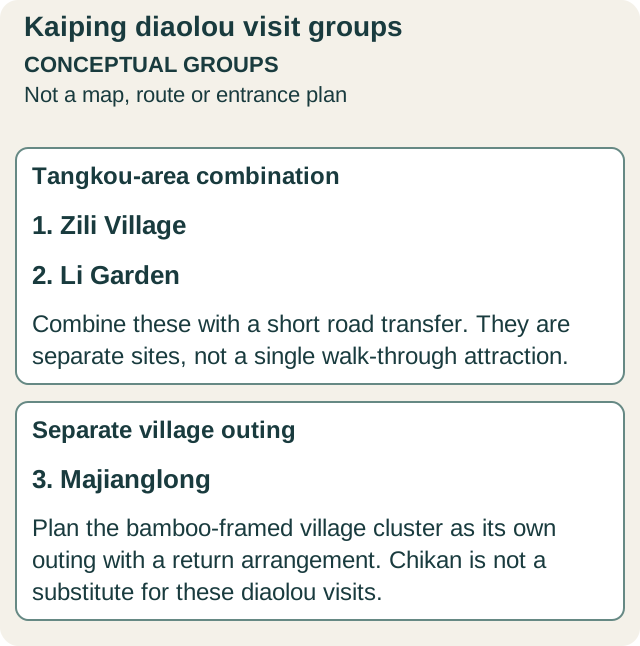
Majianglong is a separate Baihe outing farther south. It adds a wooded, bamboo-framed village landscape rather than a second garden. Choose it for a slower architectural trip, or as an alternative tower village if Zili's access is unavailable. The conceptual diagram groups the visits; it is not a navigation or distance map.
The UNESCO property has several heritage groups, while the scenic area's ticket packages use their own site lists. Li Garden is part of the tourism circuit; do not call it one of the UNESCO-inscribed tower-village groups. Chikan's separately managed commercial old-town attraction and its evening products are another decision; this guide's three-place plan does not require that ticket. Use Jiangmen for a broader regional stay rather than assuming the cities' centres and tower villages are interchangeable bases.
See a tower, a garden and a different village setting
1. Zili Village · 自力村碉楼群
Zili is the most useful first encounter because the relationship between a tall tower and low countryside is immediately visible. Walk beyond the first photograph: compare the narrow defensive openings with decorative rooflines, then notice how the village's ordinary houses and ponds sit around the taller structures.
Where an interior such as Mingshi Lou is admitted, move slowly through the domestic rooms and stairs. A fortified house was also somewhere to live, store possessions and display the family's taste. The exterior ornament and the practical protection answer different needs. You do not need access to every roof for the landscape to make sense, and a closed floor is not an invitation to seek another way up.
This is a lived-in village environment as well as a ticketed visit. Respect private courtyards, stay off crops and retain the agreed pickup point. Building access can be more restricted than access to the village grounds; decide whether the visit still meets your aim before buying a special transfer.
Hours
Plan a morning visit within the dated ticket's entry period. Temporary village or exhibition closures can override ordinary hours; obtain the current notice before booking the transfer.
Tickets
Select 自力村, not only the broad “Kaiping Diaolou” destination label. Ask which buildings can be entered that day and whether the product includes the other places you intend to visit.
Time
2–3 hours for the village setting and an admitted tower interior, shortened if interiors are unavailable.
Chinese address
广东省江门市开平市塘口镇自力村碉楼群入口
Getting there
Use a licensed taxi or hotel-arranged driver to the actual village ticket entrance. Agree the next Li Garden leg and final hotel return before separating from the driver.
How to visit
Start with the whole scene of towers, homes and fields, then enter an open tower such as 铭石楼 only where permitted. Follow the signed stairs and any floor or rooftop limit. If Zili is closed, keep Li Garden and move the village visit to a confirmed open day, or use Majianglong with a revised road quote.
2. Li Garden · 立园
Li Garden changes the question from village defence to a carefully composed family estate. Artificial waterways, bridges and pavilions connect the gardens and villa area. Look through a pavilion or across a channel toward a house: the arrangement of views is as important as any single façade.
The estate was created by Xie Weili, an overseas Chinese emigrant associated with the United States. The mixture of garden traditions and villa design gives it a different rhythm from Zili's tower-and-field walk. Follow a modest circuit through the garden and selected open interiors rather than rushing to every named photo spot.
After a morning of stairs, the garden provides variety, though it is not a verified step-free route. Modern displays may change independently of the historic buildings. Treat a temporary exhibition as an extra if open, not the reason the whole Kaiping trip must succeed or fail.
Hours
The tourism authority's July 2026 visitor reference gives 09:00–17:30 for Li Garden. Check the dated entry cutoff and current building access; that reference does not establish the other villages' hours.
Tickets
The published adult references are ¥100 for Li Garden alone or ¥180 for a two-day multi-site pass. Check the precise site list, entry dates and refund terms in the chosen product; do not assume that a pass permits unlimited repeat entry or supplies road transport.
Time
2–3 hours for the garden and selected open villa interiors, plus a lunch or tea break outside the visit.
Chinese address
广东省江门市开平市塘口镇立园景区
Getting there
Make a separate road transfer from Zili's entrance to 立园. The two belong to the same Tangkou outing but are not a single walk-through attraction.
How to visit
Follow the water and pavilions into the villa area, comparing the garden's designed views with the defensive village seen earlier. Visit the open interiors without depending on a particular temporary exhibition. Keep the final pickup outside the entrance, with enough time to leave before closing.
3. Majianglong village cluster · 马降龙碉楼群
Majianglong's interest lies in partial views. Bamboo and trees break up the architecture; a tower appears above the vegetation, then the lane returns to the scale of homes. It rewards a quieter village walk and comparisons with the more open scene at Zili.
Give it time to unfold rather than approaching only for one “best” tower photograph. The village cluster contains traditional houses, villas and tower buildings within a cultivated landscape. An open, signed route is a better guide than trying to enter every structure visible above the trees.
Choose this additional day if that difference matters to you. If you mainly want a representative tower and one garden, stop after the Tangkou pair and spend the saved day elsewhere in Guangdong. More sites on a pass do not automatically make a better visit.
Hours
Use daylight and the current Majianglong ticket-desk period. Obtain the day's last entry and admitted-building list; no unverified fixed timetable is supplied here.
Tickets
For an all-three visit, compare the published multi-site pass with the total for the actual single-site products. Confirm that 马降龙 is included, and when its two-day validity starts.
Time
2–3 hours on site; allow a separate road outing rather than adding it after a full Zili–Li Garden day.
Chinese address
广东省江门市开平市百合镇马降龙碉楼群入口
Getting there
Arrange a licensed outward and return ride from your base, with waiting and any extra village stop written into the quote. A ticket listing “Kaiping” does not collect you from the city or station.
How to visit
Walk a short signed village-and-bamboo route, pausing where the towers emerge above lower houses and planting. Enter only opened buildings. Return to the agreed road pickup; if rain or a closure removes the walk, shorten the outing rather than seeking access through residents' fields.
Kaiping city for services, Tangkou for the setting
Kaiping city / Changsha urban area: the default when arriving by rail, wanting several dinner choices and valuing an ordinary hotel with reception and transport help. Accept the separate road outing to the villages. A hotel in Jiangmen's main urban centre adds another regional journey and is not the same base.
Tangkou countryside: choose this when village atmosphere and a slower morning matter more. Confirm the exact road entrance, dinner and breakfast availability, stairs and the driver's access with luggage. A room branded “diaolou” may be in a nearby village rather than inside a paid scenic area.
Chikan: useful only when a separately planned old-town stay or evening product is part of your trip. Resolve whether the accommodation is inside a ticketed zone and which access is included; it does not remove the need to travel to Zili, Li Garden or Majianglong.
Open Kaiping hotel listings, enter one room, two adults and two nights for the core visit, or three nights for the expanded plan. Use the map to choose the actual city or Tangkou address, then confirm passport check-in, cancellation terms and arranged road transfers directly with the property. These are area choices and a real booking entrance, not named-hotel comparisons or checked room prices.
A Tangkou lunch and an unhurried evening meal
Keep lunch near Li Garden or the Tangkou village corridor so that eating does not create another cross-city trip. Regional choices named by the tourism authority include 黄鳝饭, eel rice, 马冈鹅, Magang goose, and 豆腐角, tofu snacks. Ask what a particular preparation contains and how large the portion is; a regional dish name is not a current menu or an assurance of a vegetarian filling.
For two adults, share a modest rice dish or goose portion, add a vegetable, then order more only if needed. Eel and goose are different commitments from a simple vegetable-and-rice lunch; check bones, sauces and the total price before ordering. No restaurant menu or meal here has been field-tested.
After the core day, eat near the city hotel or at the countryside property if dinner was agreed in advance. The longer Majianglong outing should include a seated lunch and water, not a rushed dash to a last shuttle. Food allowances in the budget are editorial estimates.
A complete core visit, with a meaningful extra day
Arrival evening · night 1: transfer from Kaiping South to the city or Tangkou hotel. Eat nearby, resolve tomorrow's dated tickets and current openings, and agree the driver request: hotel → 自力村 → 立园 → hotel, with waiting, pickup points and the total charge.
Core full day · night 2: visit Zili at its confirmed morning opening. Allow a proper village walk and an admitted interior, then transfer for lunch and Li Garden. Use the afternoon for the estate and leave with time for the agreed pickup. This is the full first-visit answer even without another village.
Departure morning for the short stay: collect your bags and use the pre-arranged road transfer to the correct railway station. Do not add Majianglong on the assumption that an unused pass entitlement will fit between checkout and the train.
Expanded visit · second full day and night 3: keep the same base, take the agreed outward ride to Majianglong and allow a village-and-bamboo walk. Eat lunch on the route and return without rushing. Use the rest of the afternoon for a quiet break or a confirmed local walk near the hotel. Depart the following morning. This extra time suits an architecture-led trip; it is not necessary merely to “use up” a pass.
If access changes: a partial exhibition closure may leave a worthwhile village visit, while a full village closure changes the day's plan. Move the open Li Garden earlier and use Majianglong as the tower-village alternative only after confirming the new road arrangement. In persistent heavy rain or a safety closure, shorten the outdoor stay rather than attempting closed buildings or muddy field paths.
The ticket and the vehicle solve different parts of the trip
Search Kaiping South 开平南 on China Railway 12306 for your actual origin and date. Compare the available Guangdong connections rather than relying on a fixed service in a guide. The station, city hotel, Zili entrance and Li Garden are separate destinations.
Use the signed taxi queue, a matched app pickup or the hotel's arranged licensed driver for arrival. For sightseeing, obtain a complete quote naming the stops, waiting and return. If a bus or scenic shuttle is actually available, ask the desk for its boarding point, whether your ticket qualifies and the exact return departure before leaving the first site. This itinerary does not depend on an unverified shuttle frequency or an assumed all-day hop-on service.
For admission, open the named scenic-area listing and its current product and closure information, or use the official ticket desks. Select the actual first visit date, two ordinary adults and a product listing 自力村、立园 and, for the expanded stay, 马降龙. The tourism authority's ¥180 two-day pass is a published reference; compare it with a smaller combination if that is cheaper for the places you will actually use.
The listing supplies ticket enquiries +86 750 2678888 / +86 750 2679788. Before payment, resolve the document field for your original passport, each site's entry rules, any closure and unused-ticket refund conditions. No foreign-passport checkout or discount was tested. If online purchase fails, obtain confirmation from the ticket desk before paying for a dedicated transfer; do not enter an invented Chinese identity number.
Save the driver's reachable number and each road pickup. If a return shuttle is cancelled or missed, remain at the staffed ticket area and ask it or the hotel to arrange a licensed ride. Do not start walking rural transfer roads to meet an important train. Keep the departure morning free of sightseeing and allow for the actual road and station check-in requirements.
Budget for two, with the transport visible
For two adults sharing one room, two nights and the Zili–Li Garden full day, calculate 2R + 2P + T + M + X. R is the nightly room quote, P each adult's actual admission product, T both station transfers plus the named sightseeing drive, M meals and X water or contingency. An admission pass does not pay for an unquoted car.
Worked inputs: R = ¥300, P = ¥180, T = ¥500, M = ¥360 and X = ¥100. The result is ¥600 + ¥360 + ¥500 + ¥360 + ¥100 = ¥1,920 for the pair. P uses the tourism authority's published two-day multi-site reference, not a live transaction; use a cheaper applicable two-place product if offered. Room, road and meal amounts are planning inputs, not checked quotations.
For the expanded three-night, two-full-day stay, illustrative additions of one ¥300 room-night, ¥300 for the extra Majianglong outing, ¥160 meals and ¥50 contingency give ¥2,730 for the pair, if the original pass covers that visit on its permitted dates. Otherwise add the actual required ticket; unknown admission is not zero. Recalculate from the written driver and room quotes.
Exclude intercity fares, guiding, shopping, optional exhibitions or experiences and a separate Chikan product. A rural room may change both its own rate and the transport total. The example is for ordinary adult tickets and does not assume age, nationality or local-resident concessions.
Sources and access boundaries
Sources actually read on 22 October 2026. UNESCO supports the defensive-house and migration history and the distinction between inscribed heritage groups and the broader tourism circuit. The Kaiping government descriptions explain the three places. The tourism authority's July 2026 article supplies Li Garden's published hours and the ¥100 / ¥180 references; it does not certify every village's present gate or rooftop access.
Obtain the dated site and building notices before travelling. A platform listing does not certify access to every village or interior; an old short closure must not be treated as proof of continuing closure or of reopening. Room rates, road quotes, meal costs, visit lengths and route choices here are editorial inputs. No hotel check-in, foreign-passport ticket purchase, scenic shuttle, local drive or meal was field-tested.