Tai’an Give the mountain a full day and keep your departure outside the descent deadline.
Tai’an is the place to approach Mount Tai as both a landscape and a ceremonial mountain. Inscriptions, gates and temples make the ascent more than a summit photograph; Dai Temple in the city explains the imperial rituals that gave the mountain its standing. Choose it for a sustained mountain day with cultural stops, not for solitude or an effortless panoramic viewpoint.
Allow two nights: arrive early enough for Dai Temple, spend the next full day on the mountain, and leave after a second night in town. A third night gives you a spare day for weather. The default here uses the Tianwai Village bus and Zhongtianmen cable car in daylight. The Hongmen stair route is a rewarding alternative for strong walkers, but an overnight climb is not required to enjoy Mount Tai.
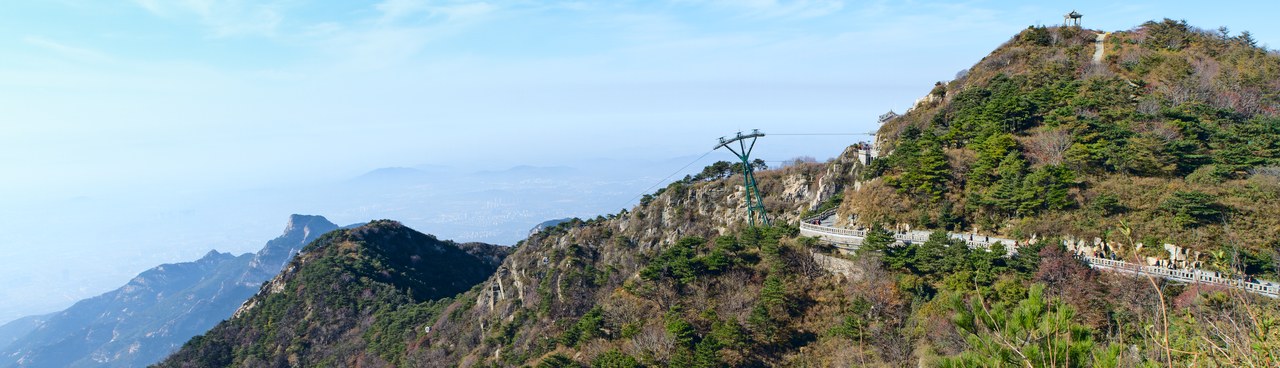
Ride up, then walk Nantianmen, Tianjie, Bixia Shrine, the Tang cliff inscription and Jade Emperor Peak · North of Tai’an, rising above the city
A full day: allow roughly 6–8 hours including transfers, queues and upper-mountain walking · Mountain admission, scenic bus and cable car are separate cost components. Select direction and quantities on the current official ticket screen.
A long stair approach that reveals the mountain’s succession of gates and inscriptions · Southern mountain approach above Dai Temple
Full-day effort; the published ascent estimate is about 4–6 hours for a fit walker, before a descent · Mountain admission; add a cable or bus only if you choose to use it.
Follow the ceremonial courtyards to Tiankuang Hall, then see the Han Cypress Courtyard · Central Tai’an, below the mountain
1.5–2.5 hours · Check whether your selected Mount Tai admission includes Dai Temple; otherwise use the temple’s own current ticket. Do not pay twice by assumption.
Bus and cable, or a sustained stair climb
Choose Tianwai Village for a mountain day with less ascent on foot. You still walk between upper viewpoints and need to cope with steps, queues and exposed weather. Choose Hongmen for the full approach and the satisfaction of climbing; it needs considerably more stamina and a deliberate descent plan. Do not buy one entrance and casually arrive at the other.
Two nights work when the mountain is the fixed main event. Three nights are better if seeing a clear view matters enough to protect a weather day. A same-day train excursion can be done with transport on the mountain, but offers little recovery if a queue or cable closure delays the descent. This guide’s default keeps the train for the following morning.
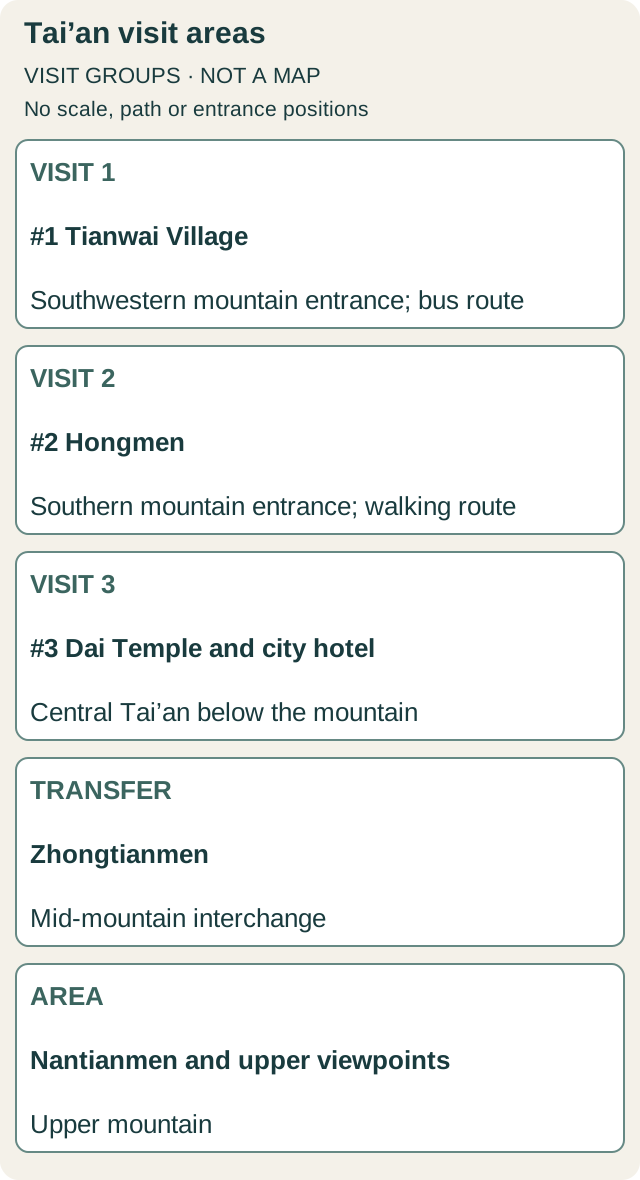
Open full-size map ↗. Alternative entrances join at Zhongtianmen; branches are choices, not a loop. Return via the selected operating route; diagram is not a trail map. This is an editorial relationship diagram, not a navigation map; box position does not encode distance or an entrance. ChinaMile diagram; location sources. Navigation: search the Chinese name in Amap.
Sleep in town for a flexible mountain day
Central Tai’an between Dai Temple and the southern mountain approaches is the best all-round base: dinner, temple access and a taxi to either entrance are straightforward. Near Hongmen helps an early walking start, while near Tianwai Village suits the bus-and-cable plan. Confirm the actual entrance location rather than relying on a hotel name containing “Taishan”.
Near Tai’an high-speed station trades away the pleasant arrival afternoon for departure convenience. Choose it only for a very short stop. A summit hotel is a different trip with limited stock and a much more restrictive luggage and weather plan; it is excluded from this first-visit budget. Confirm foreign-passport registration with your chosen property before payment.
Eat in town and carry a simple mountain lunch
In the city, look for Tai’an tofu dishes alongside greens and a rice or noodle staple. Tofu can still arrive with meat stock or minced meat, so specify vegetarian needs. A modest sit-down meal near the hotel is more useful before a climb than a long late-night search for a famous address.
Carry water and a compact lunch or snacks you already know you can eat. Mountain kiosks are convenient for replenishment, but menus and availability vary; check the posted price before buying and avoid relying on a particular summit stall. Bring your litter back to a collection point. After descending, allow a proper meal and a quiet evening rather than scheduling another strenuous sight.
Two adults, one shared room, two nights
Budget 2R + M + A + ¥560–800 for two adults: R is the room per night, M is the pair’s selected mountain admission, scenic-bus, cable and any separate temple tickets, and A is the pair’s station transfers. The allowance is ¥360–500 for food, ¥100–160 for city taxis to/from mountain entrances, and ¥100–140 for water, snacks and a contingency. It excludes intercity travel, a summit hotel, guides and shopping.
A worked example with an actual room chosen at ¥300 per night, a hypothetical transport-and-admission basket of ¥770 for two, and ¥100 in station transfers totals ¥2,030–2,270 for two. The example inputs are not advertised tariffs. Read the current checkout item by item: a low admission price does not include every cable and bus journey. Walking saves transport cost only when you truly do not take those legs; do not make exhaustion the basis of your saving.
The mountain and its city counterpart
1. Mount Tai via Tianwai Village and Zhongtianmen · 泰山:天外村—中天门—南天门
For a first visit with moderate walking, take the scenic bus from Tianwai Village to Zhongtianmen and the cable car toward Nantianmen, then explore the upper mountain on foot. The ascent saves your legs for the stone paths, views and inscriptions around the summit area. A cable ticket does not remove the steps between viewpoints.
Allow an editorial planning block of two to three hours above Nantianmen, including short breaks and the walk back towards the cable station. This is a moderate-walking out-and-back, not a summit circuit or a queue allowance. Use the following order:
Nantianmen (南天门): look down towards the final steep section of the Eighteen Bends, then go through the gate to Tianjie (天街). This is the change from climbing a staircase to walking among the upper mountain’s buildings.
Tianjie → Bixia Shrine approach (碧霞祠): follow the upper street past its food and service stops to the shrine. Pause for the roofline and pilgrimage setting. The route works from the public approach; entering religious interiors is optional and follows their own posted access conditions.
Daguan Peak / Tang cliff inscription (大观峰/唐摩崖): continue towards the summit to see the rock face used as a monumental page. The Tang emperor Xuanzong’s inscription records his Mount Tai ceremony; looking at its scale and placement is more rewarding than treating every carved word as background to a photograph.
Jade Emperor Peak (玉皇顶): finish at the highest summit precinct when the steps and weather permit. Then return by the same main route through Tianjie towards Nantianmen and follow signs specifically for the Zhongtianmen cable (中天门索道).
Shorten at Bixia Shrine: Nantianmen → Tianjie → the shrine approach → return keeps the gate, mountain street and religious setting while omitting the final summit ascent. Use this option when knees, visibility or the remaining descent window argue against continuing. Skip extra spurs to sunrise viewpoints on this first visit. Do not join the Taohuayuan cable queue by mistake: it serves a different descent. Confirm both cable and bus operation at the base that morning, and start back well before the final service; queue time sits outside the walking estimate.
Hours
The tourism bureau publishes daytime bus and cable operation, but weather, season and notices can override it. Obtain that day’s last descent times at the visitor centre.
Tickets
Mountain admission, scenic bus and cable car are separate cost components. Select direction and quantities on the current official ticket screen.
Time
A full day: allow roughly 6–8 hours including transfers, queues and upper-mountain walking
Chinese address
泰安市 天外村游客中心;山上换乘点 中天门
Getting there
Taxi to 天外村游客中心, not 红门. Inside the scenic area use the operator’s bus to Zhongtianmen; private city taxis do not substitute for this connection.
How to visit
Reserve the Tianwai Village entrance and intended date/time through 泰山景区. After the bus and Zhongtianmen cable, walk Nantianmen → Tianjie → Bixia Shrine approach → Daguan Peak → Jade Emperor Peak, then return to the Zhongtianmen cable’s upper station and bus down to Tianwai Village. Turn back at Bixia Shrine for the shorter option.
2. Hongmen walking ascent · 红门登山线
Choose Hongmen when the ascent itself is the experience you want. The repeated gates and changing views make the journey legible, but the steps are prolonged and become demanding above Zhongtianmen. The visitor bureau describes thousands of steps and little level ground; this is not equivalent to a casual city hill.
Start in daylight with comfortable footwear, water and a weather layer. Set a decision point at Zhongtianmen: continue on foot only if your pace, weather and remaining daylight support it; otherwise take the operating cable car or descend. Do not assume a downhill walk is easy on tired knees. If you finish via the bus to Tianwai Village, your exit differs from the Hongmen start and requires a new city pickup.
Hours
Use the reserved entry window and current mountain notices. This plan does not depend on 24-hour access or night-climb availability.
Tickets
Mountain admission; add a cable or bus only if you choose to use it.
Time
Full-day effort; the published ascent estimate is about 4–6 hours for a fit walker, before a descent
Chinese address
泰安市 红门游客中心 / 红门登山口
Getting there
Taxi to 红门游客中心; keep your hotel pickup independent of the arrival gate because the descent may end at Tianwai Village.
How to visit
Choose 红门 as the actual booked entrance. Tell your companions before starting whether the default descent is walking or cable plus bus, and check the final service times if using transport.
3. Dai Temple · 岱庙
Dai Temple explains the ceremonies behind the mountain climb. From the permitted entrance, orient yourself to the southern Zhengyang Gate (正阳门) and follow the central courtyards through Peitian Gate (配天门) and Ren’an Gate (仁安门) towards Tiankuang Hall (天贶殿). Look at how successive gates frame the main hall, then its yellow tiled double roof and the brackets beneath the eaves. If the interior is open for viewing, the procession mural shows the Mount Tai deity travelling out and returning.
Make Han Cypress Courtyard (汉柏院), on the eastern side, your other essential stop. The twisted trunks offer a quieter contrast to the ceremonial axis; the association with Emperor Wu of Han belongs to the trees’ historical tradition. If you have more time and the relevant display is open, the nearby eastern Imperial Residence (东御座) provides the Qin Mount Tai inscription story. For a shorter visit, keep the main hall and cypresses, then leave by an open visitor exit; a complete circuit of every gallery is unnecessary.
Allow 1.5–2.5 hours as a planning estimate. This is a good arrival-afternoon visit when last entry permits, and an indoor/outdoor cultural alternative when the mountain is inaccessible. The architecture and cypresses remain the main plan; do not make access to a particular mural or original inscription a guaranteed part of the ticket.
Hours
Daytime visit; check the temple’s current last-entry notice before committing an arrival afternoon.
Tickets
Check whether your selected Mount Tai admission includes Dai Temple; otherwise use the temple’s own current ticket. Do not pay twice by assumption.
Time
1.5–2.5 hours
Chinese address
泰安市 岱庙
Getting there
Walk or take a short taxi from a central hotel; save 岱庙 for the temple rather than 泰山 for the entire scenic area.
How to visit
Use your admission order to confirm temple inclusion and the permitted gate. Inside, use the Zhengyang Gate–Peitian Gate–Ren’an Gate–Tiankuang Hall axis, with a side visit to Han Cypress Courtyard. Indoor exhibits and mural viewing depend on which rooms are open.
Arrive, climb, recover, then depart
Arrival day: leave luggage at the hotel, visit Dai Temple’s central courts, Tiankuang Hall and Han Cypress Courtyard if last entry permits, and have dinner in town. Check the mountain forecast and official transport notice. Full day: start early at the booked entrance and use your chosen ascent. Above Nantianmen, follow Tianjie → Bixia Shrine → Daguan Peak → Jade Emperor Peak, or turn back at the shrine for the shorter visit. Return to the Zhongtianmen cable and Tianwai Village bus with time for their queues. Next morning: return to the exact railway station on your ticket.
If transport is suspended: stay in town and use Dai Temple when open; take the mountain on your spare day. Do not turn a cable closure into an unplanned strenuous climb. If visibility is poor but access is safe: decide whether the inscriptions and architecture justify the day for you. Sunrise is never guaranteed and is not promised by this itinerary.
Tai’an station is not Taishan station
Tai’an 泰安 is the high-speed station; Taishan 泰山 is the separate station closer to the established city centre. Search your departure city and dates on 12306, then use the exact printed arrival name in the taxi app. No train duration or seat availability is assumed.
Leave large luggage at your city hotel. Record whether the mountain return ends at Tianwai Village or Hongmen, and book the taxi from that entrance. A posted cable closing time is a last service boundary, not a target arrival time for a queue. Allow descent slack and station procedures; a summit viewpoint is a poor place to protect a tight train connection.
Choose the entrance before paying
Use the Mount Tai authority and the official WeChat account 泰山景区 to enter the ticket flow. Select date, entry point, time period, adults and genuine document details. Bring the same original passport used for the reservation and arrive at the entrance and within the time period on your booking. The 2026 government briefing explicitly requires overseas visitors to carry their passport for entry; follow staff directions to the appropriate document check or manual lane. This is not a requirement for every foreign visitor to activate a ticket at a manual window. If the online form fails, call the published visitor helpline 0538-96008888 to confirm how to reserve before travelling to the gate. Foreign-passport app fields and payment methods have not been field-tested.
On the morning, read the current weather/closure notice and confirm the last return cable and bus at the base. Historical official pages disagree on some bus fares and service hours, so this guide deliberately budgets the live selected basket instead of repeating an old tariff. It does not promise a particular night-climb window or holiday promotion.
What was checked
Official route, visitor-centre and booking information was read on 11 October 2026. The 2026 government briefing supports passport checking at the booked entrance and time. Its holiday-only operating hours and promotional dates are not used as year-round rules; the current trip still depends on its reservation and same-day operations. Walking times and recommended buffers are planning guidance; weather, queues and individual fitness can change them substantially.
The upper-mountain sequence, Tang inscription and Dai Temple highlights were reviewed against the Mount Tai authority’s pages on . This is an additional check of those places and their spatial relationship, not a new transaction test or a refresh of every operating fact. The two-to-three-hour upper walk and its shorter option are editorial planning choices.
.jpg)