Tianshui Give Maijishan a day with a secure return, then explore the older city without carrying your bags across it.
Tianshui brings together two different pleasures: Maijishan’s sculpture-filled cliff and the temples, courtyards and food streets of Qinzhou. The caves are the main reason to come for many travellers, but the older city adds a more relaxed cultural day and a chance to try local noodles, snacks or malatang.
Allow two full days and three nights. Choose Qinzhou as the base if you want the complete city stay, accepting the longer cave-day journey; choose Maiji District for a cave-focused short stay and rail convenience. Qinzhou and Maiji are separate parts of a spread-out city. Maijishan is beyond the Maiji urban area, not beside the railway station.
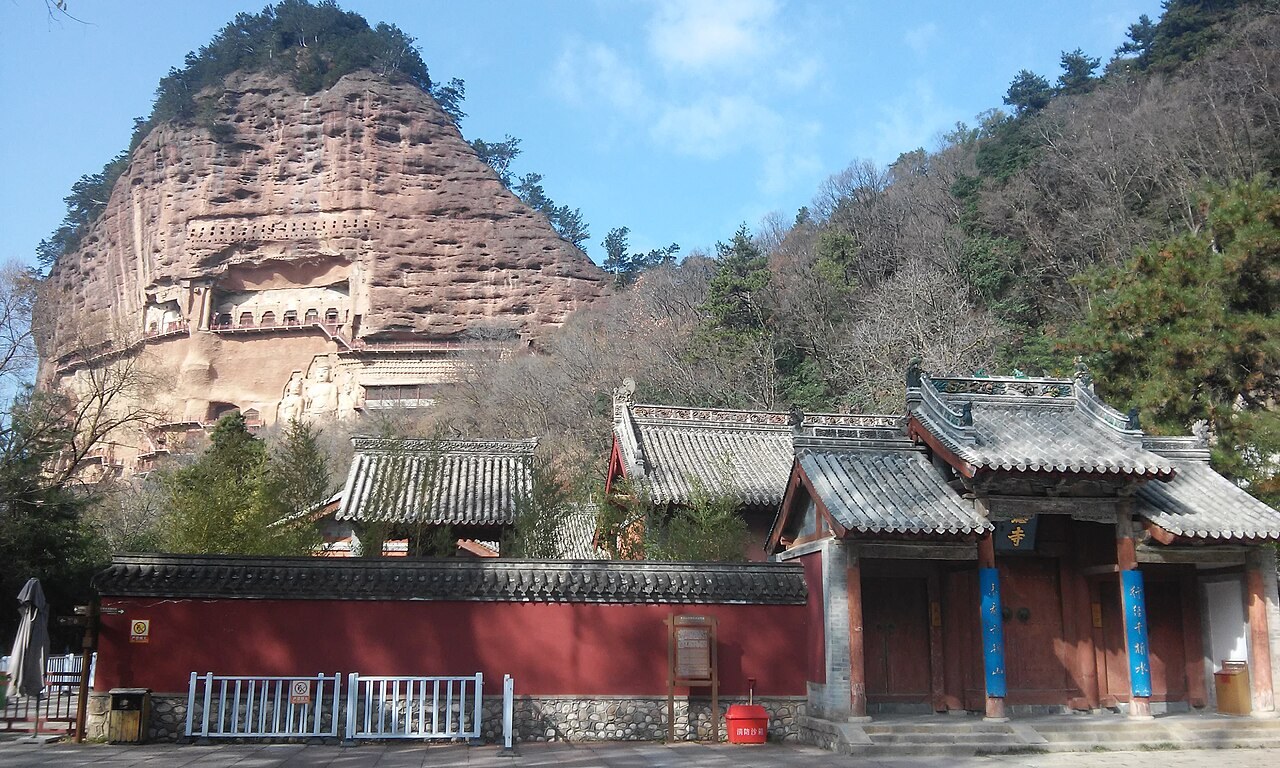
Maijishan and the temple roofs below, photographed in November 2017.Photo: Tgasrio · CC0 · Image credits
Clay sculpture and cliff-side cave galleries reached by elevated walkways · South of the Maiji urban area, beyond the station district
Most of a day including road travel and entry · Choose admission that includes the cave area. Landscape-only entry does not include the grotto walkway; shuttle and special caves are separate products.
Axial courtyards, old trees and halls devoted to the legendary culture hero Fuxi · Qinzhou District, western city visitor area
1½–2 hours; add time for an open museum exhibition · Temple admission and museum/exhibition arrangements must be checked separately at the official visitor centre.
Courtyard fronts, lanes, small shops and a slower food afternoon · Qinzhou, near the Fuxi Temple visitor cluster
1½–2½ hours with food stops · The plan uses public lanes; individual houses, exhibitions and activities may charge separately.
Qinzhou and Maiji need separate time
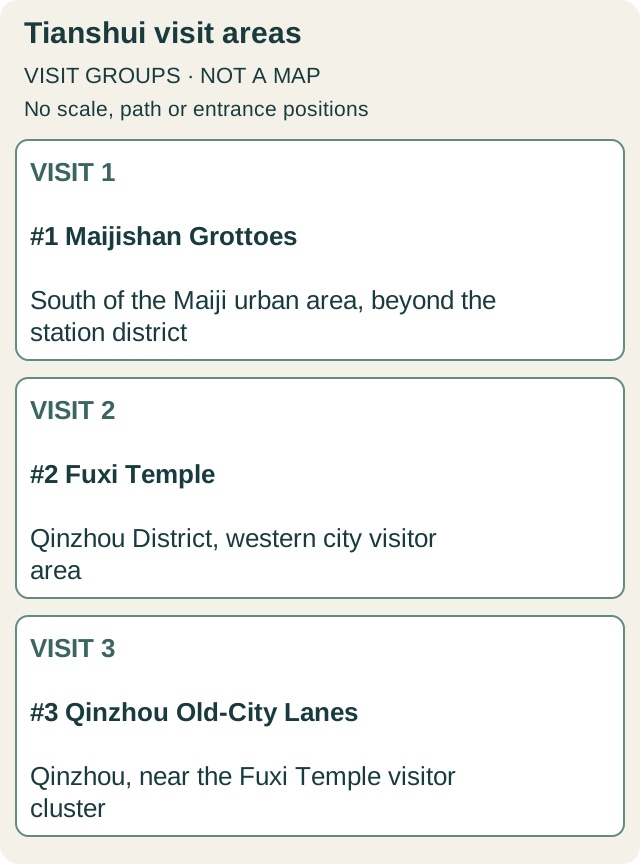
Open full-size map ↗. Not to scale. Qinzhou is the western old-city base; Maiji contains separate rail arrival areas, with Maijishan farther beyond them. The connecting line is not a direct walk or a measured transfer time. This is an editorial relationship diagram, not a navigation map; box position does not encode distance or an entrance. ChinaMile diagram; location sources. Navigation: search the Chinese name in Amap.
Qinzhou contains Fuxi Temple and the old-city lanes. Maiji contains the main railway arrival areas, with Maijishan farther beyond the urban district. A hotel search for Tianshui can return either district, so inspect the actual Chinese address before choosing.
Two full days let you devote one to the caves and one to Qinzhou. Use the clearer, officially open day for Maijishan and swap the days if weather or admission requires. For only one full day and two nights, stay in Maiji and choose Maijishan as the main visit; do not promise the complete Qinzhou cultural day as well.
Choose the evening you want, then price the transfer
Qinzhou near Fuxi Temple / the old-city edge: the default for this two-day plan, giving you local meals and a relaxed cultural day on foot or by short taxi rides. Accept that the Maijishan day involves a longer road journey. Choose a road entrance suitable for an early car collection.
Maiji near Tianshui railway station or a suitable urban hotel: the practical option when caves and rail are the main priority. Tianshui South station is a distinct high-speed station; do not assume a hotel beside the conventional station is beside your train. Map the exact property.
Near Maijishan itself: consider only when the property can confirm road access, meals and return transport for your dates. A remote inn can make the final station transfer harder. Confirm passport check-in, heating for cool weather, room stairs and the actual shared-room quote before paying.
Keep a Qinzhou evening for local food
天水麻辣烫 Tianshui malatang lets you choose vegetables, tofu products, noodles and meat ingredients that are cooked and dressed with local chilli seasoning. Ask the price basis before choosing a large basket and request your chilli level before mixing; a vegetable selection does not establish that the broth is vegetarian.
呱呱 guagua is a local snack worth trying in a small portion; ask the vendor what their version contains and how spicy the dressing is. For a seated shared dinner, 天水暖锅 nuanguo is a warming pot of layered ingredients: check its size and meat content before ordering for two.
Put the longer meal in Qinzhou after the temple and lanes. On the cave day, eat breakfast before departure and carry drinking water and a simple snack; keep a late lunch flexible for queues or weather. No named restaurant or current menu price is claimed as field-tested.
Two full days, three nights, two adults
Use 3R + A + C + T + S + ¥780–1,120 for two adults sharing one room, two full days and three nights. R is the nightly room quote, A both travellers’ combined rail arrival/departure transfers, C the agreed Maijishan return-car total, T all selected cave/temple admissions, and S any scenic shuttle tickets. Count each journey only once.
The editorial allowance is ¥480–680 for meals from arrival dinner through departure breakfast, ¥120–180 for Qinzhou local journeys and ¥180–260 for drinks and contingency. Intercity transport, shopping, paid guides, special-cave admission and optional extra attractions are excluded.
Example inputs R = ¥300, A = ¥120, C = ¥400, T = ¥240 and S = ¥60 give ¥2,500–2,840 for the pair. The room, car and ticket values are examples, not verified tariffs. Price the actual cave-inclusive product and shuttle separately; do not turn an unknown component into zero.
For the cave-focused one-day, two-night stay in Maiji, use 2R + A + C + T + S + ¥460–680. Example R = ¥300, A = ¥80, C = ¥250, T = ¥160 and S = ¥60 gives ¥1,610–1,830 for the pair. This shorter plan excludes Fuxi Temple and the full Qinzhou day; replace C with your actual return quote.
One cliff day and one city day
1. Maijishan Grottoes · 麦积山石窟
Maijishan is remarkable for the relationship between sculpture and cliff. From below, the cave openings and walkways form a pattern across the rock; up close, the figures’ faces, drapery and surviving colour make the experience intimate. The visit follows the permitted route, not unrestricted entry into every cave.
The elevated walkways are narrow and exposed, with steps. If heights or stairs are a serious problem, decide before buying cave admission: a lower-ground landscape visit is a different experience. The institute instructs visitors to keep moving, secure loose belongings and protect the objects; follow on-site photography restrictions, with no flash or touching. Special-cave visits require a separate arrangement and are not included in this first itinerary.
Hours
Use the exact dated time slot shown by the official booking service. Temporary weather closures and altered opening hours override older seasonal lists.
Tickets
Choose admission that includes the cave area. Landscape-only entry does not include the grotto walkway; shuttle and special caves are separate products.
Time
Most of a day including road travel and entry
Chinese address
天水市麦积区麦积山石窟;峡门游客服务中心
Getting there
Book a licensed return car to the current authorised visitor reception point, normally using 峡门游客服务中心 as the inquiry point. Follow the day’s traffic direction and take the chosen scenic shuttle or authorised onward access to the cave area.
How to visit
Use the official 麦积山旅游 or 麦积山石窟 account linked by the institute. Confirm the cave-inclusive ticket, date, entry slot and both travellers’ documents. If passport entry is unclear, call 0938-2655291 or 0938-2655292 before travel; a Chinese-ID field is not evidence of a tested passport workflow. Do not buy a landscape-only product expecting cave access.
2. Fuxi Temple · 伏羲庙
Fuxi Temple is the anchor of the Qinzhou day. Move through the ordered courts and halls, looking at the timber architecture and old trees, and read how Fuxi is represented in Chinese cultural tradition. This is a place of commemoration and ritual; legendary accounts are part of that tradition rather than independently verified biography.
The Tianshui Museum occupies the same cultural cluster and can add archaeological context when its galleries are open. Do not assume its schedule or admission is identical to the temple’s. Use the visitor desk to choose the available exhibition rather than promising every display.
Hours
Plan a daytime visit. Check temple entry and museum opening separately; festival evening access is not an everyday rule.
Tickets
Temple admission and museum/exhibition arrangements must be checked separately at the official visitor centre.
Time
1½–2 hours; add time for an open museum exhibition
Chinese address
天水市秦州区伏羲路110号;伏羲庙
Getting there
From a Qinzhou old-city hotel, walk where practical or take a local taxi to 伏羲庙游客服务中心. From Maiji, allow a separate cross-city road journey.
How to visit
The official visitor-centre description gives staffed ticket windows and 一部手机游天水 online access. Confirm the actual product and passport procedure at the staffed desk. Do not infer ordinary foreign-passport handling from a separately advertised foreign permanent-resident card service.
3. Qinzhou Old-City Lanes · 天水古城 · 西关片区
Use the Xiguan old-city area to see a different scale of Tianshui after the monumental temple and cliff. Courtyard entrances, narrow streets and older residential architecture sit alongside restored spaces and modern businesses. It is a lived-in and visitor-facing neighbourhood, not a single ancient building to tick off.
Walk a short route, stop for food and avoid treating every open doorway as a public attraction. If you still want another religious site, Yuquan Guan on the northern side of Qinzhou is a separate uphill temple visit; add it only with suitable daylight and energy, using its own entry conditions. It is not necessary to complete this relaxed city day.
Hours
Use daylight to see the building details. Individual businesses open independently; evening performances are not guaranteed.
Tickets
The plan uses public lanes; individual houses, exhibitions and activities may charge separately.
Time
1½–2½ hours with food stops
Chinese address
天水市秦州区西关片区;天水古城
Getting there
Pair with Fuxi Temple using current pedestrian directions. Keep a road-accessible hotel or taxi meeting point outside narrow lanes.
How to visit
Browse respectfully, enter only clearly public premises, and return to the base for dinner. If rain makes the lanes unpleasant, shorten the walk and use a confirmed-open museum gallery or a seated meal instead.
Book the cave day, keep the city day flexible
Arrival evening · night 1: reach your chosen district, check in and confirm Maijishan’s entry slot, document handling and the return car. A late arrival does not count as a full sightseeing day.
First full day · night 2: take the agreed road transfer to the authorised Maijishan reception point. Buy or validate the correct cave admission and any chosen shuttle, follow the permitted grotto route, then return by the same official visitor-access chain to the agreed pickup. Travel back to your hotel for a simple dinner.
Second full day · night 3: visit Fuxi Temple in Qinzhou, adding a currently open museum gallery if desired. Have lunch, then walk the Xiguan old-city lanes and keep time for malatang or a shared warming pot. If based in Maiji, make the return cross-city journey before the evening gets late.
Departure morning: travel to the exact station on the ticket. Swap the two full days if the cave notice or weather requires. If Maijishan closes and cannot reopen during your stay, use the Qinzhou day and revise the trip’s expectations; no other temple visit is an equivalent replacement for its cliff sculpture.
Tianshui South, Tianshui and Maijishan are different places
Search Tianshui South 天水南 for a high-speed train and compare Tianshui 天水 when an available conventional service suits your route, using 12306. Both are distinct from the Qinzhou old-city hotel area. Show the full hotel address and district to the first taxi driver.
For Maijishan, the simplest first-visit arrangement is a licensed car with a written round-trip total, waiting arrangement, pickup point and contact. Set the visitor reception point according to the official traffic notice, commonly 峡门游客服务中心; that transfer is not the scenic shuttle and does not deliver you onto the cave walkway.
The management committee states that admission and sightseeing-car tickets are sold separately. Return from the cave area by your chosen authorised access route, meet the driver at the agreed reception-point pickup and return to the hotel. If pickup fails, contact the driver and the staffed visitor centre while it is operating; use its help to arrange licensed transport before leaving. Do not wait until closing to discover that a presumed last public bus is unavailable.
If weather closes the site before departure, keep the city day and amend the ticket through its original official channel. If on site, follow staff evacuation and transport directions. This guide does not claim a verified local bus timetable or a successful foreign-passport purchase.
Use current admission, not an old screenshot
Sources were read on . The institute and management committee establish official booking accounts, distinct cave/landscape choices, separate shuttle sales and the importance of weather closures. Older pages containing pandemic controls or superseded entry hours are not carried into the itinerary.
The tourism authority describes the Qinzhou cultural cluster, and the Fuxi visitor-centre report identifies staffed service and the named online channel. Published facilities do not establish that your foreign passport has been tested. Route durations, base recommendations and budgets are editorial estimates; actual admission, return-car arrangements and dated rail tickets remain the inputs to confirm.