Mangshi Give the hilltop towers and the ordinary food streets time of their own.
Mangshi puts a different Yunnan within reach: luminous pagodas above a broad valley, a small brick tower held inside tree roots, and meals built around sharp herbs, sour flavours and rice. The attraction is the contrast between a memorable hilltop view and an easy town rhythm. Leave room for breakfast, shade and a long lunch.
Stay three nights for two full days, using one central hotel. This suits travellers who enjoy food, religious architecture and leisurely streets. With one full day, take two nights and choose the Golden Pagoda plus Shubao and a meal; the Silver Pagoda is the first addition for someone especially interested in architecture and photography.
Choose Tengchong instead if hot springs and volcanic landscapes are the main reason for travelling west. Choose Xishuangbanna for a longer tropical-garden stay on a different route. Neither is an extra stop within a Mangshi afternoon. The four visits here stay in the city; border excursions and remote mountain drives are separate journeys.
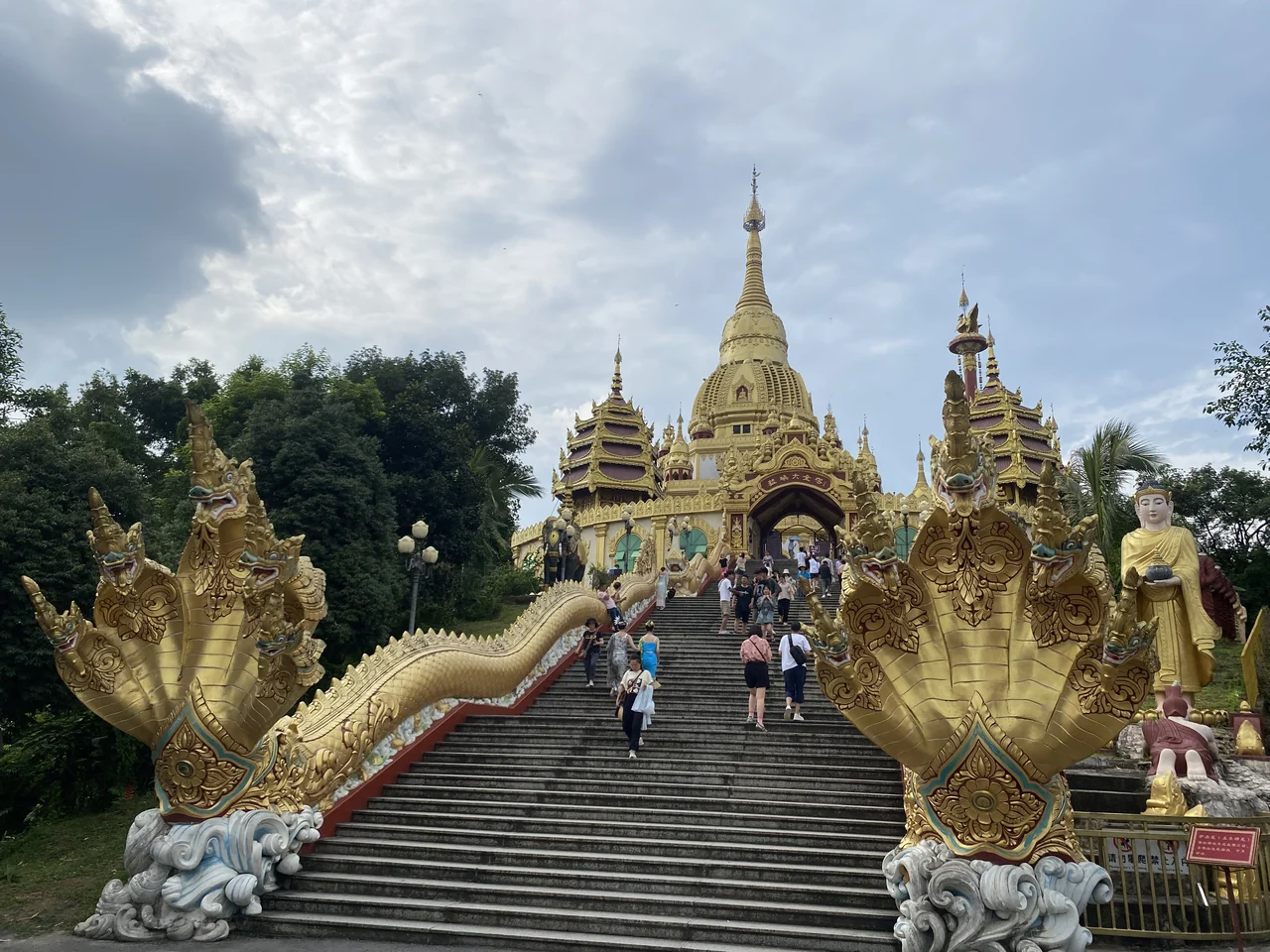
Menghuan Golden Pagoda in Mangshi, photographed on 30 July 2023. This is the Golden Pagoda, not the neighbouring Silver Pagoda; the historical view does not establish current admission or access.Photo: 瑞丽江的河水 · CC BY-SA 4.0 · Image credits
Shade, mature trees, unusual plants and displays of stones and root art · Yonghan Street urban area
About 1.5–2 hours · Published standard adult admission: ¥40.
Keep the hill pair separate from the city streets
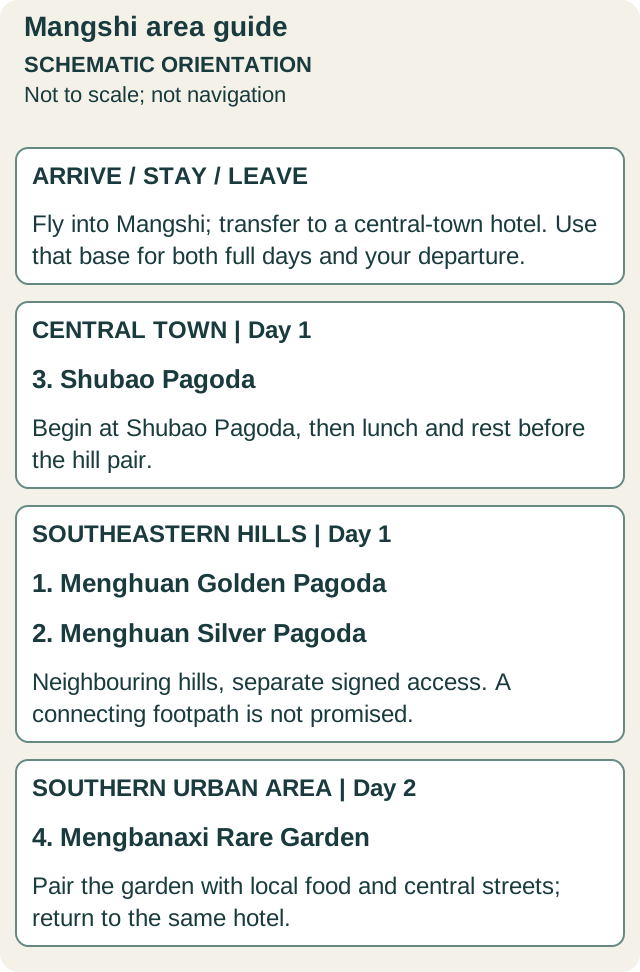
Open full-size area diagram ↗. Numbers match the guide. Named directions show broad areas; box positions do not encode geography. This schematic is not to scale or suitable for navigation, and does not prove access or current operation. ChinaMile editorial diagram; guide sources. Navigation: search the Chinese name in Amap.
1 and 2 form the southeastern hill outing; 3 and 4 belong to the urban part of the stay. Use a city base and make the hill journey once, with a confirmed connection between the actual entrances. The schematic groups places; it is not to scale and does not show a walking shortcut.
Build the day around shade: central streets and breakfast early, a proper midday break, then the hill visit with enough daylight left for both entries. Reverse the order if a clear morning and a wet afternoon are forecast. A rain day can still be a food day, but slippery terraces and lightning are reasons to postpone the hill.
Four places and how to visit them
1. Menghuan Golden Pagoda · 勐焕大金塔
The Golden Pagoda is the strongest first choice. Its scale is clearest from the surrounding terrace; closer in, the tiered form and small ornamental details reward a slower look. Leave time to look back toward the plain, so the visit introduces the city as well as the building.
This is a contemporary visitor experience around a Buddhist landmark. A photograph of a gold surface does not tell the history of every part of the complex. Follow the current instructions about shoes, dress and interior access. Give worshippers space and ask before photographing people.
If time or mobility makes two paid sites tiring, keep this one and return to town for lunch. The purpose of the paired visit is a useful contrast; it is not necessary to buy both tickets to have seen Mangshi.
Hours
Use a daylight visit. The official price list does not establish daily hours; confirm the entrance closing time before buying, especially for an evening visit.
Tickets
The Mangshi Culture and Tourism Bureau lists ¥50 for a standard adult. This is a separate ticket from the Silver Pagoda; transport and optional purchases are additional.
Time
Allow 1–1.5 hours, plus the uphill and downhill vehicle legs.
Chinese address
云南省德宏州芒市勐焕大金塔;雷崖让山
Getting there
Use 勐焕大金塔 as the licensed-car destination, then the signed visitor entrance. Agree the return pickup before leaving the car.
How to visit
Entrance → open terrace and architectural details → permitted city viewpoint → same entrance. Follow worship and photography instructions. If the hill is clouded or thunderstorms approach, move this visit to the other full day.
2. Menghuan Silver Pagoda · 勐焕银塔
Silver changes the visual emphasis: pale towers, open paved spaces and a less compressed silhouette. Look across toward the Golden Pagoda to understand why the pair belongs in one hill outing. A cloudy day still allows architectural detail, even when the distant city view is weak.
Choose this as well as gold when you like lingering over shapes and viewpoints. Choose only gold when the visit is mainly about seeing the city’s principal landmark. Light-coloured paving can be glaring in strong sun; bring water and take a shaded break between the two entries.
Costume rental and photography packages are optional commercial services. Ask for the full price and what is included before accepting a package. A ticket is not consent to a paid photo session.
Hours
Choose daylight for the white surfaces and terrace views. A sunset or lighting visit depends on the current entrance hours and a confirmed ride down.
Tickets
The official standard adult price is ¥40. Do not assume the gold-ticket QR code includes silver admission.
Time
Allow 1–1.5 hours; add time for the separate transfer between entrances.
Chinese address
云南省德宏州芒市勐焕银塔;雷崖让山片区
Getting there
Show 勐焕银塔 to the driver. The two towers share a hill area, but a straight line on a diagram is not a pedestrian route or an entrance connection.
How to visit
Enter at the signed gate, look around the open plazas and tower setting, and return to the agreed pickup. A short visit to one tower is better than reaching the second after entry closes.
3. Shubao Pagoda · 树包塔
Shubao works at a completely different scale. Stand back far enough to see the tree canopy, then examine the places where the roots clasp the tower. The interest is the relationship between a living organism and a small built structure, not a climb or an extensive temple complex.
Pair it with the surrounding everyday streets instead of making a special cross-city excursion only for a quick image. This is a good first morning stop before the hotter hill terraces. A small respectful circuit is enough; there is no reason to pose on the roots.
The municipal housing authority recorded removal of a park building in April 2026. That notice does not establish closure of the pagoda, but it reinforces the practical rule to respect any current barriers and use the exterior only.
Hours
Visit in daylight to see the brickwork and roots. Stay outside any works fencing; this is a short exterior stop.
Tickets
No interior ticket is needed for the exterior plan. Any on-site charge for a different service is outside this visit.
Time
20–40 minutes is enough for the tower itself; combine it with a meal and a modest street walk.
Chinese address
云南省德宏州芒市胞波路东段与勇罕街交汇处西北侧;树包塔
Getting there
Use 树包塔 for the central drop-off or walk from a suitably close central hotel using normal pavements and crossings.
How to visit
Walk around the permitted exterior, compare where roots and masonry meet, then leave the small space clear for others. Do not climb or pull at the roots. If the immediate approach is fenced, omit the close-up rather than walking into the work area.
4. Mengbanaxi Rare Garden · 勐巴娜西珍奇园
Mengbanaxi offers a gentler second morning: tree trunks, branching shapes, shade and botanical variety, with decorative collections that make it different from a simple neighbourhood park. Choose it for looking closely and slowing down after the hill visit.
The municipal tourism description includes unusual plants, stones and root-art displays. It does not promise a particular animal encounter or show, so neither is needed for this route. Spend time on the living collection and the open displays that interest you.
This is the easiest numbered visit to omit if your main interest is food. Keep a shorter garden circuit, then have lunch in town and a quiet afternoon rather than adding another distant paid attraction.
Hours
Choose a morning or early afternoon visit and read the day’s entrance board. The official tariff source does not confirm final admission.
Tickets
The current municipal list gives ¥40 standard adult admission. Do not assume every concession applies to an overseas document.
Time
Around 1.5–2 hours for a selected garden walk, with pauses in the shade.
Chinese address
云南省德宏州芒市勇罕街;勐巴娜西珍奇园
Getting there
Use the full Chinese garden name, not the Golden Pagoda: their operator names can appear together but the visitor entrances are different.
How to visit
Entrance → a selected mature-tree and plant circuit → stone/root-art displays that are open → the same entrance. Use the posted map to make a short loop; avoid treating the garden as a wilderness hike.
Make the food part of the visit
Sapie / 撒撇: a set of noodles, herbs and accompaniments with a strongly flavoured dip. Bitter and lemon versions are different choices; start with lemon if you prefer sourness to bitterness. Some traditional recipes use raw meat in the dip. Lemon flavour does not establish that the meat is cooked: ask 肉和蘸料都是熟的吗? and choose fully cooked dishes if the answer is unclear.
Paoluda / 泡鲁达: a sweet coconut-style drink/dessert with bread and other additions, useful as an afternoon pause. Recipes differ and may contain milk; ask before ordering for a dairy allergy. A shuaibaba / 甩粑粑 pancake is another snack choice, not a reason to skip a real lunch before the hill.
For dinner, order a modest shared selection: a cooked meat or fish dish, a cooked vegetable and rice, then add more if needed. Hand-grab-rice platters vary greatly in size; two people should see the displayed portion and full price before ordering a banquet-sized platter. The names Dai or Jingpo describe broad food traditions, not a single fixed recipe.
Use the central streets for ordinary breakfast and lunch. Xiwanchang / 新玩厂 is an optional evening food-and-retail setting, and Dai Ancient Town / 傣族古镇 is a tourism development rather than evidence that every building is old. Choose one for atmosphere if you still have energy; neither is required for the two-day plan. No specific restaurant, queue or menu price was field-tested.
Use one central hotel for three nights
Central Mangshi around Tuanjie Street and the Baobo/Yonghan area is the default: breakfast, everyday shops and city rides are easy to combine. Compare the actual street rather than the phrase city centre. A room over a busy food street can be noisy; a room one street back may be more useful than a view.
A hill-side property makes sense if the hotel setting itself is the point and you accept a vehicle ride for ordinary meals. A listing that says near the pagodas does not establish walkable access to either entrance. The airport side is useful for a very early flight but spends more of the sightseeing stay on transfers.
At Mangshi accommodation search, enter two adults, one room and three nights, then check the map against your chosen central streets. Compare the total, bed type, cancellation, air-conditioning, lift and legal pickup point. Ask the property to confirm foreign-passport check-in and send its Chinese address. This page compares bases, not named rooms or live hotel prices.
Two full days with an unhurried return
Arrival evening · night one: reach the hotel, eat nearby and keep the evening optional. A late flight does not cost you a prepaid hill visit. Ask the hotel to help confirm both pagoda entrances and their latest admission before the following day.
First full day · night two: breakfast → Shubao Pagoda, 3 → a short city walk → lunch and rest → Golden Pagoda, 1 → separate transfer to Silver Pagoda, 2 → agreed downhill pickup → dinner near the hotel. Start the hill part earlier if entry hours require it. If you prefer only one tower, spend the saved time and admission budget on an ordinary meal.
Second full day · night three: Mengbanaxi Rare Garden, 4, in the morning → lunch in town → tea, coffee or a chosen food street. Use this afternoon as the weather substitute for the hill pair if the first day was stormy. Do not add a remote border or mountain trip just because the afternoon is flexible.
Departure: take the pre-arranged airport ride, or leave for the separately confirmed coach/rail connection. For only one full day and two nights, keep Shubao and the Golden Pagoda; add silver only if the day remains comfortable, and omit the garden.
Fly to Mangshi, or keep the Baoshan road connection explicit
The straightforward air gateway is Dehong Mangshi Airport / 德宏芒市机场. Use the airport’s passenger-information site and the operating airline for your dated flight. Historical route lists and cached flight boards do not establish a service on your date. Use the official taxi queue or a licensed hotel-arranged pickup with the hotel’s full Chinese address.
A rail-based approach means checking a real train to Baoshan / 保山 on 12306 English booking and arranging a separate road journey to Mangshi. Baoshan’s transport authority reports coach services toward Mangshi; its holiday extra departures do not create a year-round guaranteed train-to-coach connection. Obtain the operating stop, departure and final coach before buying a tight rail connection.
Use the arrival day for that transfer. If the final coach cannot be confirmed or a late train misses it, stay in Baoshan or take a pre-agreed licensed transfer; do not assume a private car soliciting at the exit is the only recovery. For departure, confirm the reverse road leg before fixing the Baoshan train. There is no direct-to-Mangshi rail ticket assumed in this plan.
For attraction admission, carry the original passport. If a booking form accepts only a Chinese identity-card number, ask the staffed attraction ticket desk for its supported passport process before paying; do not enter a substitute identity number. The municipal adult prices are verified, but an overseas-passport checkout and concession entitlement were not tested.
If passport verification fails, use the supported document-photo review or take the original passport to a staffed railway ticket window. Match the ticket name and document number to that passport. Leave time for assistance at station entry if an automatic reader cannot process it. Neither a passport upload nor a ticket purchase was tested for this guide. 12306 identity-verification rules explain the official alternatives.
A three-night budget with verified adult admission
For two adults sharing one room, three nights and two full days, use 3R + T + M + A + X. R is one room per night; T is both airport legs, the hill round trip and local rides; M covers arrival dinner through departure breakfast; A covers the three paid numbered attractions; X is drinks and contingency.
The municipal tariff list dated 19 October 2026 gives gold ¥50, silver ¥40 and the garden ¥40 per standard adult. Thus A = 2 × (50 + 40 + 40) = ¥260. These are published admission tariffs, not completed transactions, and exclude transport, concessions and optional services.
With planning inputs R = ¥280, T = ¥240, M = ¥520 and X = ¥140, the total is ¥840 + ¥240 + ¥520 + ¥260 + ¥140 = ¥2,000 for the pair. Only the three standard admission figures are source-verified; room, meals, rides and contingency are editable allowances. Replace them with your actual choices.
Flights, intercity trains/coaches, shopping, alcohol, photo packages, costume hire and remote excursions are excluded. The T allowance assumes airport arrival and departure: a Baoshan road transfer must be priced separately, replacing the relevant airport leg rather than silently fitting into it. Omitting silver saves ¥80 for two; omitting the garden saves another ¥80.
Sources and what was actually checked
Sources were read on 22 October 2026. The current Mangshi tariff page supports the three adult prices; the May municipal tourism report supports the four places and their broad setting. The April housing notice concerns a park building, not a confirmed pagoda closure. The Baoshan September transport report establishes a coach route, not permanent holiday departure times.
Visit lengths, order, base choice and the non-ticket budget inputs are editorial planning judgments. No flight, coach, meal, hotel stay, call or foreign-passport ticket transaction was tested. Recheck the day’s opening board and your own dated booking; follow weather and access restrictions.